2026 Bookkeeping Guide for Jacksonville Site Contractors

Updated: Nov 7
What if a busy site-work project is bringing in revenue but quietly losing margin? For contractors in Jacksonville, the challenge is not just recording transactions. It is connecting labor, equipment, materials, and subcontractor costs to the right jobs. Effective bookkeeping for site work contractors Jacksonville FL should make those costs visible while work is underway, not only after a project closes.
Cash can also be hard to read when invoices have been sent but retainage remains outstanding, while payroll, supplier bills, and equipment costs follow different schedules. General bookkeeping can keep records organized, but without job-level tracking and consistent reporting, it may not show which projects are protecting your margin and which need attention.
This guide explains what to track, how job costing and reconciled books support project decisions, and how financial reporting and cash flow forecasting can bring upcoming obligations into view. You’ll also learn how to assess bookkeeping support for your workflows and growth needs, including QuickBooks setup, training, and ongoing financial oversight. The goal is practical clarity: understand costs and margins while projects are active, maintain dependable records, and make decisions with a steadier view of cash.
Bookkeeping for Site Work Contractors in Jacksonville: Why Generic Records Fall Short
A company-wide profit figure can look healthy while a grading job runs over budget or an excavation project takes on more equipment and subcontractor costs than planned. Site work bookkeeping organizes financial activity by project, so owners can see how individual jobs are performing instead of relying on one overall total.
Transaction recording shows where money moved. Job-level financial visibility shows which project incurred the cost and how it affects that job’s performance. That distinction is central to bookkeeping for site work contractors Jacksonville FL.
What makes site work bookkeeping different from general small-business bookkeeping?
Site work costs build across crews, materials, equipment, subcontractors, and project phases. A fuel charge is less useful for decision-making if it is recorded only as a company expense instead of being assigned consistently to the job that used the equipment. The same applies to labor, drainage materials, utility subcontractors, and paving costs.
How Job-Cost Bookkeeping Connects Site Work Expenses describes the core idea: tracking costs and revenue for a specific job. In practice, consistent cost coding helps owners compare planned and actual spending across projects. General ledger totals summarize company activity, while job-level records organize it around each project.
Which Jacksonville-area operating details should the books reflect?
Consider a contractor moving between an excavation site near downtown Jacksonville and a drainage project elsewhere in the area. Travel, equipment use, deliveries, and schedule changes can affect which job should carry a cost and when it belongs in the project record. The books should reflect the contractor’s actual workflow, project phases, and contract terms rather than forcing every job into a generic pattern.
What should accurate contractor books help an owner see?
Current, useful records can bring several practical details into view:
Costs recorded against active jobs and their work phases
Customer invoices that remain unpaid
Upcoming payroll, supplier, equipment, and subcontractor obligations
The company’s overall cash position
Reconciled books and timely financial reports give owners a clearer basis for decisions about crew allocation, equipment use, and future bids. Records cannot guarantee a profitable outcome, but they can help surface questions to address while a project is active, before costs are fully absorbed.
How Job-Cost Bookkeeping Connects Site Work Expenses to Project Performance
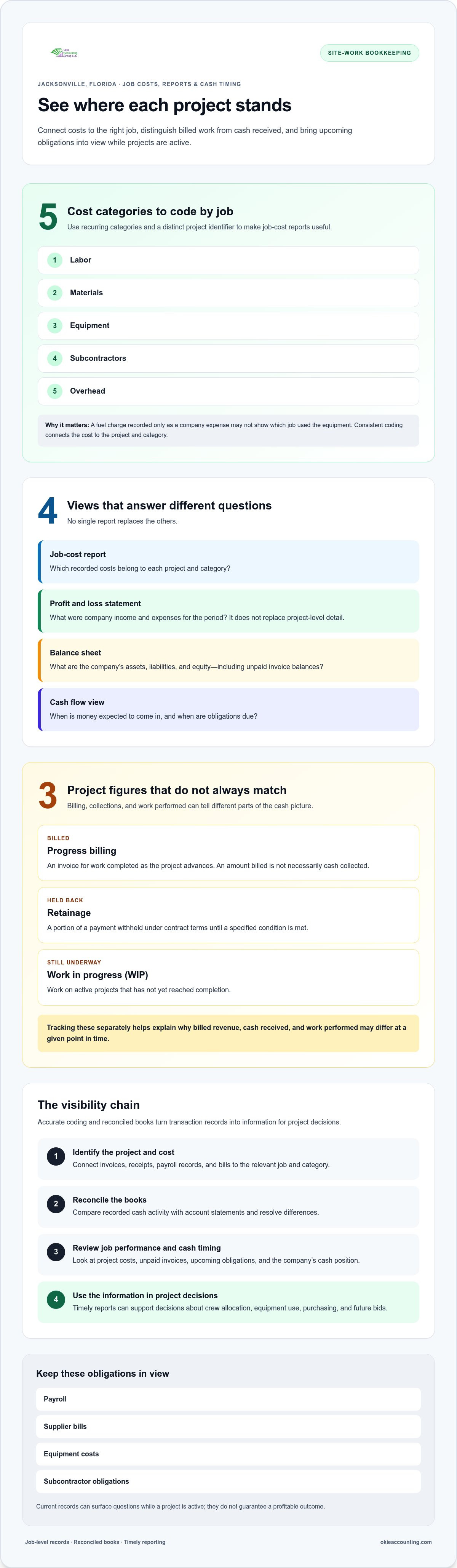
A job-cost report is only as reliable as the transactions behind it. Job-cost visibility depends on accurate, consistently coded transactions. Each project expense needs a clear job identifier and a consistent category, so owners can compare costs across jobs and understand where a project’s financial picture is changing.
How should contractors organize costs by job?
In bookkeeping software, give each project a distinct identifier and use recurring cost categories for labor, materials, equipment, subcontractors, and overhead. A supplier invoice, fuel receipt, payroll record, or subcontractor bill can then be connected to the relevant job and assigned to the appropriate category. The structure should fit the contractor’s workflows and reporting needs. Categories that are too broad can hide useful details, while unnecessary complexity can make consistent coding harder.
Uncategorized bank activity shows that money moved, but not which project used the resources or what type of cost was incurred. Consistent coding turns that activity into information an owner can review by job and use to investigate variances.
How do progress billing, retainage, and WIP affect project records?
Progress billing means invoicing for work completed as a project advances. An invoice records an amount billed, not necessarily cash collected. Retainage is a portion of a payment held back under contract terms until a specified condition is met. Work in progress (WIP) refers to work on active projects that has not yet reached completion. Together, these items help explain why billed revenue, cash received, and work performed may differ at a given point in time.
Tracking these details separately can help owners see whether open invoices or withheld retainage are affecting cash available for current obligations. For broader context, see this IRS guidance on keeping business records.
Which reports help reveal job performance and cash pressure?
Job-cost reports show recorded costs by project and category, helping identify where spending needs review.
Profit and loss statements summarize company income and expenses for a period. They do not replace project-level detail.
Balance sheets provide a snapshot of assets, liabilities, and equity, including balances such as unpaid invoices.
Cash flow views help owners consider when money is expected to come in and when obligations are due.
Reconciliations help verify the books by comparing recorded cash activity with account statements and resolving differences. Together, these reports answer distinct questions: how a job is tracking, how the company performed, what it owes or is owed, and how cash timing may affect decisions. For bookkeeping for site work contractors Jacksonville FL, this connected view can support more informed staffing, purchasing, and project planning. To discuss how job costs and financial oversight fit together, schedule a conversation about your bookkeeping needs.
How to Compare Bookkeeping for Site Work Contractors in Jacksonville, FL
Bookkeeping support should do more than sort transactions. When comparing bookkeeping for site work contractors Jacksonville FL, look at how a provider turns day-to-day records into dependable project information and whether the process fits the way your crews, equipment, and jobs operate.
What should a site work contractor expect from monthly bookkeeping?
Monthly bookkeeping typically includes transaction recording, account reconciliations, general ledger maintenance, and standard financial statements. A consistent monthly close routine keeps records current and gives owners a dependable basis for reviewing results. For analysis beyond routine recordkeeping, management accounting support can connect financial information with operational decisions.
When is bookkeeping enough, and when is controller oversight useful?
Bookkeeping maintains accurate, organized records. Controller-level oversight adds a higher-level review of financial information and systems. It can help when a contractor needs support interpreting reports, building budgets, strengthening internal controls, or assessing financial choices. Fractional controller services provide broader financial oversight.
How can QuickBooks support a project-based operation?
QuickBooks is a tool, not a complete bookkeeping system. Setup and training can align its use with a contractor’s workflow, but software alone will not ensure transactions are coded consistently, accounts are reconciled, or reports are reviewed. The process matters: clarify who enters and reviews information, how job costs are assigned, and when reports are prepared.
For remote support, establish a clear reporting cadence, a document-sharing workflow, and a process for managing access to cloud-based records. The goal is a dependable structure, whether bookkeeping tasks are handled locally or remotely, with records that support routine oversight and project-level decisions.
What to Prepare Before Switching Site Work Bookkeeping Support
A smooth transition starts with the information you need from your books, not just the records you can quickly gather. For bookkeeping for site work contractors Jacksonville FL, organize the handoff around five steps: clarify reporting needs, gather records, map active and completed jobs, review the accounting software, and agree on a recurring close and communication cadence.
Which records make a bookkeeping transition smoother?
Gather documents that show how money moves through the business and how costs connect to projects. A useful starting set includes:
Recent financial statements and bank and credit card records
Customer invoices, open receivables, supplier bills, and unpaid obligations
Job lists, contract information, and project details needed to identify work
Payroll records and subcontractor documentation, where applicable
Organize files by period or document type, and use a secure method to transfer them. A clear handoff helps the bookkeeping team understand what is current, what remains outstanding, and which records may need follow-up.
How should the contractor define useful reporting?
Start with the decisions reports need to support. Do you need to see costs by active job, identify unpaid customer invoices, understand upcoming cash demands, or compare project spending over time? Those questions help shape practical job names and expense categories. Standardize both before recurring reporting begins, so a project is not labeled differently across invoices, payroll records, and supplier bills.
Set expectations for monthly close timing, report delivery, and review conversations. Categories should be detailed enough to guide operational choices, but simple enough to apply consistently. A shared structure is more useful than a complex chart of accounts that is used differently from one transaction to the next.
What does a structured onboarding process establish?
Structured onboarding begins with a review of the existing bookkeeping system, account reconciliations, software setup, and job-cost categories. The service team can align recurring processes with the records and workflows already in place, identify information gaps, and establish how documents and questions will be handled. This creates a foundation for consistent monthly bookkeeping and reporting, rather than a one-time cleanup without a clear process going forward.
Preparing these details gives both sides a practical starting point. Schedule a discovery call to discuss your bookkeeping needs and the reporting structure that fits your site work operation.
How Okie Accounting Supports Jacksonville Site Work Contractors Beyond Data Entry
Recording transactions is necessary, but it is only the starting point. Okie Accounting Group LLC provides construction-focused monthly bookkeeping and financial oversight to businesses nationwide, including site work contractors in Jacksonville. Based in Tennessee, the firm works remotely to help owners build a dependable structure for reviewing financial activity.
How does specialized bookkeeping support site work operations?
Monthly bookkeeping brings recurring activity into an organized system: transactions are recorded, accounts are reconciled, and financial statements are prepared. With consistent records, owners can review project costs alongside the company’s broader financial position. That information can support decisions about active work and upcoming commitments, though it cannot guarantee a particular project result.
The distinction is between recording what happened and maintaining a useful financial structure. Job-cost categories, reconciliations, and regular reporting help make records meaningful for review. Consistent processes keep information current and make financial questions easier to address.
When might a contractor add payroll or controller support?
Payroll management organizes recurring compensation administration alongside broader financial records. For contractors who need more than routine bookkeeping, fractional controller services add financial oversight, including support with budgeting, internal controls, and interpreting reports for business decisions. These services address different needs and can complement a monthly bookkeeping foundation.
QuickBooks setup and training can align software use with the company’s workflow, while cash flow forecasting helps owners consider expected receipts and upcoming obligations. The right combination depends on the contractor’s workload, reporting gaps, and management priorities.
What is the next step for a Jacksonville contractor?
Before choosing the next level of support, identify what is missing today. Are job costs difficult to review? Is bookkeeping taking time away from operations? Which near-term decisions would benefit from clearer financial information? The answers can help define the support and reporting cadence for your business.
Remote financial support can provide a consistent bookkeeping and reporting process for a Jacksonville business, with communication and workflows organized around its records and needs. Book a discovery call to discuss your bookkeeping needs.
Build a Clearer Financial View of Every Job
Site work bookkeeping should show more than company-wide income and expenses. Consistent job-cost records connect project activity to financial reports, while reconciliations help keep the books dependable and cash activity clear. This foundation makes it easier to review job performance, outstanding invoices, and upcoming obligations with greater confidence.
Okie Accounting Group LLC provides construction-focused monthly bookkeeping and controller-level support, including transaction recording, bank reconciliations, and standard financial statements. Based in Tennessee, the firm serves businesses nationwide remotely, including contractors in Jacksonville, Florida. With bookkeeping for site work contractors Jacksonville FL, the right support connects accurate records with useful reporting and informed business decisions.
Ready to discuss your reporting needs, bookkeeping workload, or financial oversight? Book a discovery call to discuss your bookkeeping needs. A clearer financial structure can help you move forward with steadier insight into your projects and your business.
Frequently Asked Questions
How is bookkeeping for a site work contractor different from general bookkeeping?
Bookkeeping for a site work contractor organizes transactions by project as well as by standard account. Labor, equipment, materials, and subcontractor costs need job identifiers so owners can see which work incurred each expense. Consistent coding makes job reports easier to compare, while reconciliations help confirm recorded cash activity against account statements. The right categories depend on how the contractor operates and what decisions the reports need to support.
What should job-cost bookkeeping track for excavation and site work?
Job-cost bookkeeping should track direct labor, equipment costs, materials, subcontractor bills, and other expenses tied to a project. Consistent job identifiers and cost categories make comparisons across excavation or site work projects more meaningful. Where the reporting structure allows, separate project costs from general overhead so each view answers a clear question. These records help owners review spending, but bookkeeping alone cannot determine a project’s final profitability.
Can QuickBooks track costs by construction job?
QuickBooks can support project-based records when it is set up for the business and used consistently. Job identifiers, expense coding, and organized workflows for invoices, receipts, and payroll records help connect activity to projects. Reconciliations and clean source documents also matter because reports reflect the quality of the underlying records. QuickBooks setup and training can help owners and staff follow repeatable procedures that fit the company’s workflow.
How often should a site work contractor review bookkeeping reports?
Monthly reporting is a practical baseline for reviewing reconciled financial statements and cash activity. For active projects, owners may also benefit from more frequent operational reviews, depending on their needs and the records available. A monthly financial close serves a different purpose from day-to-day project management: it organizes and checks financial activity for the period, while operational reviews help monitor work as it progresses. No single schedule fits every contractor.
Can a remote bookkeeper support a Jacksonville, Florida contractor?
Yes. Cloud-based records, secure document sharing, and a defined workflow can support remote bookkeeping for a Jacksonville contractor. Okie Accounting Group LLC is based in Tennessee and serves businesses nationwide, including Jacksonville, Florida. A clear communication plan keeps questions, record handoffs, and reporting routines organized. Agreeing on how documents are shared and when reports are prepared supports a consistent working relationship without requiring an in-person office in Jacksonville.
When should a site work contractor consider a fractional controller?
Fractional controller support can be useful when an owner needs more than recurring transaction recording. A controller can help with budgeting, strengthening internal controls, cash flow forecasting, and interpreting financial reports for business decisions. Consider the complexity of your operations and the financial questions you need answered, rather than relying on a fixed revenue threshold. Bookkeeping maintains accurate records; controller-level oversight adds structure and interpretation to guide decisions.
What records should I prepare before changing bookkeeping support?
Gather recent financial statements, bank and credit card records, customer invoices, unpaid bills, payroll records, and a current job list. Existing software access and cost categories can also show how transactions and projects are currently organized. Securely sharing orderly records gives the bookkeeping team a clearer starting point and helps identify information that may need follow-up. The transition process can vary based on your existing books, workflows, and reporting needs.


Comments