2026 Financial KPIs for Home Builders: Profit Protection

Updated: Nov 7
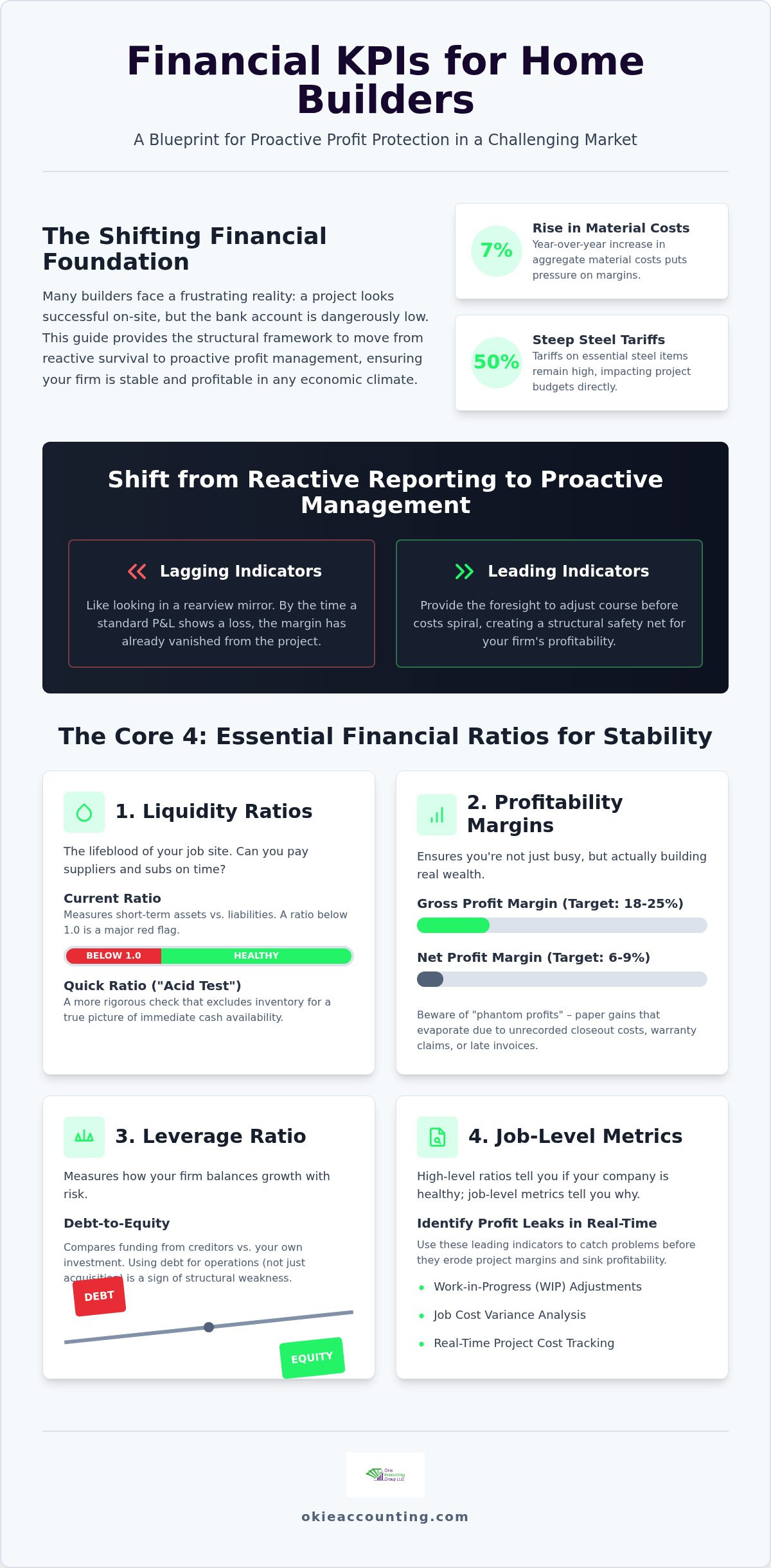
Why does a project that looks successful on the job site often leave your bank account dangerously low when it's time to pay the bills? It's a frustrating reality for many residential firms in 2026, where aggregate material costs have risen 7.0% year-over-year and tariffs on essential steel items remain at 50%. You aren't alone if you feel like you're building on shifting sand. Mastering the right financial KPIs for home builders is the only way to move from reactive survival to proactive profit protection.
You understand the mechanics of a build; we understand the mechanics of the money behind it. We'll show you how to move past the stress of low cash reserves and the difficulty of securing bonding due to poor reporting. This guide provides the structural framework you need to maintain gross margins between 18% and 25% while scaling your operations. We will examine the specific metrics that indicate true business health, from cash flow forecasting to real-time project cost tracking, ensuring your firm remains stable and profitable in any economic climate.
Beyond the Balance Sheet: Why Home Builders Need Specialized Financial KPIs
Standard accounting often treats every business the same, but residential construction is a unique beast. If you rely solely on a monthly profit and loss statement, you're looking in the rearview mirror. By the time a lagging indicator shows a loss, the project is already framed and the margin has vanished. Effective financial KPIs for home builders act as leading indicators, providing the foresight needed to adjust course before costs spiral. This shift toward a Profit Protection mindset creates a structural safety net for your firm. It moves your focus from simple administrative tasks to high-level risk management. Standard KPIs often fail home builders because they don't account for the 6 to 12 month production cycles that define this industry.
The 2026 Economic Landscape for Builders
Precision is mandatory in the current environment. With 30-year fixed mortgage rates hovering around 6.63% to 6.67% as of August 2026, buyer affordability is under significant pressure. Simultaneously, aggregate material costs have climbed 7% over the last year, driven by market volatility and steep tariffs. These pressures mean your liquidity metrics and leverage ratios are under a constant microscope. Real-time data isn't a luxury; it's a requirement for survival. When capital is expensive, you can't afford to have cash trapped in inefficient builds or unbilled change orders. You need to know your numbers today to protect your cash flow tomorrow.
KPIs as a Tool for Bonding and Bankability
Your financial reporting is essentially your business resume when you approach a bank or a surety agent. Sureties look beyond your bank balance to evaluate your internal controls and financial accounting ratios. They want to see that you understand your Work-in-Progress (WIP) and can identify cost variances before they become crises. A clean dashboard of financial KPIs for home builders lowers your perceived risk profile. This discipline makes it much easier to secure the larger project lines and bonding capacity required to scale your business.
Implementing these systems through fractional controller services ensures that your financial framework is as solid as the homes you build. It transforms your bookkeeping from a chore into a strategic partner for long-term stability.
The Core 4: Essential Financial Ratios for Long-Term Stability
Building a house requires a solid foundation; managing the finances for those builds requires the same structural integrity. While revenue often gets the glory, the "Core 4" financial kpis for home builders focus on the underlying health of the business. These ratios ensure you aren't just busy, but actually profitable and solvent. By monitoring these metrics, you move from guessing your financial position to knowing exactly where you stand before the next foundation is poured.
Liquidity: The Current and Quick Ratios
Liquidity is the lifeblood of any job site. If you can't pay your subcontractors or suppliers on time, your project stalls and your reputation suffers. A current ratio below 1.0 is a major red flag for home builders. It indicates that your short-term liabilities exceed your current assets, meaning you're technically insolvent. For a more rigorous check, we use the Quick Ratio. The Quick Ratio serves as the "acid test" for builders because it excludes inventory and only counts cash or receivables that can be converted to cash immediately.
Profitability: Gross vs. Net Margin Frameworks
Profit isn't just what's left over at the end of the year. In 2026, custom home builders should target industry benchmarks from the NAHB for gross margins between 18% and 25%. However, high gross margins can hide "phantom profits." These are paper gains that evaporate during project closeout due to unrecorded punch-list costs, warranty claims, or late-arriving vendor invoices. Your net profit, which typically averages between 6% and 9% in the current market, is the true indicator of wealth. It factors in your overhead and owner draws, giving you a realistic view of what the business actually keeps.
Debt-to-Equity: Balancing Growth and Risk
Leverage is a tool, but it's one that can collapse your business if used incorrectly. Your debt-to-equity ratio measures how much of your firm is funded by creditors versus your own investment. High leverage is often necessary for land acquisition, but using debt to cover basic operational expenses is a sign of structural weakness. Maintaining a healthy equity cushion allows you to weather market dips or interest rate spikes without losing your firm. If these numbers feel overwhelming, our team can help you build the systems to track them accurately. You might consider scheduling a discovery call to see how we can bring clarity to your specific ratios.
Job-Level Metrics: Identifying Profit Leaks Before They Sink the Project
High-level ratios tell you if your company is healthy, but job-level metrics tell you why. For residential builders, profit doesn't disappear all at once; it leaks out through small, unmanaged variances across multiple cost codes. Protecting your bottom line requires a transition from "end-of-job" post-mortems to real-time oversight. By implementing specific financial kpis for home builders at the project level, you can identify slippage while there is still time to course-correct. This granular approach transforms your financial data into an early warning system for every build in your pipeline.
Mastering Job Cost Variance
Visibility starts with a structured Chart of Accounts and granular cost codes. If your framing or concrete costs exceed the estimate, you need to know exactly why before the next phase begins. We recommend the "10% Rule" for proactive management. If any sub-category overrun exceeds 10% of the original budget, it triggers an immediate review. This process helps you distinguish between one-time errors and systemic "slippage" where estimated costs consistently diverge from reality. Using this variance data allows you to sharpen future estimating accuracy, ensuring that the 7% rise in material costs seen in 2026 is reflected in your next contract.
The Power of WIP Accounting
Work-in-Progress (WIP) reports are the most critical tools for seeing the true health of active builds. Many builders fall into the trap of looking at their bank balance and assuming they are profitable, but cash collected is not the same as earned revenue. Over-billing can create a false sense of security by providing temporary cash flow that belongs to future project phases. Conversely, under-billing is a silent killer that starves your business of capital. Understanding WIP Accounting for Construction ensures you recognize revenue based on the actual percentage of completion, providing a clear view of your project's performance.
Backlog and Revenue Pipeline
Stability depends on the quality of your future work, not just the volume. Measuring "Months of Work" remaining in your pipeline provides a clear timeline for your resource needs. In an inflationary environment where lumber prices fluctuate between $536 and $573 per thousand board feet, you must ensure your backlog is priced to protect your margins. Essential construction KPIs also include the "Revenue per Employee" metric. This data point is vital for scaling your crew effectively without bloating your overhead. It helps you determine if your current team is operating at peak efficiency or if you're carrying excess capacity that erodes your net profit.
Building Your Dashboard: Implementing KPI Tracking in QuickBooks Online
A dashboard is only as reliable as the data foundation beneath it. For many firms, the struggle to track financial KPIs for home builders stems from a cluttered or generic Chart of Accounts. Your accounting software should serve as a high-precision instrument, providing a clear window into every project's health. By moving beyond basic record-keeping and building a structured reporting framework, you transform QuickBooks Online from a tax-prep tool into a strategic command center. This transition requires a disciplined approach to data entry and a commitment to project-based tracking.
Foundational QuickBooks Setup for Builders
Structural integrity begins with how you categorize your costs. We recommend organizing your accounts by project phase, such as site work, framing, and finishes. This level of detail allows you to see exactly where a project might be drifting off course. It's equally vital to ensure that payroll and overhead are allocated correctly to specific jobs rather than being dumped into a general expense bucket. Without this allocation, your job-level profit margins will be artificially inflated. For a deeper look at optimizing your system, explore our Mastering QuickBooks for Contractors guide. Automating data entry through bank feeds and receipt capture tools further ensures that your KPIs are both accurate and timely.
The Monthly Financial Review Process
A monthly "Deep Dive" into your numbers is a non-negotiable habit for any builder looking to scale. This process involves more than just checking your bank balance; it requires reconciling your "Cash on Hand" with "Committed Costs." You might have $200,000 in the bank, but if you have $180,000 in upcoming subcontractor payments and material invoices, your actual liquidity is much tighter than it appears. Our Management Accounting Services focus on this level of granular oversight, helping you distinguish between available cash and project obligations. This monthly discipline prevents the "end-of-project surprise" where profits seemingly vanish during the final punch list. If you're ready to build a more professional financial framework, you can book a discovery call with our team to discuss your specific reporting needs.
Advanced builders often supplement QuickBooks with third-party reporting tools for enhanced visualization. These integrations can pull data into clean, graphic dashboards that highlight trends in your liquidity and leverage ratios. Whether you use native QuickBooks reports or an integrated stack, the goal remains the same: immediate clarity. When you can see your data at a glance, you can make decisions based on facts rather than feelings. This level of control is what separates high-growth firms from those that struggle to maintain their margins.
From Data to Decisions: Leveraging Fractional Controller Oversight
Data alone doesn't build a profitable business. You need the ability to translate those numbers into actionable strategies. While a bookkeeper ensures your transactions are categorized, a fractional controller analyzes your financial kpis for home builders to identify trends, risks, and opportunities. This shift from data entry to strategic oversight is what allows you to move from reactive building to proactive business leadership. It's the difference between looking at a pile of lumber and seeing a finished home; one is just material, while the other is the result of a deliberate plan.
When to Scale Beyond Basic Bookkeeping
You'll know it's time to scale when your financial reports raise more questions than they answer. If you're seeing low cash reserves despite a busy schedule or struggling to secure project lines from lenders, your firm has likely outgrown simple bookkeeping. In the high-stakes world of residential construction, the cost of "bad data" can be devastating. A fractional controller acts as a strategic partner, protecting your profit margins by ensuring your overhead, labor, and material costs are perfectly aligned with your revenue goals. This specialized focus on financial kpis for home builders allows you to spot profit leaks before they impact your year-end balance sheet. They provide the "Big Firm" intelligence you need to navigate market shifts without the expense of a full-time C-suite executive.
The Strategic Roadmap for 2026 and Beyond
Looking ahead to the remainder of 2026 and into 2027, the economic environment remains complex. With mortgage rates hovering near 6.7% and material costs up 7% year-over-year, your annual budgeting process cannot be based on guesswork. Strategic oversight helps you use your current KPIs to forecast future cash flow, plan for equipment purchases, and determine the right time for crew expansion. This disciplined approach ensures you're always "lender-ready," providing the financial transparency that banks and sureties demand. By building this structural framework, you aren't just managing a business; you're engineering its long-term health. You can Scale your firm with Fractional Controller Services to ensure every decision is backed by rigorous data and professional insight.
Ultimately, the transition from a service provider to a strategic leader requires a shift in how you view your financial data. Instead of seeing it as a record of what happened, start seeing it as a roadmap for what's possible. When you have clarity over your numbers, you gain confidence in your growth. This partnership ensures that as you build homes for your clients, you're also building a sustainable legacy for your business. The systems you put in place today will define your profitability for years to come.
Engineering a More Profitable Future for Your Firm
Mastering financial KPIs for home builders is more than an administrative exercise; it's a structural necessity for long-term survival. We've explored how identifying job-level profit leaks through WIP adjustments and maintaining the Core 4 ratios can protect your firm against 2026 market volatility. By shifting from reactive bookkeeping to proactive strategic oversight, you ensure that every project contributes to genuine wealth rather than just high revenue. This transition allows you to lead with confidence, knowing your margins are secured by data rather than guesswork.
Our team brings specialized expertise in construction job costing and provides nationwide US support to scaling home builders. We act as your strategic partner, building the foundational systems that turn raw data into actionable growth plans. You've built a reputation for quality on the job site. Now, it's time to build a financial framework that's just as strong. Let's work together to ensure your firm remains resilient, profitable, and ready for whatever the market brings next.
Get the Financial Clarity Your Construction Firm Needs
Frequently Asked Questions
What is the most important financial KPI for a home builder?
The Net Profit Margin is arguably the most critical metric because it represents the actual wealth your business retains after all expenses, overhead, and owner draws are paid. While high revenue looks impressive, it doesn't guarantee sustainability. In 2026, home builders should aim for a net margin between 6% and 9%. Monitoring this alongside your gross margin ensures that your internal operations aren't consuming the profits earned on the job site.
How often should a contractor review their financial KPIs?
You should perform a comprehensive review of your financial data at least once a month. This deep dive allows you to reconcile cash on hand with committed costs and identify budget overruns before they become permanent losses. Successful firms often supplement this with weekly pulse checks on job cost variance. Consistent monitoring ensures that you aren't waiting until the end of a six month build to discover that your margins have vanished.
What is a healthy gross profit margin for residential construction in 2026?
For residential construction in 2026, a healthy gross profit margin typically falls between 18% and 25%. This range provides enough cushion to cover operating overhead while leaving room for a sustainable net profit. Given that aggregate construction material prices have risen approximately 7.0% year-over-year, maintaining this margin requires aggressive job costing and real-time tracking of financial KPIs for home builders to account for volatile inputs like lumber and steel.
Can I track construction KPIs using only QuickBooks Online?
Yes, you can effectively track financial KPIs for home builders using QuickBooks Online, provided your Chart of Accounts is structured for project-based accounting. You must utilize the Projects or Classes feature to allocate labor, materials, and overhead to specific builds. While QBO handles the data entry and basic reporting, many builders integrate third-party visualization tools or work with a fractional controller to interpret the data for high-level strategic planning and forecasting.
Why is the Quick Ratio more important than the Current Ratio for builders?
The Quick Ratio is more important because it excludes inventory, such as land or unsold homes, which can't be converted to cash instantly. In a market where 30-year fixed mortgage rates are near 6.67%, housing inventory can sit longer than expected. The Quick Ratio, often called the acid test, only considers cash and accounts receivable. It tells you if you can meet your immediate obligations, like subcontractor payments, without needing to sell a house first.
What is "Slippage" and how does it affect my project profitability?
Slippage is the gradual erosion of profit that occurs when actual project costs exceed your original estimates. It often happens through small, unmanaged variances in labor hours or material waste. If your lumber costs fluctuate between $536 and $573 per thousand board feet and you haven't adjusted your estimates, slippage will sink your profitability. Tracking this metric helps you identify systemic errors in your bidding process or inefficiencies on the job site.
How does a fractional controller help with KPI management?
A fractional controller moves beyond simple transaction recording to provide high-level strategic oversight. They interpret your data to help you make informed decisions about equipment purchases, crew expansion, and cash flow forecasting. Instead of just telling you what you spent, they explain how those expenditures impact your long-term stability. This partnership provides the financial intelligence of a large corporation while remaining affordable for scaling residential construction firms that need professional discipline to grow.
Is job costing the same thing as KPI tracking?
Job costing is the process of tracking expenses for a specific project, while KPI tracking involves analyzing those costs to measure overall business health. Think of job costing as the raw material and KPIs as the structural blueprints. You use job costing data to calculate essential metrics like gross margin per project and cost variance. Without accurate job costing, your financial KPIs will be unreliable, making it impossible to protect your firm's profitability effectively.


Comments