2026 House Flipping: Strategic Accounting for Profit

Updated: Nov 7
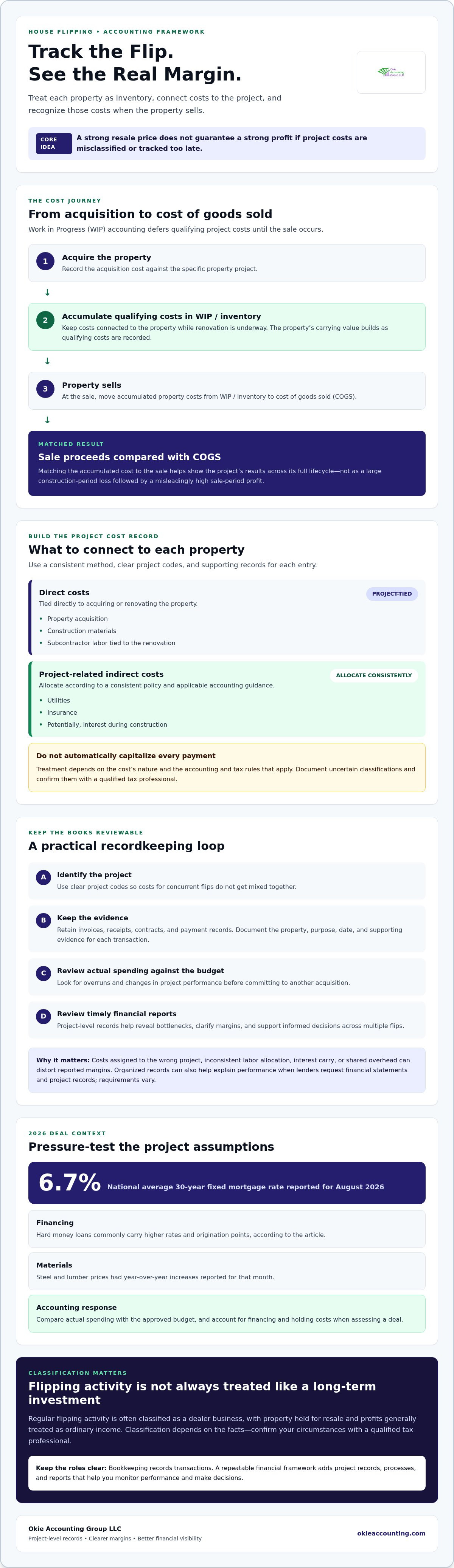
A flip can sell at a strong price and still deliver a disappointing profit if costs are misclassified or tracked too late. That’s why accounting for house flipping 2026 starts with a structural shift: treat each property as inventory, not simply as a capital asset.
It’s easy to focus on acquisition, renovation, and resale while juggling contractor payments and financing. But without project-level records, your true margin may stay hidden until the books are closed, and tax season can bring questions about how your flipping activity is classified.
This guide explains how to track acquisition and renovation costs, recognize cost of goods sold when a property sells, and use separate project records, cash flow forecasts, and timely financial reports to spot bottlenecks. It also explains why dealer-versus-investor classification matters, while distinguishing bookkeeping from tax advice. With the right systems in place, your books can be clearer for lenders, your margins easier to monitor, and your business better equipped to manage multiple projects.
Accounting for House Flipping 2026: A Practical Framework
For each property, keep costs connected to the project, distinguish inventory from current-period expenses, and review actual spending against the budget. These habits help flippers in Tennessee and Jacksonville, Florida, see how a renovation is performing before the property sells.
The 2026 House Flipping Landscape: Why Tactical Accounting is the New Standard
A flip can sell at a strong price and still miss its profit target if financing, renovation spending, and project timing aren’t tracked clearly. Tactical accounting helps you compare actual costs with the budget and respond when a project changes course. For flippers in Tennessee or Jacksonville, Florida, local market conditions may differ, but the need to see each property’s costs and performance remains the same.
Financing and material costs can put pressure on margins. Redfin reported a 6.7% national average 30-year fixed mortgage rate in August 2026, while the research for this article reports that hard money loans commonly carry higher rates and origination points. ENR also reported year-over-year increases in steel and lumber prices that month. These pressures make it important to compare actual project spending with the approved budget and account for financing and holding costs when assessing a deal.
A spreadsheet may work for one property, but concurrent flips can lead to version-control problems, missed transactions, and slow reconciliations. A consistent accounting system with project-level records makes it easier to review performance across Tennessee or Jacksonville properties without mixing their costs. Bookkeeping records transactions; a financial framework adds repeatable processes and reports that support decisions.
The Shift from Passive Investing to Active Flipping
Flipping generally involves acquiring and reselling property for profit rather than holding it as a long-term investment, as the overview of Flipping explains. Regular flipping activity is often classified as a dealer business, with property held for resale and profits generally treated as ordinary income. Classification depends on the facts, so confirm your circumstances with a qualified tax professional. Your records should reflect the work of operating a flipping business, not just the movement of an investment asset. For foundational context, see management accounting.
The Cost of Financial Invisibility in House Flipping
Costs assigned to the wrong project can distort reported margins. Interest carry, shared overhead, and labor that isn’t allocated consistently may make a project appear more profitable than it is. Use clear project codes and retain supporting documentation so reports reflect the costs associated with each property.
Review subcontractor records: Keep accurate payee details and payment records to support appropriate 1099 reporting. Confirm current requirements with a tax professional.
Compare actuals with plans: Review project results against budgets to identify overruns and reconsider decisions before committing to another acquisition.
Lenders may request organized financial statements and project records when evaluating a borrower, though requirements vary. Current, reliable reports help you explain performance and make informed decisions. Whether your flips are in Tennessee or Jacksonville, Florida, a structured financial framework makes project performance easier to assess and growth decisions more grounded.
Inventory vs. Expense: The Structural Framework of Flip Accounting
A renovated property can absorb cash for months before it generates revenue. If you record its purchase and renovation costs as immediate expenses, your profit-and-loss report may show a large loss during construction, followed by a misleadingly high profit when the home sells. For active flipping businesses, properties are generally treated as inventory held for sale, so qualifying costs build the property’s carrying value on the balance sheet.
Work in Progress (WIP) accounting is the process of deferring project costs until the sale occurs. In practice, costs accumulate in a WIP or inventory account during renovation. When the property sells, the accumulated cost is moved to cost of goods sold and matched against the sale proceeds. This aligns reported results with the project’s full lifecycle instead of making unfinished jobs look unprofitable.
Determining Your Cost Basis for 2026 Flips
Choose a consistent method for assigning costs to each property, then support each entry with invoices, receipts, contracts, and payment records. Practical categories include:
Direct costs: Property acquisition, construction materials, and subcontractor labor tied to the renovation.
Project-related indirect costs: Utilities, insurance, and potentially interest during construction, allocated according to a consistent policy and applicable accounting guidance.
Not every payment should automatically be capitalized. A cost’s treatment depends on its nature and the accounting and tax rules that apply. Document the property, purpose, date, and supporting evidence for each transaction, and confirm uncertain classifications with your tax professional. The guide to accounting for house flipping also outlines common acquisition, rehabilitation, holding, and selling cost categories to consider in your tracking system.
Active Business Classification and Tax Implications
Regular flippers are typically treated as dealers, meaning homes held for resale are inventory and profits are generally ordinary business income rather than capital gains. Classification depends on the facts of your activity, so don’t assume that one holding period or bookkeeping choice settles your tax treatment. Review your circumstances with a qualified tax professional.
A common reporting error is expensing materials as soon as they’re purchased, even when they’re part of an unfinished flip. That can distort interim profit and leave the property’s inventory value understated. Use property-level job costing to keep purchases connected to the right project, then prepare organized records for a management accounting review. If you need help strengthening project-based bookkeeping and reporting, you can discuss your accounting needs with the team.
Configuring QuickBooks Online for House Flipping in 2026
QuickBooks Online (QBO) gives real estate investors and their accounting teams access to shared, cloud-based records, whether projects are in Tennessee or Jacksonville, Florida. But software alone won’t produce reliable project margins. The setup must distinguish property inventory and work in progress (WIP) from operating expenses, then connect each transaction to the flip it belongs to. That structure is central to accounting for house flipping 2026.
Start with a specialized Chart of Accounts. Use separate accounts for inventory or WIP, acquisition costs, renovation materials, subcontractor labor, utilities, insurance, financing costs, and selling expenses as appropriate to your accounting policy. Consistent categories make reports easier to interpret and help prevent renovation spending from being mixed with general overhead. Have an accounting professional review the account structure before relying on it for financial reporting.
Step-by-Step: Setting Up Your 2026 Flip Project
Enable tracking features: In QBO settings, turn on Projects and, if useful for your reporting structure, Classes. Availability and settings can depend on your QBO subscription, so verify your plan’s current features.
Create a project for each property: Use a consistent naming convention, such as the property address or an internal project ID. This keeps Tennessee and Jacksonville projects distinct in reports.
Map accounts for inventory and WIP: Work with your accountant to determine which accounts hold costs during renovation and how costs will be recognized when the property sells.
Tag transactions consistently: Assign bills, expenses, and relevant income to the correct project. Review uncategorized or unassigned transactions regularly so project reports stay useful.
When bank feeds bring in transactions, match them to existing bills or receipts where possible instead of accepting suggested categories without review. Receipt capture can help document purchases made at a property or local supplier, but retain supporting records and check that each receipt is attached to the correct transaction and project. Automation can reduce data entry, but it doesn’t replace review.
Advanced Tracking: Job Costing and Labor Allocation
For internal labor, use a consistent method to assign eligible labor costs to the project where the work occurred. Keep time records or other support that show the employee, task, date, and property, and coordinate the accounting treatment with payroll and tax professionals. For subcontractors working on flips in Tennessee or Jacksonville, record payments under consistent vendor names, attach invoices, and track the project and type of work. Confirm current information-reporting obligations with a qualified tax professional.
As QBO’s tools evolve, review automated matches and expense categories before posting. Automation may not understand a flip’s accounting treatment. Clear procedures help your team code transactions consistently across locations. QuickBooks setup and training can help business owners and staff learn the system and its project-tracking workflow.
Managing Cash Flow and Profit Protection for Scaling Investors
A flip can show a projected profit and still run short of cash before sale. Renovation invoices, loan payments, utilities, insurance, and a longer-than-planned listing period all draw on liquidity. In a higher-interest market, that timing gap can threaten the next project even when the current property may ultimately sell at a gain. Cash flow forecasting helps you plan for when money leaves and when proceeds are realistically expected, rather than relying on a single optimistic resale date.
Build a rolling forecast for each property and a consolidated view of the business. Track opening cash, committed project spending, expected bills, debt payments, contingency reserves, and estimated sale proceeds by period. Compare actuals with the forecast and update assumptions as construction or sale timelines change. This gives you a clearer basis for deciding whether another acquisition is financially supportable.
Forecasting for the 2026 Real Estate Cycle
Stress-test each project for a delayed sale and higher-than-planned costs. Include carry costs, such as interest, utilities, and insurance, for the extended timeline, and set a contingency reserve within the project plan rather than treating every available dollar as acquisition capital. A forecast that shows a shortfall early gives you time to consider options before bills come due.
Use documented project budgets, payment history, and cash flow projections when discussing financing terms with hard money lenders. Reliable figures can support a more informed conversation about timing and project capacity, though terms depend on the lender and deal.
Monthly Financial Reviews: The Strategic Advantage
Reconcile bank and credit accounts monthly so the books reflect cleared transactions and discrepancies are investigated promptly. Then review a Profit and Loss statement by project alongside the budget. Look for margin creep: labor overruns, repeat material purchases, rising holding costs, or expenses coded to the wrong flip. A cost that looks small on one transaction can become material when it recurs across several projects.
Pair that report with a cash forecast. If actual spending is ahead of plan, decide whether to revise the scope, adjust the timeline, or preserve more liquidity before committing to another acquisition. Document approvals, retain receipts and invoices, and use consistent review procedures to reduce duplicate or unsupported payments. These controls protect profit while making financial reports more dependable.
Organized monthly records also make it easier to respond when a lender requests current statements or project details. Requirements vary, so confirm what each lender needs and keep reconciliations, budgets, and project reports current. Strong accounting for house flipping 2026 means having decision-ready information before a financing or acquisition deadline, not assembling it under pressure. To discuss cash flow forecasting and financial reporting for your flipping operation, schedule a discovery call.
Transitioning to Strategic Financial Oversight with a Fractional Controller
Bookkeeping tells you what has happened. Strategic financial oversight helps you understand what the numbers mean for your next decision. If you’re managing several flips, struggling to see reliable project margins, or repeatedly assembling reports when a lender asks for them, transaction recording alone may no longer be enough. Fractional controller services can add structured financial review and reporting as your real estate business grows.
For house flippers in Tennessee and Jacksonville, Florida, each property has its own budget, timeline, financing, and exposure to local market conditions. A fractional controller can help interpret project reports, identify patterns in overruns, and create consistent processes for evaluating cash needs and business performance. The value isn’t a guaranteed return. It’s clearer information and more disciplined decisions about where capital is going and what needs attention.
The Difference Between Administrative Tasks and Strategic Growth
Administrative bookkeeping records and organizes transactions. Controller-level oversight builds on those records by reviewing financial reports, project costing, and cash flow information so owners can act on it. For example, if labor costs repeatedly exceed budget across renovations, project reports can help reveal the pattern and inform future estimates or scope decisions. Timely financial information supports a measured response to changing financing and renovation costs.
Okie Accounting Group LLC specializes in bookkeeping and fractional controller services for real estate investors. Explore fractional controller services to learn how this type of oversight may support your operation.
Partnering for Long-Term Stability
Cloud-based financial systems can help owners and teams manage records for properties in Tennessee and Jacksonville, Florida, with consistent processes and accessible reporting. A fractional financial leader can help strengthen those processes as your business grows, so adding a property doesn’t mean rebuilding the books or relying on disconnected spreadsheets. The goal is a framework that supports accurate reporting and informed decisions across projects.
Financial readiness also means keeping records organized for lender requests and coordinating tax questions with a qualified tax professional. Fractional controller services aren’t income tax preparation, but dependable books can give your tax professional clearer information to work with. With accounting for house flipping 2026 grounded in project visibility and structured review, you can move from reacting to financial surprises toward greater operational clarity and confidence.
Build a Stronger Financial Foundation for Your Next Flip
In 2026, protecting margins takes more than recording transactions. Treating properties as inventory, tracking costs by project, and reviewing cash flow regularly helps you see how each flip is performing and where financial pressure may be building.
A well-configured accounting system can support accurate project reporting, while fractional controller oversight helps turn those reports into informed decisions as your business grows. Together, these practices create a scalable framework for accounting for house flipping 2026, from renovation through resale.
Okie Accounting Group LLC specializes in bookkeeping for real estate investors and provides fractional controller services for scaling firms, with nationwide remote financial leadership. If you’re ready to strengthen your project-level reporting and gain clearer insight into your finances, explore strategic bookkeeping support.
With the right structure in place, you can approach each new project with greater clarity and confidence.
Frequently Asked Questions
Is house flipping considered a business or an investment by the IRS in 2026?
Regular house flipping is often treated as a business activity, but the IRS classification depends on the facts and circumstances of your activity. Flippers classified as dealers generally hold properties as inventory, and profits are typically taxed as ordinary income rather than capital gains. Don’t assume that a particular holding period or business label determines your status. Ask a qualified tax professional to review your situation and filing obligations.
How do I properly track renovation expenses for a house flip in QuickBooks?
Set up a separate QuickBooks Online project for each property, then assign bills, expenses, and relevant payments to that project using consistent accounts and categories. For accounting for house flipping 2026, track materials, subcontractor costs, and other project spending with invoices or receipts. Costs treated as inventory generally remain in WIP or inventory until sale, when they’re recorded as cost of goods sold. Reconcile accounts and review unassigned transactions regularly.
What is the difference between capital improvements and repairs in house flipping?
Capital improvements generally add value to a property or adapt it for a new use, while repairs typically maintain or restore its existing condition. For a flip held as inventory, many renovation costs are generally included in the property’s inventory cost rather than deducted immediately. Don’t assume that an item called a repair is automatically deductible. The correct treatment depends on the work, its purpose, and applicable tax rules, so document the details and seek tax guidance.
Do I need to pay self-employment tax on my house flipping profits?
If you’re an individual actively flipping houses as a business, your net earnings may be subject to self-employment tax. For 2026, the research provided states a 15.3% rate, consisting of Social Security and Medicare components, with the Social Security portion applying up to the 2026 wage base. Your circumstances, entity structure, and other earnings can affect the calculation. Ask a qualified tax professional to determine how the rules apply to your return.
What accounting method is best for house flipping: Cash or Accrual?
There isn’t one accounting method that fits every flipper. Cash-basis books record income and expenses when money changes hands, while accrual accounting records transactions when earned or incurred. Either way, a flipping business needs reliable inventory and project-cost tracking so work in progress isn’t mistaken for an immediate expense. The method permitted for tax reporting can depend on your business and applicable IRS rules. Confirm the appropriate approach with a tax professional.
How can I ensure my house flipping financials are ready for a bank loan?
Keep reconciled accounts, current financial statements, project-level profit and loss reports, cash flow forecasts, and organized supporting documents such as invoices and project budgets. Use consistent accounting categories and ensure transactions are assigned to the correct property. These practices make it easier to explain how funds are being used and how projects are performing. Lender requirements vary, so ask your bank which reports and records it expects before submitting an application.
What are the most common accounting mistakes house flippers make?
Frequent mistakes include expensing inventory costs before a property sells, mixing spending across projects, overlooking holding costs, and relying on records that aren’t reconciled. Incomplete subcontractor documentation and unassigned transactions can also make reporting less dependable. Set a consistent process for capturing project costs, reviewing account activity, and checking results against budgets. Regular financial reviews help surface missing information and cost overruns while there’s still time to respond.


Comments