Bookkeeping for HVAC Contractors: A Strategic Framework for Profitability

Updated: Nov 7
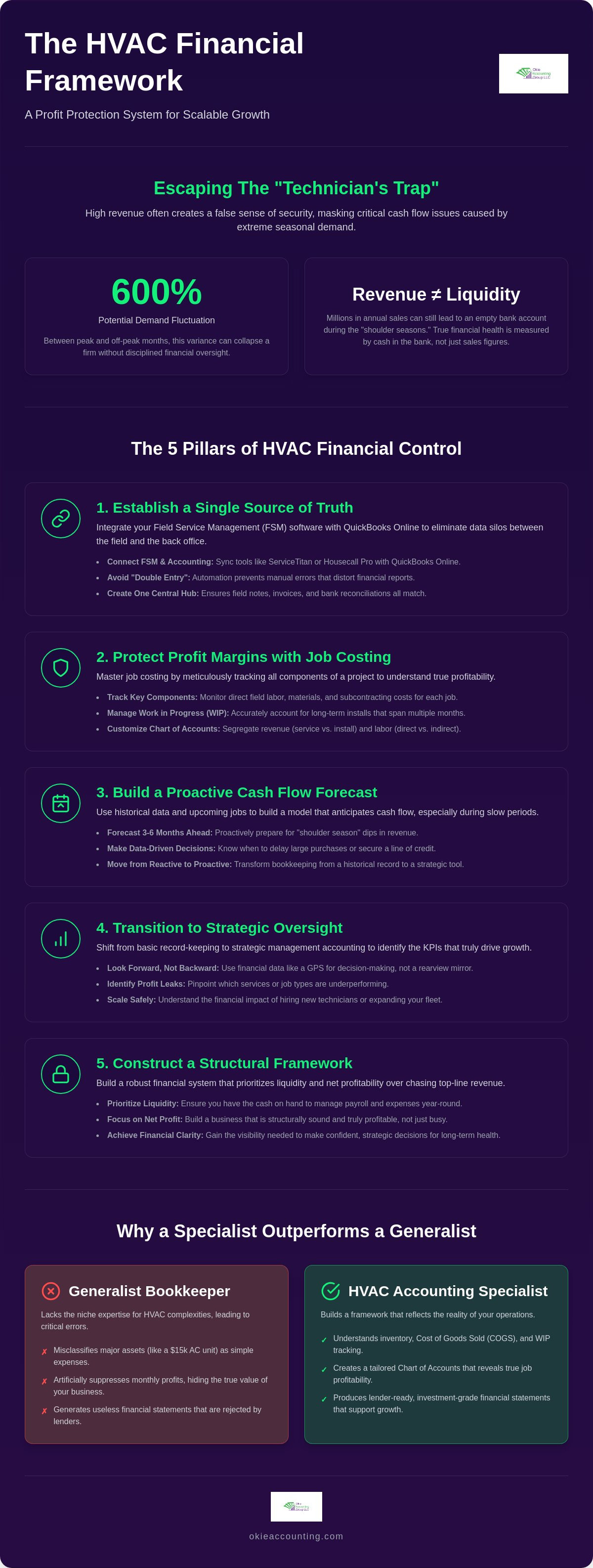
Why does your bank account feel empty in October when your crews were running around the clock in July? This disconnect is a common reality in an industry where demand can fluctuate by as much as 600 percent between peak and off-peak months. You know how to manage a complex installation, but the financial side of the business often feels like a different beast entirely. It's exhausting to deal with seasonal cash flow dips or the nagging suspicion that your large installs aren't as profitable as they look on paper. Most owners find themselves caught between the technical demands of the field and the administrative weight of the back office.
Effective bookkeeping for hvac contractors is about more than just tracking expenses for tax season; it's about building a structural framework for long-term health. We're going to show you how to transform your raw financial data into a profit protection system that manages seasonality and ensures your margins stay intact. You'll learn how to distinguish between field service data and true accounting integrity, creating lender-ready statements that support your growth. This guide provides a clear path from operational complexity to total financial clarity, giving you the visibility needed to see which jobs are truly driving your success.
Beyond the Ledger: Why HVAC Bookkeeping Demands a Specialized Framework
Operating a successful HVAC firm requires more than just technical proficiency in the field. It demands a sophisticated understanding of how money moves through a business that is simultaneously a retail service provider and a construction contractor. Many owners fall into the "Technician’s Trap," where high top-line revenue creates a false sense of security. You might see millions in annual sales, yet find your bank account empty during the shoulder seasons. This happens because revenue doesn't equal liquidity. Without a specialized framework, the extreme seasonal demand variance, which can range from 250 percent to 600 percent, can easily collapse a firm that lacks disciplined oversight.
Traditional bookkeeping often focuses on historical data for tax compliance. However, to scale safely, you must transition toward Management accounting. This discipline uses internal financial data to drive strategic decisions rather than just recording what happened in the past. It’s the difference between looking in the rearview mirror and using a GPS. By implementing specialized bookkeeping for hvac contractors, you establish a system that identifies profit leaks before they become crises. This proactive stance provides the quiet confidence needed to manage a growing team and multiple crews without losing control of your margins.
The Complexity of HVAC Financial Transactions
HVAC firms operate in a hybrid environment. You sell small parts and quick service calls while also managing massive, multi-day installations. Each requires a different financial lens. Service calls involve immediate retail-style transactions and complex sales tax tracking across various counties and jurisdictions. Installations require long-term project tracking and labor allocation. HVAC bookkeeping is a structural framework for growth that transforms raw financial data into actionable business intelligence.
Why Generalist Bookkeepers Often Fail HVAC Firms
Generalist providers often lack the niche expertise required to handle industry-specific nuances like equipment inventory. A generalist might record a $15,000 equipment purchase as an immediate expense, which artificially suppresses your monthly profit and obscures the value of assets in your warehouse. This misclassification makes your financial statements useless for lending or scaling. Adopting a specialized approach to management accounting ensures that your chart of accounts is built to reflect true Cost of Goods Sold (COGS). This level of detail allows you to see the actual profitability of each install, protecting your firm from the hidden costs that generic systems often overlook.
Building Your Financial Infrastructure: FSM Integration and QuickBooks
A solid financial structure isn't built on spreadsheets and scattered notes. It requires a centralized hub where every transaction is recorded with precision. QuickBooks Online serves as this "source of truth" for your firm, providing the foundational stability needed to scale. As emphasized in the SBA's guide to managing business finances, maintaining accurate and organized records is the bedrock of any successful enterprise. For mechanical contractors, this infrastructure is what separates a reactive business from a proactive, profit-driven organization. Professional bookkeeping for hvac contractors requires this level of operational discipline to ensure that every dollar is accounted for.
The FSM-to-Accounting Bridge
Most HVAC owners utilize Field Service Management (FSM) software to handle dispatching, technician notes, and customer invoicing. While tools like ServiceTitan or Housecall Pro are excellent for field operations, they aren't full-scale accounting systems. The danger lies in the data gap between the field and your general ledger. Automated syncing is essential to avoid the "Double Entry" nightmare, where manual data entry leads to inevitable clerical errors. If your field notes don't match your bank reconciliations, your financial reports will provide a distorted view of your health. You can learn more about establishing this connection in our guide to QuickBooks for contractors.
Customizing Your Chart of Accounts
A generic chart of accounts is a liability. It hides the critical data you need to protect your margins. Your ledger must be tailored to the specific mechanics of the HVAC industry. This means moving beyond basic expense tracking and implementing a structural framework that reflects your actual operations. Key categorizations include:
Revenue Segregation: Separate high-margin residential service revenue from complex, long-term installation revenue.
Labor Allocation: Distinguish direct field labor (technician hours on jobs) from indirect administrative overhead.
Vehicle and Fleet Costs: Track vehicle maintenance, fuel, and insurance as specific line items to monitor fleet efficiency.
This granular approach to bookkeeping for hvac contractors allows you to identify exactly which departments are driving profit and which are draining your cash. When your financial infrastructure is built correctly, you gain the clarity needed to make data-driven decisions. If your current systems are creating more confusion than control, it may be time to discuss a customized QuickBooks setup and training plan to get your back office back on track.
Mastering Job Costing: How to Protect Your HVAC Profit Margins
Job costing is the pulse of your business. If you aren't tracking the exact costs associated with every service call and installation, you're essentially operating in the dark. High-level bookkeeping for hvac contractors requires a granular breakdown of four primary pillars: direct labor, materials, equipment, and subcontractors. When these elements are recorded accurately, you can see exactly where your money is going. This data doesn't just sit on a ledger; it informs your future bidding strategies. If a specific crew consistently takes longer on a 17 SEER2 system install than your estimate allowed, your job costing data will highlight that discrepancy before it drains your annual profits.
For firms handling large-scale commercial installs, tracking Work in Progress (WIP) is vital. You cannot wait until a project is 100 percent complete to understand its financial impact. By recognizing revenue based on the percentage of completion, you maintain a realistic view of your current liquidity. This prevents the common mistake of overbilling or underbilling, which can lead to severe cash flow shortages during the final stages of a project. Additionally, you must account for "unapplied labor." This represents the hours your technicians are on the clock but not billable to a specific job, such as drive time or training. Identifying these gaps allows you to improve technician efficiency and tighten your operational framework.
Service vs. Installation: Different Costing Models
Service work and installations require distinct financial lenses. Service calls often utilize flat-rate pricing, while installations may rely on a complex time-and-materials estimate. To maintain profitability, you must calculate a "fully burdened" labor rate for your technicians. This rate includes not just their hourly wage, but also payroll taxes, insurance, and benefits. Understanding this true cost is essential for setting prices that actually cover your overhead. For more on building this type of scalable financial infrastructure, explore our insights on construction bookkeeping services.
Inventory Management and Vehicle Stock
Your service vans are rolling warehouses. Tracking inventory across multiple vehicles is one of the most significant challenges in bookkeeping for hvac contractors. Shrinkage, unrecorded parts usage, and disorganized truck stock can quietly kill your bottom line. Implementing a monthly reconciliation process for physical inventory ensures that what's on your shelves matches what's in your books. This discipline reduces waste and ensures that every copper fitting and capacitor used in the field is billed to the correct job, protecting your margins from the inside out.
Managing Seasonality: Cash Flow Strategies for the HVAC Off-Season
The "Shoulder Season" crisis is a recurring threat for firms that lack a disciplined financial framework. In the HVAC industry, Spring and Fall often bring a significant drop in emergency calls and system replacements. Without strategic bookkeeping for hvac contractors, these quiet months can lead to a liquidity crunch that stalls your momentum. You shouldn't be surprised by these dips. Instead, you can use the high-demand periods of Summer and Winter to build a "War Chest." This strategic reserve planning ensures you have the capital necessary to keep your top technicians on payroll when the phones stop ringing.
Leveraging maintenance contracts is another essential tactic for stabilizing your income. These agreements transform unpredictable emergency work into recurring, predictable revenue. They provide a baseline of cash flow that covers your fixed overhead during the off-season. When you manage these contracts through a structured ledger, you gain a clearer picture of your guaranteed monthly income. This predictability allows you to plan for equipment upgrades or marketing pushes without the fear of overextending your resources.
Forecasting for Growth and Stability
Moving away from "checkbook accounting" is the first step toward long-term stability. You need to look beyond your current bank balance and implement data-driven forecasting. By analyzing historical data, you can predict seasonal labor and material spikes with high accuracy. We recommend looking at least three to six months in advance to ensure your liquidity remains intact. For a deeper dive into these techniques, see our guide on mastering construction cash flow management. This level of foresight allows you to make hiring or purchasing decisions based on projected health rather than immediate panic.
Financial Readiness for Tax Planning
An organized back office makes tax season a non-event. For an HVAC firm, this involves more than just filing papers. It requires proactive management of equipment depreciation, particularly under Section 179, which can have a massive impact on your cash position. Maintaining lender-ready financial statements year-round is also critical. If you need to finance new equipment during a slow month, your books must demonstrate strength and stability to secure the best rates. If you want to stop reacting to the seasons and start controlling your cash flow, schedule a discovery call today to build a forecasting model that works for your business.
Scaling Your HVAC Firm with Fractional Controller Oversight
Scaling an HVAC business requires a fundamental shift in how you view your back office. While basic bookkeeping for hvac contractors ensures that your bills are paid and your taxes are filed, it doesn't necessarily provide the roadmap for expansion. There comes a point where an owner must stop being the primary technician and start being the primary strategist. This transition often happens when you move from a single crew to multiple teams; the complexity of your financial data outpaces your ability to manage it manually. This is where strategic oversight becomes the engine for your firm's growth.
Professional financial reporting does more than just clarify your internal health; it builds external credibility. If you're looking to secure higher bonding limits for large commercial contracts or better credit lines for fleet expansion, your financial statements must be impeccable. Lenders and insurance providers look for the structural integrity that only specialized management can provide. By establishing these foundational systems, you move from a reactive service provider to a strategic partner in your own business's success. This level of discipline ensures that your growth is both sustainable and profitable.
KPIs That Drive HVAC Success
To scale effectively, you must focus on the metrics that actually move the needle. A Fractional Controller helps you interpret Key Performance Indicators (KPIs) that go beyond simple revenue totals. Monitoring your gross profit margin by department allows you to see whether your residential service calls are subsidizing your commercial installs, or vice versa. Additionally, tracking the "Break-Even" point per technician hour is vital for maintaining profitability as your payroll grows. Utilizing fractional controller services ensures that these high-level insights are always at your fingertips, allowing you to make hiring and equipment decisions based on hard data rather than gut feelings.
Your Strategic Partner in Growth
The final stage of financial maturity is moving from historical recording to forward-looking strategy. An industry specialist doesn't just tell you what happened last month; they help you plan for the next twelve. This involves a monthly financial review where you analyze variances in your budget and adjust your course in real-time. This proactive stance alleviates the stress of the unknown and provides the quiet confidence needed to lead a growing organization. If you're ready to build a structural framework for bookkeeping for hvac contractors that allows you to step out of the field, schedule a consultation with Okie Accounting Group LLC to secure your firm’s financial future.
Secure the Structural Integrity of Your HVAC Business
Transforming your back office from a source of stress into a growth engine requires a fundamental shift in perspective. You've seen how integrating your field service software with a clean ledger creates a reliable source of truth. By mastering job costing and implementing proactive cash flow forecasting, you can finally break the cycle of seasonal volatility. Specialized bookkeeping for hvac contractors is the foundation upon which you build a truly scalable enterprise. It moves your firm beyond mere record-keeping and into the realm of strategic profit protection.
At Okie Accounting Group, we provide the nationwide expertise in construction accounting necessary to stabilize your operations. Whether you need specialized QuickBooks training for your field-service team or strategic fractional controller oversight to manage multiple crews, we're here to serve as your dedicated financial partner. You don't have to navigate these complexities alone. It's time to gain total control over your data and make decisions with absolute confidence. We look forward to helping you build a more profitable future.
Get the Financial Clarity Your HVAC Firm Deserves
Frequently Asked Questions
Why is job costing so important for HVAC contractors?
Job costing is essential because it reveals the actual profitability of every installation and service call you perform. Without it, you cannot determine if your labor rates and material markups are high enough to cover your overhead. This level of detail allows you to identify specific crews or system types that may be draining your profits, ensuring you only bid on work that supports your bottom line.
Do I need a specialized bookkeeper if I use ServiceTitan or Housecall Pro?
Yes, you still need specialized expertise because Field Service Management software is not a replacement for a general ledger. Professional bookkeeping for hvac contractors ensures the data syncing between your field tools and QuickBooks Online remains accurate. This prevents "Double Entry" errors and guarantees that your bank reconciliations match your field activity, providing a true "source of truth" for your business.
What is the best accounting software for a growing HVAC company?
QuickBooks Online is widely considered the industry standard for growing mechanical firms. It offers robust integration capabilities with major field service tools and handles complex job costing with precision. Its cloud-based nature allows for real-time financial reporting and seamless collaboration with your accounting team. This software provides the foundational stability needed to manage multiple crews and high transaction volumes without losing data integrity.
How often should an HVAC contractor review their financial statements?
You should review your Profit and Loss statement and Balance Sheet at least once a month with your accounting partner. During peak Summer and Winter months, a weekly review of your cash flow forecasting is highly recommended. This frequency allows you to catch margin slippage early and manage the rapid movement of cash that occurs when your technicians are running around the clock.
What are the most common bookkeeping mistakes HVAC owners make?
The most frequent errors include misclassifying expensive equipment inventory as an immediate expense and failing to track "unapplied labor" for technicians. These mistakes artificially lower your net profit and obscure your true cost of goods sold. When these foundational items are recorded incorrectly, your financial statements become useless for making strategic growth decisions or securing lender financing for your fleet.
Can a bookkeeper help me manage my HVAC inventory across multiple trucks?
A specialized bookkeeper establishes the structural framework for inventory management by recording truck stock as an asset rather than a flat expense. While your team performs the physical counts, your bookkeeper reconciles that data against the general ledger. This process helps identify shrinkage and ensures that every part used in the field is correctly billed to a job, protecting your profit margins from the inside out.
How does a fractional controller differ from a standard bookkeeper for HVAC?
A bookkeeper focuses on historical data entry and tax compliance, while a fractional controller provides forward-looking strategic oversight. They act as a high-level mentor who interprets complex KPIs and manages long-term cash flow forecasting. This role is designed for firms looking to scale, as it moves the owner out of the daily administrative grind and into a position of data-driven leadership.
How do I handle payroll for technicians with complex commission structures?
You must integrate your commission tracking directly into your bookkeeping for hvac contractors to ensure payroll accuracy and regulatory compliance. A specialized professional helps you structure these payments based on actual job profitability rather than just top-line revenue. This approach ensures your incentive programs reward technicians for high-quality work while simultaneously protecting the firm's overall financial health and liquidity.


Comments