Bookkeeping for Renovators: Track Project Costs, Changes, and Profit

Updated: 6 days ago
What if a renovation’s biggest profit leak isn’t an unexpected expense, but a scope change that never makes it into the project records? With materials, labor, and customer payments moving on different timelines, bookkeeping for renovators needs to track changes as carefully as costs.
If you’ve ever looked at a healthy bank balance and still wondered whether a job is profitable, you’re not alone. Expenses can get mixed with general business costs, while revised scope makes the original budget harder to interpret. Cash received tells you what’s been collected, not what the project has earned.
This guide explains how to organize each renovation’s financial activity so you can understand costs and margins while work is underway. You’ll learn how to connect project records with labor, materials, change orders, and customer payments, then use monthly reports to support clearer decisions.
We’ll walk through the bookkeeping structure behind useful job costing, explain why scope revisions belong in the financial record, and show how consistent reporting can reveal cash-flow pressure. The goal is practical clarity: knowing where each project stands and what the numbers mean for your next move.
Why renovation bookkeeping needs to follow each project’s changing scope
Renovation bookkeeping is the project-aware recording of income, costs, and other financial activity, so each job can be reviewed on its own and in the context of the business. A signed estimate establishes the planned work and budget, but it isn’t a complete record of the final scope. Selections may change, site conditions can reveal additional work, and client requests may revise the plan. If those changes aren’t recorded and connected to the job, its financial picture can drift from the work actually being delivered.
Keep project costs distinct from general business overhead, such as administrative expenses that support the company as a whole. Otherwise, overhead can make a job appear less profitable than it is, or project costs can disappear in a broad expense category. Project revenue is what the books recognize for the job, cash received is money collected, and project profit is what remains after the job’s costs are accounted for. These figures answer different questions, so bookkeeping for renovators should keep them distinguishable.
What makes bookkeeping for renovators different?
Several active renovations can each have a different budget, timeline, and payment schedule. The original estimate may cover one set of materials and tasks, while a revised selection or newly discovered site condition changes the expected cost. Capture the original scope and approved revisions as separate, connected records. Consistent project tracking, a core principle of Job Costing, helps owners review each job without mixing its performance with company-wide results.
Which renovation records should connect to each job?
Give every job a consistent identifier and use it to organize estimates, approved change orders, supplier invoices, receipts, and subcontractor bills. Keep the original estimate available alongside each approved change so the financial trail shows what was planned and what was added or revised. Record customer deposits and progress payments against the relevant job, noting the applicable payment terms. You should be able to trace each transaction from the books back to its supporting document.
This structure supports clear monthly bookkeeping: transactions can be matched to source documents and assigned to the right project, making missing or misclassified items easier to spot. It also gives you a dependable starting point for reviewing a completed job and understanding how its final scope affected performance.
How job costing connects renovation estimates, labor, and materials
An estimate gives you a plan. Job costing gives you a way to compare that plan with a renovation’s financial activity as work progresses. Job costing assigns a project’s income and costs to that specific project, making its financial performance visible. For bookkeeping for renovators, that means more than tagging a supplier bill with a job name. Costs need consistent categories so you can see what the work is consuming and how actual results compare with expectations.
Common direct cost categories include:
Materials: supplies purchased for the renovation, recorded against the job they support.
Direct labor: labor costs tied to work performed on that project.
Subcontractors: bills for specialty work assigned to the relevant job.
Permits and other job-specific costs: expenses incurred for a particular renovation rather than for the business generally.
Use cost codes, or consistent categories, to group similar costs in both the estimate and bookkeeping records. If an estimate separates cabinetry, plumbing, and labor, use categories for the actual transactions that let you compare those areas. A consistent structure can help reveal where costs differ from plan. Keep general overhead, such as office expenses, separate from direct project costs so job reports show project performance rather than the combined cost of the project and running the company.
How should renovators organize job costs?
Assign each renovation a consistent project identifier and use it across bills, receipts, customer invoices, and payment records. Then organize the chart of accounts or cost categories so direct project expenses can be distinguished from general business expenses. Choose categories that reflect how your business estimates and reviews work. There’s no single cost-code structure that fits every renovator, but consistent use matters more than complexity.
How do change orders affect job-cost reports?
When a client approves added work, record the change so the revised scope, related revenue, and expected cost adjustments remain visible. Keep the original estimate distinguishable from the updated project expectations. Then consider how the change affects labor requirements, material purchases, timing, and expected margin. Without that update, a report may compare actual costs against a plan that no longer describes the work being done.
If your current records make it difficult to compare estimates with actual project costs, you can talk through your bookkeeping structure and the reporting questions you need it to answer.
Cash flow, progress payments, and profit: what renovation books should distinguish
A project can bring in cash and still be under pressure, or show expected profit while cash is tight. Renovation books need to distinguish four related but different measures: cash received, revenue recorded, costs incurred, and estimated project performance. Deposits and progress payments affect when money enters the bank, but they don’t by themselves show how much of the job has been earned or whether its costs are on track.
Near-term cash also depends on timing beyond customer payments. An unpaid customer invoice is money expected but not yet collected; an outstanding vendor bill is an obligation that may soon require cash. Tracking both helps you see potential gaps before they disrupt purchasing or payroll. For broader planning, see this guide to construction cash flow management.
Why project cash flow can differ from project profit
Consider a renovation where materials must be purchased before the next progress payment arrives. The bank balance falls when the supplier is paid, while the customer’s payment is still outstanding. That timing difference doesn’t, on its own, determine whether the project is profitable. The job’s financial performance depends on the revenue and costs recorded under the business’s accounting setup, as well as a realistic view of remaining work and expected costs.
Bank activity shows when money moved. Project-level reporting connects income and costs to the job. Owners need both: the bank view helps assess available cash, while project reports help evaluate performance. Treating one as a substitute for the other can obscure either an upcoming cash need or a job that’s drifting from its expected margin.
How WIP reporting can add project context
Work in progress (WIP) reporting provides a view of active jobs before they’re finished. It can show project status alongside recorded costs and financial expectations, while a finished-job review looks back at the completed work and its final recorded performance. WIP isn’t a replacement for bank reconciliation or accurate job records.
How WIP is measured and reported depends on the business’s circumstances and accounting setup. Avoid assuming that one method fits every renovator or using a WIP report alone to make accounting or tax decisions. Reliable bookkeeping for renovators brings these views together so cash timing, current obligations, and project performance inform decisions without being confused with one another.
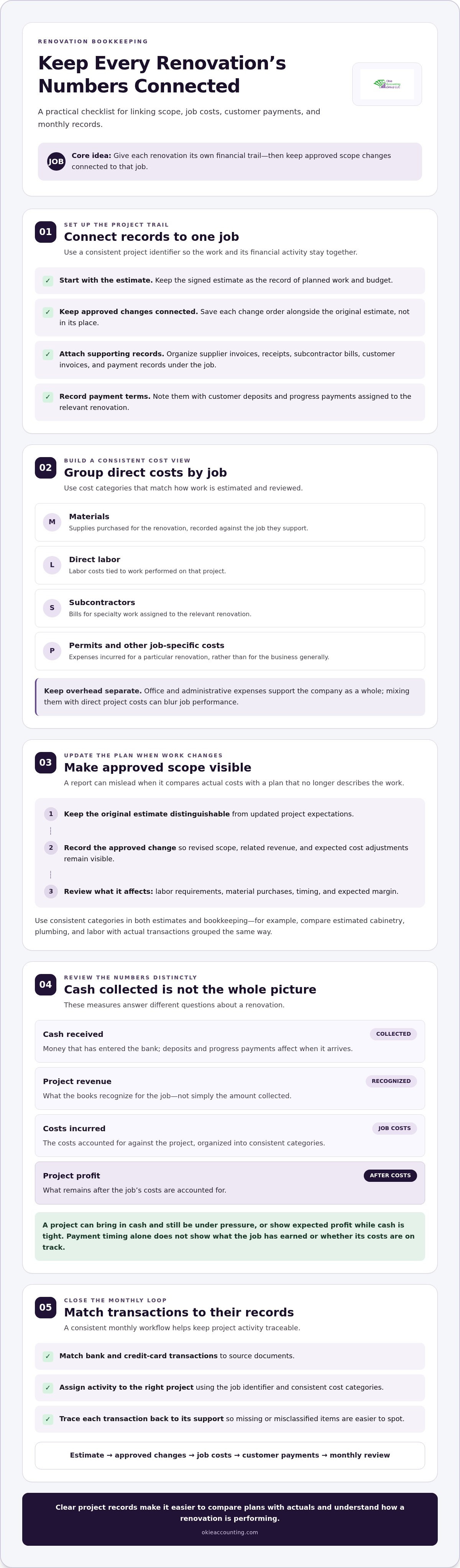
A monthly bookkeeping workflow renovators can use to keep projects current
A reliable monthly close turns scattered project paperwork into information you can use. Gather and code the records first, reconcile accounts next, then review project performance alongside the company’s cash needs. This recurring process helps keep bookkeeping for renovators current as jobs progress and scope changes are approved.
What should happen during each monthly close?
Collect and organize records. Gather supplier bills, receipts, customer invoices, payment records, and approved scope changes. Assign each item to the right project and cost category.
Match transactions to support. Compare bank and credit-card activity with source documents and project records. Confirm that each transaction is categorized and assigned correctly.
Reconcile accounts. Compare recorded activity with account statements, then investigate missing, duplicated, or uncategorized transactions before relying on reports.
Review project and company reports. Use the same reporting period each month to review project income, direct costs, customer balances, vendor bills, and overall cash needs.
Keep approved revisions linked to the relevant job records so the report reflects the scope being performed, not only the initial estimate. Monthly bookkeeping creates the foundation; a consistent close makes it useful for reviewing active projects.
How can renovators turn reports into operating decisions?
Once accounts are reconciled, compare each active project’s current costs with its estimate and documented scope revisions. A cost increase may reflect changed selections, added work, or a coding error, so investigate the source before adjusting plans. Review accounts receivable and upcoming payables at the same time. This can flag a customer invoice needing follow-up, a vendor bill coming due, or a project purchase that could affect near-term cash.
Look across completed jobs for patterns that can inform future estimates, such as recurring labor overruns or material categories that often differ from plan. Use those observations as guidance, not as a template that assumes every renovation will behave the same way. Project conditions, selections, and scope vary, so sound decisions depend on consistent records and context.
For a broader view of the systems behind this process, explore construction bookkeeping services. If you’re ready to strengthen your monthly close and project reporting, schedule a discovery call to discuss your bookkeeping needs.
When renovation bookkeeping needs ongoing support and financial oversight
A few late transactions can quickly become a visibility problem when you’re managing multiple renovations. If reconciliations keep slipping, project costs land in inconsistent categories, or you can’t tell which jobs need attention, recurring bookkeeping can restore a dependable view of business activity. For renovators, the value is ongoing: current records support better project reviews month after month, not just a one-time cleanup.
When is monthly bookkeeping support useful?
Monthly support can help when you’re juggling active jobs and struggling to keep invoices, receipts, and payments organized across them. Regular reconciliations align recorded transactions with account activity, while consistent project categorization makes financial statements more useful. Together, these records clarify what’s happening across the business and provide a steadier foundation for reviewing each renovation. Explore construction bookkeeping services for a broader look at the financial structure behind construction businesses.
Routine bookkeeping maintains that foundation by recording transactions, reconciling accounts, and preparing standard financial statements. It helps answer, “Are the records complete and current?” Accurate records alone may not answer, “What should we change?” Higher-level financial oversight can add perspective.
When might a renovator need controller-level insight?
Consider controller-level support if you need help building or reviewing budgets, strengthening internal controls, or interpreting financial reports to guide operating decisions. A controller can connect project-level information with wider business priorities, such as whether spending plans fit cash needs or reporting processes provide useful oversight. The aim is to make financial data more actionable, not simply to produce more reports. Learn about fractional controller services for higher-level financial oversight.
Okie Accounting Group LLC provides remote bookkeeping and controller support from Tennessee to construction businesses nationwide, including renovators in Jacksonville, Florida. Consistent monthly records and the right level of financial interpretation can help project information support clearer decisions about current work and the business as a whole.
If you’re ready to improve project visibility or strengthen financial oversight, book a discovery call to discuss your bookkeeping needs.
Build a Clearer Financial Picture of Every Renovation
Strong bookkeeping for renovators keeps changing project scope connected to costs, income, and payments. With consistent job costing, you can compare actual expenses with estimates, while monthly reports help distinguish cash timing from project performance. Regular reconciliations and project reviews turn those records into a steadier basis for operating decisions.
Okie Accounting Group focuses on construction and real estate businesses, providing monthly bookkeeping, financial reporting, and fractional controller support. Its remote services are available to businesses across the United States, including renovation businesses in Tennessee and Jacksonville, Florida, helping owners build a dependable financial foundation and add higher-level oversight as their needs grow.
If your project records are difficult to interpret or your reports aren’t guiding decisions, take the next step toward greater clarity. Book a discovery call to discuss your bookkeeping and financial reporting needs. With a consistent system behind each project, you can move forward with more confidence in the numbers.
Frequently Asked Questions
What is bookkeeping for renovators?
Bookkeeping for renovators is the organized recording of business income, expenses, and financial activity by project as well as for the company overall. It connects project costs, customer payments, and scope updates to the right renovation, making it easier to compare jobs without losing sight of general business expenses. Regular reconciliations and financial reports help keep the records current and give owners a clearer view of project performance and cash needs.
How do renovators track expenses by project?
Assign each renovation a consistent project identifier, then use it when recording supplier bills, receipts, subcontractor invoices, and other job expenses. Apply consistent categories for materials, direct labor, permits, and other costs so you can compare actual spending with the estimate. Keep general business overhead separate from direct job costs. Reconcile bank and credit-card activity regularly, matching transactions to supporting documents and project records to catch errors or missing information.
Can QuickBooks track renovation costs by job?
QuickBooks can support job-level cost tracking when the bookkeeping setup and workflow are organized around projects. Renovators need consistent project identifiers and expense categories, with bills and other transactions assigned to the appropriate job. The exact approach depends on the accounting setup and how the business needs to report costs. QuickBooks setup and training can help establish a workflow that supports project records and more useful financial reporting.
What happens if a renovation project has change orders?
Record each approved change order with the project’s financial records, keeping it distinct from the original estimate. Update the project’s expected income and costs to reflect the revised scope, including likely effects on labor, materials, subcontractors, or timing. This preserves a clear trail of what was initially planned and what changed. Without that distinction, reports may compare actual costs against an outdated scope and provide a misleading view of job performance.
How is renovation project profit different from cash flow?
Project profit reflects the relationship between revenue recorded for a job and its costs; cash flow reflects money moving into and out of the business. A deposit can increase the bank balance before the work is complete, while material purchases may use cash before a customer payment arrives. Unpaid customer invoices and vendor bills also affect near-term cash needs. Reviewing bank activity alongside project reports helps owners understand both liquidity and job performance.
When should a renovation business hire a bookkeeper?
Consider recurring bookkeeping support if reconciliations are delayed, project expenses are categorized inconsistently, or you can’t reliably see how active jobs are performing. Monthly reconciliations and financial statements provide a steadier view of business activity; controller-level support can add budgeting, internal controls, and financial interpretation. Okie Accounting Group provides remote support nationwide, serving businesses in Tennessee and Jacksonville, Florida, as well as across the United States.


Comments