Cash Flow Management for Real Estate Investors: The 2026 Strategic Framework

Updated: Nov 7
Is your real estate portfolio a self-sustaining wealth engine, or is it a house of cards waiting for the next major maintenance spike to collapse your liquidity? Many investors treat cash flow as a passive outcome of rent collection, but in a market where 30-year fixed rates sit at 6.69 percent, passive management is a recipe for stagnation. Effective cash flow management for real estate investors is no longer just an administrative task; it's the essential structural framework required to protect your margins and ensure financial readiness for your next acquisition.
You likely know the stress of inconsistent rental income or the frustration of trying to prepare lender-ready financials when your data is scattered across disconnected spreadsheets. We believe that total clarity over your financial data is the only way to alleviate the complexities of scaling a portfolio in today's environment. This article provides a comprehensive blueprint to master your liquidity, leveraging 2026 tax advantages like permanent 100 percent bonus depreciation to maximize your returns. We'll examine how to build a scalable financial infrastructure, establish predictable monthly cash flow, and transition from reactive bookkeeping to proactive, data-driven decision-making that protects your long-term stability.
The Foundation of Real Estate Profitability: Why Cash Flow is Your Structural Integrity
Cash flow management for real estate investors isn't a passive monthly check-in; it's the structural framework that supports your entire portfolio. Think of liquidity as the oxygen of your business. Without it, even the most valuable assets become liabilities that you can't maintain. While many novice investors focus solely on "cash on cash return" targets, they frequently miss the distinction between paper profit and actual cash availability. Understanding the fundamentals of real estate investment requires a shift in perspective. You must value financial readiness, the state of having liquid capital available to seize opportunistic acquisitions when they arise, rather than just recording historical data. Proactive cash flow management for real estate investors ensures you have the capital to act when the market shifts.
The Difference Between Net Income and Cash Flow
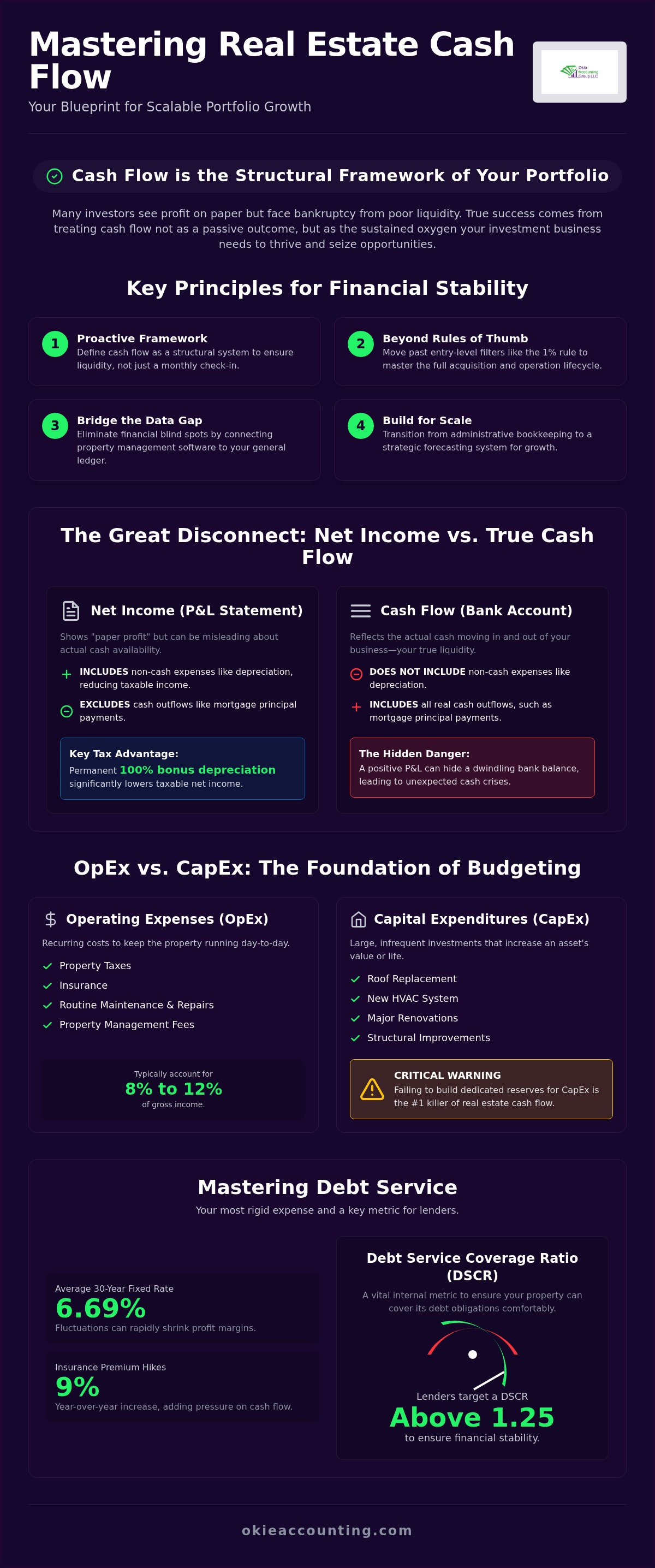
Your Profit and Loss (P&L) statement can be misleading because it doesn't always reflect the cash moving through your accounts. It includes non-cash expenses like depreciation. Under the One Big Beautiful Bill Act of 2025, 100 percent bonus depreciation is now permanent for qualifying property. While this significantly reduces your taxable net income, it doesn't remove a single dollar from your bank account. Conversely, mortgage principal payments are cash outflows that don't appear as expenses on a P&L; they only appear on the balance sheet. If you're only looking at net income, you might think you're thriving while your bank balance actually dwindles. This disconnect is why "profitable" investors often face bankruptcy. They lack the oversight to see that their debt service and capital improvements are eating their liquidity faster than the rent can replenish it.
Why Investors Fail to Scale Without a System
Scaling a portfolio requires moving beyond the "spreadsheet trap." Manual tracking works for one or two doors, but it fails as complexity increases. When you have multiple properties, the risk of co-mingling funds or neglecting general ledger maintenance grows exponentially. Without a clean data foundation, you lose the clarity needed to make high-level choices. Implementing a professional system for Accounting for Real Estate Investors: Building a Structural Framework for Growth is the difference between a collection of properties and a scalable business. A disciplined system ensures that every dollar is accounted for, protecting your margins from the "death by a thousand cuts" of untracked maintenance spikes and rising insurance premiums, which have seen a 9 percent year-over-year increase recently. Financial chaos is the primary barrier to growth; a structured framework is the solution.
Beyond the 1% Rule: Decoding the Mechanics of Real Estate Cash Flow
Rules of thumb like the 1 percent rule serve as useful initial filters, but they aren't management strategies. They fail to account for the nuanced reality of property age, tenant turnover, or localized insurance hikes. True cash flow management for real estate investors involves tracking the "Real Estate Life Cycle," which spans from the initial acquisition through daily operations and long-term capital improvements. Generic rules ignore these shifts. You need a data-driven approach that recognizes how a 1970s multifamily unit requires a vastly different reserve strategy than a 2024 build. Transitioning from "rules of thumb" to precise data is the only way to maintain structural integrity as you scale.
Operating Expenses (OpEx) vs. Capital Expenditures (CapEx)
Clarity begins with a sharp distinction between OpEx and CapEx. Operating Expenses include your recurring costs: property taxes, insurance, and routine maintenance. These are the predictable flows required to keep the doors open. Identifying Common Cash Flow Pitfalls often starts with miscategorizing these items. Capital Expenditures, such as roof replacements or HVAC systems, are significant, infrequent investments that increase the asset's value. Failing to set aside reserves for CapEx is the primary killer of real estate cash flow. While typical maintenance costs run between 8 percent and 12 percent of gross income, a single structural failure can wipe out a year of profit if you haven't built a dedicated reserve framework into your monthly accounting.
The Role of Debt Service in Cash Flow Planning
Debt service is the most rigid component of your cash flow, and it's becoming more complex in the 2026 market. With 30-year fixed-rate mortgages averaging 6.69 percent, interest rate fluctuations can quickly narrow your margins. Managing your Debt Service Coverage Ratio (DSCR) is no longer just for the bank's benefit; it's a vital internal metric. Lenders typically target a DSCR above 1.25 to ensure the property can comfortably cover its obligations. Maintaining lender-ready financial statements is essential for refinancing or securing your next acquisition. If your current reporting doesn't provide this level of detail, consider scheduling a discovery call to discuss how a structured framework can protect your portfolio's liquidity.
By moving beyond entry-level formulas, you gain the ability to predict future liquidity rather than just reacting to past expenses. This disciplined approach ensures that your portfolio remains a stable vehicle for wealth rather than a source of financial stress.
Structural Vulnerabilities: Common Cash Flow Pitfalls and How to Bridge the Data Gap
A critical structural vulnerability in many portfolios is the "Data Gap" between property management software and the general ledger. While tools like AppFolio or Buildium are excellent for tenant communication and rent collection, they are not comprehensive financial systems. Relying solely on property management reports often leads to a fragmented view of your business. True cash flow management for real estate investors requires a unified general ledger where every transaction, from mortgage interest to payroll, is reconciled. Without this bridge, you're operating with blind spots that property-level reporting simply cannot illuminate.
One of the most dangerous habits an investor can develop is managing by bank balance. Checking your account to see if you can afford a repair is a reactive, short-term tactic that ignores upcoming liabilities. It doesn't account for property taxes, insurance premiums that have spiked by 9 percent recently, or the 5 percent to 10 percent vacancy rates typical in the current market. Accurate data allows you to mitigate these risks before they become crises. "Lazy" bookkeeping, such as failing to record expenses in real-time, results in missed deductions and avoidable late fees that quietly erode your profit margins over time.
The Hidden Danger of Inaccurate Project Tracking
Tracking expenses at the property level, often called job costing, is a non-negotiable requirement for scaling. Without granular visibility, it's impossible to identify which assets are high-performers and which are draining your liquidity. Poor classification often leads to tax overpayment because you aren't accurately capturing the structural improvements that qualify for permanent 100 percent bonus depreciation. Job costing for real estate is the systematic allocation of every expense to a specific property asset, providing the granular visibility required for profit protection and accurate ROI analysis. This level of detail ensures that your capital is always deployed where it generates the highest return.
Managing Irregular Income Patterns
Real estate is rarely a business of steady, linear growth. You will inevitably face "lumpy" cash flow during property sales, major lease-ups, or extensive renovations. Handling these fluctuations requires a strategic cash reserve built on actual historical data rather than optimistic guesses. If you also manage development projects, you'll find that Mastering Construction Cash Flow Management: The 2026 Strategic Guide offers specialized frameworks for handling the unique complexities of project-based draws and contractor payments. Maintaining a disciplined reserve ensures you have the financial readiness to cover maintenance costs, which typically range from 8 percent to 12 percent of gross rental income, even during months of high vacancy. Proactive oversight turns irregular patterns into a predictable, manageable cycle.
Building a Scalable Forecasting System: From Basic Bookkeeping to Strategic Oversight
Moving from basic administrative recording to strategic oversight requires a disciplined, five-step approach. Many investors stop at simply recording expenses, which leaves them vulnerable to market shifts. To build a system that truly supports growth, you must first clean your data foundation with a professional QuickBooks setup. Once the foundation is solid, implementing monthly bank reconciliations and general ledger maintenance ensures that your data is accurate and lender-ready. From there, you can establish a 12-month rolling cash flow forecast, conduct monthly financial reviews to compare actuals against projections, and adjust your strategy based on key performance indicators (KPIs).
QuickBooks Online for Real Estate: The Strategic Hub
Cloud-based accounting is the gold standard for nationwide portfolios because it allows for real-time, remote support and data access. Within QuickBooks, utilizing features like Classes and Locations is essential for property-level tracking. These tools allow you to separate income and expenses by specific asset, providing the structural integrity needed for complex portfolios. For those who also manage renovation or development projects, Mastering QuickBooks for Contractors: The 2026 Strategic Guide outlines how to leverage these features for detailed project oversight. Automated bank feeds further reduce manual entry errors, ensuring your general ledger remains a reliable source of truth.
The 12-Month Rolling Forecast
A forecast is a living document, not a static report. By using historical data, you can predict seasonal maintenance spikes and property tax deadlines with precision. Effective cash flow management for real estate investors relies heavily on "Scenario Planning." This involve asking critical questions: What happens to our liquidity if vacancy increases by 10 percent? How does a 22 percent spike in insurance premiums, as seen in some markets recently, impact our debt coverage? By modeling these variables, you move from a state of reactive stress to one of operational clarity. You'll know exactly when you have the "financial readiness" to acquire a new property or when you need to tighten reserves.
This transition from administrative tasks to financial leadership is what distinguishes a hobbyist from a professional investor. If you're ready to move beyond basic bookkeeping and implement a scalable structural framework, you can schedule a discovery call to discuss our Fractional Controller services. We don't just record your past; we help you build a system that secures your future.
The Strategic Partner Advantage: Transitioning from Administrative Tasks to Financial Leadership
Scaling a real estate portfolio is a journey from operational chaos to structural integrity. Many investors begin this journey by hiring a basic bookkeeper to "keep the books clean," but as complexity increases, this reactive approach becomes a bottleneck. The transition from hiring a service provider to partnering with a Fractional Controller is the defining moment for a growing business. While a bookkeeper records what has already happened, a Fractional Controller analyzes your data to shape what happens next. Comprehensive cash flow management for real estate investors requires this shift from administrative recording to proactive financial leadership.
The return on investment for professional oversight is both immediate and measurable. When your financials are consistently lender-ready and your Debt Service Coverage Ratio (DSCR) is monitored with precision, you secure more favorable terms from lenders. This financial readiness allows you to move faster than the competition. You gain the confidence to make smarter acquisition decisions because you have absolute clarity on your liquidity. You aren't guessing whether you can afford the next deal; you're using a data-driven framework to prove it. This level of discipline protects your profit margins and ensures your portfolio remains stable during market fluctuations.
Why Specialized Real Estate Accounting Matters
Generalist providers often lack the niche-specific knowledge required to manage the unique mechanics of property investment. They might misclassify major structural repairs or fail to understand the nuances of the "Real Estate Life Cycle" we discussed earlier. Sarah O’Quinn’s approach at Okie Accounting Group provides a proactive framework for profit protection that generalists simply cannot match. By utilizing our Fractional Controller Services, you ensure that your accounting system is a strategic hub for growth rather than just a historical archive. We speak the language of job costing, CapEx reserves, and portfolio stability.
Next Steps: Securing Your Portfolio’s Future
The path from financial complexity to operational clarity begins with a single, strategic choice. You don't have to manage the stress of inconsistent income or fragmented data alone. You can choose to build a scalable financial infrastructure with a disciplined mentor who is as invested in your success as you are. We invite you to move beyond basic administrative tasks and embrace a higher level of financial leadership. To begin your transition, schedule a strategy session with Okie Accounting Group today. Let us conduct a structural financial review that secures your portfolio's future and protects your long-term wealth.
Building Your Structural Framework for 2026 and Beyond
Success in the 2026 real estate market requires more than just high rental yields; it demands a disciplined approach to liquidity and financial readiness. By bridging the data gap between property management and your general ledger, you move from reactive bookkeeping to proactive leadership. Mastering cash flow management for real estate investors ensures you aren't just recording past expenses but are actively protecting your margins against rising insurance costs and maintenance spikes. A scalable forecasting system is the essential foundation for any portfolio intended to grow without financial chaos.
We provide specialized strategic frameworks and nationwide remote support to help you transition from administrative stress to data-driven growth advisory. Our team is dedicated to building the systems that ensure your long-term stability and profit protection. If you're ready to secure your portfolio's future with a strategic partner, it's time to Gain Financial Clarity for Your Portfolio with Okie Accounting Group. Your path to operational clarity starts with a single discovery call. Let's build a foundation that lasts.
Frequently Asked Questions
What is the difference between a bookkeeper and a fractional controller for real estate?
A bookkeeper focuses on recording historical transactions and maintaining accurate records of what has already occurred. In contrast, a Fractional Controller provides high-level strategic oversight and future-focused analysis. This role involves interpreting your data to protect profit margins and ensure financial readiness for new acquisitions. While bookkeeping is an administrative task, a controller acts as a strategic partner, helping you build the structural frameworks necessary for scaling a complex portfolio.
How often should a real estate investor update their cash flow forecast?
You should update your 12-month rolling forecast at least once a month. This regular cadence allows you to compare actual performance against your projections and adjust for market shifts, such as the 9 percent year-over-year increase in insurance premiums seen recently. Monthly updates ensure your cash flow management for real estate investors remains proactive rather than reactive, providing the clarity needed to handle seasonal maintenance spikes or unexpected vacancy periods without stress.
Can QuickBooks Online handle multiple rental properties effectively?
QuickBooks Online is the gold standard for managing multiple properties when configured correctly. By utilizing the "Classes" and "Locations" features, you can track income and expenses for each individual asset within a single general ledger. This setup provides the granular visibility required for job costing and property-level ROI analysis. It also allows for automated bank feeds and nationwide remote support, making it an ideal strategic hub for investors with portfolios spread across different markets.
What are the most important KPIs for real estate cash flow management?
The most critical KPIs include your Debt Service Coverage Ratio (DSCR), Cash-on-Cash Return, and Net Operating Income (NOI). Lenders typically look for a DSCR above 1.25 to ensure the property can comfortably cover debt obligations. Tracking these metrics through a unified general ledger ensures you have a clear understanding of which properties are driving profit and which are underperforming. These data points are essential for making informed, data-driven acquisition decisions as you scale.
How much cash reserve should I keep for my rental portfolio?
A standard recommendation is to maintain a reserve of three to six months of operating expenses per property. However, a more precise approach involves setting aside 8 percent to 12 percent of gross rental income specifically for maintenance and another 5 percent to 10 percent for vacancy. Using actual historical data from your financial reports allows you to build a strategic reserve that reflects the specific age and condition of your assets rather than relying on generic guesses.
Why is CapEx tracking so important for long-term cash flow?
Capital Expenditures (CapEx) represent significant, infrequent investments like roof replacements or HVAC systems that increase an asset's value. Tracking these separately from routine Operating Expenses (OpEx) is vital because failing to reserve for them is a primary cause of liquidity failure. Accurate CapEx tracking also ensures you maximize tax benefits, such as the permanent 100 percent bonus depreciation enacted in 2025, which protects your long-term profit margins and supports portfolio stability.
Do I need a specialized accountant for real estate investing?
Partnering with a specialized accountant is essential because generalist providers often overlook the unique mechanics of the real estate sector. Specialized expertise is required to manage complex tasks like project-based job costing, DSCR monitoring, and navigating the permanent 100 percent bonus depreciation rules. A real estate-focused partner understands the "Real Estate Life Cycle" and provides the structural integrity needed to transition from basic administrative tasks to high-level financial leadership.
How does cash flow management help with getting new investment loans?
Professional cash flow management for real estate investors produces the lender-ready financial statements required for rapid scaling. When you can present accurate, reconciled reports that demonstrate a healthy DSCR and consistent liquidity, you build trust with financial institutions. This clarity often leads to better loan terms and faster approvals. Lenders want to see a disciplined structural framework that proves you have the financial readiness to handle both debt service and unexpected operational costs.


Comments