Construction Change Order Accounting: A Strategic Framework for Profit Protection

Updated: Nov 7
The silent killer of your project margins isn't the rising cost of materials or labor shortages; it's the uncaptured, unbilled, and unorganized change order. Without a rigorous system for construction change order accounting, many contractors find themselves accepting profit fade as an inevitable reality. This passive stance leads to inaccurate financial statements that confuse lenders and jeopardize your bonding capacity. You shouldn't have to choose between keeping a project moving and getting paid for the work your team actually performs.
We believe that managing your financial data should provide clarity, not confusion. Mastering these accounting complexities is the key to maintaining precise financial control and eliminating disputes over scope creep. This article provides a strategic framework for recording changes in real-time to keep your Work in Progress (WIP) reports accurate and your cash flow protected. We'll explore the transition from reactive administrative tasks to proactive structural systems that safeguard your business's long-term health and stability.
Why Change Orders are the 'Silent Profit Killers' in Construction
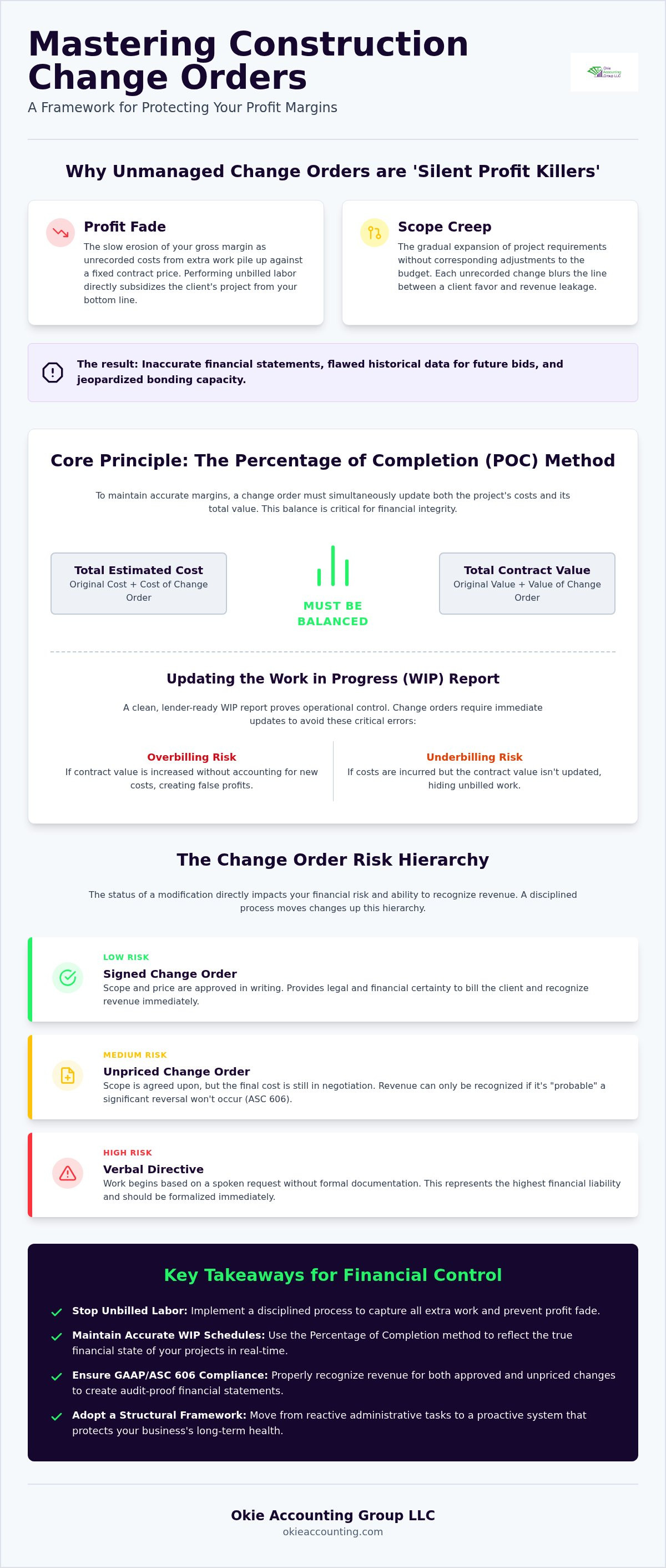
Many contractors fall into a psychological trap where they prioritize project momentum over administrative discipline. When a client requests a modification, the field team often starts work immediately to avoid schedule delays. However, without a formal What is a Change Order? process in place, this operational agility quickly becomes a financial liability. This is the primary driver of "profit fade," a term describing the slow erosion of your gross margin as unrecorded costs pile up against a fixed contract price.
Poorly managed modifications create a destructive ripple effect. If you don't implement rigorous construction change order accounting, one unrecorded labor hour or an extra day of equipment rental distorts the financial health of the entire project. Generalist bookkeepers often miss these nuances. They see a bill for materials but don't realize it belongs to a change that hasn't been added to the contract yet. This lack of specialized oversight makes your financial reports unreliable for lenders or bonding agents who require precise data to evaluate your firm's stability.
Identifying Revenue Leakage and Scope Creep
You must establish a clear distinction between minor field adjustments and billable changes. Doing "favors" for a client might feel like building a relationship, but it's actually revenue leakage that your business cannot afford. Scope creep is the gradual expansion of project requirements without corresponding budget adjustments. Every time your crew performs work outside the original contract without a recorded change, you're essentially subsidizing the client's project at the expense of your own bottom line.
The Impact on Job Costing and Resource Allocation
Undocumented changes don't just cost money; they drain your most valuable resources. They increase your labor burden and skew equipment utilization rates, making it appear that your team is less efficient than they actually are. When these extra expenses are "buried" in the original project estimate, your job costing becomes fiction. This makes it impossible to bid accurately on future work because your historical data is fundamentally flawed. Utilizing fractional controller services provides the strategic oversight needed to capture these costs in real-time, ensuring your project remains a financial success rather than a cautionary tale. Precise construction change order accounting ensures that every resource spent is accounted for and every dollar earned is collected.
Fundamental Accounting Principles for Construction Changes
Construction change order accounting relies heavily on the Percentage of Completion (POC) method to ensure revenue matches the actual progress of work. When a change occurs, it's not just a field adjustment. It's a structural update to your financial model. Both your "Total Estimated Cost" and "Total Contract Value" must shift simultaneously to maintain an accurate margin. If you increase costs without updating the contract value, your profit percentage drops artificially. Conversely, if you increase the contract value without accounting for the extra labor and materials, you create a false sense of financial health. This balance is critical for maintaining the structural integrity of your long-term business growth.
Adjusting the WIP Schedule for Contract Modifications
Your Work in Progress (WIP) report is the heartbeat of your financial readiness. When a change order is issued, you must immediately update the "Estimated Costs to Complete." Failure to do so leads to overbillings that aren't actually profits or underbillings that signal unbilled work. Bonding agents look for these discrepancies to judge your operational control. A clean, lender-ready WIP report proves you have a firm grip on project changes. Many firms find that scheduling a strategic discovery call helps align these complex reports with their actual field operations.
Revenue Recognition and ASC 606 Compliance
Under ASC 606, recognizing revenue from changes requires a disciplined five-step approach. You first determine if the change order constitutes a separate contract or a modification of the existing one. This distinction depends on whether the change adds distinct goods or services at their standalone selling price. For unpriced changes, you must account for "variable consideration." This means you only recognize revenue if it's probable that a significant reversal won't occur later. This level of rigor aligns with the Change Order Accounting Clause found in federal regulations. These rules mandate separate cost tracking for modifications to protect project integrity. Following these standards ensures your financial statements remain beyond reproach during audits or bank reviews.
Accounting for Approved vs. Unapproved Change Orders
The financial risk inherent in any project often centers on the status of modifications. At the top of the hierarchy are signed change orders; these provide the legal and financial certainty needed to bill the client and recognize revenue. Below these are unpriced changes where the scope is agreed upon but the final cost remains in negotiation. At the bottom lies the verbal directive, which represents the highest risk to your project margins. Proper construction change order accounting requires you to treat these levels differently to avoid inflating your revenue or hiding your actual costs.
GAAP standards allow for revenue recognition on unapproved changes only if it's probable that you'll collect the amount. This usually means you shouldn't recognize revenue for a claim or a disputed change until the legal right to payment is established. However, you must still record all costs as they occur. This mismatch between recognized costs and deferred revenue is where profit fade begins to take root. Protecting your cash flow requires a disciplined approach to tracking these "unbilled" costs so you don't lose sight of the capital you've already committed to the field.
Managing the Risk of Verbal Change Orders
Field teams often feel pressured to "just get it done" to stay on schedule. This creates an accounting danger zone where your firm incurs labor and material costs without a corresponding increase in the contract value. To prevent this, you need internal controls that mandate immediate reporting from the job site to the office. Verbal changes should be documented as "pending" in the accounting system to track incurred costs immediately. This ensures your financial statements reflect the real-time consumption of resources even before the paperwork is finalized.
Accounting for Disputed Changes and Claims
It's vital to distinguish between a change and a claim. A change is a mutual agreement to alter the scope, while a claim is a demand for payment due to unforeseen delays or disagreements. Following established Change Order Accounting Procedures helps you segregate these costs so they don't muddy your primary job costing data. When a change becomes a dispute, you may need to reclassify that expected revenue as a contingent asset. This shift has a significant impact on your cash flow forecasting and bonding capacity. A fractional controller provides the high-level oversight needed to navigate these disputes, ensuring that your financial reporting remains conservative and accurate throughout the litigation or negotiation process.
Building a Scalable Change Order Workflow in QuickBooks
QuickBooks Online serves as the foundational tool for many contractors, but its default settings rarely accommodate the complexities of project modifications. To implement effective construction change order accounting, you must move beyond simple invoicing and build a structural framework within your software. This begins by maintaining a strict 'Estimate' vs. 'Actual' workflow. Instead of modifying the original project estimate, you should create separate sub-estimates for every change. This practice keeps your original job costing data clean while providing a clear audit trail for the extra work performed.
Isolating these costs ensures that project managers can see exactly where the budget is drifting. By using specific classes or sub-items, you prevent change order expenses from being absorbed into the baseline contract. This isolation is the only way to protect your margins from the "death by a thousand cuts" that undocumented changes cause. Automating this pipeline from approval to invoice reduces administrative lag, ensuring that your financial data is always current. It's not just about recording history; it's about building a system that alerts you to financial risks before they become permanent losses.
Configuring Sub-Estimates for Clear Reporting
Building a lender-ready reporting system requires a precise setup in your Chart of Accounts. Follow these steps to maintain integrity:
Create a 'Change Order' sub-item for each major cost category such as Labor, Materials, and Subcontractors.
Map these items to specific income and expense accounts to track gross profit per change.
Tag every vendor bill and time entry to the relevant change order sub-estimate immediately.
Many firms benefit from specialized QuickBooks training for contractors to ensure their internal teams maintain this consistency across every project. Consistency in data entry is the only way to ensure your reports reflect reality.
Real-Time Margin Tracking and Project Reporting
Once your data entry is structured, you can run 'Project Profitability' reports that break out margins for each modification. This granular view allows you to identify which types of changes are most profitable and which are draining your resources. It's common for change orders to have higher margins than the base contract, but you'll only see this if your tracking is precise. Setting up automated alerts for unbilled costs ensures that your office team never forgets to invoice for work already completed in the field. Integrating this real-time data into your cash flow forecasting provides the visibility needed for long-term stability. If you're ready to transition from basic record-keeping to strategic financial leadership, book a discovery call today to refine your accounting systems.
Strategic Oversight: Protecting the Firm's Financial Health
Basic bookkeeping records what already happened, but strategic oversight tells you what's happening now and what will happen next. In the context of construction change order accounting, simply entering data into a ledger isn't enough to protect your margins. You need a robust system that evaluates the financial risk of every project modification in real-time. High-level financial leadership ensures that your business stays profitable even when project scopes become increasingly complex. By shifting your focus from "recording history" to "strategic financial leadership," you build a foundation for sustainable growth and long-term stability.
Monthly financial reviews serve as the ultimate safety net for your firm's health. During these sessions, a controller examines the delta between estimated and actual costs for every active change. If a project manager forgot to log a subcontracted extra or a field team performed work without a signed directive, the review process catches these errors before they become permanent losses. This level of scrutiny ensures that profit protection is an active, disciplined process rather than a passive hope. It's the difference between reacting to a crisis and managing a predictable outcome.
Beyond Bookkeeping: The Role of Strategic Financial Oversight
Many firms find that their internal staff can handle day-to-day entries but struggle with the high-level analysis required for accurate WIP reporting. This is where fractional controller services become essential. They bridge the gap between the field's operational needs and the executive team's financial strategy. By fostering a "culture of documentation," you ensure that project managers capture every deviation from the scope as it occurs. When your construction bookkeeping services are tightly aligned with project-level realities, you eliminate the dangerous lag time between work performed and revenue recognized.
Establishing Internal Controls for Long-Term Stability
Structural integrity isn't just for the buildings you construct; it's for your financial systems too. Designing a clear approval matrix for project changes protects your company assets from unauthorized scope creep. Regular WIP audits led by an expert controller catch construction change order accounting errors that generalists often overlook. This proactive approach allows you to close the loop on every project by using historical data to refine your estimating process. By analyzing why certain changes occurred, you can bid more competitively and accurately on future work. This disciplined framework transforms your accounting department into a strategic partner that's invested in the business's long-term health and success.
Building Your Foundation for Financial Readiness
Protecting your hard-earned margins requires more than just recording receipts; it demands a disciplined approach to construction change order accounting. By implementing a structural framework that aligns field operations with real-time financial data, you eliminate the uncertainty that leads to profit fade. You've seen how precise WIP reporting and rigorous QuickBooks workflows transform your accounting department from a back-office expense into a strategic profit-protection system. Accurate data doesn't just satisfy lenders; it empowers you to make confident, data-driven choices for the future of your firm.
Our team brings a specialized focus to the construction and real estate sectors. We provide the strategic fractional controller oversight and expert QuickBooks Online implementation needed to maintain absolute control over every project modification. You don't have to navigate these complexities alone. We're dedicated to serving as your strategic partner in building a stable, high-growth business that's ready for any challenge.
Gain financial clarity and protect your project margins with Okie Accounting's specialized services.
Frequently Asked Questions
What is the difference between a change order and a construction claim in accounting?
A change order is a mutual agreement between the contractor and the owner to modify the project scope, price, or schedule. In contrast, a claim is a unilateral demand for payment or time when an agreement hasn't been reached. Accounting standards treat change orders as contract modifications, while claims are often classified as contingent assets or variable consideration. Claims carry significantly higher financial risk because the legal right to payment is often disputed.
Can I recognize revenue on a change order that hasn't been signed yet?
You can recognize revenue on unsigned changes only if you determine it's probable that a significant reversal won't occur. Under ASC 606, this requires a high hurdle of probability regarding the amount you'll collect. If the client directed the work but hasn't finalized the price, you might recognize revenue to the extent of costs incurred. This is a critical aspect of construction change order accounting that requires disciplined professional judgment.
How do change orders affect my Work in Progress (WIP) schedule?
Change orders shift both the "Total Contract Value" and "Total Estimated Costs" on your WIP schedule simultaneously. If you record costs for a change but don't update the contract value, you'll show a false decrease in your profit percentage. Conversely, updating the price without the corresponding costs creates "overbillings" that don't reflect actual earnings. Keeping these values synchronized ensures your WIP remains a reliable document for lenders and bonding agents.
Should I track change order costs separately from the original project costs?
Yes, you should track change order costs separately to maintain the integrity of your original job costing data. Segregating these expenses allows you to analyze the profitability of specific modifications and prevents scope creep from muddying your baseline estimates. This practice is essential for future bidding accuracy and provides necessary documentation if a change later becomes a dispute. It also ensures that you're capturing the true labor burden for extra work.
What are the ASC 606 requirements for construction contract modifications?
ASC 606 requires a five-step process to recognize revenue, focusing on whether a modification creates a separate contract or modifies an existing one. If the change adds distinct goods at their standalone selling price, it's treated as a separate contract. If not, it's a cumulative catch-up adjustment to the existing project. You must also evaluate "variable consideration," which limits revenue recognition to amounts that are highly likely to be collected from the client.
How does poor change order accounting impact my bonding capacity?
Poor construction change order accounting leads to inaccurate WIP reports, which directly erodes the trust of bonding agents. If your reports show consistent profit fade or large, unexplained underbillings, agents perceive your firm as high-risk. This perception often leads to reduced bonding limits or higher premiums. Maintaining precise financial control over changes proves you have the operational discipline necessary to manage larger, more complex projects and protects your firm's long-term growth potential.
How can QuickBooks Online help me manage construction change orders?
QuickBooks Online enables real-time tracking through sub-estimates and classes specifically designed for project modifications. By creating a sub-estimate for each change, you can link vendor bills and labor hours directly to that specific scope. This setup automates the path from approval to invoicing, reducing the administrative lag that often leads to unbilled work. Proper software configuration ensures your job costing data stays clean and provides the visibility needed for strategic financial leadership.
Why is a fractional controller better than a standard bookkeeper for managing changes?
A standard bookkeeper focuses on recording historical transactions, whereas a fractional controller provides strategic oversight and internal controls. Controllers lead monthly WIP audits to catch unrecorded changes before they become financial losses. They bridge the gap between field operations and financial strategy, ensuring that your accounting systems support long-term stability. This high-level leadership is vital for navigating the complex revenue recognition rules and the risk management inherent in the construction sector.


Comments