Construction Invoice Management Best Practices: A Strategic Framework for 2026

Updated: 6 days ago
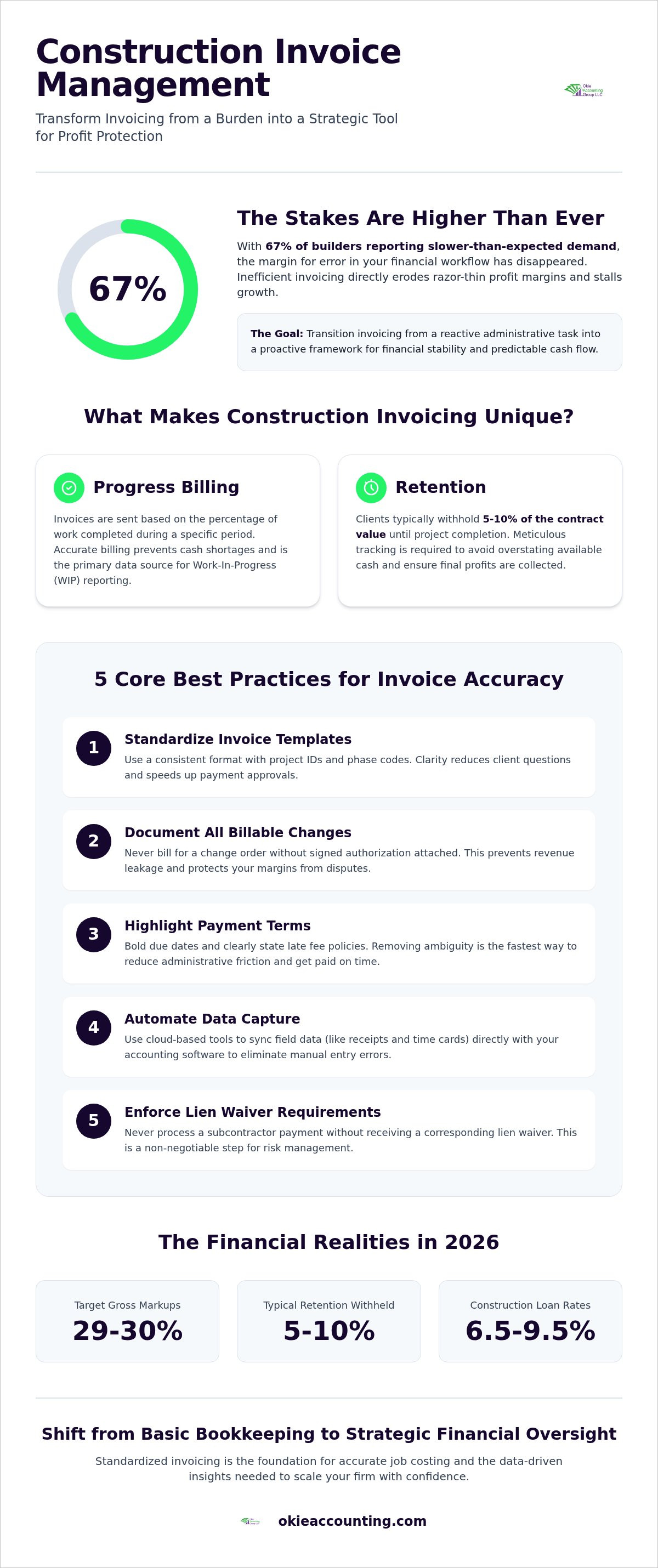
In 2026, an invoice is no longer just a request for payment; it's the primary defense mechanism for your firm's profit margins. With 67% of builders reporting slower than expected demand earlier this year, the margin for error in your financial workflow has effectively disappeared. Implementing construction invoice management best practices is now the fundamental difference between a business that survives on razor-thin margins and one that scales with predictable, healthy cash flow.
It's frustrating to deal with tight cash flow caused by sluggish payment cycles or the compliance anxiety that stems from missing subcontractor lien waivers. You shouldn't have to choose between finishing a project on time and maintaining accurate financial records. This article will teach you the specialized processes and structural frameworks required to turn your invoicing from an administrative burden into a strategic tool for profit protection. We'll examine how to synchronize field data with office reporting to achieve faster payment cycles, reliable job costing, and a significant reduction in the friction that often stalls construction growth.
What is Construction Invoice Management and Why is it Unique?
Construction invoice management is the systematic lifecycle of creating, transmitting, tracking, and reconciling project-based financial requests. It isn't a simple administrative task; it's a foundational system that ensures your firm remains solvent. In 2026, where builders are targeting gross markups of 29-30%, even minor inefficiencies in this cycle can erode your net profit. This process is deeply tied to the principles of Construction accounting, which requires a specialized approach to revenue recognition and job costing that generalist firms often overlook.
Effective construction invoice management best practices recognize that our industry operates on a unique three-tier billing reality. You might bill in advance for mobilization, in arrears for completed tasks, or through complex progress structures. When administrative lag occurs, it does more than just delay a check. It creates a disconnect between your actual cash position and your reported data, which directly impacts your firm's liquidity and bonding capacity.
The Role of Progress Billing
Progress billing is the standard for long-term projects, often utilizing AIA-style documents or percentage-of-completion methods. This structure ensures that you're paid for the value of work performed within a specific period. Accurate progress billing is essential to prevent front-loading, which can lead to cash shortages later, or under-billing, which essentially means you're interest-free financing the owner's project. These invoices are the primary data source for your WIP accounting for construction, allowing you to see exactly where a project stands against its budget at any given moment.
Retention and Its Impact on Cash Flow
Retention adds a layer of complexity that few other industries face. Managing the 5-10% of contract value withheld until project completion requires meticulous tracking. If you don't account for retention properly in your general ledger, you risk overstating your available cash, leading to poor procurement decisions. Following construction invoice management best practices means treating retention as a separate line item that's actively managed. You must have a clear strategy for billing and collecting these funds promptly at closeout to ensure the final 10% of your profit doesn't stay locked in the owner's bank account.
5 Core Best Practices for Construction Invoice Accuracy
Accuracy in your billing cycle is the bedrock of project profitability. When invoices are vague or inconsistent, payment cycles stretch and disputes arise. Adopting construction invoice management best practices ensures that your firm maintains professional discipline while protecting its cash position. This requires a shift from viewing invoicing as a back-office chore to treating it as a strategic financial tool. Implementing the following five core practices will create the structural integrity your firm needs to scale.
Standardize Invoice Templates: Use a consistent format that includes project IDs and phase codes. This clarity reduces the time clients spend questioning what they're paying for.
Document Billable Changes: Never bill for a change order without a signed authorization attached. Strict documentation prevents revenue leakage and protects your margins.
Highlight Payment Terms: Bold your due dates and clearly state late fee policies. Ambiguity is the primary cause of administrative friction.
Automate Data Capture: Use cloud-based tools to sync field data directly with QuickBooks. This eliminates the manual entry errors that plague traditional paper-based systems.
Enforce Lien Waiver Requirements: Never process a subcontractor payment without a corresponding lien waiver. This is a non-negotiable step for risk management and compliance.
Standardization as a Growth Tool
Standardizing your data isn't just about neatness; it's about scalability. Every invoice must include granular details like project IDs and phase codes to ensure accurate job costing. When your field team adopts a culture of documentation, the data they provide becomes a reliable asset. This level of detail is exactly what's required to leverage high-level fractional controller services. Without standardized inputs, strategic oversight is impossible because the underlying data lacks the necessary precision.
Managing Terms and Incentives
In 2026, the cost of capital remains a significant concern for builders. With professional construction loan rates typically ranging from 6.5% to 9.5%, waiting 30 days for payment is expensive. You might find that "Due on Receipt" terms or offering a small early payment discount is more cost-effective than carrying the interest on a project. Conversely, setting firm expectations for late fees serves as a deterrent against slow-paying clients. If you're struggling to find the right balance for your firm's specific needs, you can schedule a discovery call to discuss a tailored cash flow strategy. Protecting your profit margins requires a proactive approach to how and when you get paid.
Integrating Invoices with Job Costing and WIP Reporting
Invoicing is rarely the final step in a transaction; it's the primary data source for your project's financial heartbeat. To protect your margins, you must establish what we call the "Golden Thread." This is the unbreakable link between every vendor invoice and a specific job cost code. When a subcontractor bills for site prep, that data shouldn't just sit in a folder. It must immediately hit your ledger against that specific budget line. This level of precision is a cornerstone of construction invoice management best practices.
Without this integration, you're susceptible to "profit fade." This occurs when project costs escalate silently because invoices are sitting on a desk or stuck in an email chain. By the time they're entered, it's often too late to make the operational adjustments needed to save the job's profitability. Cloud-based accounting systems bridge this gap, allowing for a real-time field-to-office sync that turns static documents into actionable intelligence. This data also fuels your invoice aging reports, which are the only reliable way to build accurate cash flow forecasting models.
Eliminating the "Month-End Surprise"
Waiting until the final week of the month to process a stack of invoices is a strategic risk you can't afford in 2026. This "administrative batching" creates a massive blind spot in your financial reporting for three weeks out of every four. Implementing a daily or weekly processing cycle ensures your data remains current and reliable. Mastering QuickBooks for Contractors is essential here, as it provides the tools to automate these workflows and keep your job costing accurate without overwhelming your office staff.
WIP Reporting and Revenue Recognition
Your Work in Progress (WIP) report is the ultimate truth-teller for your firm. It highlights the critical distinction between billed revenue and earned revenue. If your invoice management is sloppy, you won't know if you're over-billed (holding cash for work not yet performed) or under-billed (financing the client's project with your own capital). Both scenarios carry risks. Significant under-billing drains your liquidity, while over-billing can mask a failing project. Banks and bonding agents look specifically at these metrics. Accurate, timely invoicing is often the deciding factor in your ability to secure the financing needed for your next major project.
Streamlining the Approval Workflow to Protect Cash Flow
An approval workflow is the primary gatekeeper of your firm's liquidity. Without a disciplined hierarchy, your office might pay for materials that never arrived or labor that wasn't performed to specification. To implement construction invoice management best practices, you must define exactly who has the authority to approve costs at specific dollar thresholds. A Project Manager might approve field supplies up to $5,000, while the Owner or Controller must sign off on major subcontractor draws. This structure prevents unauthorized spending and ensures that every dollar leaving the business is verified by the person closest to the work.
One of the most effective internal controls is the "Three-Way Match." This process requires your team to compare the Purchase Order (PO), the receiving report from the field, and the vendor's invoice before any payment is issued. If these three documents don't align, the invoice is flagged for review. This rigor is especially critical for managing change orders. You must ensure that every "extra" requested in the field is documented and billed before the work is completed. Letting change orders pile up until the end of a project is a guaranteed way to trigger disputes and delay your final payment.
Field-to-Office Communication Frameworks
Reducing administrative friction requires a seamless connection between your job site and your accounting software. Many firms struggle with delayed approvals because field managers are buried in paperwork. You can bridge this gap with specialized QuickBooks training for construction teams, which empowers project managers to approve subcontractor invoices via mobile apps in real-time. Validating invoice accuracy through digital field reports ensures that your office staff isn't chasing down signatures. Establishing a strict "no-PO, no-pay" policy further enforces these internal controls, making it clear that documentation is a prerequisite for payment.
Subcontractor Compliance and Risk Mitigation
Invoicing and compliance are inseparable in the construction industry. Your approval workflow must include a checklist for subcontractor insurance certificates, W-9s, and the strategic exchange of lien waivers. Paying a subcontractor before receiving a signed lien waiver exposes your firm to significant legal and financial risk. Additionally, for projects involving federal funding or specific state requirements, you must ensure compliance with construction payroll services to handle prevailing wage reporting. If your current approval process feels chaotic or lacks these essential safeguards, you can book a discovery call to help you build a more resilient financial framework. Protecting your cash flow starts with a workflow that prioritizes both speed and specialized oversight.
Scaling Your Firm with Strategic Financial Oversight
Many contractors believe that a new piece of software will automatically fix their financial chaos. It won't. Software is an accelerator, not a cure. If you automate a broken process, you simply generate bad data at a higher velocity. True growth requires moving beyond basic bookkeeping and embracing management accounting. This transition is what turns your financial department from a cost center into a profit-protection engine. By implementing construction invoice management best practices, you create the high-quality data stream necessary for high-level decision-making.
The Fractional Controller Advantage
A Fractional Controller acts as a growth catalyst by providing the oversight that most mid-sized firms lack. They don't just record transactions; they interpret the story behind the numbers. For instance, they might identify that rising costs for steel mill products, which increased by 22% over the last year, are beginning to erode your 29% gross markup targets. This level of Fractional Controller Services allows you to pivot your bidding strategy before a trend becomes a crisis. They also build the internal controls that prevent waste and protect your firm from the fraud risks inherent in large-scale subcontractor payments.
Next Steps: Building Your Financial Infrastructure
Scaling your firm requires a shift from reactive to proactive management. You shouldn't find out you're losing money at the end of a project. You should see the trend early enough to act. Start by conducting a thorough financial health audit of your current invoicing process. Identify where the bottlenecks occur. Is it in the field approval? Is it in the data entry? Once you understand the friction points, you can select a tech stack that fits your specific niche, whether you're in residential remodeling or high-growth sectors like data center construction.
Partnering with a specialized firm like Okie Accounting Group LLC provides the stability and strategic leadership needed to navigate the complexities of 2026. By focusing on foundational systems rather than just administrative tasks, you ensure that your business is prepared for whatever market shifts lie ahead.
Build a Foundation for Predictable Growth
Establishing a resilient financial system is just as critical as the structural integrity of your physical projects. We've explored how moving from reactive billing to a proactive framework protects your profit margins and ensures your firm remains solvent. By integrating real-time data with WIP reporting and enforcing strict approval hierarchies, you eliminate the administrative lag that often stalls growth. These construction invoice management best practices aren't just administrative tasks; they're the strategic tools required to navigate the complexities of 2026.
At Okie Accounting Group LLC, we offer specialized construction and real estate expertise to help you transition from basic bookkeeping to strategic leadership. Our fractional controller strategy and mastery of cloud-based accounting systems provide the data-driven insights you need to scale with confidence. It's time to stop worrying about cash flow cycles and start focusing on your next major project. You've built the structures that define our communities; let us help you build a financial infrastructure that's just as durable. Gain Financial Clarity with Okie Accounting Group LLC today and secure the long-term stability your firm deserves.
Frequently Asked Questions
What is the most common mistake in construction invoice management?
The most common mistake is administrative batching, where firms wait until the end of the month to process all invoices. This creates a massive blind spot in your financial data for weeks at a time. By the time you realize a project is over budget, it's often too late to adjust. Implementing construction invoice management best practices requires a shift to weekly processing cycles to maintain real-time visibility and control.
How does progress billing differ from standard invoicing?
Progress billing differs from standard invoicing by requesting payment based on the percentage of work completed rather than a flat fee or simple time and materials. This method typically uses AIA-style documents to detail the total contract amount and the current amount due. It ensures that your cash flow aligns with project milestones, reducing the risk of under-billing or financing the client's project with your own capital.
Can I use QuickBooks Online for complex construction job costing?
You can absolutely use QuickBooks Online for complex job costing if it's configured correctly for the construction industry. While some legacy firms prefer desktop versions, QBO offers the cloud-based accessibility needed for real-time field-to-office data sync. Success depends on specialized setup and staff training to ensure every expense is correctly categorized to specific cost codes, allowing for accurate WIP reporting and proactive profit protection.
What documents should always accompany a construction invoice?
Every construction invoice should be accompanied by signed change orders, daily field reports, and relevant subcontractor invoices. Providing this supporting documentation upfront reduces administrative friction and prevents payment delays caused by client questions. It establishes a clear paper trail for every dollar billed, which is essential for protecting your firm's professional reputation and ensuring you get paid for every extra task performed on the job site.
How do I handle subcontractor lien waivers during the invoicing process?
Handle subcontractor lien waivers by requiring a signed conditional waiver as a prerequisite for processing any payment request. Once the payment is issued, ensure you receive an unconditional waiver in return. This exchange is a critical risk mitigation step that protects the property owner and shields your firm from legal disputes. Automating this process within your workflow ensures that no payment is ever released without the necessary compliance documents.
Why is retention so difficult to track and how can I fix it?
Retention is difficult to track because it represents a non-cash asset that stays on your balance sheet for months or years. To fix this, you must record retention as a separate line item in your general ledger rather than letting it sit in general accounts receivable. This prevents you from overstating available cash. Actively managing these amounts ensures they are billed and collected immediately upon project closeout, protecting your final profit.
What is the "Three-Way Match" and why does it matter for contractors?
The "Three-Way Match" is a control process where you compare the purchase order, the receiving report from the field, and the vendor invoice before payment. For contractors, this matters because it prevents paying for materials that were never delivered or were damaged upon arrival. It ensures that your firm only pays for what was authorized and received, which is a fundamental component of construction invoice management best practices.
How often should I review my accounts receivable aging report?
You should review your accounts receivable aging report at least once a week to maintain a healthy cash position. In a high-interest environment where construction loan rates can reach 9.5%, every day an invoice remains unpaid costs your firm money. Regular reviews allow you to identify slow-paying clients early and initiate follow-up procedures. This data is also a prerequisite for accurate cash flow forecasting and strategic growth planning.


Comments