Fractional Controller for Construction Companies: The 2026 Strategic Growth Framework

Updated: 6 days ago
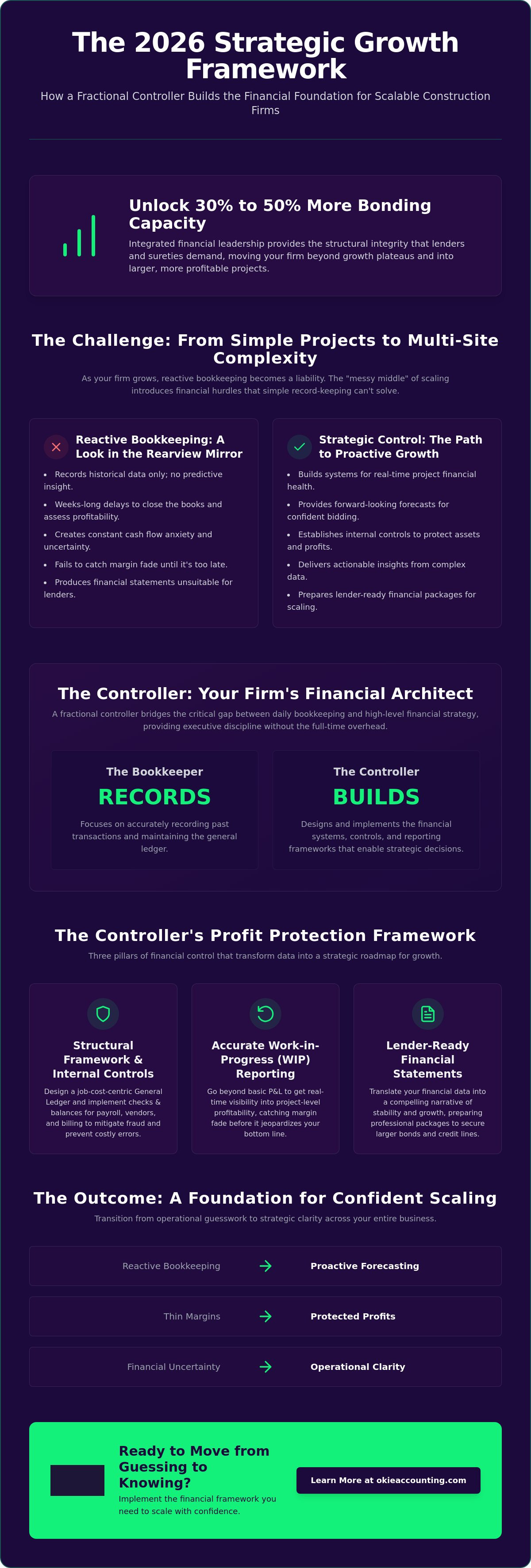
Did you know that construction firms integrating a fractional controller for construction companies into their leadership often see a 30% to 50% increase in their bonding capacity? This isn't just about better math; it's about presenting a level of financial structural integrity that lenders and sureties demand in 2026. You likely started your business to build, yet you now find yourself managing thin margins and the persistent anxiety of cash flow timing between major project milestones. It's a common plateau where you've outgrown your solo bookkeeper and need more than just historical data to move forward.
We understand that your complex needs require a partner who is as invested in your project-based success as you are. This article provides the 2026 Strategic Growth Framework, showing you how a fractional controller provides the high-level financial oversight and structural frameworks needed to scale your construction firm with confidence. We'll explore how to achieve predictable profit margins on every job, secure lender-ready financial statements, and transition from basic administrative tasks to a comprehensive system of profit protection. By the end of this guide, you'll see how to move from reactive bookkeeping to proactive forecasting, from thin margins to protected profits, and from financial uncertainty to operational clarity.
The Financial Complexity of Scaling a Construction Firm
Scaling a construction company is not a linear process; it's a structural transformation. When you were managing a single crew or one project at a time, your financial oversight could afford to be informal. However, as you move into the "messy middle" of growth, where you're juggling multiple site milestones, fluctuating material costs, and overlapping payroll cycles, simple administrative tracking isn't enough. Many firms reach a plateau where their existing systems begin to buckle under the weight of multi-project complexity. This transition requires a shift from simple recording to strategic financial management.
The hidden cost of "messy books" is often found in the gaps between project expenses and final billings. If your accounting system doesn't capture a change order or a surge in material costs in real-time, that money often stays on the table. Scaling without financial visibility is one of the primary drivers of construction firm failure. Without a clear view of your project-based financial health, you're essentially guessing on your next bid. This puts your entire operation at risk, as one poorly estimated job can wipe out the profits of three successful ones. This is why a fractional controller for construction companies is often the missing piece of the growth puzzle.
The Problem with Reactive Bookkeeping
Most bookkeeping is reactive; it records history. While knowing what you spent last month is necessary, scaling requires a predictive financial framework. You've likely outgrown your current setup if your month-end close takes weeks or if you can't determine the exact profitability of a job until months after it's finished. The emotional toll of this uncertainty is significant. Owners often feel a constant, low-level anxiety because they don't know if their bank balance represents true profit or just temporary cash from a recent mobilization fee. A bookkeeper maintains the records, but they don't build the systems that alleviate this stress.
Project-Based Financial Hurdles
Construction accounting is unique because of the long payment cycles and the complexity of revenue recognition. Generalist accountants often struggle with these nuances, leading to inaccurate financial statements that can't be used for bonding or lending. Understanding the role of a company's controller is vital here, as they focus on the internal controls that prevent under-billing. Under-billing is a silent killer of liquidity. It means you're essentially financing your client's project with your own cash flow. A fractional controller for construction companies ensures your data is accurate and timely, providing the clarity needed to make high-stakes bidding decisions with confidence. Real-time data allows you to pivot before a project's thin margins disappear entirely.
What a Fractional Controller Does for Construction Companies
A fractional controller for construction companies acts as the strategic architect of your financial department. While a bookkeeper focuses on the recording of past transactions, the controller focuses on the design of the systems that capture those transactions. Just as specialized industries like hair and beauty use SalonIQ for their management and marketing, a controller builds the structural framework that ensures every dollar is tracked and every project is measured against its original estimate. This role bridges the gap between raw data entry and the high-level financial leadership required to manage a multi-project portfolio, providing executive-level discipline without the overhead of a full-time hire.
Structural Framework and Internal Controls
Controllers establish the internal controls necessary to protect your assets and your reputation. They design a General Ledger that supports granular project tracking, ensuring every expense is tied to a specific job code from the start. They implement essential checks and balances for payroll and vendor payments to mitigate the risk of fraud, duplicate billing, or costly errors. This often involves verifying that subcontractor insurance is current before payments are released. By aligning your systems with the basics of construction accounting, they ensure your records are compliant with GAAP and industry standards. This level of discipline is what separates a stable, scalable firm from one that is merely busy and at risk.
Financial Reporting and Data Interpretation
Beyond maintaining the books, a controller provides the interpretation you need to lead with confidence. They translate complex balance sheets into actionable insights that guide your bidding, hiring, and equipment purchasing decisions. Instead of just looking at a company-wide Profit and Loss statement, you receive detailed project-level analysis that highlights margin fade before it becomes a crisis. The controller creates a narrative of growth, helping you understand exactly where your cash is tied up and how to free it for future milestones. They play a critical role in preparing lender-ready financial packages, giving you the professional edge needed to secure larger bonds and credit lines. If you're ready to move from guessing to knowing, you can schedule a discovery call to see how this oversight fits your specific growth goals.
Controller vs. CFO vs. Bookkeeper: Choosing Your Oversight
Selecting the right financial partner is about matching their specific skill set to your firm's current stage of growth. Many contractors mistakenly treat these roles as interchangeable, but they serve distinct functions within your organizational hierarchy. A bookkeeper is your tactical foundation; they handle the daily recording of transactions, manage payroll entries, and perform basic bank reconciliations. While vital for keeping the lights on, a bookkeeper rarely has the technical expertise to build the complex structural systems needed for multi-project scaling. At the other end of the spectrum, a CFO focuses on long-term capital strategy, equity structures, and potential mergers or acquisitions. They look at the horizon, not the engine room.
The controller is the critical bridge between these two extremes. They oversee the accuracy of the books and build the internal frameworks that ensure data integrity. For firms in the "messy middle" of growth, a fractional controller for construction companies provides this essential middle-tier oversight. They don't just record what happened; they ensure the systems are in place so you can trust the numbers. This role is about maintaining the engine of your business, ensuring that every project's financial gears are turning in sync with your overall goals.
When to Hire a Fractional Controller
Knowing when to hire a fractional controller often comes down to revenue milestones and operational friction. Typically, construction companies with $2M to $10M in revenue find themselves at a crossroads where their solo bookkeeper is overwhelmed. If your month-end reconciliations take weeks instead of days, or if you're making major equipment purchases based on "gut feeling" rather than cash flow forecasts, you've reached the tipping point. You need a strategic partner who can clean up the data and establish professional-grade reporting before the lack of visibility leads to a liquidity crisis.
The ROI of Fractional Oversight
The return on investment for fractional oversight is often immediate and measurable. While a full-time executive hire can cost upwards of $175,000 per year, a fractional controller for construction companies offers the same level of expertise at a fraction of the cost. This partnership pays for itself by identifying margin leaks and uncaptured project expenses that often go unnoticed in "messy" books. Additionally, having a controller maintain clean, accurate data throughout the year significantly reduces the complexity and cost of year-end tax preparation. You're no longer paying a CPA to fix basic errors; you're handing them a professional package that's ready for filing. This structural discipline protects your profits and ensures your firm is always ready for its next growth milestone.
Implementing a Profit Protection Framework
Profit protection is not about simple cost-cutting. It's about building a structural defense against the variables that erode your bottom line, such as uncaptured change orders or inefficient labor allocation. For many firms, the difference between a successful year and a liquidity crisis lies in the accuracy of their Work-in-Progress (WIP) reporting. A fractional controller for construction companies implements a framework that moves beyond basic accounting to provide a real-time pulse on every active job. This systemic approach ensures that you aren't just busy, but consistently profitable.
Establishing a monthly financial review process is the cornerstone of this framework. During these sessions, your controller analyzes variances between estimated and actual costs, allowing you to catch margin fade while there's still time to course-correct. This level of oversight identifies which project types yield the highest returns and which are draining your resources. By turning raw data into a strategic defense, you can bid on future work with a clear understanding of your true capacity and cost structure.
Mastering Job Costing and WIP
Effective profit protection requires tracking labor, materials, and overhead at the project level with absolute precision. A fractional controller ensures that every hour of field labor and every invoice from a supplier is coded correctly from the moment it enters the system. This data feeds into the "Over/Under" report, which is perhaps the most critical tool for a growing contractor. This report identifies projects where you have billed more than the work performed (over-billing) or performed more work than you've billed (under-billing). Recognizing these positions early prevents you from spending "borrowed" cash and ensures you have the liquidity to reach the next milestone. If you're ready to stabilize your project data, you can schedule a consultation to review your project margins.
Cash Flow Forecasting for Contractors
Navigating the peaks and valleys of the construction cycle requires more than a bank balance check. It requires a predictive model that accounts for project schedules, retention releases, and specific payment terms. A fractional controller for construction companies builds these forecasts to help you manage the "float" between projects. This ensures you have the capital necessary to mobilize for a new job without compromising the payroll of an existing one. By Mastering Construction Cash Flow Management, you can begin building a strategic reserve. This financial cushion protects your firm against industry downturns or unexpected project delays, providing the stability needed to make long-term investments in equipment and talent.
Scaling Your Firm with Okie Accounting’s Strategic Oversight
At Okie Accounting Group LLC, we believe that your financial department should be a source of structural strength rather than a cause of operational stress. We provide the disciplined financial foundation your firm needs to move beyond the "messy middle" of growth and into a phase of sustainable scaling. Our approach is built on the principle that accurate data is the only reliable fuel for expansion. By integrating a fractional controller for construction companies into your leadership team, you gain the rigorous management necessary to protect your margins and stabilize your cash flow.
This partnership allows you to transition from a reactive, service-based entrepreneur to a strategic business leader. You no longer have to spend your nights wondering if your bank balance accounts for upcoming retention releases or if a specific crew is consistently underperforming. We provide the quiet confidence that comes from professional oversight, ensuring that every financial decision is backed by verified project data. When your internal systems are organized and predictable, you can focus on what you do best: building the projects that define your company's legacy.
A Strategic Partnership, Not Just a Service
We don't simply provide reports; we build the foundational systems that support long-term stability. As your remote financial leaders, we integrate with your existing team to establish the checks and balances required for a multi-project portfolio. This includes refining your general ledger, optimizing your job costing workflows, and ensuring your payroll processes are both compliant and efficient. Our commitment is to act as a disciplined mentor, helping you navigate the unique mechanics of the construction cycle with a forward-thinking mindset. You can Explore our Controller Services to see how we tailor our structural frameworks to meet the specific needs of commercial subcontractors and general contractors alike.
Ready for Financial Clarity?
The journey toward operational clarity begins with a thorough assessment of your current financial health. During our initial collaborative engagement, we focus on cleaning up historical data to ensure your starting point is accurate. We look back at past project performance to identify trends, which allows us to build a reliable, forward-looking system that predicts your future cash needs. This methodical transition ensures that your lender-ready financial statements are a true reflection of your firm's potential. If you are ready to experience the stability that comes from expert oversight, you can Schedule a consultation with Okie Accounting Group today. Let's build a financial framework that is as solid as the structures you create.
Secure the Financial Foundation of Your Construction Firm
Scaling your company requires more than just winning the next bid; it demands a transition from reactive bookkeeping to proactive, structural oversight. By implementing a profit protection framework and mastering the nuances of WIP reporting, you move from the "messy middle" of growth to a position of operational clarity. A fractional controller for construction companies serves as the strategic architect of this transformation, ensuring your data is accurate, your margins are protected, and your firm is always lender-ready.
Okie Accounting Group LLC, led by dedicated industry professional Sarah O’Quinn, specializes in building these essential structural frameworks for the construction and real estate sectors. We don't just record transactions; we provide the remote financial leadership and specialized expertise needed to support your long-term stability. If you're ready to move beyond basic administrative tasks and become a more strategic business leader, we invite you to Partner with Okie Accounting for Strategic Financial Oversight. Experience the confidence that comes from having a disciplined partner who is as invested in your project-based success as you are. Your path to sustainable growth starts with financial clarity.
Frequently Asked Questions
What is the difference between a bookkeeper and a fractional controller?
A bookkeeper focuses on the daily recording of transactions, whereas a fractional controller for construction companies designs the structural systems that ensure those transactions are accurate. While the bookkeeper manages data entry, the controller establishes internal controls and provides the strategic oversight needed to interpret that data. This distinction is critical for firms moving from simple administrative tracking to comprehensive profit protection and sustainable growth.
How many hours a month does a fractional controller typically work for a construction company?
The engagement length depends entirely on the complexity of your project portfolio and your current growth stage. Most fractional arrangements involve a consistent monthly schedule focused on high-level review and system building rather than daily tasks. This model allows you to access executive-grade expertise without the financial burden of a full-time salary, making it a highly scalable solution for contractors in the "messy middle" of expansion.
Does my construction firm need to be a certain size to benefit from controller services?
Construction firms typically benefit most from these services when they reach the $2M to $10M revenue range. At this stage, the complexity of managing multiple project milestones and fluctuating cash flows often exceeds the capabilities of a solo bookkeeper. However, any firm experiencing "messy books," uncaptured project expenses, or anxiety over cash flow timing can benefit from the structural frameworks and strategic clarity a controller provides.
Can a fractional controller help me with QuickBooks Online setup?
Yes, a fractional controller ensures your QuickBooks Online setup is optimized for the unique demands of construction accounting. This isn't just about basic software configuration; it involves designing a General Ledger and a Chart of Accounts that support granular job costing. Proper setup is the foundation of reliable reporting and prevents the data integrity issues that often plague scaling firms as they move into larger projects.
How does a controller help with construction project job costing?
A controller improves job costing by implementing systems that track labor, materials, and overhead at the project level in real-time. They establish the internal workflows that ensure field data is captured accurately and integrated into your financial statements. This oversight allows you to identify margin fade early and make data-driven adjustments before a project concludes, ensuring that every job contributes to your firm's overall profitability.
What reporting should I expect from a fractional controller each month?
You should expect a comprehensive reporting package that includes Work-in-Progress (WIP) reports, cash flow forecasts, and project-level Profit and Loss statements. These reports move beyond historical data to provide a narrative of your firm's health. A fractional controller for construction companies interprets these numbers each month to highlight variances and opportunities for profit protection, ensuring you always know exactly where your cash is tied up.
Will a fractional controller work with my existing CPA or tax preparer?
Absolutely. A fractional controller acts as the strategic bridge between your internal operations and your external tax preparer or CPA. By maintaining clean, GAAP-compliant records throughout the year, the controller reduces the time and cost associated with year-end tax preparation. This ensures your CPA receives a professional financial package that is ready for filing without extensive corrections, allowing them to focus on high-level tax strategy.
How does fractional oversight improve my chances of getting a business loan?
Professional oversight significantly improves your loan readiness by providing lenders with accurate, transparent financial statements. Banks and surety companies look for the structural integrity that a controller brings to a firm's reporting. In fact, firms with this level of oversight often see a 30% to 50% increase in bonding capacity. This demonstrates that your business is managed with executive-level discipline, leading to more favorable terms on credit lines.


Comments