Generic Bookkeeper vs. Specialized Construction Fractional Controller: Which Fits?

Updated: Nov 7
A clean set of books can still leave you guessing about which jobs are protecting your margin. For construction companies, recording transactions is essential, but it doesn’t automatically explain project performance, cash timing, or where costs are drifting. That’s the distinction behind the generic bookkeeper vs specialized construction fractional controller decision: accurate records are the foundation; construction-focused oversight helps turn them into useful direction. If your financial statements don’t show how individual projects are tracking, you may need more than transaction recording.
You may know your books need attention but still be unsure whether to prioritize consistent reconciliations and reporting or deeper financial management. This article explains what each role covers and how the two can work together. We’ll look at monthly bookkeeping, then at controller-level work such as budgeting, internal controls, and interpreting financial data in a construction context. You’ll be better equipped to identify what’s missing and choose support that fits your company’s needs.
Generic Bookkeeper vs. Construction Fractional Controller: What Is the Difference?
The practical difference is the kind of question each role is equipped to answer. A bookkeeper records and reconciles financial activity so the accounts reflect what has happened. A fractional controller reviews that information, interprets what it means for the business, and helps shape financial oversight. For a construction company, knowing total expenses is useful, but understanding how financial activity relates to project work can support better management decisions.
A general bookkeeper’s work commonly centers on maintaining accurate accounting records. A construction fractional controller provides part-time oversight, with a focus on analysis, budgeting, and internal controls. The comparison in generic bookkeeper vs specialized construction fractional controller isn’t about which role matters more. It’s about whether your current need is reliable recordkeeping, deeper financial interpretation, or both.
What does a general bookkeeper typically handle?
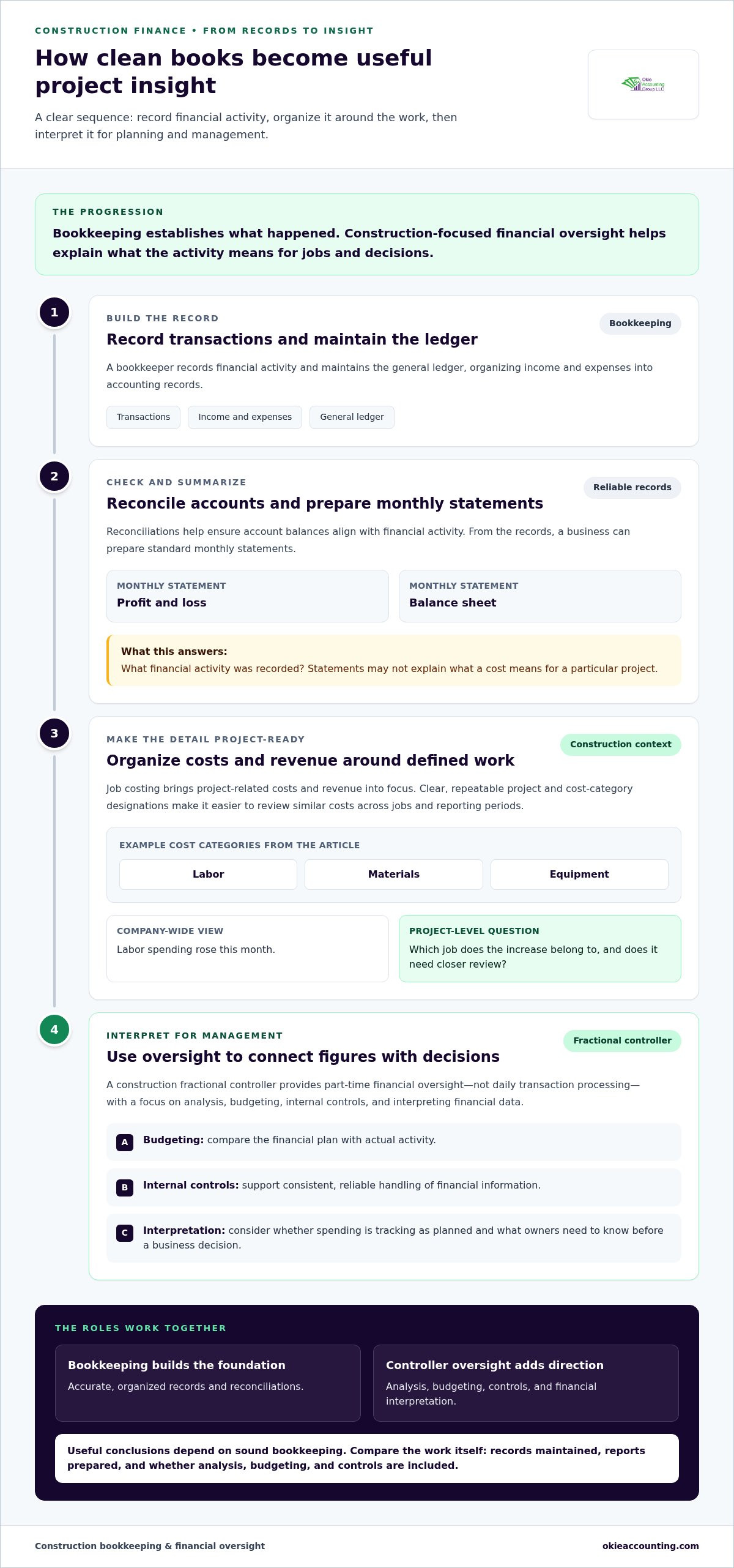
Bookkeeping establishes the financial record. Recurring tasks can include recording transactions, reconciling bank accounts, and maintaining the general ledger. These steps organize income and expenses and help ensure account balances align with financial activity. From those records, a business can prepare standard monthly financial statements, such as a profit and loss statement and balance sheet.
These statements are valuable, but they primarily present recorded activity. They may show what the company spent without explaining what a cost means for a particular project or how current results compare with a budget. Accurate records are essential; interpreting them for management decisions may call for additional oversight.
What makes a construction fractional controller specialized?
A construction-focused fractional controller brings financial oversight to a project-based business. Budgeting helps establish a financial plan and compare it with actual activity. Internal controls are the processes that support consistent, reliable handling of financial information. Interpretation connects the figures to practical questions, such as whether spending is tracking as planned and what information an owner needs before making a business decision.
The work is strategic rather than centered on daily transaction processing, but it depends on sound bookkeeping. A controller can draw useful conclusions only from financial records that are organized and maintained with care. The roles can complement each other: bookkeeping builds the foundation, while controller oversight helps make that foundation more useful for planning and management. Okie Accounting Group’s fractional controller services focus on financial oversight, budgeting, internal controls, and interpreting financial data.
Construction accounting has project-based considerations that differ from general recordkeeping. Construction Accounting on Wikipedia offers background on topics such as job costing and project-level financial management. This helps explain why construction experience can matter when translating accounting information into operational insight.
Titles alone don’t define the work. Providers may combine bookkeeping and oversight in different ways, so compare responsibilities and outputs. Ask what records are maintained, which reports are prepared, and whether the scope includes analysis, budgeting, and controls. Comparing the work itself makes it easier to identify what your company needs without diminishing the importance of either role.
Why Construction Companies Need More Than Clean Books
Company-wide totals can look orderly while concealing very different results across active jobs. A monthly report might show that overall labor and material expenses rose, but not whether a particular project is using resources as planned or whether costs are being recorded consistently. Clean books show what financial activity was entered. Project-level organization helps show where that activity belongs, and financial oversight helps interpret what it may mean for operations.
A reliable records foundation starts with consistent transaction coding and reconciliations. Construction bookkeeping becomes more useful when costs and revenue can be reviewed in relation to defined work, rather than only as broad company totals. For example, consistent project and cost-category coding makes it easier to compare the same types of costs across jobs and reporting periods. The quality of any analysis still depends on accurate, well-organized records.
How job-level information changes the financial picture
Consider a contractor managing two projects. Combined company reports may show that labor spending rose this month, but they won’t necessarily reveal whether the increase belongs to a job that needs closer review or a project where work is progressing as planned. Job costing organizes project-related costs and revenue around defined work, giving the owner a more useful way to examine each job.
Consistent categories matter. When labor, materials, and equipment costs are recorded using clear, repeatable project designations, a company can review them more coherently over time. This doesn’t make the figures self-explanatory, but it gives management a stronger basis for asking focused questions. Detailed work-in-progress accounting is a separate area of construction financial management.
When accurate reports still leave owners with questions
Reconciled records increase confidence that reports reflect recorded activity, but they don’t automatically answer what to do next. An owner may still need to understand how actual spending compares with a budget, whether financial controls support consistent processes, or how reported results should inform operational decisions. Construction accounting has project-specific considerations; NetSuite’s Expert Guide to Construction Accounting provides further context on the discipline and its specialized concepts.
Bookkeeping data supports informed construction decisions by showing what was recorded and where, while interpretation connects those figures to project and business priorities. That distinction is central to the generic bookkeeper vs specialized construction fractional controller question: entering and reconciling activity establishes the record; oversight helps assess what that record may signal. If you’re weighing which level of financial support fits your construction business, you can discuss your construction financial needs with Okie Accounting Group LLC.
Bookkeeper vs. Fractional Controller: Compare Responsibilities and Outputs
The difference becomes clearer when you compare the work and questions each role addresses. A bookkeeper focuses on recording financial activity accurately and keeping accounts organized. A fractional controller oversees how financial information is reviewed and used, with responsibilities that may include budgeting, internal controls, and interpretation. In a construction business, these functions can complement each other rather than compete.
These are common responsibility patterns, not fixed deliverables for every provider. Scope can vary, so compare the actual work being performed rather than relying on a job title. One provider may handle overlapping tasks, while another may separate recordkeeping from review. The key is knowing which responsibilities are covered and what outputs your business needs.
Which construction finance questions fit each role?
Questions about whether transactions are entered, accounts are reconciled, or records are complete fit bookkeeping responsibilities. Questions about how actual activity compares with a budget, whether controls support consistent processes, or what financial results may mean for planning fit controller oversight. For more context on the broader role, NOW CFO’s Understanding the Fractional Controller Role discusses financial oversight and related responsibilities.
How the two roles can work together
The work follows a practical sequence: transactions are recorded, accounts are reconciled, and reports are prepared. Controller-level review can then interpret those reports, assess them against budgets, and consider whether financial controls support dependable information. If the underlying records are incomplete or inconsistent, analysis has a weaker foundation. Strong processes make review more useful; thoughtful review helps owners connect financial information to business priorities.
This is the central distinction in the generic bookkeeper vs specialized construction fractional controller comparison: bookkeeping builds and maintains the record, while controller oversight adds analysis and structure for management. A company may need one function first, or both in complementary scopes. At Okie Accounting Group LLC, fractional controller services connect financial oversight, budgeting, internal controls, and interpretation of financial data.
How to Decide Which Financial Support Your Construction Business Needs
Choose support based on the gap you need to close, not on a title alone. This four-step assessment can help clarify whether your priority is dependable recordkeeping, stronger financial interpretation, or a combination of both.
Check record reliability. Are transactions recorded consistently, and are accounts reconciled? A backlog, unreconciled balances, or gaps in monthly records point to a bookkeeping process that needs attention first.
Review your reporting needs. Do you receive regular financial statements you can use, or are reports delayed, incomplete, or difficult to follow? Reliable records and a consistent reporting rhythm create a sound basis for review.
Identify the decisions you’re facing. If you’re asking how spending compares with a budget, whether financial controls are working, or what results mean for business planning, controller-level oversight may add value.
Consider operational complexity. As projects and financial activity grow more complex, you may need clearer budgeting, stronger controls, or more interpretation to keep management decisions grounded in financial information.
When bookkeeping support may address the current gap
Start with bookkeeping if transactions are piling up, accounts remain unreconciled, or monthly reports are inconsistent. These are process concerns that make it harder to rely on the figures. Establish dependable records before drawing firm conclusions from financial reports. Ongoing construction bookkeeping services can support organized records through transaction recording, reconciliations, ledger maintenance, and standard monthly statements.
When controller-level oversight may add value
If your records are reasonably dependable but you still lack a clear process for budgeting, financial controls, or interpreting results, the gap may be oversight rather than data entry. Increasing project or operational complexity can also make it more important to review financial information in context. Decision-focused management accounting support connects financial information with planning and business decisions.
Some companies need both functions. Bookkeeping provides organized records; controller oversight adds review and interpretation. The balance can change as the business grows, so support doesn’t have to be an all-or-nothing choice. This is the practical point behind the generic bookkeeper vs specialized construction fractional controller comparison: match the scope of support to the work that needs attention now, then reassess as your needs evolve.
If you’d like to identify which financial responsibilities need attention first, schedule a discovery call to discuss your construction business’s needs.
How Okie Accounting Connects Construction Bookkeeping With Controller Oversight
Construction businesses need financial records that are dependable and useful for management. Okie Accounting Group specializes in construction and real estate, connecting monthly bookkeeping with fractional controller support according to a company’s processes and needs. The goal is to establish an organized records foundation and, where needed, add oversight that helps owners interpret financial information. This reflects the key distinction in the generic bookkeeper vs specialized construction fractional controller question: recording activity and making sense of it are different responsibilities, but they can work together. Okie Accounting Group serves businesses in Tennessee and Jacksonville, Florida, with remote financial support.
What construction-focused financial support can address
Monthly bookkeeping includes transaction recording, bank reconciliations, general ledger maintenance, and standard monthly financial statements. These recurring tasks help keep records organized and give the business a regular view of recorded financial activity. Reconciled records can support more confident financial review, while the statements themselves don’t automatically explain what results mean for a project or management decision.
Fractional controller support adds financial oversight, budgeting, internal controls, and interpretation of financial data. In practice, that can mean reviewing information in relation to company budgets, considering whether processes support reliable reporting, and helping management understand what the figures may indicate. Fractional controller services can complement bookkeeping when owners need both sound recordkeeping and more structured financial review.
Cash flow forecasting and financial reporting can also be relevant parts of a company’s financial support. Their usefulness depends on organized information and a clear understanding of what management needs to monitor. The right scope should reflect current processes, reporting concerns, and the decisions owners need to make, rather than defaulting to the same arrangement for every construction business. When a contractor uses QuickBooks, setup and training can help owners and staff use the accounting platform effectively.
What to prepare for a useful first conversation
A practical discussion starts with the current state of your financial processes. Consider noting:
How transactions are recorded and accounts are reconciled.
Which reports you receive regularly and where reporting feels inconsistent or unclear.
Which construction-specific questions you have about project performance, budgeting, or planning.
What has changed in your operations and where financial oversight feels stretched.
You don’t need to have every answer ready. A clear outline of what’s working, what’s delayed, and which decisions feel difficult can help identify whether bookkeeping, controller-level oversight, or a combination deserves attention first. From there, support can be aligned with the records and management needs you have today.
To discuss your construction business’s bookkeeping and financial oversight needs, schedule a discovery call with Okie Accounting Group LLC.
Build Financial Support Around Your Next Stage
Financial support doesn’t have to be a permanent either-or decision. As your project mix and management needs change, revisit the role your financial information needs to play. Start by naming the decisions you want to make with greater confidence, then consider what records, reporting, and oversight could help inform them. This keeps the generic bookkeeper vs specialized construction fractional controller choice connected to your business priorities, not just job titles.
A useful next step is to identify one recurring financial question that remains difficult to answer. That question can clarify where your current process needs attention and what kind of support may fit. With a clear starting point, you can shape a practical path toward stronger financial readiness and a steadier basis for decisions.
Schedule a discovery call to discuss construction-focused bookkeeping and controller support, and take the next step toward greater clarity in your financial operations.
Frequently Asked Questions
Can a general bookkeeper handle bookkeeping for a construction company?
Yes, a general bookkeeper can support a construction company if their workflow captures the information the business needs. Before deciding, consider whether transactions can be consistently associated with the right projects and cost categories, and whether records are maintained in a way that supports useful reporting. The generic bookkeeper vs specialized construction fractional controller choice depends on the complexity of that work and whether you also need construction-focused financial interpretation.
Does a fractional controller replace a bookkeeper?
Not necessarily. The roles address different needs, and a fractional controller engagement doesn’t automatically include routine bookkeeping. A controller may review reports and guide financial processes while a bookkeeper maintains day-to-day records. For example, a company might retain its existing bookkeeper and add controller oversight to review financial information and support planning. Define responsibilities clearly so important tasks aren’t missed or duplicated.
When should a construction company hire a fractional controller?
Consider fractional controller support when management regularly needs more than transaction records to make financial decisions. For instance, if the owner is preparing to take on additional work but lacks a consistent way to assess budgets, review financial controls, or interpret current results, oversight may help structure that review. A company doesn’t need to wait for a crisis; recurring questions that remain unanswered can signal a need for more financial guidance.
How does job costing help construction businesses understand profitability?
Job costing organizes financial activity around individual projects, helping owners examine costs in relation to the work they belong to. For example, reviewing labor and material costs against a project’s budget can help identify which categories deserve a closer look. Consistent project coding is essential: if costs are assigned inconsistently, comparisons become less reliable. Job costing provides a more specific view than company-wide totals alone, but it doesn’t guarantee a project’s final profitability.
Can a fractional controller work with an existing bookkeeper?
Yes. They can work alongside an existing bookkeeper when responsibilities and information handoffs are clear. The bookkeeper may maintain records and prepare reports, while the controller reviews financial information and supports budgeting or internal controls. A practical starting point is to agree on which reports the controller will review, how questions about entries are raised, and who is responsible for follow-up. This coordination can help make the existing financial process more useful to management.
What information should I have before comparing bookkeeping and controller services?
Bring a straightforward picture of how your finances currently operate. Useful items include the accounting software you use, a recent set of financial reports, a list of recurring bookkeeping tasks, and any known gaps or delays. Also note the decisions you’re trying to make, such as reviewing a project budget or planning upcoming work. For contractors in Tennessee or Jacksonville, Florida, this preparation can help focus a discussion on your actual operations.
Is a fractional controller only for large construction companies?
No. A fractional controller can be relevant to a smaller construction company if its financial oversight needs exceed what routine recordkeeping provides. The decision is better based on operational complexity and the management questions that need attention than on company size alone. A part-time arrangement can provide access to controller-level oversight without adding a full-time role. Okie Accounting Group supports businesses remotely, including construction companies in Tennessee and Jacksonville, Florida.


Comments