Jacksonville Builder Payroll: A Buyer's Guide

Updated: 6 days ago
What if the biggest payroll risk isn’t a missed pay run, but labor costs you can’t trace back to the homes your crews are building? A search for payroll for residential builders Jacksonville Florida is really a search for more than paycheck processing. Changing schedules, multiple job sites, and project-based labor call for accurate records and clear review steps.
Payroll support can reduce administrative work, but responsibilities still need to be defined. The builder and provider should agree on who collects and approves hours, handles pay adjustments, manages filings, and reviews each payroll. When payroll records connect with bookkeeping, labor costs can be tracked by project instead of disappearing into a general expense total.
This guide explains how to evaluate payroll support for a Jacksonville residential building business, including crew pay accuracy, job-cost reporting, and the division of responsibilities. It also outlines Florida and federal requirements to verify, from wage and overtime rules to workers’ compensation and new-hire reporting. The goal is a dependable process that gives you clearer labor data and more control over payroll decisions.
Why Jacksonville residential builders need payroll built around project work
A crew might begin the week on one home, move to another site midweek, and adjust hours as project phases change. If time records don’t keep pace, pay may be inaccurate and labor costs may be assigned to the wrong job. Payroll for residential builders Jacksonville Florida involves more than issuing paychecks. It requires a dependable process for wages and project records.
Construction payroll involves administering wages and maintaining records of worker information, hours, deductions, payments, and reporting. Processing a pay run addresses immediate compensation. Consistent records also give owners information they can use to review labor spending and make business decisions.
What makes residential builder payroll different?
Residential crews may work different schedules, at multiple job locations, and across projects at different stages. Complete, timely hour records help the builder or payroll provider check hours before processing pay. Consistent job and task codes make those hours more useful for project reporting. Without a job code, labor may be recorded correctly as payroll expense but remain unclear as a project cost.
Worker status also requires care. Calling someone a subcontractor, or paying them through a particular method, doesn’t by itself determine whether they’re an employee or an independent contractor. Classification depends on the facts of the working relationship. Review those facts against applicable requirements rather than relying on a label.
Where payroll affects project visibility
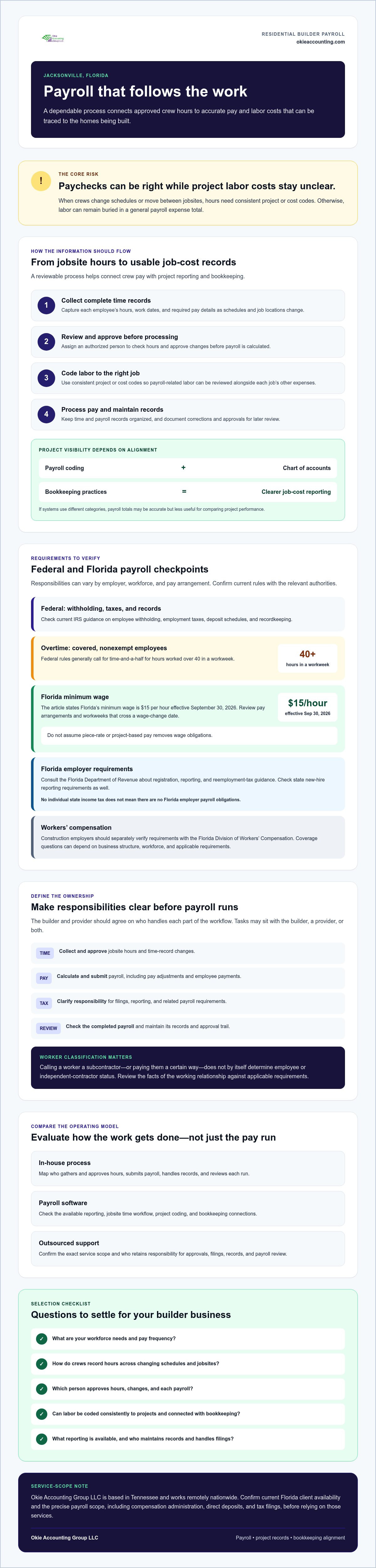
When hours and labor expenses are coded consistently to the correct residential project, owners can review payroll-related costs alongside each job’s other expenses. That visibility depends on alignment between payroll coding, the chart of accounts, and bookkeeping practices. If those systems use different categories, payroll totals may be accurate but still not useful for comparing project performance.
Payroll records are part of a broader construction accounting system. For context on construction accounting methods and project-based cost tracking, see the linked overview. Coordinating payroll with bookkeeping can help turn worker-level records into clearer project reporting. Learn more about construction bookkeeping services for the wider financial recordkeeping picture.
For builders operating in Jacksonville and Duval County, the workflow should reflect how crews move between local residential jobs without assuming every provider offers in-person service. Okie Accounting Group LLC is based in Tennessee and works remotely nationwide. Confirm current Florida client availability and the precise payroll scope before relying on its services.
Payroll for residential builders Jacksonville Florida: pay, records, and Florida requirements
A reliable pay run starts before employees receive their wages. For a Jacksonville residential builder, the process should connect approved jobsite hours to accurate calculations, employee payments, and records that can be reviewed later. Federal and Florida responsibilities vary by employer, workforce, and pay arrangement. Confirm current rules with authoritative agencies rather than relying on a generic checklist.
From jobsite hours to an approved pay run
Collect time records for each employee and confirm the hours, work dates, and required pay details. An authorized person should review and approve the records before payroll is calculated. Assigning hours to consistent project or cost codes helps labor expenses flow into useful job reports instead of remaining an unallocated payroll total.
Document corrections and approvals, and keep the underlying time and payroll records organized. This creates a reviewable trail if a pay amount needs explanation or a project’s labor costs need checking. Decide who gathers hours, approves changes, submits payroll, and maintains records. Those responsibilities may sit with the builder, a provider, or both.
Which Florida payroll details should builders verify?
Start with the IRS for current federal guidance on employee withholding, employment taxes, deposit schedules, and recordkeeping. Overtime also requires attention: federal rules generally call for time-and-a-half for covered, nonexempt employees for hours worked over 40 in a workweek. Florida’s minimum wage is $15 per hour effective September 30, 2026. Review pay arrangements and any workweek that crosses a wage-change date carefully. Don’t assume a piece-rate or project-based arrangement removes wage obligations.
For Florida-specific employer requirements, consult the Florida Department of Revenue for registration, reporting, and reemployment-tax guidance. Check new-hire reporting requirements with the state as well. The absence of individual state income tax does not mean there are no Florida employer payroll obligations.
Construction employers should separately verify workers’ compensation requirements with the Florida Division of Workers’ Compensation. Coverage questions can depend on business structure, workforce, and any applicable exemptions, so confirm how the rules apply to the builder’s circumstances. A payroll provider may handle agreed administrative tasks, but the service agreement should state who supplies information, approves filings, and follows up on notices.
If you’re assessing a provider, a discovery call to clarify payroll scope and responsibilities can help establish fit. Confirm current Florida client availability and the exact tasks included before proceeding.
How to compare payroll options for a Jacksonville residential building company
The right payroll setup fits your crew workflow without leaving hours, project codes, or approvals unclear. Compare internal administration, payroll software, and outsourced payroll support by more than convenience. For payroll for residential builders Jacksonville Florida, focus on who owns each step, what records you can review, and how exceptions are handled.
Compare the workflow, not just the pay run
Workflow ownership
Reporting and integrations
Support and review controls
Internal administration
Your staff manages setup, hours, calculations, payments, and records.
Depends on the tools and bookkeeping workflow you maintain.
You retain direct control, and must assign time for checks and corrections.
Payroll software
Your team enters and approves information; the software supports selected processing tasks.
Check available exports or connections for payroll and job-cost records.
Support and approval features vary. Confirm what requires your review.
Outsourced payroll support
Tasks are divided between your team and the provider under an agreed scope.
Ask what reports are available and how payroll data can reach bookkeeping.
Clarify communication, client sign-off, corrections, and provider support.
These are operating models, not guarantees of accuracy or compliance. In every model, the builder should understand what information must be supplied, who approves the final payroll, and how errors or unusual items are resolved.
Questions to ask before choosing support
Ask prospective providers to describe their actual workflow rather than relying on broad service labels. Confirm whether the agreed scope includes pay-run administration, direct deposits, filings, or employee record maintenance. Establish how your team submits and approves hours, how adjustments are documented, and who follows up on missing information or approaching deadlines.
Test the workflow against a realistic case: an employee works at two homes during one pay period, then submits a correction after hours have been approved. Can the records retain the correction and show who authorized it? Can labor still be assigned to the right project? Clear answers show whether the process can accommodate changing jobsite schedules.
Review reporting and integrations, too. Payroll data supports job-cost reporting only when project codes and bookkeeping categories align. Ask what reports are available, how data is transferred, and whether you can review exceptions before payroll is finalized.
The choice comes down to workload, visibility, and control. Internal administration keeps decisions close to your team but requires consistent time and oversight. Software can organize recurring tasks, though staff still need to enter and verify information. Outsourced support may shift agreed tasks, but responsibilities and approval points should remain explicit. A construction payroll framework should make those boundaries clear, not suggest that a provider removes the employer’s need to review payroll.
A Jacksonville builder’s checklist for choosing payroll support
Start with your operating pattern, not a provider’s feature list. A builder with crews moving between Jacksonville and other Duval County job sites needs a process that captures hours, approvals, and project assignments consistently. Use this checklist to define your requirements before comparing payroll support. Local operating context helps shape the workflow, but it doesn’t replace checking applicable Florida and federal rules with the relevant agencies or a qualified professional.
Map your workforce and pay schedule. List employee roles, subcontractor relationships that may need classification review, pay frequency, and how schedules change across active jobs.
Document the jobsite time workflow. Note who records hours, how employees identify the project or cost code, who reviews entries, and how late or corrected time is handled.
Define the handoffs. Ask who reviews hours, approves the pay run, submits any agreed filings, answers employee record questions, and resolves discrepancies. Get the division of responsibilities in writing.
Confirm what you must provide and when. Clarify the employee and pay information, time records, approvals, and deadlines required for each payroll.
Check the reporting and support model. Request details on available reports, record access, communication channels, correction procedures, and service boundaries. Find out how payroll data can connect with bookkeeping and job costing.
Verify compliance responsibilities. Identify which duties remain yours and confirm current requirements with the appropriate federal or Florida agency, or a qualified professional. Don’t treat a provider relationship as a guarantee of compliance.
Prepare for a useful provider evaluation
Bring a sample pay period, a time-approval example, your pay schedules, and a list of the project reports you use to review labor. Gather current employee and contractor records, but share sensitive information only through an appropriate, secure process. Ask the provider to walk through a realistic case, such as a crew member splitting hours between two homes and submitting a correction after initial approval.
That discussion can show whether the workflow preserves approvals, tracks changes, and assigns labor to the correct jobs. If owners also need help interpreting labor costs within broader financial results, explore management accounting support.
For payroll for residential builders Jacksonville Florida, assess fit based on clear responsibilities, useful project reporting, and a review process your team can sustain. Okie Accounting Group LLC works remotely from Tennessee, so confirm current Florida client availability and exact service scope. Schedule a discovery call to discuss payroll fit and responsibilities.
When Okie Accounting payroll support may fit a Jacksonville builder
Once you’ve defined your workflow, reporting, and review controls, assess whether a construction-focused payroll provider fits. Okie Accounting Group LLC provides payroll management that includes compensation administration, direct deposits, and tax filings. These service elements may suit a builder seeking support beyond basic paycheck processing, but confirm the exact tasks and responsibilities before engagement.
Payroll records can also be more useful when coordinated with monthly bookkeeping and financial reporting. When employee hours and labor costs are assigned consistently to residential projects, connected financial records can help owners review labor alongside other project expenses. The value depends on agreed coding, information handoffs, and reporting needs, not simply running payroll through a provider.
Clarify scope, approvals, and records
Ask which payroll tasks Okie handles and which actions remain with the builder. Confirm who supplies and approves hours, authorizes payroll, reviews corrections, and responds to requests for missing information. Ask which systems are supported, what onboarding records are needed, how pay schedules are set up, and what reports and communication practices are included.
Before relying on a Jacksonville-specific arrangement, confirm that Okie currently accepts residential builder clients in Florida and clarify the exact service scope, including filing responsibilities and client approvals. Okie is based in Tennessee and works remotely nationwide. It should not be mistaken for a Jacksonville office or local in-person provider.
Use a discovery call to assess fit
Bring a concise picture of your workforce, pay schedule, current time-approval process, and how you assign labor to jobs. Share the reports you use, or want to use, to review project costs. These details can help both sides assess whether the payroll workflow and bookkeeping coordination are a practical match.
A conversation can establish service fit, responsibilities, and reporting needs, but it is not a promise of a particular outcome. If you’re evaluating payroll for residential builders Jacksonville Florida, book a discovery call to discuss your payroll workflow and the scope that may suit your business.
Build a payroll process that supports stronger project decisions
Reliable payroll for residential builders Jacksonville Florida depends on more than timely pay. Clear time approvals, defined responsibilities, and consistent project coding help connect crew compensation with useful labor-cost reporting. Before choosing support, compare how each option handles corrections, records, and employer review. Then verify current Florida and federal requirements for your business.
Okie Accounting Group LLC provides construction-focused payroll management, including compensation administration, direct deposits, and tax filings. Its specialized bookkeeping and fractional controller support for construction businesses may also help owners connect payroll records with broader financial reporting. Okie works remotely from Tennessee, so confirm Jacksonville client availability and the precise service scope, including which approvals and responsibilities remain with you.
Ready to clarify your next steps? Bring your payroll workflow and reporting questions to a conversation. Book a discovery call to discuss your builder payroll needs and explore whether the service is a fit. Clear roles and reliable records can help you approach payroll decisions with greater confidence.
Frequently Asked Questions
What should residential builders look for in a payroll service in Jacksonville, Florida?
Look for a provider whose responsibilities, review steps, and reporting are clearly defined. Ask who gathers and approves crew hours, processes pay, handles agreed filings, corrects errors, and maintains payroll records. For payroll for residential builders Jacksonville Florida, check whether the workflow can assign labor to projects and accommodate changing jobsite schedules. Confirm how your team supplies information, what approvals remain yours, and how payroll data can connect with bookkeeping.
Can a payroll provider help residential builders track labor costs by project?
Yes, a payroll provider may support project-level labor tracking if hours and payroll expenses are consistently coded to the correct jobs and that structure aligns with bookkeeping. For example, crew hours assigned to separate home builds can be summarized by project rather than appearing only as a company-wide payroll total. Ask what reports are available, how project codes are captured, and how payroll information reaches your accounting records. Payroll processing alone doesn’t ensure useful job-cost reporting.
Do Jacksonville builders need to register for Florida reemployment tax?
Some builders may need to register and report for Florida reemployment tax, but the obligation depends on the employer’s circumstances. Don’t assume registration applies to every business or that your payroll provider determines liability automatically. Check current employer registration, reporting, and tax requirements directly with the Florida Department of Revenue or a qualified professional. If you use payroll support, clarify who handles any agreed registration or filing tasks and what information or approvals you must provide.
How should residential builders handle payroll for employees and subcontractors?
Keep employee payroll records separate from subcontractor payment records, and don’t determine worker status from a contract label or payment method alone. Classification depends on the facts of the working relationship, and different agencies may apply different tests. Maintain clear records of hours, compensation, approvals, and project assignments for employees, along with relevant agreements and payment records for subcontractors. If status is uncertain, seek guidance from a qualified professional before choosing how to report or pay the worker.
What payroll records should a Florida residential builder keep?
Maintain organized records that support each pay run, including worker information, time entries, approvals, pay calculations, deductions, payment details, corrections, and relevant filing confirmations. Keep project or cost-code information with hours if you need labor reporting by job. Applicable recordkeeping rules and retention periods can depend on the record and employer, so verify current federal and Florida requirements with the relevant agencies. A consistent, accessible system makes it easier to review a discrepancy or explain a project’s labor costs.
Can an outsourced payroll provider guarantee compliance for a construction company?
No provider should promise guaranteed compliance. An outsourced provider may perform specific payroll tasks under an agreed scope, but the builder still needs to supply accurate information, review payroll, approve decisions, and understand which employer responsibilities remain in-house. Before engaging a provider, document filing responsibilities, client approvals, correction procedures, and communication about deadlines or notices. Verify applicable requirements with authoritative sources or a qualified professional, since obligations can depend on the business and its workforce.
Does Okie Accounting provide payroll services to Jacksonville, Florida builders?
Okie Accounting Group LLC provides payroll management and works remotely from Tennessee, but current acceptance of residential builder clients in Jacksonville and the exact service scope should be confirmed directly. Its payroll management includes compensation administration, direct deposits, and tax filings. Ask which filings and records are included, what approvals remain yours, and how payroll can coordinate with construction bookkeeping or financial reporting. Don’t assume the firm has a Jacksonville office or provides local in-person service.


Comments