Jacksonville Commercial Property Bookkeeping: 2026 Guide

Updated: 6 days ago
What if your portfolio’s biggest reporting problem isn’t a lack of data, but that property-level performance is buried in portfolio-wide totals? That’s the challenge bookkeeping for commercial property investors Jacksonville needs to address. When transactions aren’t reconciled or expenses are classified inconsistently, it’s hard to trust a property’s results or make clear operating and investment decisions.
Managing multiple properties, entities, and bank accounts adds work. You need more than transaction entry: you need a monthly process that organizes records by property and entity, reconciles accounts, and produces useful reports. This guide explains what to look for in bookkeeping support, how monthly bookkeeping creates a dependable foundation, and when fractional controller services can add financial oversight. You’ll also learn how property-level reporting can turn complex portfolio records into information you can use as your investments grow.
Why Jacksonville Commercial Property Investors Need Property-Level Bookkeeping
Commercial property bookkeeping organizes a portfolio’s financial activity so records show more than what came in and went out. They need to reveal which property generated income, which costs it incurred, and which entity owns or operates the asset. Without that structure, portfolio totals can look complete while hiding a property’s actual operating performance.
The challenge grows when an investor manages several assets through separate entities, bank accounts, or loans. If payments for two properties land in one account, or expenses are coded inconsistently, comparing results becomes difficult. Unreconciled accounts, vague expense categories, and reports that arrive too late to inform decisions are practical warning signs. When searching for “bookkeeping for commercial property investors Jacksonville,” look for a process that handles property-level details, not just general portfolio balances.
What should commercial property bookkeeping show?
Useful records separate income and expenses by property and, where appropriate, by owning entity. They also track bank activity, accounts payable, receivables, and recurring operating transactions. This structure lets you trace a reported balance back to the activity behind it, rather than relying on broad categories that combine unrelated assets.
Monthly reconciliations connect recorded transactions to bank statements and other account records. Investigating and correcting differences makes the general ledger a more dependable basis for financial statements. For a foundational overview of the asset types and investment context, see What is Commercial Property?
Why Jacksonville investors benefit from consistent records
Investors in Jacksonville, Florida, benefit from consistent records whether their properties are in the city or spread across a broader portfolio. A consistent chart of accounts and property coding makes it easier to compare assets on the same basis. For example, if maintenance costs rise at one building, property-level records help distinguish that change from expenses elsewhere in the portfolio.
Consistent records also help answer practical questions: Is rent recorded to the right asset? Are recurring bills assigned to the correct entity? Do account balances match the underlying records? Organized books can help owners assess operating performance and cash needs with greater confidence. They also make it easier to identify missing documentation before relying on reports.
Bookkeeping provides financial visibility; it doesn’t replace tax or legal advice. Records can organize transactions and preserve a clearer financial history, while tax treatment, entity obligations, and legal questions require guidance from an appropriately qualified professional. A disciplined bookkeeping framework gives investors a stronger factual starting point without confusing recordkeeping with specialized advice.
How Monthly Bookkeeping Turns Property Transactions into Useful Reports
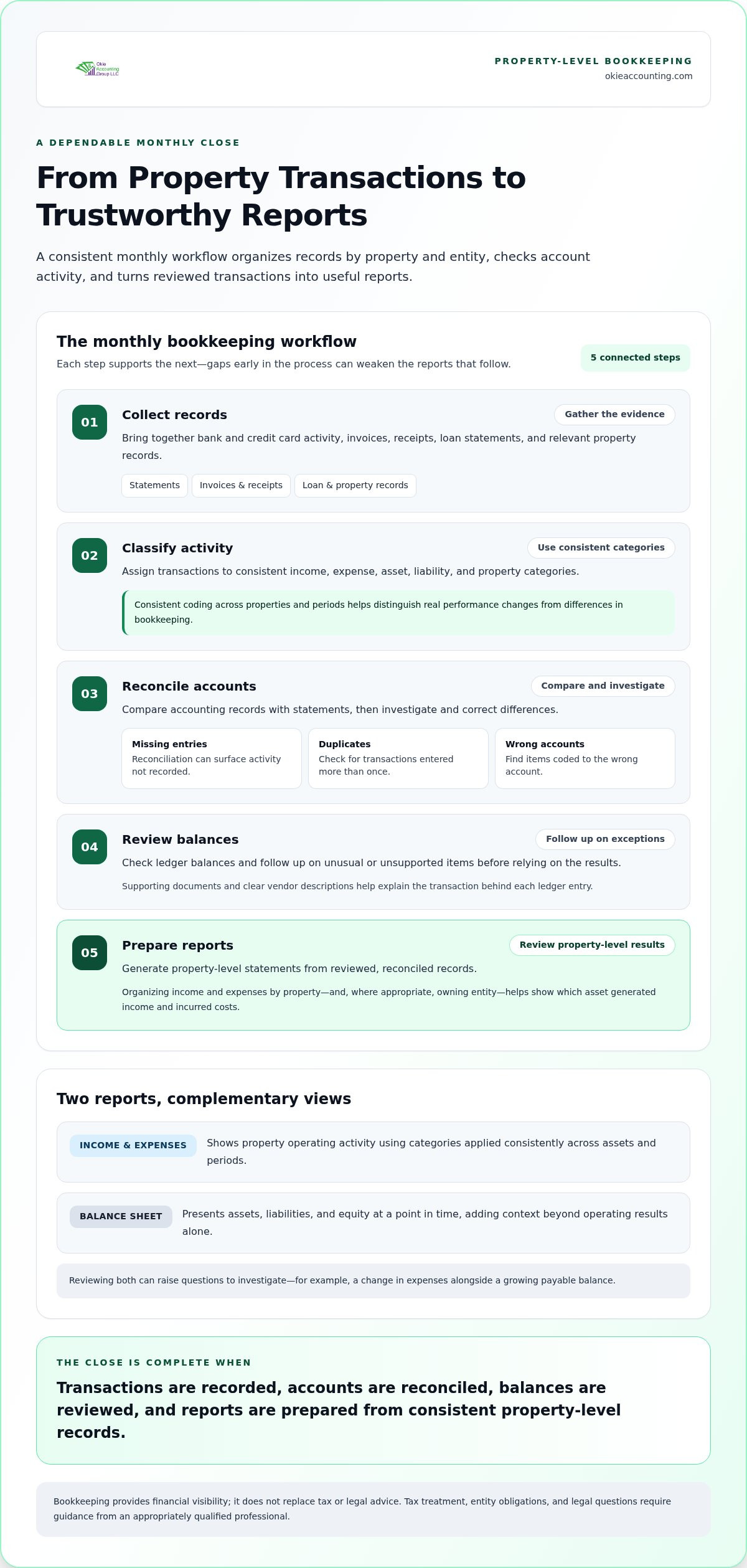
A monthly bookkeeping process turns payments, deposits, and bills into records an investor can review and use. Each step supports the next: incomplete documentation makes classification less reliable, and unreconciled accounts weaken the reports built from them. For bookkeeping for commercial property investors Jacksonville, a consistent close also makes it easier to compare a property’s results with its own prior periods.
Collect records: Gather bank and credit card activity, invoices, receipts, loan statements, and relevant property records.
Classify activity: Assign transactions to consistent income, expense, asset, liability, and property categories.
Reconcile accounts: Compare accounting records with statements and investigate differences.
Review balances: Check ledger balances and follow up on unusual or unsupported items.
Prepare reports: Generate property-level statements from reviewed, reconciled records.
Reconciliation is a control, not just a checkbox. Matching recorded activity to bank and credit card statements can surface missing entries, duplicate transactions, or items coded to the wrong account. Resolving differences before preparing reports helps prevent errors from carrying forward and distorting later comparisons. Consistent categories matter too: if the same type of expense is coded differently across properties or periods, apparent performance changes may reflect bookkeeping choices rather than operations.
Which records should feed the bookkeeping process?
Statements show cash movement, while invoices, receipts, loan statements, and property records help explain each transaction. A clear vendor description and supporting document can distinguish a routine operating charge from a payment associated with financing. Keep files organized by property and owning entity, using a repeatable method for naming and submitting documents. This creates a traceable path from each ledger entry to its source record.
Which reports help investors review property performance?
A property-level income and expense report shows operating activity using categories applied consistently across assets and periods. The balance sheet adds context by presenting assets, liabilities, and equity at a point in time; operating results alone don’t show the full financial position. Reviewing both can raise questions to investigate, such as a change in expenses alongside a growing payable balance. Financial review can connect these records to decisions and planning.
A monthly close is complete when transactions are recorded, accounts are reconciled, balances are reviewed, and reports are prepared from consistent property-level records. This sets a practical standard without tying accuracy to an arbitrary turnaround date. Okie Accounting Group provides monthly bookkeeping that includes transaction recording, bank reconciliations, general ledger maintenance, and standard monthly financial statements. You can discuss your bookkeeping workflow with the team.
How to Compare Bookkeeping Support for a Jacksonville Property Portfolio
Bookkeeping support should fit the way your portfolio is structured, not force every asset into one undifferentiated set of records. Compare more than transaction entry: consider property coding, reconciliations, reporting, communication, and who reviews the work. A clear setup defines responsibilities and produces records you can use across properties and entities.
Use this framework to compare processes:
Questions that reveal whether the bookkeeping process fits
Start with your own structure: list your properties, owning entities, accounts, and loans. Then assess whether the workflow can reflect those distinctions while keeping coding consistent. Find out how reconciliation differences, adjustments, and unanswered questions are documented and resolved. Consider whether report timing and communication align with your decision cycle, such as reviewing operating results before a budget discussion. These criteria are especially useful when a Jacksonville portfolio spans multiple properties or entities.
Fit depends on more than the number of assets. Several properties owned by one entity may require a different tracking structure from a portfolio where each asset has a separate entity and bank account. The workflow should accommodate that complexity while keeping categories consistent enough for meaningful comparisons. If handoffs are unclear or review responsibilities are undefined, even organized transaction entry may not deliver decision-ready reports.
When should an investor consider controller-level oversight?
Routine monthly bookkeeping focuses on recording activity, maintaining the ledger, reconciling accounts, and preparing financial statements. As a portfolio grows more complex, an investor may also need budgeting, cash flow forecasting, stronger internal controls, or help interpreting financial results. That calls for a different level of oversight: using accurate records to guide financial decisions.
Fractional controller support adds higher-level review to a consistent bookkeeping foundation. Okie Accounting Group provides fractional controller services for investors who need financial oversight beyond transaction processing, including support with budgeting, internal controls, and interpreting financial data. You can discuss your portfolio’s bookkeeping needs with the team.
A Practical Bookkeeping Readiness Checklist for Jacksonville Investors
A clear starting inventory shows whether your portfolio’s records are ready for a consistent monthly process. For bookkeeping for commercial property investors Jacksonville, map how properties, entities, accounts, and source records connect, then note missing information or unclear responsibilities.
Build a simple inventory with one line for each property. Include its owning entity, related bank and credit card accounts, loans, and recurring financial activity. Then gather the records available for each:
Recent bank and credit card statements
Loan statements and current payment details
Invoices, receipts, and other transaction support
Prior accounting reports and general ledger records
Property and entity names used in existing bookkeeping files
Mark gaps rather than trying to resolve everything at once. Note unreconciled accounts, transactions without supporting documents, entries missing property or entity coding, and reports that use different categories or naming conventions. This diagnostic can help distinguish a one-time cleanup need from a process issue that could recur each month.
What to organize before moving to a consistent monthly process
Alongside source records, document who has access to the accounting system, who submits financial records, and who approves or reviews transactions. Identify recurring deposits and payments so they can be recognized and categorized consistently. Clear access and responsibilities reduce handoff confusion and make follow-up easier when a transaction needs explanation.
How to make portfolio reporting easier to maintain
Choose repeatable names for properties, entities, accounts, and recurring transactions, then use them consistently. Set a recurring schedule for submitting statements and documents, reviewing open questions, and resolving missing information. These habits make reports easier to maintain as the portfolio changes. Financial review can then connect organized records with planning.
Keep the scope clear. Preparing bookkeeping records is separate from filing tax returns, choosing a legal structure, or making property management decisions. Records can give you an organized financial picture, but they don’t determine the right tax treatment or legal approach. For Jacksonville-area or Florida-specific requirements, consult an appropriately qualified professional.
Once the inventory is assembled, define a practical next step: organize missing documents, clarify transaction review responsibilities, or establish a repeatable monthly workflow. To discuss how to organize your portfolio records and bookkeeping process, schedule a bookkeeping discovery call.
What Working with Okie Accounting Can Look Like for Property Investors
For investors whose records span properties, entities, and accounts, a dependable bookkeeping process can turn routine financial activity into a clearer view of the portfolio. Okie Accounting Group LLC provides remote bookkeeping and financial oversight to clients across the United States, including real estate investors in Jacksonville, Florida. Based in Tennessee, the firm supports investors with an organized monthly foundation and higher-level review as financial needs evolve.
Monthly bookkeeping includes recording transactions, reconciling bank accounts, maintaining the general ledger, and preparing standard financial statements. These tasks establish a consistent record of portfolio activity. For someone evaluating bookkeeping for commercial property investors Jacksonville, the key is whether the process produces reliable property-level information that can support decisions, not just a list of transactions.
How bookkeeping and controller support differ
Monthly bookkeeping maintains accurate, reconciled financial records. It gives investors an orderly basis for reviewing income, expenses, balances, and cash movement. Controller support works at a higher level, helping owners interpret results, consider budgets, and strengthen financial controls. It builds on the bookkeeping foundation rather than replacing the transaction work that keeps records current.
An investor may start with structured monthly bookkeeping and add oversight as the portfolio becomes more complex or planning needs deepen. Fractional controller services provide financial review focused on oversight and decision support. Together, consistent books and financial reporting can connect property activity with broader portfolio priorities.
What to discuss on a discovery call
A useful conversation begins with the structure and goals of your portfolio. Be ready to describe:
The properties you own or operate and their related entities
The bank accounts, loans, and current accounting workflow
How records are gathered, reviewed, and assigned to properties
Your reporting priorities and the decisions those reports need to support
Any reconciliation gaps, open questions, or need for budgeting and financial interpretation
This context helps clarify whether the immediate need is a dependable monthly bookkeeping process, deeper controller-level oversight, or a combination that can develop over time. It also helps define expectations for reconciliations, financial statements, communication, and review responsibilities. Financial reporting and planning can connect organized property records with performance review.
If you’re ready to discuss your properties, entities, current workflow, and reporting priorities, schedule a discovery call with Okie Accounting Group LLC. The conversation can help identify the bookkeeping structure and level of oversight that fit your portfolio’s needs.
Build a Clearer Financial Path for Your Portfolio
Your next step doesn’t need to be a major overhaul. Choose one recurring point of friction, such as unclear property coding or reports that lack context, and define what better financial visibility would look like. A focused conversation about bookkeeping for commercial property investors Jacksonville can help turn that goal into a practical process for your portfolio.
Bring your questions about property and entity records, reporting priorities, and the level of financial oversight you need. You can discuss a path toward records that support informed decisions as your investments develop.
Schedule a discovery call to discuss your property bookkeeping needs. A more organized financial foundation can make the next decision clearer and more manageable.
Frequently Asked Questions
What does bookkeeping for commercial property investors include?
Bookkeeping for commercial property investors includes recording and organizing financial activity so owners can see how money moves through their properties and entities. Beyond deposits and payments, the work can include tracking outstanding bills, loan activity, and transactions that need clarification. For example, a vendor payment with an unclear description should be traceable to supporting documentation and the correct property, rather than left as an unexplained general expense.
How should a commercial property investor track income and expenses by property?
Use a consistent accounting structure that identifies the property and, when applicable, the owning entity for each transaction. Keep source documents connected to entries so each item can be reviewed later. For instance, if a management deposit combines rent and a tenant reimbursement, retain the supporting statement and record the components separately when the documentation allows. Consistent treatment makes property comparisons more meaningful and helps owners investigate unusual activity.
Can one bookkeeping system handle multiple commercial properties and entities?
Yes, a single accounting system can often support multiple properties and entities if its structure keeps their activity distinguishable. The setup should reflect how each asset is owned and financed, and avoid mixing transactions simply because they flow through a shared account. Before consolidating records, identify which reports you need for each entity and which should show the portfolio as a whole. The bookkeeping structure should support both views.
How often should commercial property bookkeeping be reconciled?
Bank and credit card accounts should generally be reconciled monthly, after the statements for the period are available. A regular cadence helps identify discrepancies while transactions are easier to trace. An account with little activity still needs a reliable review schedule; low volume doesn’t prove that the recorded balance is correct. Loan accounts and other balance sheet accounts also benefit from periodic review against supporting records.
What reports should Jacksonville commercial property investors review each month?
Review a property-level income statement, balance sheet, and cash flow information each month, then compare results with prior periods or the owner’s budget where available. Look for changes that warrant follow-up, such as an unexpected increase in a cost category, a growing unpaid balance, or cash movement that differs from operating results. Reports are most useful when investors can trace questions back to the underlying transactions and documentation.
When does a real estate investor need a fractional controller instead of bookkeeping alone?
A fractional controller may be helpful when accurate records are no longer enough to answer the investor’s financial questions. For example, an owner may need budgeting, stronger transaction controls, cash flow forecasting, or help interpreting results across several entities. Bookkeeping maintains the underlying records; controller-level oversight uses financial information to support planning and review. The need depends on the complexity of decisions and the level of financial oversight the owner wants.
Does Okie Accounting provide bookkeeping remotely for Jacksonville property investors?
Yes. Okie Accounting Group provides remote bookkeeping and fractional controller support to clients across the United States, including investors in Jacksonville, Florida. Its cloud-based accounting workflows support remote management of financial records and reporting. Jacksonville investors can discuss their property and entity structure, current bookkeeping process, and reporting priorities to identify how monthly bookkeeping or deeper financial oversight can fit their needs.


Comments