Jacksonville Paving: 2026 Fractional Controller Guide

Updated: 6 days ago
What if a paving job that looks profitable on the bid is quietly draining cash once labor, asphalt, equipment, and billing timing are accounted for? For Jacksonville contractors, project-level financial oversight matters more than another monthly report. A fractional controller for paving contractors Jacksonville can turn financial records into clearer decisions without adding a full-time finance executive. If job costs are hard to interpret and cash doesn’t line up with completed work, invoices, and collections, that concern is well founded.
This guide explains how fractional controller support can help a paving business track job profitability, strengthen cash planning, and make financial information more useful while projects are underway. You’ll learn what controller oversight includes, how to assess whether it fits your company’s needs, and what to look for in reporting, budgeting, internal controls, and forecasting. The goal is practical clarity: dependable numbers to help you see where each project stands and make decisions with greater confidence.
Why Jacksonville Paving Contractors Need More Than Basic Bookkeeping
Recording expenses tells you what the business spent. It doesn’t automatically show whether a specific paving job is performing as expected. Labor hours, asphalt and other materials, subcontractor charges, equipment costs, and the timing of purchases all affect a project’s financial picture. Without consistent job-level information, an owner may see expenses in the books but struggle to connect them to the work that generated them.
A fractional controller for paving contractors Jacksonville businesses can use provides part-time financial oversight tailored to the company’s needs. A controller moves beyond recording activity to interpret financial information, monitor budgets, and strengthen internal controls. This work builds on dependable bookkeeping, helping owners understand what the numbers mean for active projects and decisions ahead.
Where paving job profitability becomes difficult to see
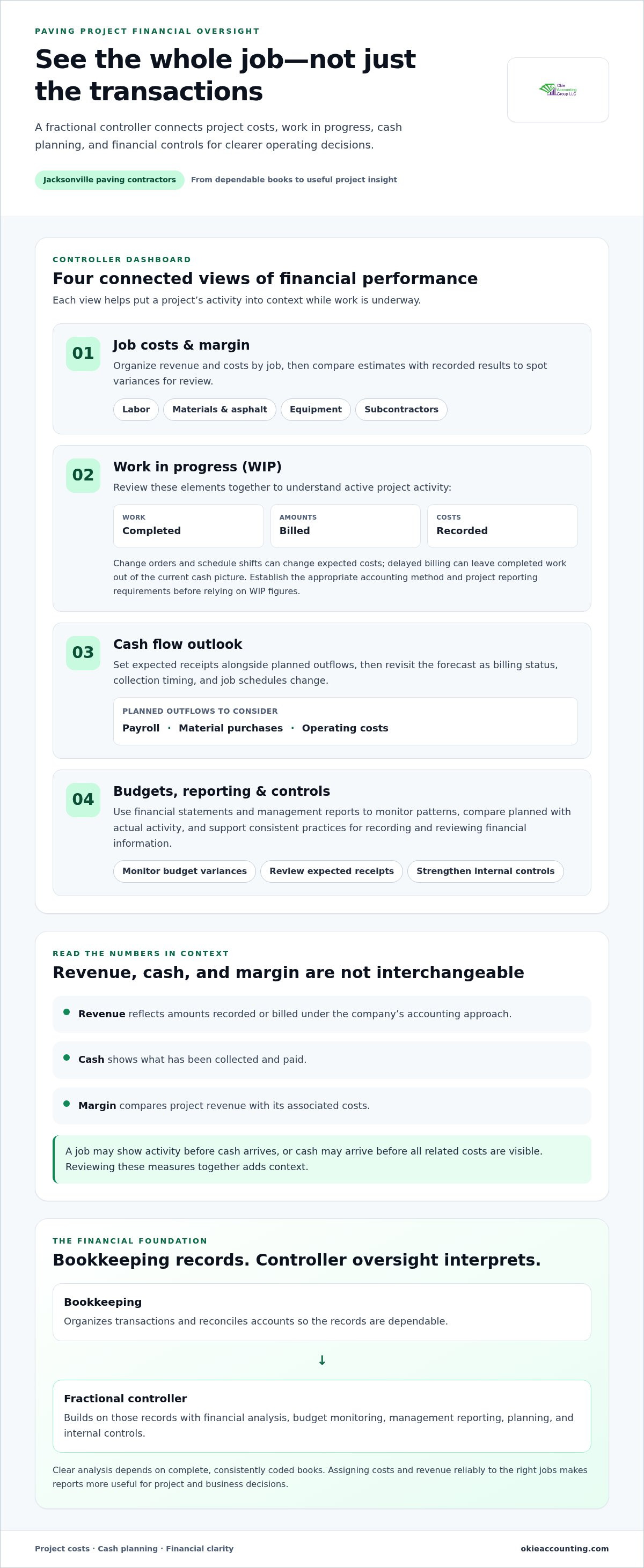
When costs are recorded without consistent project coding, comparing jobs becomes less reliable. Labor or equipment expenses assigned generally rather than to the relevant job can obscure whether the original budget still reflects the work underway. Change orders and schedule shifts can alter expected costs, while delayed billing can leave completed work out of the current cash picture. Timely review connects these moving pieces rather than treating each transaction in isolation.
Revenue, cash in the bank, and earned project margin are related, but they are not interchangeable. Revenue reflects amounts recorded or billed under the company’s accounting approach; cash shows what has been collected and paid; margin compares project revenue with its associated costs. A job may show activity before the cash arrives, or cash may come in before all related costs are visible. Reviewing these measures together provides better context.
Bookkeeping records activity; controller oversight interprets it
Bookkeeping organizes transactions and reconciles accounts so the records are dependable. Controller oversight uses that foundation for budgeting, financial analysis, management reporting, and internal controls. In short, a fractional controller provides part-time financial oversight tailored to a business’s needs. The controller role is often described as the head of accounting, with responsibility for financial reporting and internal controls.
Recommendations are only as useful as the information behind them. If job costs are incomplete or inconsistently categorized, analysis can’t reliably show where a project stands. Construction-focused bookkeeping supports that foundation by organizing financial records for project-based operations. With sound records in place, controller review can help interpret patterns, assess budget variances, and give owners clearer information for decisions about current and future work.
What a Fractional Controller Can Do for a Paving Company
Controller oversight turns financial records into a recurring management tool. A controller reviews financial statements, monitors budgets, and identifies patterns that matter to decisions, such as costs tracking above plan or expected customer receipts not matching upcoming obligations. For paving businesses, this work can connect job costing, cash flow forecasting, and management reporting so owners can assess project activity alongside the company’s broader financial position.
Bookkeeping records and reconciles financial transactions; a fractional controller analyzes those records, monitors performance against budgets, and supports financial planning and internal controls. That analysis depends on complete, consistently coded books. If costs or revenue aren’t assigned reliably to the right jobs, reports may present an incomplete picture rather than a sound basis for decisions.
Project-level reporting, work in progress, and margin visibility
Job-level reporting organizes revenue and cost categories so owners can compare estimates with actual results. For example, reviewing planned and recorded labor, materials, equipment, and subcontractor costs by job can highlight variances for further investigation. Work-in-progress (WIP) reporting adds a view of active projects, helping management consider work completed, amounts billed, and costs recorded together. Establish the appropriate accounting method and project-specific reporting requirements before relying on WIP figures to assess financial position.
Consistent reporting creates a more useful basis for project reviews. A management accounting framework can help organize financial information around planning and operating decisions, rather than limiting review to historical transactions.
Cash forecasts, budgets, and financial controls
A cash flow forecast lays out expected receipts alongside planned outflows, such as payroll, material purchases, and other operating costs. It gives owners a forward-looking view to revisit as billing status, collection timing, and job schedules change. Harvard Business School Working Knowledge discusses financial risks in the construction industry, underscoring the value of disciplined financial review in project-based businesses.
Budgets provide a reference point for comparing planned and actual activity. Internal controls help establish consistent practices for recording and reviewing financial information. Together, these systems give controller analysis a reliable structure and help management ask focused questions about variances, upcoming cash needs, and project performance. Use cash flow forecasting to connect expected receipts and planned outflows with current job and billing information.
For a paving owner weighing this level of oversight, a conversation about controller support can help identify financial priorities and define a practical scope.
How to Evaluate Fractional Controller Services for Your Jacksonville Paving Business
Fractional support is most useful when it addresses specific gaps in your financial process. Consider whether your current setup gives you the information and oversight needed to make decisions about active jobs, cash needs, and business priorities. Compare the scope of support with your records, team capacity, reporting needs, and the decisions you’re trying to make.
Signs your company may need controller-level oversight
Recurring uncertainty about project margins, cash timing, or what monthly reports mean can signal a need to strengthen financial oversight. Growth, several active jobs, or increasing complexity may also prompt a review. Start by naming the decisions you want financial information to support, such as reviewing job performance or planning cash commitments.
Questions to use when comparing service scope
Assess whether bookkeeping accuracy, reporting, budgeting, and forecasting connect into a coherent process. Clarify who maintains records, who reviews results, how often management receives useful reporting, and how findings relate to decisions. For remote collaboration, define how the controller will coordinate with the owner and existing office staff, including responsibilities and review cadence.
A fractional controller services overview can help frame the scope. For a fractional controller for paving contractors Jacksonville business, the right arrangement connects a dependable financial foundation with the oversight needed for its decisions.
Applying Controller Oversight to Jacksonville Paving Operations
A practical financial review starts with a repeatable structure, not a complicated reporting package. For a paving contractor operating in Jacksonville, remote controller support can work with the owner and office staff to organize project information and review it consistently. The process should fit the company’s records, responsibilities, and decisions.
Set up project information that supports useful reporting
Consistent job identifiers and cost categories give reports a dependable structure. If the estimate tracks labor, materials, equipment, and subcontractors separately, recording actual costs under comparable categories makes it easier to review variances. Billing status adds context by showing whether project activity has been invoiced. Accounting software configuration and staff workflows matter: unclear project codes or inconsistent entry practices can undermine reports, even when transactions are recorded.
For contractors using QuickBooks, QuickBooks setup and training can support a more consistent approach to software use and financial records.
Create a recurring review rhythm for active work
A monthly review can be a useful starting point, though the right cadence depends on the business and its reporting needs. A controller and owner can review financial statements, project performance, receivables, and forecast assumptions together. The aim is to turn reports into specific follow-up questions, assign responsibility, and document decisions, rather than simply file the numbers and move on.
Use this four-step framework to put oversight into practice:
Establish clean records: Reconcile accounts and resolve missing or unclear transactions before relying on reports.
Define job categories: Apply consistent identifiers to project revenue and costs, including labor, materials, equipment, and subcontractors.
Set a review cadence: Choose a schedule that lets management review job activity, billing status, receivables, and forecast assumptions in time to use the information.
Use findings in decisions: Investigate variances, update plans where appropriate, and record the decisions and follow-up actions.
Requirements involving Florida payroll, taxes, licensing, or public contracts can depend on the work and circumstances. Verify applicable details against current official guidance before using them to shape accounting procedures or financial plans. A fractional controller for paving contractors Jacksonville engagement can structure reporting and financial review around the company’s operations, while owners and staff provide the underlying project information.
To discuss how controller oversight can fit your paving company’s records and review needs, schedule a conversation about financial oversight.
How Okie Accounting Supports Paving Contractors with Financial Oversight
Okie Accounting Group LLC connects construction-focused monthly bookkeeping with fractional controller support, giving paving businesses a dependable financial foundation and a layer of interpretation. The firm is based in Tennessee and provides remote financial support nationwide, including to Jacksonville businesses. The focus is practical: organize reliable financial information, then use it to support management decisions.
Connect accurate books with controller-level insight
Monthly bookkeeping maintains transaction records, reconciles accounts, keeps the ledger organized, and prepares standard financial statements. Those records matter because controller analysis is only as reliable as the information behind it. With a sound bookkeeping foundation, controller oversight can help interpret financial results, review budgets, strengthen internal controls, and connect reporting with cash flow forecasts.
For example, a paving owner may want to understand how recorded project costs compare with expectations, or how upcoming obligations relate to expected receipts. Financial reporting and management accounting support can put those questions into a consistent review structure. The aim is not simply to produce another report, but to make financial information more useful for planning and operating decisions.
Okie Accounting Group LLC provides a fractional controller for paving contractors Jacksonville businesses can work with remotely. Its construction focus connects bookkeeping and oversight to project-based financial needs, with the scope shaped around the company’s records, priorities, and management requirements.
Plan a practical first conversation
Which project details do you need to see in financial reports?
Where is cash visibility unclear, including expected receipts and planned outflows?
How are transactions, reconciliations, and project information currently handled?
Which business priorities should budgeting, reporting, or forecasting help inform?
These points help frame what’s working, where information gaps remain, and what level of bookkeeping or controller oversight fits. A clear discussion of your records and workflows helps define priorities and the support needed to address them.
Build a Clearer Financial View of Every Paving Job
Strong financial oversight starts with dependable records, consistent job-level reporting, and a review rhythm that helps owners use the information to guide decisions. Bookkeeping keeps transactions organized; controller support adds financial interpretation, budgeting, internal controls, and cash flow forecasting. Together, these systems can help a paving business better understand project activity and plan with greater clarity.
A fractional controller for paving contractors Jacksonville businesses can work with remotely provides a practical level of financial oversight without requiring a full-time finance executive. Okie Accounting Group provides construction-focused bookkeeping and fractional controller services, with remote support available nationwide. Founded in 2020 and led by Sarah O’Quinn, the firm focuses on construction and real estate.
If you’re ready to discuss your reporting needs, financial workflows, or cash visibility, book a discovery call to discuss financial oversight for your paving business. A focused conversation can help define support around your company’s priorities and next stage. Build a clearer financial process for your Jacksonville paving business with Okie Accounting Group LLC.
Frequently Asked Questions
What does a fractional controller do for a paving contractor?
A fractional controller provides part-time financial oversight tailored to a paving company’s needs. The work includes reviewing financial reports, monitoring budgets, strengthening internal controls, and interpreting financial information. For example, a review can examine whether job costs, billing status, and cash forecasts give the owner a useful view of active work. The scope reflects the company’s records, staffing, reporting requirements, and the decisions its financial information needs to support.
When should a paving contractor hire a fractional controller?
Consider controller support when bookkeeping records transactions but doesn’t answer questions about project performance, cash timing, or financial planning. Growth, multiple active jobs, or more complex reporting needs can also prompt an assessment. Review the workload, the quality of current records, and the decisions you need to make. If monthly reports leave you unsure what action to take, additional financial interpretation can help.
Can a fractional controller help improve paving job costing?
A fractional controller can review whether project revenue and costs are categorized consistently enough to support useful comparisons. That may involve examining how labor, materials, equipment, and subcontractor costs appear in job reports. The quality of the analysis depends on accurate source records and a workable job-costing process. Controller oversight can help interpret recorded costs and identify questions for review, but it can’t guarantee a particular project margin or financial result.
Is a fractional controller the same as a bookkeeper?
No. Bookkeeping generally records transactions, reconciles accounts, and maintains financial records. Controller oversight uses those records for financial reporting, budgeting, internal controls, and business decisions. The work is connected: a controller’s analysis is more useful when the books are complete and dependable. Depending on the company’s needs, bookkeeping, controller support, or both may be appropriate, with responsibilities defined so routine recordkeeping and financial interpretation work together.
Can a Jacksonville paving contractor work with a remote fractional controller?
Yes. A Jacksonville paving company can work remotely with a controller using clear information-sharing and communication practices. Okie Accounting Group LLC is based in Tennessee and provides remote financial support nationwide, including to Jacksonville-area businesses. A productive arrangement connects the company’s accounting systems and internal financial responsibilities with regular reviews of reports and business priorities.
How much does a fractional controller cost for a paving company?
The cost depends on the work involved, including the condition of the accounting records, reporting needs, and level of controller oversight required. A single figure won’t reflect every paving company’s scope. A discussion of your current workflows, financial priorities, and reporting requirements can help define the engagement that fits your needs.
What should a paving contractor prepare before a fractional controller engagement?
Gather current financial statements, an overview of active jobs, and questions about project reporting or cash planning. Be ready to describe how transactions are recorded, who manages bookkeeping, and who makes financial decisions. You don’t need to resolve every process before discussing support. A clear picture of existing records and workflows helps identify where reporting is useful now and where the company needs a more consistent financial structure.


Comments