Monthly Cost Review: A Practical Guide to Better Business Decisions

Updated: 6 days ago
What if the biggest cost in your monthly report isn’t the one putting pressure on your business? An increase could reflect a one-time project need, a recurring price change, or spending that hasn’t been assigned to the right job or property. A monthly cost review helps you find the reason before making a decision that affects cash flow or profitability.
Cutting a cost just because it increased can create problems if that spending supports operations or protects project margins. First establish what changed, why it changed, and what decision, if any, should follow.
This guide explains how to review monthly business costs using consistent financial information. Learn how to compare expenses over time, connect spending to construction projects or real estate properties, investigate meaningful variances, and distinguish avoidable costs from necessary investments. With accurate bookkeeping and useful financial reporting, you can make timely decisions with a clearer view of cash flow and business performance.
What a Monthly Cost Review Reveals About Your Business
A monthly cost review examines recorded spending, identifies what changed, investigates why it changed, and considers whether action is warranted. It’s more than a list of expenses or a search for costs to cut. The aim is to understand how spending relates to current operations, projects, properties, cash flow, and profitability.
A monthly cost review links recorded expenses to explanations and business decisions. An increase may point to waste, but it may also reflect completed work, a repair that protects a property, or a bill recorded in a different period. Context helps owners decide whether to accept, adjust, or investigate a cost instead of reacting to a number in isolation.
Bookkeeping provides the foundation for this analysis, but it isn’t the analysis itself. Recording transactions, reconciling accounts, and assigning expenses consistently make the figures dependable. Reviewing patterns and deciding what they mean takes another layer of attention. For an overview of how costs are classified and understood, see Cost Accounting Principles.
Which costs belong in a monthly review?
Include spending that helps explain how the business operated during the period. Group costs according to the decisions you need to make, rather than forcing every business into one chart of accounts. A practical review often considers:
Recurring commitments: insurance, software, rent, and other ongoing obligations.
Variable operating costs: materials, utilities, subcontractor work, and maintenance that can change with activity.
Project- or property-related expenses: costs assigned to a specific job, phase, building, or operating need.
Distinguish cash paid during the month from expenses recorded for that period. A payment may cover an earlier month’s bill, while a cost incurred this month may not be paid until later. Comparing cash activity with period-based expense records helps prevent timing differences from looking like sudden cost increases or savings.
Why construction and real estate costs need context
In construction, contractor and material spending is easier to understand when connected to the relevant project, phase, and planned work. A rise in subcontractor costs may reflect progress on a job, or it may deserve a closer look if the work or coding doesn’t match expectations. Project-level records help you investigate the difference. Strong management accounting practices can connect financial information to operational decisions.
Real estate costs also change with operating conditions. A property’s expenses may shift because of occupancy, repairs, or other needs. Compare the expense with what was happening at that property during the same period before deciding whether it signals a problem. Consistent coding by project or property clarifies where resources are going, what they support, and which changes need follow-up.
How a Monthly Cost Review Works: From Records to Explanation
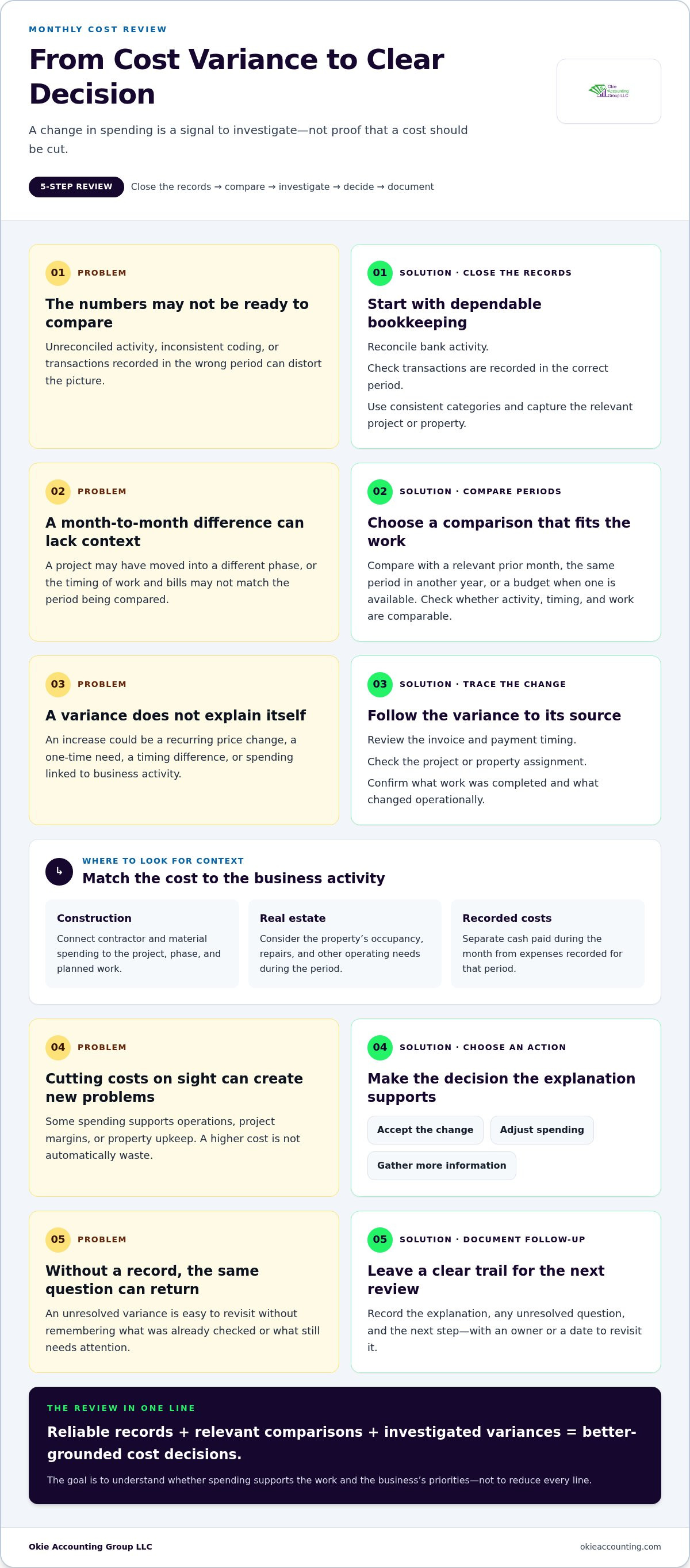
A reliable review follows a clear path from closed books to documented decisions. Comparisons are only useful when the records are dependable, and actions are only sound when changes have been explained. Treat a cost variance as a signal to investigate, not proof that spending is wasteful.
Use this sequence to keep the review focused:
Close the records. Reconcile bank activity and make sure transactions are recorded in the correct period.
Compare periods. Review current costs against a relevant prior month, the same period in another year, or a budget when one is available.
Investigate variances. Trace meaningful changes to invoices, timing, business activity, or project-specific circumstances.
Choose an action. Decide whether to accept the change, adjust spending, or gather more information.
Document follow-up. Record the explanation, next step, and who will handle it or when it should be revisited.
This monthly cost review process turns a report into a management tool. Cost management is not about reducing every line. It’s about understanding whether spending supports the work and the business’s priorities.
Prepare reliable monthly records
Before comparing expenses, reconcile bank activity and check that transactions are categorized consistently. Confirm that relevant project or property details are captured in the accounting system. If a subcontractor invoice is coded to a general expense category instead of the job it supports, the total may be accurate while the project-level picture is not. A sound management accounting structure makes that information more useful for construction decisions.
Investigate cost changes before acting
Choose a comparison that makes operational sense. A project’s costs may look very different from the previous month simply because it has moved into another phase. A prior period or budget can provide context, but first check whether the work, activity, and timing are comparable.
For a significant variance, trace the transaction to its source. Review the invoice, payment timing, project or property assignment, and work completed. For example, a jump in repair costs at a rental property may reflect a one-time repair rather than a lasting increase in routine maintenance. Record the explanation, note any unresolved question, and assign a practical next step with an owner or review date. That follow-through prevents the same variance from being investigated without context next month.
If you want support connecting accurate records to clearer cost decisions, you can discuss your bookkeeping and financial oversight needs.
How to Interpret Cost Changes Without Cutting the Wrong Things
A cost that differs from expectations deserves a closer look, not an automatic cut. Compare it with your own budget, prior results, and operating conditions rather than relying on generic industry benchmarks. The same increase can mean something different if a project has entered a labor-intensive phase, a property needs a repair, or an invoice was recorded later than the work occurred.
Use this comparison to identify the right question before choosing a response:
Is a cost overrun a warning sign or a timing difference?
Trace the transaction through its key dates: when the work happened, which period the invoice covers, when the invoice was received, and when payment cleared. Then check whether the expense belongs to one project, a specific property, or the wider business. A cost coded to the wrong job can make one project appear over budget while hiding the actual cost elsewhere. A variance alone isn’t proof of weak cost control. Verify the facts and establish what changed.
How to assess cost reductions and trade-offs
Lower spending isn’t automatically better. Separate discretionary purchases from costs needed to deliver contracted work, maintain a property, or meet operating commitments. Before reducing an expense, consider whether doing so could affect project margins, staffing capacity, service quality, safety, or future obligations. Delaying necessary maintenance, for example, may reduce current spending while leaving a property’s needs unresolved.
Timing matters, too. A project can appear profitable on paper while payment timing puts pressure on available cash. Consider when costs must be paid alongside expected customer receipts, and use controller-level cash flow oversight to consider cost patterns and liquidity together. The goal is to address spending that no longer serves a purpose while preserving costs that support delivery and long-term performance.
A Practical Monthly Cost Review Checklist for Owners
A repeatable checklist keeps the review focused on decisions, not just totals. Set a consistent time each month after the books are ready, then adjust the depth of the review to your transaction volume and business complexity. A company tracking several construction projects or properties may need to examine costs by job or location, while a simpler operation may focus on fewer expense categories.
Start with items that could affect cash flow, project performance, or operating plans. Small fluctuations don’t all require investigation. Prioritize costs that are unusual, significant to the business, repeated across periods, or difficult to explain.
What should an owner review each month?
Check the records. Confirm bank and credit card reconciliations are complete. Look for uncategorized transactions, inconsistent expense coding, and costs missing a relevant project or property assignment.
Compare significant costs. Use the most relevant reference available, such as the budget, a prior period, or the expected costs for a project’s current phase. Make sure the comparison reflects similar activity and timing.
Ask what changed. For a notable difference, identify the supporting invoice or transaction and check for an operational explanation. If the reason remains unclear, note what documentation or input is needed.
Decide and follow up. Record whether to accept the change, investigate further, or adjust a plan. Keep an action log with the issue, decision, responsible person, and next review date.
This log creates continuity. If a property repair or project expense comes up again, the owner can see what was decided instead of starting the investigation from scratch. It also keeps open questions visible between monthly reviews.
When should the review lead to a larger decision?
Escalate an item when a variance repeats, project costs remain unclear, or a pattern could put pressure on cash. Before committing to a change, use a cash flow forecast to consider when payments are due and when cash is expected to arrive. This helps distinguish a cost issue from a timing challenge and puts the decision in the context of upcoming obligations.
Owners who need to connect cost patterns with project results or broader business priorities may benefit from a structured management accounting approach. Controller-level perspective can help assess what the numbers imply before a major operational or spending decision. Keep the process proportionate: resolve routine questions efficiently, and reserve deeper analysis for issues that could affect margins, delivery, or liquidity.
If you’d like support building more consistent financial oversight, schedule a conversation about your bookkeeping and controller needs.
Turn Monthly Cost Reviews Into Ongoing Financial Oversight
A useful review depends on reliable records and a consistent process. For a business with straightforward operations and costs that are easy to explain, accurate bookkeeping and a regular owner review may provide enough visibility. As projects, properties, and financial decisions become more complex, interpreting the numbers can require additional perspective.
What ongoing bookkeeping contributes to the review
Monthly bookkeeping supports recurring cost reviews through consistent transaction recording, account reconciliations, and monthly financial statements. Those records help owners see spending by period and, when the accounting structure captures it, by project or property. Without consistent coding, the same type of expense may appear under different categories, making it harder to compare results or identify a genuine change.
Team workflows matter, too. If employees enter transactions or assign costs, shared procedures help keep records consistent. QuickBooks training can help a team follow those workflows, while regular bookkeeping keeps the underlying information organized for review. Bookkeeping establishes the recordkeeping foundation; it doesn’t explain by itself what a pattern means for a business decision.
When controller-level interpretation can help
Consider additional decision support when repeated variances remain unexplained, project or property costs are difficult to interpret, or spending decisions have broader implications for cash flow and profitability. Fractional controller support can bring structure through budgeting, internal controls, and financial interpretation. The goal is to give owners useful context, not to assume that every increase needs a cut.
For a construction business, that may mean reviewing whether project costs align with planned work and how spending timing relates to incoming customer payments. For a real estate investor, it may mean looking at expenses alongside property operations and upcoming cash needs. In either case, consistent reports give the owner a clearer basis for deciding what needs attention and what supports the business.
Fractional controller services add context to the financial information behind those decisions. This can help when an owner needs to connect recurring reports to budgets, internal controls, or forward-looking choices.
There’s no need to build an elaborate process before the basics are working. Start with complete records, consistent reporting, and a recurring review. Add interpretation as decisions become more complex. If you’re looking for greater clarity around your financial information, controller-level support can be a practical next step.
Make Your Next Review a More Confident Business Decision
Give your financial review a clear purpose. Choose one open question from your latest reports, such as whether a cost pattern is likely to continue or how upcoming payments may affect available cash. At the next review, check what changed and whether your decision still fits the business. This makes a monthly cost review an ongoing discipline rather than a one-time exercise.
For construction companies and real estate investors in Tennessee and Jacksonville, Florida, that discipline can connect financial information to project and property decisions. Okie Accounting Group LLC provides monthly bookkeeping and fractional controller support, with remote accounting services for businesses across the United States. The right level of support depends on whether you need more consistent records, deeper interpretation, or both.
If clearer financial oversight would help you make decisions with greater confidence, book a discovery call to discuss your monthly financial oversight. Together, you can identify a practical next step and build a stronger foundation for the decisions ahead.
Frequently Asked Questions
What is a monthly cost review?
A monthly cost review is a recurring check of business spending that helps owners understand how expenses relate to operations and plans. It can reveal whether a subscription is still being used, whether supplier terms have changed, or whether upcoming commitments need attention. Reviewing renewal dates alongside recurring charges, for example, can help an owner plan ahead instead of discovering a commitment after it renews.
How do you conduct a monthly cost review?
Begin with a clear question, such as whether a new expense is recurring or whether a planned purchase still fits current priorities. Gather relevant statements, invoices, and agreements, then note any decision that needs operational input. A manager may be able to confirm whether a software account or equipment rental is still needed. Keep supporting documents with the review notes for future reference.
What should a small business review each month?
A small business can review operating expenses, outstanding vendor bills, recurring subscriptions, payroll-related costs, and upcoming purchase commitments. Include items that could affect next month’s plans, not just expenses that have cleared the bank. A service business might check whether software seats still match the team’s needs, while an owner with vehicles might review maintenance spending and planned replacements.
How can contractors review costs by project?
Contractors can organize project records so invoices, subcontractor charges, materials, and other direct costs can be traced to the job they support. Compare those costs with the project estimate and current scope, then consider approved changes and work completed. If a charge can’t be tied to a job, flag it for review rather than assigning it based on guesswork. Consistent job coding makes comparisons more meaningful over time.
How do you tell whether a cost increase is a problem?
A cost increase may warrant action if it continues without a clear business reason, conflicts with an agreed budget, or points to a process that needs attention. First check whether the charge is duplicated, newly recurring, or associated with a change in workload. A higher material bill during a busier project period may be expected; the same increase without a matching operational explanation deserves closer review.
Can a monthly cost review improve cash flow?
A monthly cost review can support cash flow planning by making upcoming payments and recurring commitments more visible. It won’t create cash on its own, but it may help an owner anticipate a cluster of vendor bills, adjust the timing of discretionary purchases, or follow up on expected receipts. Pairing expense information with a cash flow forecast gives owners a better basis for evaluating timing before taking on a new obligation.
Who can help with monthly bookkeeping and cost analysis?
Bookkeepers can maintain transaction records and reconciliations, while controller-level support can help interpret financial information for budgeting and business decisions. Okie Accounting Group LLC provides monthly bookkeeping and fractional controller services for construction companies and real estate investors, including businesses in Tennessee and Jacksonville, Florida. Its remote accounting support also serves businesses across the United States, helping owners build dependable financial information for ongoing oversight.


Comments