Nashville Commercial Builders: 2026 Bookkeeping Guide

Updated: 6 days ago
What if the biggest risk in your books isn’t a missed transaction, but a project report that arrives too late to inform a decision? For Nashville commercial builders, bookkeeping needs to do more than record expenses. The right bookkeeping for commercial builders Nashville projects require can help owners see whether costs and committed expenses are being tracked clearly, and whether month-end reporting arrives in time to guide decisions.
It’s reasonable to ask whether a general bookkeeper can support construction workflows. Reliable monthly books and reconciliations matter, but so does knowing what project-level visibility your business needs and whether a provider can support it. This guide explains how to assess construction bookkeeping, compare providers, and choose a system that keeps financial information organized as projects move forward.
You’ll learn what to ask about job-cost tracking, reporting, provider scope, communication, and onboarding, as well as how recurring bookkeeping differs from fractional controller oversight. Use these criteria to compare options in Nashville and across Tennessee, then define a process that fits your business.
Why Nashville Commercial Builders Need Construction-Specific Bookkeeping
Commercial construction rarely follows the neat rhythm of a simple monthly ledger. A builder may be managing active projects, subcontractor invoices, customer billing schedules, and costs that arrive at different points in the work. If records are delayed or coded inconsistently, it can be difficult to tell what a project has spent, what expenses are still committed, or how the company is performing overall.
Construction bookkeeping organizes and reconciles financial activity so owners can review both business-wide results and project-level costs. It goes beyond entering transactions. For a starting point on industry concepts and cost categories, see Construction accounting. The practical system still needs to fit the builder’s contracts, software, and operating processes.
For Nashville builders considering bookkeeping for commercial builders Nashville, the central question is how project costs connect to the general ledger and monthly financial statements. A transaction record can show that a payment was made. Consistent coding and timely reconciliations help identify which project incurred the cost and make it easier to assess results against the information available. Ask providers exactly what project-level tracking their proposed scope includes. Standard monthly books do not automatically include job-cost reports.
What makes commercial construction bookkeeping different?
Project costs build over time. Labor, materials, subcontractor charges, change orders, and timing differences between work performed and billing can all affect the picture an owner sees. A cost may be recorded in the books without enough detail to assign it clearly to a project. Commitments also matter to planning, but how they’re captured depends on the builder’s processes and the agreed bookkeeping scope.
Useful project reporting depends on consistent cost coding and complete source records, such as bills and project documentation. Before starting, clarify how the provider will use those records, what software access is needed, and which project reports are included. Ask how unclear or incomplete documentation will be flagged and who will follow up. Exact workflows vary by contract, software, and builder operations.
When is it time to evaluate bookkeeping support?
Consider reviewing your process if reconciliations routinely fall behind, project margins are unclear, or bookkeeping backlogs keep pulling the owner away from operations. Growth can add complexity, too. More concurrent projects or expanding payroll may increase transaction volume and make timely reporting harder to maintain. Ask what records and responsibilities need to be in place for a provider to deliver the reporting you expect.
Construction-focused bookkeeping turns organized, reconciled records into a clearer basis for reviewing project performance and business decisions. If a provider also offers controller support, ask where recurring recordkeeping ends and higher-level oversight begins. That distinction helps you select services that fit your needs without assuming every engagement includes the same project-level capabilities.
How to Evaluate Job Costing, Reconciliations, and Monthly Reporting
Compare accurate bookkeeping with project-level analysis. Both matter, but transaction processing alone won’t show how costs are distributed across active work. As you evaluate bookkeeping for commercial builders Nashville, ask which capabilities are included and what records or software processes they depend on. Request a clear explanation of how a project cost moves from its source document into the books and any related report.
Job costing groups costs by project and meaningful categories so a builder can review where project spending is recorded. Ask whether labor, materials, subcontractor charges, and other costs can be coded consistently, and how the provider handles incomplete or unclear source records. Comparisons are only as useful as their inputs. Confirm how approved budgets are supplied and which costs are treated as incurred. Work-in-progress methods vary, so verify whether they’re included and how they’re handled before assuming standard reporting covers them.
For additional construction finance education, the Construction Financial Management Association offers resources for construction financial professionals. Use those principles to shape questions for prospective providers, not to assume a particular method or report is part of their service.
Which monthly close and reporting processes matter?
Reconciliations are a core control. They help identify differences between recorded activity and bank or card statements, but they don’t replace job-cost analysis. Ask how often accounts are reconciled, how missing records are requested, and how discrepancies are documented and resolved. Confirm the expected close cadence and whether monthly statements include a profit and loss statement and balance sheet.
Reconciled books provide a more dependable foundation for management reporting. Review the reporting schedule alongside cash flow visibility. Ask what information is provided, when it’s available, and what assumptions the reports rely on. For broader context on building financial processes as a company grows, see management accounting support.
If you’re assessing what reporting your business needs, you can discuss your bookkeeping scope with Okie Accounting Group LLC.
How to Compare Nashville Bookkeeping Providers and Address Common Concerns
A provider’s construction experience matters, but it isn’t enough on its own. Compare what each engagement includes: named deliverables, close cadence, software access, and communication practices. A construction-focused provider should be able to explain how project coding and reconciliations fit into its workflow, and which reports are part of the agreed scope. Industry organizations such as the Associated General Contractors of America (AGC) can provide broader construction context, but your provider still needs to show how its process fits your business.
Remote support can work when responsibilities are explicit. Agree on who provides statements and project records, who follows up on missing information, how questions are raised, and who reviews completed reports. Without that structure, distance can amplify delays. With clear roles and reliable document-sharing processes, location alone doesn’t determine whether the working relationship is effective. This can matter for builders in Nashville and elsewhere in Tennessee who are considering remote bookkeeping support.
Questions to ask before choosing a bookkeeping partner
Use specific questions to test fit for bookkeeping for commercial builders Nashville, rather than relying on general assurances. Ask how the provider handles project coding, reconciliations, reporting timelines, and document collection. Confirm who reviews reports, responds to questions, and resolves incomplete or inconsistent records. Then request a written scope that names recurring deliverables and clarifies exclusions. Don’t assume every construction accounting task, including specialized project reports, is automatically included.
Also distinguish routine bookkeeping from adjacent professional services. Monthly bookkeeping can include transaction recording, reconciliations, general ledger maintenance, and financial statements, depending on the engagement. It isn’t the same as income tax preparation or a certified audit. If you need higher-level review of financial information and management reporting, ask whether fractional controller services fit the need and how that oversight differs from recurring bookkeeping.
How should a Nashville builder assess local fit?
Start with your actual operating footprint and project mix. Discuss where projects are performed, how your company bills, and what financial processes you need supported. Ask how the provider will identify Tennessee-specific questions that affect your business and who is responsible for regulated advice. Verify relevant tax, legal, payroll, or licensing requirements with appropriate professionals or current official sources. A provider shouldn’t imply local presence or jurisdiction-specific expertise unless it can confirm those claims.
The selection test is practical: can the provider explain its responsibilities, your responsibilities, and the records that connect them? Clear answers give you a stronger basis for comparing proposals and setting expectations before work begins.
What a Smooth Bookkeeping Handoff and First Months Should Include
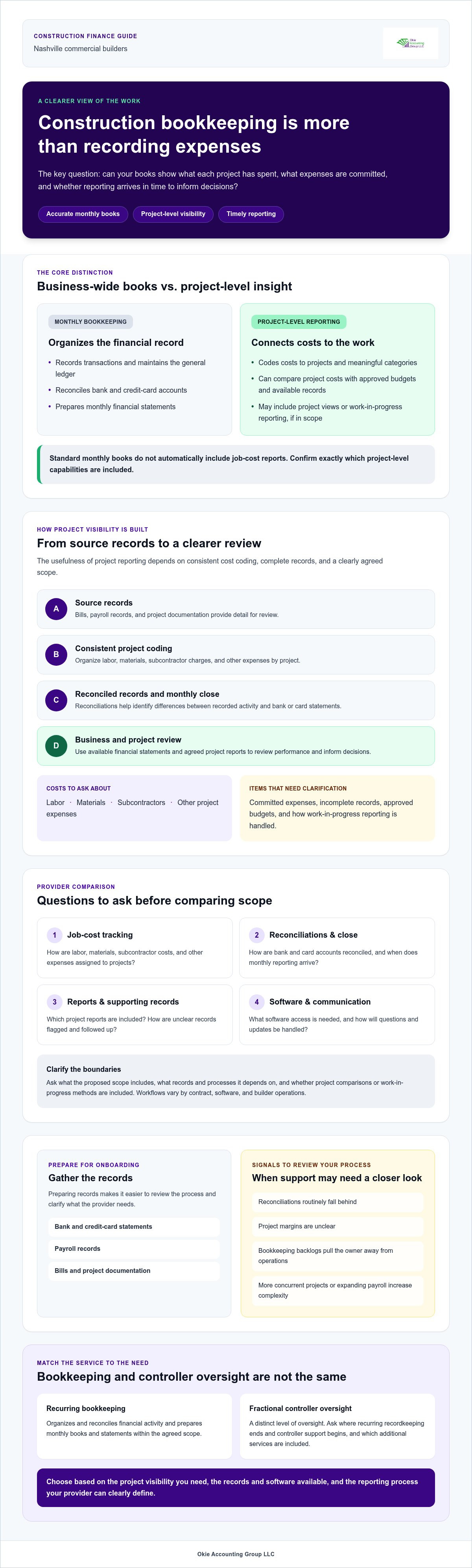
A well-planned handoff gives both the builder and bookkeeping provider a clear starting point. For bookkeeping for commercial builders Nashville, onboarding should move through defined stages: discuss the business and its project mix, review access and existing records, confirm the bookkeeping setup and responsibilities, then begin the recurring close. This sequence helps surface missing information before it creates reporting delays.
Timing depends on the condition and completeness of the records, account complexity, and agreed engagement scope. Set expectations together rather than relying on a one-size-fits-all schedule. Confirm who supplies documentation, who handles approvals where needed, how questions will be raised, and which communication channel the team will use.
What information should a builder prepare?
Before transferring sensitive records, ask the prospective provider for an onboarding checklist tailored to the engagement. Useful items may include:
Recent bank and credit-card statements, plus existing bookkeeping files.
Payroll records and vendor details needed for the agreed scope.
A current project list, cost categories, and available contract or other project documentation.
Outstanding bills or records that may need clarification during the initial review.
Organize what’s available, but don’t guess at missing details. Identify gaps and agree on who will follow up. A clear responsibility map helps prevent duplicate work and makes it easier to see which records are ready for the first close.
How do QuickBooks setup and training fit the process?
Software configuration should reflect how the business operates and what reporting the engagement is expected to support. Before changing an existing file or setting up a new one, confirm the chart of accounts, access permissions, project-tracking needs, and reporting expectations with the provider. The right configuration depends on the builder’s workflow and agreed scope.
If implementation or staff instruction is needed, review the provider’s QuickBooks setup and training scope. For broader software education, consult resources such as Mastering QuickBooks for Contractors: The 2026 Strategic Guide.
As recurring closes begin, agree on how statements and supporting documents will be delivered, how missing items will be flagged, and when reports are expected. This creates a repeatable process rather than a one-time cleanup. To discuss the records, setup, and scope your business may need, schedule a discovery call with Okie Accounting Group LLC.
How Okie Accounting Supports Commercial Builders Seeking Financial Clarity
For builders evaluating bookkeeping for commercial builders Nashville, the right starting point is a clearly defined service scope. Okie Accounting Group LLC provides monthly bookkeeping for construction companies, including transaction recording, bank reconciliations, general ledger maintenance, and standard monthly financial statements. These recurring tasks establish organized financial records. Discuss and confirm any project-level costing or work-in-progress reporting as part of the proposed engagement.
Which Okie Accounting Group LLC services may fit a commercial builder?
Monthly bookkeeping may suit a builder who needs consistent records and reconciliations. Depending on business needs, payroll management, cash flow forecasting, and financial reporting are also available. These services can complement bookkeeping, but agree on the information and deliverables included in advance. Okie Accounting Group LLC also offers QuickBooks setup and training.
Fractional controller services are a separate option when routine recordkeeping alone isn’t enough. A builder may want higher-level financial oversight to support budgeting, review internal controls, or interpret financial information for decisions. Explore management accounting services to understand how financial oversight differs from recurring bookkeeping.
Set clear boundaries, too: Okie Accounting Group LLC doesn’t offer income tax preparation or certified audits. If you need either, confirm the right provider separately.
What should happen on an initial discovery call?
Use the conversation to describe your project volume, current software, reporting gaps, and business goals. Bring questions about what records are needed, how responsibilities will be divided, which deliverables are included, and how onboarding will work. If you need specific job-cost, project, or work-in-progress capabilities, ask whether they’re supported in the proposed scope rather than assuming they’re standard.
A useful discussion should leave you with a clearer view of fit, next steps, and what information the provider needs to assess the engagement. That gives both sides a practical basis for defining expectations before recurring work begins.
Build a Clearer Financial Foundation for Your Projects
Choosing bookkeeping for commercial builders Nashville starts with looking beyond transaction entry. Confirm how reconciliations, reporting cadence, project-cost visibility, and provider responsibilities fit together. A clear scope and organized handoff help establish dependable records you can use to review business performance and make informed decisions.
Okie Accounting Group LLC’s monthly bookkeeping includes transaction recording, bank reconciliations, general ledger maintenance, and standard financial statements. Depending on your needs, payroll management, cash flow forecasting, and financial reporting may also be relevant. Fractional controller services offer a separate option for builders seeking higher-level financial oversight. Confirm the specific project-costing and reporting capabilities you need as part of any proposed engagement.
For commercial builders in Nashville and across Tennessee, an initial conversation can help clarify current records, software, reporting gaps, and goals. Okie Accounting Group LLC also works remotely with businesses nationwide, including in Jacksonville, Florida. Schedule a discovery call to discuss your bookkeeping needs and whether the service scope fits your business.
Frequently Asked Questions
What bookkeeping does a commercial construction company need?
A commercial construction company needs accurate, reconciled records that support business reporting and, where included in scope, project review. Core monthly bookkeeping may cover transaction recording, bank reconciliations, general ledger maintenance, and financial statements. Builders should also ask how costs will be coded, what project records are needed, and whether the provider’s engagement includes project-level reports. The right setup depends on the company’s operations, software, and reporting needs.
How does job costing help commercial builders track project performance?
Job costing groups project expenses into useful categories, such as labor, materials, and subcontractor costs, so builders can review recorded spending by project. It can help owners compare costs with approved budgets when records and coding are consistent. Ask how the provider handles incomplete documentation and whether project reports are included. Work-in-progress reporting uses specific methods, so confirm the provider’s approach and scope rather than assuming it comes with routine bookkeeping.
Can a remote bookkeeper support a Nashville construction company?
Yes, a remote provider can support a Nashville construction company when records, software access, communication, and responsibilities are clearly organized. Agree on how statements and project documents will be shared, who follows up on missing information, and how questions are handled. Okie Accounting Group is based in Tennessee and works remotely nationwide. Its remote model can serve businesses in Tennessee and beyond, including Jacksonville, Florida, subject to confirming the specific engagement scope.
What should I ask before hiring a construction bookkeeper in Nashville?
Ask about construction experience, transaction recording, reconciliation frequency, reporting timelines, software access, and how costs can be coded to projects. Request a written scope that names deliverables and exclusions. Confirm who reviews reports, responds to questions, and follows up on incomplete records. For bookkeeping for commercial builders Nashville, also ask whether project-cost or work-in-progress reporting is included, and what records your team must provide to support it.
Does construction bookkeeping include payroll and cash flow forecasting?
Not automatically. Payroll management and cash flow forecasting are distinct services, so confirm whether each is included in the provider’s proposal or available as an additional service. Okie Accounting Group offers monthly bookkeeping, payroll management, and cash flow forecasting. Ask what information is required, which tasks the provider handles, and how reporting is delivered. The written scope should make clear how these services relate to recurring bookkeeping.
How long does it take to transition bookkeeping to a new provider?
There isn’t one reliable timeline for every builder. A transition depends on the completeness of existing records, the number and complexity of accounts, software access, and the agreed scope. Before transferring sensitive files, request an onboarding checklist. Clarify who will provide statements, payroll records, bills, and project documents, then agree on setup review and the first recurring close. Missing or inconsistent records may require additional follow-up before reporting is ready.
Is bookkeeping the same as fractional controller service?
No. Monthly bookkeeping focuses on recurring recordkeeping, such as transaction recording, bank reconciliations, general ledger maintenance, and standard financial statements. Fractional controller services provide a higher level of financial oversight, which may include budgeting, internal controls, and interpreting financial information for business decisions. Ask providers to distinguish recurring deliverables from strategic oversight so you can select support that matches your current needs.
Can a bookkeeper advise on Tennessee construction tax or compliance requirements?
Ask the provider to clarify the boundary between bookkeeping and regulated advice. A bookkeeper may organize financial records, but don’t assume that service includes tax preparation or legal advice. Verify Tennessee or Nashville-specific tax, payroll, licensing, and compliance questions with appropriate professionals or current official sources. Okie Accounting Group does not offer income tax preparation or certified audits, so builders needing those services should consult a qualified provider for that scope.


Comments