Outsourced Construction Bookkeeping in Nashville, TN: A 2026 Buying Guide

Updated: 6 days ago
The closest bookkeeper may not be the right fit for your construction business. If project costs, commitments, and payments don’t reconcile, balanced books can still leave you unsure which jobs are protecting their margins and whether cash is available for what’s next. Choosing outsourced construction bookkeeping Nashville TN contractors can rely on means looking beyond location to project-level visibility and dependable processes.
It’s reasonable to want accurate books without adding an internal finance hire before your business needs one. But basic transaction entry may not provide the timely, job-level detail you need to make decisions. A capable partner should explain what they manage, how often they reconcile accounts and deliver reports, and which responsibilities remain with your team.
This 2026 buying guide covers the bookkeeping processes to define, construction-specific capabilities to compare, and questions to ask about communication and document workflows, including for remote service. You’ll also learn how monthly financial statements, payroll management, QuickBooks support, and cash-flow forecasting may fit into an engagement, so you can choose a partner that supports clearer project and cash-flow decisions.
Outsourced Construction Bookkeeping in Nashville, TN: What Should It Solve?
Construction finances need more than a record of money in and money out. Project costs, customer payments, vendor bills, and payroll records must be organized consistently to show how financial activity connects to the work. Without that structure, a contractor may have accurate transactions but limited visibility into what each job is costing.
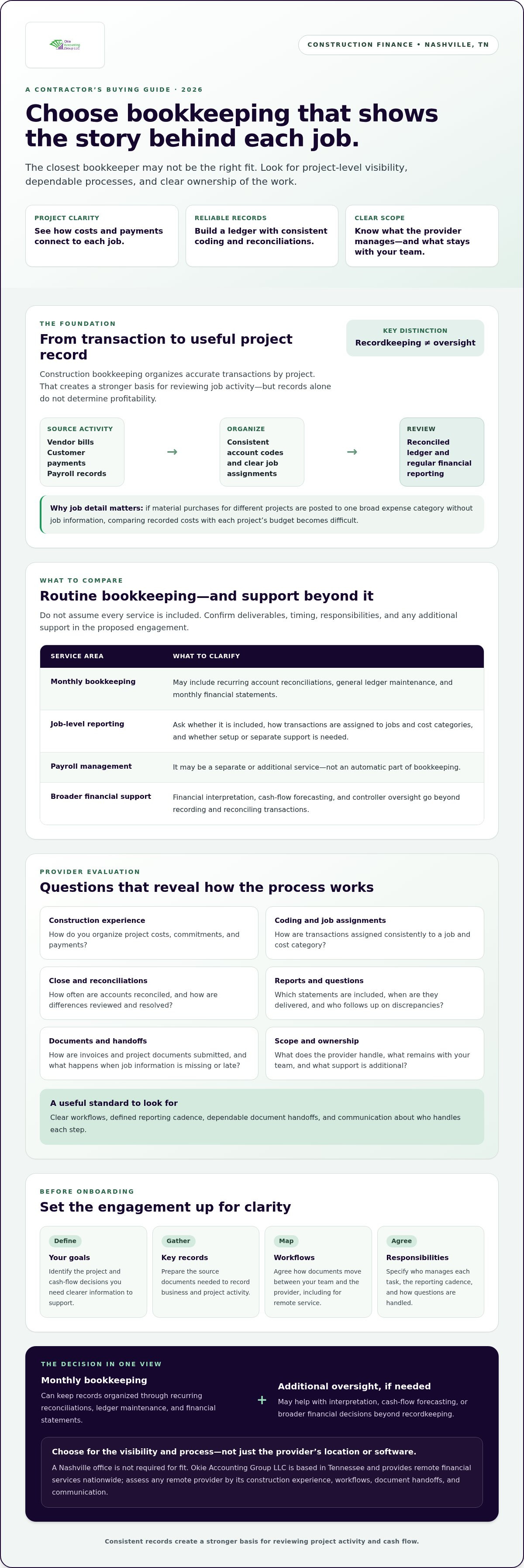
Construction bookkeeping is recurring financial recordkeeping that organizes accurate transactions by project, helping contractors understand how costs and payments relate to each job. That foundation supports reliable reporting. It is distinct from interpreting results, planning cash flow, or providing broader financial oversight, which may call for additional controller support.
How construction bookkeeping differs from general small-business bookkeeping
In general bookkeeping, assigning a transaction to an expense category may be enough for basic business reporting. Construction records also need useful project or job classifications. A vendor bill for materials, a customer payment, and payroll records should be coded consistently so owners can see how costs and receipts relate to particular work.
Those records don’t automatically determine a job’s profitability, but they give owners a stronger basis for reviewing project activity. The principles behind specialized construction accounting illustrate why construction finances may require methods and reporting considerations beyond routine transaction entry. For a deeper look at financial oversight, explore this controller services overview.
What Nashville-area contractors should expect from outsourced support
A monthly bookkeeping engagement may include recurring account reconciliations, general ledger maintenance, and monthly financial statements. These deliverables help keep records organized and give owners a regular view of the business. Confirm the tasks, reporting cadence, communication channels, and responsibilities in the proposed engagement rather than assuming every provider follows the same process.
Payroll management may be a separate or additional service, not an automatic part of bookkeeping. Financial interpretation, cash-flow forecasting, and controller oversight also go beyond recording and reconciling transactions. Ask where the provider’s bookkeeping scope ends and what additional support is available if you need help using reports to guide decisions.
For contractors considering outsourced construction bookkeeping Nashville TN, a provider doesn’t need a Nashville office to be a fit. Okie Accounting Group LLC is based in Tennessee and provides remote financial services nationwide. Assess any remote provider by its construction experience, defined workflows, document handoffs, and clear communication about who handles each step.
What Should an Outsourced Construction Bookkeeping Service Track?
A dependable construction ledger depends on more than entering bills and deposits. Transactions need accurate account coding, clear project assignments, and regular reconciliation so the books reflect business activity. That foundation helps owners review costs and payments with greater confidence instead of relying on scattered records.
Job costing, vendor records, and project-level visibility
Ask how the provider assigns each transaction to a job and cost category. For example, if material purchases for two active projects are posted to the same broad expense category without project details, it may be difficult to compare either job’s recorded costs with its budget. Consistent categories make those comparisons more useful and can help reveal where information is missing.
Vendor bills, payment records, and project documentation all contribute to the picture. If invoices arrive late or lack job information, the books may not show project activity promptly or consistently. Useful job costing depends on consistent coding and timely source documents. The U.S. Bureau of Labor Statistics’ U.S. construction sector data provides broader context on employment and earnings in the industry. A contractor’s own records, meanwhile, help clarify how costs are distributed across its projects.
For related planning considerations, see this construction cash-flow management guide.
Monthly close, reconciliations, and financial reporting
Monthly bank reconciliations compare activity recorded in the accounting system with transactions shown by the bank. Reviewing and resolving differences helps keep the ledger dependable. A consistent monthly close then provides a clearer basis for reviewing revenue, expenses, and the company’s overall financial position.
Monthly financial statements can help owners see how the business is performing, but the timing and contents of reports vary by engagement. Before choosing a provider, ask which statements are included, when they’re delivered, and who answers questions or follows up on discrepancies. Also confirm whether job-level reporting is part of the scope or requires separate setup or support.
When comparing outsourced construction bookkeeping Nashville TN providers, focus on the process behind the reports, not just the software they use. Clarify how documents are submitted, what your team must provide, and how missing or unclear records are handled. If you’re weighing monthly bookkeeping against broader financial oversight, you can discuss which level of support fits your needs.
How to Compare Nashville Construction Bookkeeping Providers
Choose a provider by how clearly they can explain the work behind the numbers. Software familiarity and general accounting experience matter, but they don’t show whether a provider can consistently organize project transactions, complete a monthly close, or communicate when records are incomplete. Ask each candidate the same questions so you can compare processes, not just promises.
Questions that reveal construction-specific experience
Ask the provider to walk through a typical transaction, from receiving a vendor bill to assigning it to a project and cost category. Then ask how they flag missing information instead of guessing. Clarify what the monthly close covers, how unresolved differences are communicated, and who follows up. A redacted sample report can show whether the format is understandable and relevant to your decisions.
Remote and local service models can both work. For an outsourced construction bookkeeping Nashville TN engagement, location alone doesn’t establish fit. Compare expectations for responsiveness, document exchange, meeting cadence, and urgent questions. A remote provider should explain how your team submits records and how both sides track outstanding items.
Before signing, request a written scope that distinguishes provider tasks from client responsibilities. Confirm which bookkeeping work is included, what is excluded, how additional needs are handled, and who to contact when a discrepancy or deadline needs attention. These details prevent assumptions from becoming gaps in the workflow.
Bookkeeping or controller support: which scope fits?
Monthly bookkeeping generally centers on ongoing recordkeeping, reconciliations, and financial statements. It doesn’t necessarily include strategic analysis. If you need help interpreting results, strengthening internal controls, or developing budgets, ask whether separate controller support fits your needs. The fractional controller services overview explains this distinct level of financial oversight.
How to Prepare for Outsourced Bookkeeping in Nashville
A well-planned handoff gives your bookkeeping partner the context needed to organize records around your construction operations. Before engaging a provider, work through four steps: define what you want clearer financial information to help you decide, gather the records they’ll need, map how information moves through your business, and agree on who owns each task.
Records and workflows to organize before onboarding
Start by identifying your accounting software, business bank accounts, and the people who currently manage financial records. Then trace how key documents reach bookkeeping. Note who receives vendor invoices, who records customer receipts, and how payroll information and project documents are shared. This map can expose handoff gaps before they affect the books.
Prepare to discuss which records are available and how they’re stored. Depending on your business and the agreed scope, useful materials may include:
Bank records and access details for the accounting system
Vendor invoices and customer payment records
Payroll information relevant to the bookkeeping workflow
Project documents that help identify jobs and categorize costs
A list of unresolved discrepancies or recurring questions about reports
Don’t spend time making every record look perfect before speaking with a provider. Instead, identify what’s missing or unclear so you can agree on how to address it. Onboarding timing depends on the condition of the records and the work included in the engagement, so avoid relying on a fixed timeline before those details are reviewed.
Setting clear expectations for communication and service scope
Before work begins, confirm who approves transactions, answers bookkeeping questions, supplies missing documents, and reviews monthly statements. Agree on a file exchange method, who can access the accounting system, how often you’ll communicate, and when financial information will be reviewed. A defined review rhythm helps keep questions from lingering between reporting periods.
For remote outsourced construction bookkeeping Nashville TN, clear communication matters as much as proximity. Establish a primary contact on each side and decide how the team should flag urgent discrepancies or incomplete project details. Put the provider’s responsibilities and your team’s responsibilities in writing, including services outside the bookkeeping scope.
If your current QuickBooks setup or staff familiarity needs attention as part of the transition, review the available QuickBooks setup and training support. Once you’ve outlined your records and workflows, schedule a discovery call to discuss your bookkeeping needs.
Choosing an Outsourced Bookkeeping Partner: From Records to Better Decisions
A strong bookkeeping relationship should give your team a dependable routine for handling financial information. As you assess providers, look for clear ownership of each task, a defined process for raising questions, and reports delivered on an agreed schedule. These practical details help you judge whether outsourced construction bookkeeping Nashville TN will fit the way your company operates, not just whether a provider understands accounting software.
Signs the bookkeeping relationship is producing useful clarity
Useful support means you can identify which records are ready for review, which items still need clarification, and what the monthly statements show. Consistent project classifications make it easier to compare recorded activity across reporting periods. If your needs extend beyond keeping the books organized to interpreting financial results or reviewing internal controls, discuss whether fractional controller support is appropriate. That added oversight is distinct from routine bookkeeping and doesn’t guarantee a particular financial outcome.
A practical next step for Nashville-area contractors
Okie Accounting Group LLC is based in Tennessee and provides remote services nationwide, including construction-focused bookkeeping and fractional controller services. For an initial discussion, bring examples of recurring bookkeeping challenges and explain what you need your financial reports to clarify. Ask which tasks are included, what your team must provide, and how communication will work. Confirm the engagement’s suitability and scope directly before making a decision.
With those details on the table, you can assess whether the proposed support matches your business’s current needs. Book a construction bookkeeping discovery call to discuss your situation and possible next steps.
Build a Clearer Financial Picture for Your Next Project
Choosing outsourced construction bookkeeping Nashville TN comes down to more than finding someone to record transactions. Look for a construction-aware process that keeps project records consistently organized, makes monthly financial information easier to review, and clearly defines responsibilities and communication. Confirm which reconciliations, general ledger maintenance, and financial statements are included before agreeing to an engagement.
Monthly bookkeeping may provide the recurring recordkeeping you need; broader interpretation or oversight may call for fractional controller support. Okie Accounting Group LLC is Tennessee-based, serves businesses remotely nationwide, and provides construction-focused bookkeeping and fractional controller services. The right scope depends on your records, workflows, and reporting needs, so discuss those details directly rather than making assumptions from a service description.
Bring your current bookkeeping challenges and the questions you want your reports to answer. Book a construction bookkeeping discovery call to discuss whether the services and process are a fit. With clear expectations and consistent financial records, you can approach project decisions with greater confidence.
Frequently Asked Questions
What does outsourced construction bookkeeping include?
Outsourced construction bookkeeping commonly includes recurring transaction recording, bank reconciliations, general ledger maintenance, and standard monthly financial statements. The exact scope depends on the engagement, so confirm which records and reports are covered and how often they’re delivered. Payroll management, cash-flow forecasting, and additional financial oversight may be available separately. For Nashville contractors, define who provides source documents, handles questions, and reviews the statements before work begins.
How is construction bookkeeping different from regular small-business bookkeeping?
Construction bookkeeping organizes financial activity around projects, not just general income and expense categories. A material invoice, for example, needs an accurate account category and useful job assignment if the contractor wants to review recorded costs by project. Payroll records and customer payments also contribute to project visibility. Consistent coding and complete source documents help make comparisons more meaningful, though interpreting project performance may require additional financial analysis.
Can a remote bookkeeping firm work with a construction company in Nashville, TN?
Yes. A remote firm can work with a Nashville-area contractor if both sides establish clear document, system-access, and communication workflows. Confirm how records are exchanged, who responds to questions, and when financial reports are reviewed. Okie Accounting Group LLC is based in Tennessee and provides remote services nationwide, including support for businesses in Tennessee and Jacksonville, Florida. A local office is not the only measure of service fit.
How do outsourced bookkeepers track job costs?
Bookkeepers can assign transactions to projects and consistent cost categories in the accounting records. For example, vendor invoices should include enough information to identify the project and expense type. Contractors should ask how incomplete documents are flagged and who supplies missing details. Regular coding practices support clearer comparisons between recorded activity and project budgets, but useful job-cost information also depends on timely, accurate source records from the business.
What should I ask before hiring a construction bookkeeper?
Ask about construction experience, transaction coding, monthly reconciliations, the close process, and which financial statements are included. Clarify what your team must provide, how missing records or discrepancies are handled, and who answers follow-up questions. Request a sample report with confidential information removed. For outsourced construction bookkeeping Nashville TN providers, compare the actual workflow, document exchange, and communication cadence rather than relying on location or software familiarity alone.
When does a construction company need a fractional controller instead of bookkeeping alone?
Monthly bookkeeping may be sufficient when your main need is ongoing transaction recording, reconciliations, general ledger maintenance, and standard financial statements. Consider discussing fractional controller support if you also need help with budgeting, internal controls, or interpreting financial information for decisions. These are distinct levels of support: bookkeeping maintains the records, while controller services provide higher-level financial oversight. Confirm which responsibilities fit your needs and the proposed engagement.
What records should a contractor prepare before outsourcing bookkeeping?
Gather available bank records, accounting-system information, vendor invoices, customer payment records, payroll information, and project documents that help identify jobs and categorize costs. Also note who currently maintains each record, any unresolved discrepancies, and recurring questions about financial reports. You don’t need to make every file perfect first. Identify gaps and agree with the provider on document exchange, responsibilities, and how missing details will be addressed.


Comments