Part-Time Controller Guide for Jacksonville Contractors

Updated: 6 days ago
What if your contracting business could gain controller-level oversight without adding a full-time hire? If you’re searching for a part-time controller for general contractors Jacksonville FL, you may already know that bookkeeping alone can’t explain why a project’s margin is shifting or whether cash will cover upcoming commitments. Clear job-cost and work-in-progress reporting can help turn those numbers into timely decisions.
It’s reasonable to want financial support that fits your workload and gives you more than a stack of monthly reports. A controller builds on accurate bookkeeping with stronger reporting, cash flow forecasting, and financial review. That can help you see what’s happening across projects and decide where to focus.
This guide explains what a part-time controller can do for a Jacksonville contracting business, how to assess whether the service fits your systems and needs, and what information to prepare before engaging one. It also covers construction-specific capabilities to look for, from job-level cost visibility to useful work-in-progress analysis, and how to distinguish financial oversight from routine bookkeeping.
Why Jacksonville General Contractors Consider a Part-Time Controller
When several jobs are active, a contractor’s overall financial picture can be hard to read. One project may be progressing as planned while another absorbs extra labor or material costs. Company-wide revenue and expenses alone may not show which job is protecting its margin, which needs attention, or whether the business has enough cash for upcoming commitments.
A part-time controller provides ongoing financial oversight without requiring a full-time internal role. For general contractors in Jacksonville, that can mean bringing job-level results, company budgets, cash flow, and financial reports into a more useful decision-making framework. This guide is about engaging a financial service, not applying for a controller job.
What financial pressures make controller support relevant?
Project decisions depend on more than the balance currently in the bank. Committed costs, such as scheduled labor or subcontractor work underway, affect what a job is likely to require. Billing timing and collection delays also determine when expected revenue becomes available cash. If you don’t consider these details together, it can be difficult to judge whether a project is tracking to budget or how much flexibility the company has for new commitments.
Controller support helps organize these signals for review. Budget-to-actual reporting can flag costs that differ from plan, while cash flow forecasting can help owners consider when receipts and payments are expected. The aim isn’t to remove uncertainty from construction work. It’s to make the financial information behind decisions clearer.
What does a controller add beyond bookkeeping?
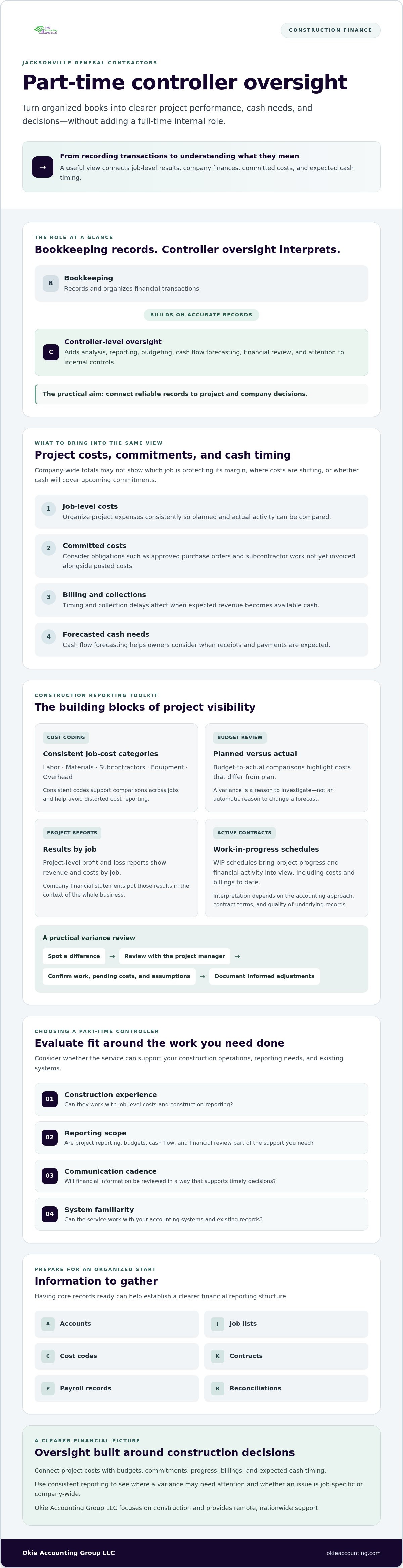
Bookkeeping records and organizes financial transactions. Controller-level oversight builds on those records through analysis, reporting, budgeting, and attention to internal controls. The role of a financial controller generally involves oversight of accounting and financial reporting. For a contractor, the practical value is connecting reliable records to project and company decisions.
Bookkeeping records what happened; controller oversight helps interpret what it means for project performance, cash needs, and the decisions ahead.
Consistent reports give owners a basis for better questions: Is a cost variance tied to one job or appearing across several? Do forecasted cash needs line up with billing and collections? Are the reports complete enough to support a budget decision? A controller can help establish a repeatable review process so these questions surface before they become urgent, rather than leaving the owner to interpret a month-end report alone.
For owners assessing a part-time controller for general contractors Jacksonville FL, the distinction matters. You may need financial leadership that turns organized books into actionable visibility, not simply another person entering transactions. Learn more about fractional controller services as you consider what level of oversight fits your business.
What a Part-Time Controller Should Track Across Jacksonville Construction Projects
Useful project reporting starts with consistent records. Each transaction needs to connect to the right job and cost category, so owners can compare the plan with actual activity instead of relying on company-wide totals. A part-time controller for general contractors Jacksonville FL should be able to help establish and review a reporting structure that reflects how the contractor manages its work.
How should job costing support project decisions?
Job-cost coding organizes project expenses into categories such as labor, materials, subcontractors, equipment, and overhead. Consistent codes make it possible to compare similar costs across jobs and spot where a project differs from its budget. For example, if subcontractor costs are coded inconsistently, a report may understate a job’s costs and distort the comparison.
Recorded transactions are only part of the picture. Committed costs, such as approved purchase orders or subcontractor work not yet invoiced, provide context about future project obligations. Reviewing these alongside posted costs helps owners avoid treating an incomplete cost picture as the final result.
A variance is a reason to investigate, not an automatic reason to change a project forecast. Review emerging differences with the project manager: confirm what work is complete, whether costs are pending, and whether the original assumptions still hold. A consistent process supports informed adjustments and preserves a clear record of why expectations changed.
Which reports help owners see the financial picture?
Project-level profit and loss reports show revenue and costs by job, while company financial statements put those results in the context of the whole business. Budget comparisons add another layer by highlighting differences between planned and actual costs. Together, these reports can help an owner distinguish a project-specific issue from a broader cash or cost trend.
Work-in-progress (WIP) schedules support review of active contracts by bringing project progress and financial activity into view, including costs and billings to date. Their interpretation depends on the contractor’s accounting approach, contract terms, and the quality of underlying records. Methods and conclusions shouldn’t be assumed to apply universally. Have the appropriate accounting professional review the approach and its use for your contracts.
Construction-focused reporting depends on sound records beneath the analysis. The Construction Financial Management Association (CFMA) is a resource for construction financial professionals and industry education. For foundational context, see this overview of construction bookkeeping services. If you’re assessing how these reports could fit your Jacksonville operation, you can discuss your reporting needs and accounting systems.
How to Compare Controller Options for a Jacksonville General Contracting Firm
The right financial support depends on the decisions you need help making, the complexity of your projects, and how much continuity your team requires. A bookkeeper, a full-time controller, and fractional controller support serve different needs. Compare their scope and working process, not just their titles.
When is fractional support a better fit than a full-time hire?
Fractional support may fit when routine books are maintained but owners still lack clear project reporting, budget review, or cash flow insight. It isn’t automatically the right choice for every firm, and it shouldn’t be assumed to cost less. Consider the volume and complexity of your work, the decisions that need financial input, and the availability your team requires. Clarify the expected scope and cadence before deciding.
What questions should Jacksonville contractors ask providers?
Ask how the engagement will work in practice, especially if support is remote. Confirm how documents will be shared, who can access accounting records, how often you’ll meet, and who is responsible for preparing, reviewing, and following up on reports. The provider should also explain how its work fits with your existing bookkeeping and project-management processes.
How will job costing, work-in-progress reporting, and cash flow forecasts be handled?
What construction experience informs the reporting approach?
Which accounting systems can the provider work with, and what information must your team supply?
Who reviews exceptions with the owner, and how are follow-up responsibilities divided?
Look for clear answers about communication and responsibilities, not just a list of deliverables. The Construction Financial Management Association can also provide construction finance education as you assess what specialized knowledge your business needs. For a broader overview of the service model, see fractional controller services.
If you’re weighing options for a part-time controller for general contractors Jacksonville FL, you can discuss your systems and financial oversight needs before deciding what engagement structure fits.
How to Prepare Your Books and Team for Controller Support
Preparation doesn’t mean every account must be perfect before you speak with a provider. A clear view of what’s organized, what’s missing, and who handles each financial task makes it easier to define the right scope. It also helps distinguish bookkeeping cleanup, which addresses gaps in past records, from ongoing controller oversight, which uses reliable information to support recurring decisions.
What information should a contractor gather first?
Start with what you have, and flag anything incomplete rather than assuming the books are ready. For an initial discovery conversation, collect:
Current financial statements, account list, accounting-system details, and access requirements.
Active-job list, approved budgets, cost codes, costs recorded to date, and available project reports.
Contracts, billing status, payroll records, and the names of people who approve or provide financial information.
Recent reconciliations and a note of unreconciled accounts, reporting gaps, or periods that may need cleanup.
These materials help identify whether the priority is organizing historical transactions, improving job-level reporting, or setting up a regular review process. The provider and contractor should agree on which work is included before ongoing oversight begins.
How can remote financial oversight work across Florida?
Remote support depends on clear access, secure document sharing, and dependable handoffs. Ask how financial records will be exchanged, who can approve transactions, how project managers should submit job updates, and how questions will be handled between scheduled reviews. Confirm who prepares the information and who reviews it with the owner.
A practical onboarding process can follow this sequence:
Discovery: Discuss business goals, current systems, reporting concerns, and the work the internal team already handles.
Readiness review: Identify missing records, reconciliation gaps, access needs, and whether bookkeeping cleanup should be addressed separately.
Workflow agreement: Assign responsibility for document delivery, approvals, payroll information, and project-manager updates.
Reporting cadence: Set expectations for report timing, review meetings, follow-up on exceptions, and the information owners need to act.
For a part-time controller for general contractors Jacksonville FL, ask specifically how remote coordination will work with both the owner and field team. A provider should also clarify the boundaries of its work. Florida-specific payroll or contracting requirements can vary by situation, so verify them with qualified sources rather than relying on a general accounting discussion.
To discuss your accounting systems, records, and controller-support needs, schedule a discovery conversation.
Choosing Okie Accounting for Part-Time Controller Support in Jacksonville
Okie Accounting Group LLC focuses on construction companies and real estate investors, bringing industry context to bookkeeping and fractional controller support. Its remote, nationwide model means Jacksonville contractors can discuss financial oversight without assuming there’s a local office or onsite service. A conversation can clarify whether the available support fits your company’s needs and current systems.
Controller oversight is most useful when it builds on dependable records. Monthly bookkeeping can provide the foundation, while financial reporting and cash flow forecasting can help owners interpret project and company performance. The fit depends on the work you need done, the information your team can provide, and the responsibilities you want to retain internally.
What should a discovery conversation clarify?
Bring a practical picture of your operation: the number of active projects, the reports you rely on, your accounting software, and the workflows used to collect costs and approve transactions. Describe where visibility breaks down, such as delayed project updates or uncertainty about cash needs. This gives both sides a clearer basis for discussing scope.
Clarify which reports and financial support are included, how often you’ll review them, what system access is needed, and who owns each task. For related financial analysis context, ask how management accounting needs connect to your reporting priorities.
What are the practical next steps?
Before moving forward, confirm four things:
Service fit: The provider’s construction experience and available support match your reporting needs.
Readiness: You understand which records are in order and whether bookkeeping cleanup needs to be addressed separately.
Communication: Remote access, document sharing, meeting cadence, and team handoffs are clear.
Scope: Deliverables, approval responsibilities, and follow-up expectations are agreed upon.
Review the details of controller services as you define the support you’re seeking. If cash forecasting is a priority, bring questions about billing schedules, expected collections, and upcoming commitments to the discussion. For a part-time controller for general contractors Jacksonville FL, use the conversation to confirm service availability and whether the remote engagement aligns with your operation.
Ready to explore the fit? Schedule a discovery conversation to discuss your projects, systems, and financial reporting needs.
Build a Clearer Financial View of Your Projects
Controller support can help turn organized bookkeeping into more useful project reporting, cash flow forecasts, and budget reviews. The right fit depends on your company’s reporting needs, current systems, and desired level of financial oversight. Before engaging support, clarify the scope, responsibilities, and communication cadence.
If you’re considering a part-time controller for general contractors Jacksonville FL, Okie Accounting Group LLC brings a focus on construction and real estate, with remote financial leadership and advisory support nationwide. Founded in 2020 and led by Sarah O’Quinn, the firm provides bookkeeping and fractional controller services. A discovery conversation can help you discuss your contracting business’s needs and determine whether the available support is a fit.
Schedule a discovery call to discuss controller support for your contracting business. With clearer reporting and a defined review process, you can make financial decisions with greater confidence and keep your attention on building a stronger operation.
Frequently Asked Questions
What does a part-time controller do for a general contractor?
A part-time controller provides ongoing financial oversight without filling a full-time internal role. For a general contractor, that can include reviewing financial reports, budgets, cash flow forecasts, and job-cost information to help owners understand performance and decide what needs attention. Agree on the exact scope in advance. Controller support builds on reliable bookkeeping records, but focuses on interpreting and overseeing financial information rather than only entering transactions.
Is a fractional controller different from a construction bookkeeper?
Yes. A construction bookkeeper generally records transactions, categorizes costs, reconciles accounts, and maintains financial records. A fractional controller uses those records for a broader layer of oversight, such as reviewing reports, budgets, project results, and cash flow. The roles can complement each other. For example, a bookkeeper may record costs to a job, while the controller reviews project reporting and helps the owner investigate a variance.
When should a general contractor hire a part-time controller?
Consider controller support when your financial records are maintained but you still lack timely insight into project margins, budgets, or cash needs. It may also be worth exploring if reporting demands are increasing and no one on your team has capacity to review financial results consistently. The right timing depends on workload, company complexity, and the availability you need. Fractional support isn’t automatically the best fit for every contractor.
Can a remote controller work with a Jacksonville construction company?
Yes, remote financial oversight can work when the contractor and provider establish secure document sharing, system access, clear responsibilities, and regular communication. Okie Accounting Group LLC is based in Tennessee and provides remote support nationwide, not in-person service from a Jacksonville office. Jacksonville contractors should discuss their systems, field-team workflows, and reporting needs, then confirm whether fractional controller support is currently available for their business.
What should a contractor prepare before a controller engagement?
Gather current financial statements, accounting-system information, account details, active-job lists, cost codes, project budgets, contracts, payroll records, billing status, and recent reconciliations. Include examples of reports you already use and identify unreconciled periods or missing project information. You don’t need to assume every record is ready. Clearly flagging gaps helps define whether bookkeeping cleanup is needed before ongoing controller oversight can rely on the information.
Does a part-time controller provide tax preparation or certified audits?
Not necessarily. Controller oversight and financial reporting are distinct from income tax preparation and certified audits, so ask providers to confirm the exact scope of their services. Okie Accounting Group LLC offers fractional controller services, monthly bookkeeping, financial reporting, cash flow forecasting, payroll management, and QuickBooks setup and training. It does not offer income tax preparation or certified audits. Consult appropriately qualified professionals for services outside that scope.
How can I tell whether my contractor's job costing is ready for controller oversight?
Check whether transactions are consistently assigned to individual jobs and useful cost categories, such as labor, materials, subcontractors, and equipment. Reconciled accounts, current job budgets, and a process for capturing committed costs provide stronger context for reports. Ask project managers whether they can supply timely updates on costs and progress. Inconsistencies don’t automatically rule out controller support, but identifying them helps determine what needs correction before relying on job-cost comparisons.


Comments