Rental Property Cash Flow Statement: 2026 Investor Guide

Updated: Nov 7
Why does your profit and loss statement show a healthy gain while your business bank account feels dangerously thin? It's a common frustration for real estate investors who realize that taxable income rarely reflects the actual cash available to fund their next acquisition. You likely understand that paper profits don't pay the mortgage or cover the 7.9% interest rates currently squeezing margins. Without a precise rental property cash flow statement, you're essentially flying blind; you're unable to distinguish between accounting figures and the actual liquidity needed for structural growth.
I'll show you how to master the mechanics of your portfolio's liquidity and transform a basic financial report into a powerful tool for scaling. We'll move beyond simple administrative tracking to build a professionalized system that provides clear visibility into your monthly cash position. This guide previews the essential components of 2026 financial management, including how to account for the "One Big Beautiful Bill Act" and how to present lender-ready financials that make refinancing a seamless process. By the end, you'll have the strategic oversight required to protect your margins and make data-driven choices for your future.
What is a Rental Property Cash Flow Statement?
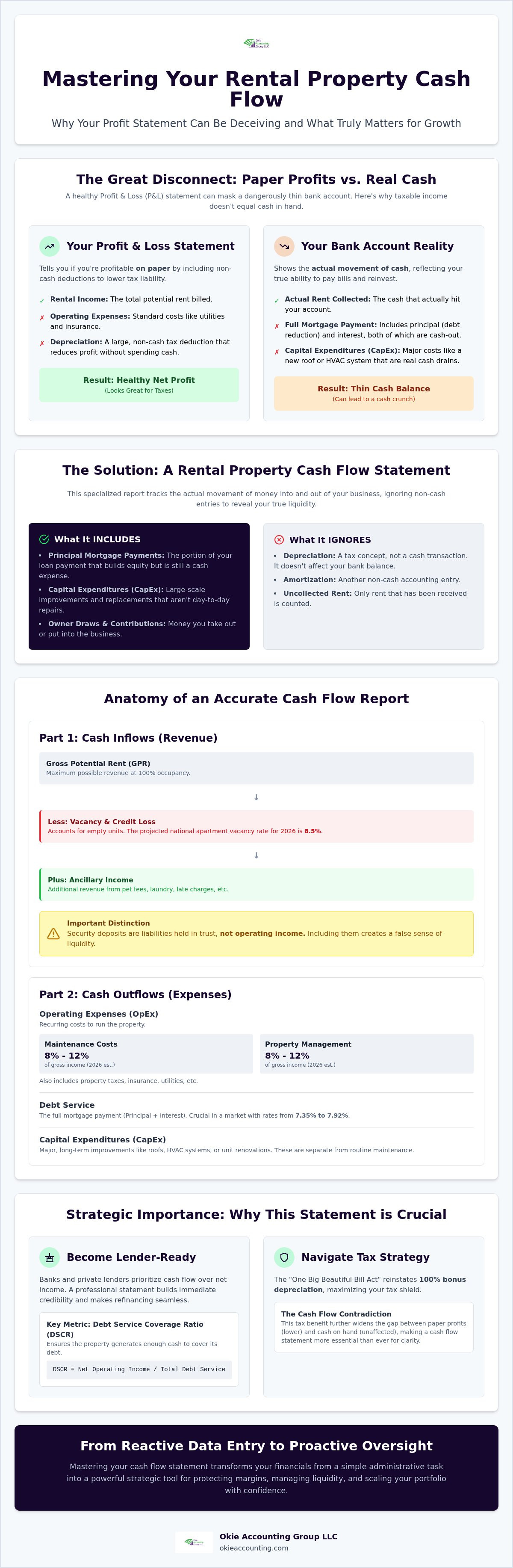
A rental property cash flow statement is a specialized financial report that tracks the actual movement of cash into and out of your real estate business. While a standard cash flow statement covers operating, investing, and financing activities, the rental version focuses specifically on the "net" reality of your portfolio. It ignores non-cash accounting entries like depreciation to show you exactly how much spendable money remains after all obligations are met. This transparency is vital for maintaining structural integrity as you grow.
Many investors confuse this document with a Profit and Loss (P&L) statement. A P&L tells you if you're profitable on paper, often including non-cash deductions that lower your tax liability. However, it doesn't account for the principal portion of your mortgage payment or capital expenditures for major repairs. The cash flow statement bridges this gap. It serves as the foundation for accounting for real estate investors, providing the organized system needed to ensure your business remains solvent month over month.
Timing is everything. In real estate operations, your expenses don't always align with your income cycles. If your property taxes are due in November but your rent growth is stagnant at the 0.6% projected for multifamily units in 2026, you need to know your cash position months in advance. This statement highlights the "when" of your finances. It ensures you don't face a shortfall during seasonal vacancy peaks or unexpected maintenance events.
The Role of Liquidity in Real Estate
Liquidity is the lifeblood of a sustainable portfolio. In a market where investment property mortgage rates start around 7.35% to 7.92%, your margins are tighter than ever. A detailed statement identifies potential "cash crunches" by showing where your money is tied up, whether in uncollected rent or prepaid insurance premiums. Cash flow liquidity is the ability to meet short-term obligations without selling assets. By monitoring this metric, you can pivot your strategy before a minor deficit turns into a structural failure.
Lender-Ready Financials and Your Statement
Banks and private lenders prioritize your cash flow over net income. When you apply for a refinance, lenders look at your Debt Service Coverage Ratio (DSCR) to ensure the property generates enough cash to cover the debt. A professional rental property cash flow statement demonstrates that you have a disciplined system for tracking this performance. It builds immediate credibility. It shows partners that you understand the "why" behind your numbers rather than just performing basic data entry. This level of reporting is essential for anyone looking to scale their portfolio in the current high-interest environment.
The Core Components of an Accurate Cash Flow Report
A high-performing rental property cash flow statement requires more than a simple list of deposits and checks. It demands a granular breakdown of every financial lever affecting your liquidity. To build a structural framework that supports scaling, you must separate your operational reality from your theoretical potential. This begins with distinguishing Gross Potential Rent (GPR) from the actual cash collected. While GPR represents your maximum possible revenue at 100% occupancy, your statement must reflect the reality of current market conditions, such as the projected 8.5% national apartment vacancy rate for 2026.
Operating expenses serve as the next critical layer. In the current economic climate, property taxes and insurance premiums are rising sharply, making meticulous tracking non-negotiable. Standard underwriting for 2026 assumes maintenance costs and property management fees each range between 8% and 12% of gross income. If you are currently repositioning assets through unit turns or major rehabs, integrating construction bookkeeping services is essential. This ensures that project-based costs don't get lost in general operational data, allowing for precise tracking of your capital deployment.
Tracking Revenue Beyond the Monthly Rent
Ancillary income often represents the difference between a stagnant asset and a thriving one. Your report should clearly line-item pet fees, laundry income, and late charges to capture the full scope of your property's earning power. However, accuracy requires caution. Security deposits should never be treated as operating income; they are liabilities held in trust. Including them in your cash flow totals creates a false sense of liquidity that can lead to poor acquisition choices. If you need help establishing these professionalized systems, you can schedule a discovery call to review your current reporting structure.
Operating Expenses vs. Capital Expenditures (CapEx)
Distinguishing between a recurring repair and a long-term improvement is vital for your financial health. A standard P&L might hide the impact of a major roof replacement through depreciation, but your cash flow statement reveals the immediate $20,000 hit to your liquidity. CapEx reserves are essential for maintaining the property's structural integrity and value. By separating these non-operating outlays from daily repairs, you gain a realistic view of your "cash flow after debt service," which is the only figure that truly determines your ability to reinvest and scale.
Cash Flow vs. Net Income: Solving the 'Phantom Profit' Problem
One of the most disorienting experiences for an investor is seeing a positive net income on a tax return while facing a cash shortage in the business checking account. This phenomenon, often called "phantom profit," occurs because net income is an accounting construct rather than a measure of spendable liquidity. Your Profit and Loss (P&L) statement includes non-cash deductions and excludes major cash outflows like mortgage principal. To understand the true health of your portfolio, you must look to your rental property cash flow statement to reconcile these discrepancies.
Net income serves its purpose for tax reporting and high-level performance tracking, but it doesn't pay for emergency plumbing or new acquisitions. It represents your revenue minus operating expenses and non-cash items. If you rely solely on this figure, you risk making aggressive growth decisions based on money that isn't actually available. A structural financial framework ensures you distinguish between the profit you report to the IRS and the cash you have available to deploy.
The Impact of Non-Cash Expenses
Depreciation is the primary driver of the gap between profit and cash. Under the "One Big Beautiful Bill Act" of 2025, investors can still leverage 100% bonus depreciation for qualified property placed in service during 2026. This creates a massive tax shield, significantly lowering your taxable net income without costing a single dollar of daily cash flow. While this is excellent for wealth preservation, it can cloud your financial view if you don't account for it correctly. Utilizing a professional fractional controller is essential for reconciling these non-cash adjustments, ensuring you understand exactly how your tax strategy interacts with your monthly liquidity.
Debt Service and Cash Flow Reality
Debt service is the second major factor in the phantom profit puzzle. When you make a mortgage payment, only the interest portion appears on your P&L as an expense. The principal portion is considered a reduction of a liability; it increases your net worth on the balance sheet but is not "expensed" against your income. However, both interest and principal are total cash outflows. In a 2026 market where investment mortgage rates hover between 7.35% and 7.92%, the cash impact of debt service is substantial. Principal payments are a cash outflow that increases net worth but reduces immediate liquidity. Your rental property cash flow statement captures this total movement, providing a grounded reality that a standard income statement simply cannot offer.
How to Use Your Cash Flow Statement for Strategic Growth
Stop treating your rental property cash flow statement as a static historical record. It is a forward-looking roadmap. To scale effectively, you must analyze your data through a disciplined four-step process that prioritizes liquidity over paper equity. First, calculate your cash-on-cash return. In the 2026 market, investors are targeting 8% to 12% to validate performance. Second, identify "leakage" by comparing actual maintenance and management costs against industry benchmarks. Third, use your statement to forecast the capital needed for large-scale renovations. Finally, replace outdated rules of thumb with your own historical data to set accurate vacancy and repair reserves.
Calculating Investor KPIs from Your Statement
While capitalization rates (Cap Rates) help evaluate market value, they often ignore the impact of financing. To understand your true performance, you must focus on cash-on-cash returns. This metric tells you exactly how hard your invested capital is working for you. If you are managing multi-family rehabs, apply mastering construction cash flow management principles to ensure your project doesn't stall due to a liquidity crunch. This data also informs the critical "sell or hold" decision. If your cash performance plateaus, it may be time to execute a 1031 exchange into a higher-performing asset.
Scalable Tracking with QuickBooks Online
Manual spreadsheets inevitably fail as your portfolio grows beyond five units. They lack the structural integrity required for professionalized financial systems. Transitioning to QuickBooks Online allows you to establish a Chart of Accounts specifically designed for real estate. This organization is vital when you are managing your own property improvements. By mastering QuickBooks for contractors, you can track job costs with precision, ensuring every dollar spent on a renovation is correctly categorized for both cash flow and future depreciation. Establishing these systems now creates the foundation for a lender-ready portfolio.
Building a scalable investment system starts with financial clarity. If your current reporting feels disorganized or lacks the strategic depth you need to grow, it's time for a more methodical approach. You can book a discovery call today to discuss how a professionalized financial framework can support your 2026 acquisition goals.
Professional Oversight: Moving from Bookkeeping to Strategic Partnership
Scaling a real estate portfolio requires more than simply knowing what happened last month. It requires knowing what to do next. While many software solutions promise to automate your tracking, they often fail to provide the structural financial framework necessary for long-term stability. Basic data entry only records history; a professional rental property cash flow statement provides a roadmap for the future. By moving beyond administrative tasks, you establish the disciplined oversight required to protect your margins in a market where investment property rates hover between 7.35% and 7.92%.
Lender-ready financials are no longer a luxury for the elite investor. In 2026, banks have increased their scrutiny of liquidity and debt service coverage. Having professionalized reports prepared every month ensures you're always positioned for a refinance or a sudden acquisition opportunity. This level of readiness transforms your business from a collection of properties into a scalable investment system. It builds trust with partners and provides you with the quiet confidence that your capital is being managed with rigorous precision.
Why Real Estate Investors Need Fractional Controller Services
A fractional controller acts as a strategic mentor for your portfolio, offering high-level financial strategy without the overhead of a full-time executive. This role goes deep into the "why" behind your numbers. If your operating expenses are creeping above the 12% benchmark, a controller identifies the specific leakage. They also establish internal controls to provide oversight of third-party property managers, ensuring that every dollar of rent collected is accounted for correctly. For investors seeking this level of specialized advice, our controller services provide the structural integrity needed to scale without losing control of your data.
Next Steps: Your Discovery Call with Okie Accounting Group LLC
Transitioning from financial complexity to operational clarity begins with a single, focused conversation. During a strategy session with Okie Accounting Group LLC, we'll examine your current reporting systems and identify the gaps preventing you from scaling. We don't just offer bookkeeping; we offer a partnership dedicated to your portfolio's long-term health. We help you implement the systems that turn a standard rental property cash flow statement into a powerful decision-making tool. You can take the first step toward professionalized financial oversight and book your discovery call with Sarah O'Quinn today. Let's build the framework that supports your growth through 2026 and beyond.
Securing Your Portfolio's Financial Future
Mastering your rental property cash flow statement is the definitive step toward transitioning from a passive owner to a disciplined real estate executive. You now understand that paper profits don't equate to liquidity and that structural frameworks are required to survive a 7.9% interest rate environment. By distinguishing between non-cash depreciation and actual debt service, you gain the clarity needed to identify operational leakage and fund future acquisitions with confidence. This transition from basic data entry to strategic oversight is what separates stagnant portfolios from those that successfully scale.
At Okie Accounting Group LLC, we provide the specialized real estate and construction expertise you need to grow without the stress of financial complexity. Our nationwide cloud-based accounting support and fractional controller strategic oversight ensure your reporting is always lender-ready and optimized for profit protection. We don't just record your history; we help you engineer your future through meticulous management and data-driven choices.
Schedule your Discovery Call to gain total financial clarity over your portfolio and begin building a more resilient investment system today. We look forward to partnering with you on your journey toward operational excellence and long-term stability.
Frequently Asked Questions
What is the difference between a cash flow statement and a profit and loss statement?
A Profit and Loss statement records your revenue and expenses to determine taxable net income, often including non-cash items like depreciation. In contrast, a rental property cash flow statement tracks the actual movement of currency into and out of your accounts. It includes mortgage principal and capital improvements that the P&L excludes. This distinction is vital for understanding your real-time ability to meet obligations and fund new acquisitions.
How do I calculate cash flow for a rental property?
You calculate cash flow by taking your total collected revenue and subtracting all cash outlays, including operating expenses, debt service, and capital expenditures. It's essential to use actual rent collected rather than Gross Potential Rent to ensure accuracy. This calculation provides the bottom line of your property's liquidity. It tells you exactly how much spendable cash remains at the end of the month after all structural costs are covered.
Is depreciation included in a cash flow statement?
No, depreciation is not included in a cash flow statement because it is a non-cash accounting deduction. While it provides a significant tax shield under the 100% bonus depreciation rules of the One Big Beautiful Bill Act, it doesn't involve an actual bank withdrawal. Your statement focuses exclusively on liquid capital. Excluding non-cash items ensures you have a clear, undistorted view of your portfolio's current cash position and operational sustainability.
How much cash reserve should I keep for a rental property?
Most disciplined investors maintain a reserve of three to six months of operating expenses and debt service per property. For 2026, standard underwriting assumptions suggest setting aside 5% to 10% for vacancies and 8% to 12% for maintenance. These reserves protect your portfolio's structural integrity during unexpected repairs or market shifts. Having a dedicated capital reserve ensures you aren't forced to sell assets during temporary cash crunches or high-interest periods.
Can a property have a positive net income but negative cash flow?
Yes, this occurs when your cash outlays for mortgage principal and capital improvements exceed your non-cash deductions like depreciation. You might show a paper profit for tax purposes while your bank account actually shrinks. This phantom profit scenario is common in high-leverage strategies where debt service consumes your liquid gains. Monitoring your rental property cash flow statement is the only way to identify this risk before it impacts your solvency.
What is a good cash-on-cash return for a rental property in 2026?
In the current 2026 market, investors typically target a cash-on-cash return of 8% to 12%. With investment property mortgage rates starting around 7.35%, achieving these benchmarks requires rigorous expense management and strategic rent positioning. A stabilized return of 7% is often considered the minimum threshold for a viable deal. These targets ensure your invested capital outperforms safer alternatives while accounting for the increased costs of financing and property insurance.
Do I need QuickBooks for my rental property accounting?
While spreadsheets work for a single unit, QuickBooks Online is essential for scaling a professional real estate portfolio. It allows you to build a structural financial framework with a specialized Chart of Accounts. This system supports automated bank feeds, precise job costing for renovations, and the generation of lender-ready financials. Implementing a robust accounting platform ensures your data remains organized and accurate as you transition from administrative tasks to strategic oversight.
How often should I review my rental property cash flow statement?
You should review your statement at the close of every month to maintain total financial clarity. Monthly reviews allow you to spot leakage in operating expenses or unexpected maintenance trends before they erode your margins. This consistent cadence ensures you're always prepared for quarterly tax planning and annual performance audits. Regular oversight transforms your financial data from a historical record into a proactive tool for managing your portfolio's long-term health and stability.


Comments