Tennessee Construction Company Financial Checkup: 2026 Checklist

Updated: 6 days ago
Could a profitable-looking job still leave your company short on cash, or your books unready for a licensing application? A Tennessee construction company financial checkup can reveal the gap between project activity and the financial picture you rely on to make decisions. Review costs, margins, and cash flow together, whether your construction business operates in Tennessee or Jacksonville, Florida.
If accounts aren’t reconciled or job records aren’t consistent, that picture may be incomplete. An internal management review also isn’t automatically the same as financial documentation required for contractor licensing. Tennessee requirements can differ based on the application, renewal, and requested monetary limit, so it’s important to know which records serve which purpose.
This checklist walks through job costs, profitability, cash position, reconciliations, and reporting. It also clarifies the difference between ongoing financial oversight and formal licensing documentation, and outlines what records to assemble for more informed operating decisions and stronger financial readiness.
What a Tennessee Construction Company Financial Checkup Covers
A construction company can have active jobs, payroll due, receivables in progress, and significant obligations ahead, yet still lack a clear view of its financial position. A Tennessee construction company financial checkup brings those moving parts into one structured review. It examines record accuracy, report usefulness, emerging risks, and the information owners need to make operating decisions.
A financial checkup is an internal management review of reliable records and decision-ready reports. It does not, by itself, provide the external assurance or documentation that may be required for a specific licensing submission. Reconciliations and financial reporting help owners understand performance and organize records, but they don’t automatically meet a formal preparation standard.
Construction businesses also operate within a broader state economy shaped by varied industries and regional conditions. The Economy of Tennessee offers general context, but company-level decisions require a closer view: what each job is earning, what it still needs to spend, and when cash is expected to move.
Why construction finances need a job-level view
Each project has its own schedule, billing pattern, labor demands, material purchases, subcontractor commitments, and change orders. One job may be progressing as planned while another is absorbing extra labor or waiting on a customer payment. Company-wide revenue and expense totals can hide those differences, making an underperforming project harder to spot before it affects overall results.
Job costing organizes costs and revenue by project so management can compare actual activity with the job’s budget or current expectations. Consistent project records help owners investigate variances, monitor committed costs, and assess whether reported progress is translating into margin and cash. During a checkup, the goal is to determine whether existing records give a dependable project-level picture, not to build a new software system.
Internal checkup versus licensing financial statement
A management checkup helps answer practical questions: Are accounts reconciled? Do job records support the reports? Are cash needs and obligations visible? Its value is better oversight, not a formal opinion on whether financial statements are fairly presented. A compilation, review, or audit is a separate type of financial statement engagement, with distinct purposes and levels of assurance. The appropriate statement depends on the submission requirements.
Tennessee contractor licensing applications and renewals may require a particular statement type or preparation standard. Don’t assume internally prepared reports, even carefully maintained ones, satisfy that requirement. Before assembling a licensing package, review the current instructions from the Tennessee Board for Licensing Contractors and match the documentation to the specific application. Keep the recurring checkup in place either way: it supports management decisions, while licensing documentation serves a separate purpose.
Which Financial Signals Should a Tennessee Contractor Review?
Financial reports are only as dependable as the records behind them. A useful Tennessee construction company financial checkup starts with current books and reconciled bank, credit card, loan, and other key accounts. Reconciliation helps catch missing transactions, duplicate entries, and timing differences before they distort the balance sheet, income statement, or cash reporting.
“Financial ratios and balances are only useful when the underlying records are current and reconciled.” A strong-looking margin or working capital figure can mislead if costs are uncoded, receivables are outdated, or transactions haven’t been entered. The Construction Financial Management Association (CFMA) is a construction-focused resource for financial professionals. Before using any management measure, first make sure the underlying data is sound.
Review project performance alongside company results
Compare each project’s budget with recorded labor, materials, subcontractor costs, and other expenses. Look for variances and determine whether they reflect changed scope, schedule slippage, purchasing differences, or incomplete cost entry. Job-level review adds context to company totals: an overall profit can conceal a project whose costs are rising faster than expected.
Work in progress (WIP) reporting helps connect project progress with revenue and costs recorded over time. Details depend on the company’s accounting approach, so use WIP as a prompt to investigate project status, not as a substitute for sound job records. Late or incomplete job coding can make a project appear more profitable than it is, or shift costs into the wrong reporting period.
Read financial statements for decision signals
Each report answers a different operating question. Review them together rather than treating a single balance or ratio as a verdict:
Balance sheet: Check assets and liabilities, including receivables, cash, debt, and amounts owed. Working capital shows short-term resources relative to short-term obligations, but interpret it alongside timing and collectability.
Income statement: Assess recorded revenue, expenses, and operating results for the period. Compare actual results with budget and prior periods, then investigate meaningful changes rather than assuming that more revenue means stronger profitability.
Cash forecast: Map expected customer receipts against payroll, supplier payments, subcontractor obligations, debt payments, and other upcoming outflows. A profitable job can still create a cash squeeze if payment timing doesn’t align with costs.
Accounts receivable, accounts payable, and payroll are timing signals, not isolated totals. Review which invoices are overdue, which bills are coming due, and when payroll must be funded. Receivables may look healthy while collections lag; payable balances may signal upcoming pressure even when the income statement shows a profit. A cash forecast turns those dates into practical decisions. For a deeper look at timing and cash planning, continue with the construction cash flow management guide.
If reports are accurate but difficult to interpret, management accounting support can connect the numbers to budgets, project performance, and operating choices. A clear dashboard makes exceptions easier to spot and follow up on.
For contractors in Tennessee and Jacksonville, Florida, a conversation about financial reporting and oversight can help clarify priorities for tracking project results and cash needs.
Tennessee Contractor Licensing: What a Financial Checkup Does, and Doesn’t, Prove
A financial checkup helps an owner understand the company’s records, project performance, cash position, and financial risks. It supports planning and control. But it isn’t automatically a licensing document, and organized financial reports don’t establish that they meet a required preparation standard.
Bookkeeping oversight alone does not establish a reviewed or audited statement. A Tennessee construction company financial checkup and a formal financial statement engagement serve different purposes. Use internal reports for decisions without assuming they’ll satisfy a licensing submission.
How internal management reporting differs from formal assurance
Management reports are prepared for internal use. They help owners monitor results, compare performance with budgets, plan cash needs, and decide where to investigate. Their usefulness depends on accurate, timely records, but consistent bookkeeping doesn’t provide external assurance.
A compilation, review, and audit are distinct engagement types. In general, a compilation presents financial information without expressing assurance; a review provides limited assurance; and an audit provides a higher level of assurance based on audit procedures. These terms aren’t interchangeable. Bookkeeping and controller oversight can support reliable internal reporting, but they don’t substitute for a CPA-prepared statement if one is required.
What Tennessee contractors should verify before filing
Start with the Tennessee Board for Licensing Contractors as the authoritative source for current state requirements. Instructions may vary with the specific application or license action, so confirm the applicable details rather than relying on an older checklist or a figure repeated in an online article.
Which financial statement type and preparation standard apply to the filing?
Which licensing category and requested monetary limit are relevant?
What documents, forms, and submission dates does the current application require?
Have the Board’s instructions changed since the company last applied or renewed?
Verify each item against current Board materials before assembling the package. Don’t assume a requirement for one application applies to another, or that a prior filing establishes what’s needed now. If a financial statement is required, treat its preparation as a separate workstream from the company’s recurring financial review.
That separation doesn’t make internal oversight less valuable. Current reconciliations and consistent reports help owners monitor financial readiness and address recordkeeping gaps before a filing becomes urgent. Management accounting support can connect reports to budgets and operating decisions, while the required statement type and licensing documentation remain governed by the Board’s current instructions.
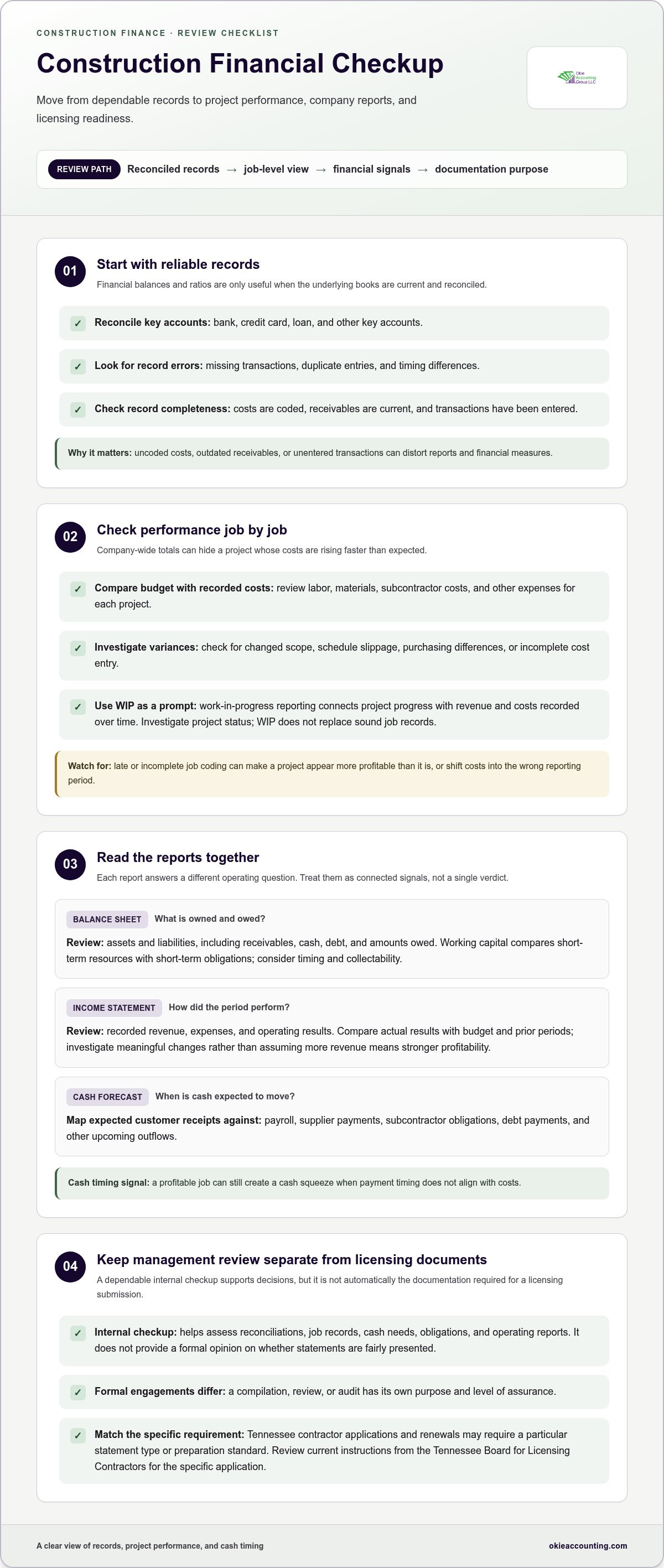
A Practical Financial Checkup Checklist for Tennessee Construction Companies
A checkup works best as a monthly routine, not a scramble before a major decision or filing. Put a recurring close and review on the calendar, then follow the same sequence each month. Consistency makes changes easier to spot and helps distinguish a one-time exception from a pattern that needs attention.
Use this checklist to move from raw records to assigned action:
Close the records: Gather bank and credit account activity, customer invoices, vendor bills, payroll data, and current job-cost entries for the period.
Reconcile accounts: Match recorded activity to statements. Investigate uncategorized, duplicate, or unsupported transactions before relying on balances.
Review job records: Confirm costs and revenue are assigned to the right projects, using consistent job identifiers and cost categories.
Assess the reports: Review company results, project variances, receivables, upcoming obligations, and cash expectations together.
Assign follow-up: Document exceptions, the person responsible, a target date, and the corrective action or explanation needed.
Prepare reliable records before interpreting results
Start with completeness. Check whether invoices, bills, payroll records, and job documentation have been entered for the period, then confirm that transactions are categorized consistently. A labor charge without a job identifier, for example, may appear in company expenses but fail to inform the project’s performance record. Resolve gaps or clearly mark them as open items rather than treating incomplete reports as final.
Sound construction bookkeeping gives this monthly process a dependable foundation through transaction recording, reconciliations, general ledger maintenance, and financial statements. The checkup can then focus on interpreting results instead of reconstructing basic activity.
Turn review findings into assigned follow-up
Keep a brief exception log. Record unusual budget variances, overdue receivables, incomplete job documentation, and unresolved reconciliation differences. For each item, name an owner and target date, then revisit open actions during the next review. For example, assign someone to trace a project cost posted without a job code to its source record and correct or explain the entry.
Cloud accounting procedures can support consistent entry and review. If your team is refining its QuickBooks workflow, QuickBooks setup and training can help establish practices that fit the company’s reporting needs. Keep the Tennessee construction company financial checkup practical: accurate records first, clear exceptions next, and accountable follow-through every month.
To build a consistent bookkeeping and review process, schedule a discovery call to discuss your company’s financial reporting needs.
How Ongoing Bookkeeping and Controller Support Can Keep the Checkup Useful
A financial checkup stays useful only if the information behind it stays current. Construction projects shift, bills arrive, payroll runs, and customer payments land on different schedules. A repeatable review needs a dependable flow of records and reports, not a one-time cleanup that becomes outdated as work moves forward.
Monthly bookkeeping creates that foundation through transaction recording, reconciliations, general ledger maintenance, and consistent financial statements. With current records, owners can revisit project results and cash needs using the same reporting structure each month. The goal isn’t simply to produce reports, but to make the company’s financial position easier to see and act on.
Match support to the financial gap
If transactions aren’t consistently recorded, accounts remain unreconciled, or monthly reports are hard to rely on, bookkeeping support addresses the information foundation. If the records are in place but leaders need help turning them into operating decisions, controller-level oversight may be the better fit. That work can include budgeting, internal controls, financial oversight, and interpretation of results.
These functions work together, but solve different problems. Bookkeeping establishes a consistent record of activity; controller support helps assess what the information means and how to respond. Construction-focused management accounting support can connect financial reports to budgets and business decisions, while fractional controller services add financial oversight and interpretation as needs grow.
Neither ongoing bookkeeping nor controller support should be mistaken for formal assurance. If a licensing filing calls for a particular statement preparation standard, the company must address that requirement separately. A well-maintained accounting system makes internal oversight more useful, but it doesn’t turn management reports into a reviewed or audited statement.
Make the next financial review easier to act on
Choose support based on the obstacle you want to remove. A company struggling to keep records current may need stronger bookkeeping routines. A company with consistent reports but unanswered questions about budgets, controls, or financial trends may benefit from controller-level analysis. Some businesses need both: a reliable reporting foundation and experienced interpretation of what the numbers signal.
For construction companies in Tennessee and Jacksonville, Florida, remote support can make ongoing financial oversight practical without requiring the owner to manage every reporting task alone. A discovery call is an opportunity to discuss reporting priorities, current financial processes, and where the review feels least dependable. The goal is to clarify what needs attention and what kind of ongoing support fits.
Schedule a discovery call to discuss your construction company’s financial checkup and the bookkeeping or controller support that can help keep it useful.
Turn Your Next Review Into a Stronger Operating Rhythm
The value of a Tennessee construction company financial checkup comes from what you do with what it reveals. Choose one financial blind spot to address first, assign an owner to the next step, and make the improvement part of your regular review process. Small, consistent actions give your team a steadier basis for decisions as projects and priorities shift.
If you’re ready to make financial reporting more useful to your company, a discovery call can help clarify priorities and identify a practical path forward. Schedule a discovery call to discuss your construction company’s financial checkup.
With a clear process and dependable support, you can move forward with greater financial confidence.
Frequently Asked Questions
How often should a Tennessee construction company complete a financial checkup?
Review your financials monthly, after the books for the period are closed, so you can compare performance consistently and catch issues before they accumulate. Add a focused review when a major project changes scope, a large customer payment is delayed, or the company takes on a substantial new commitment. Keep the same reporting cutoff each month; otherwise, period-to-period comparisons may reflect timing differences rather than real changes.
Does a financial checkup meet Tennessee contractor licensing financial statement requirements?
No. An internal checkup doesn’t automatically satisfy a licensing requirement. The statement type and preparation standard can depend on the specific filing or license action. Before submitting documents, use current instructions from the Tennessee Board for Licensing Contractors to confirm what applies to your application. Treat management reports as tools for operating decisions, and handle any required formal financial statement preparation separately.
What records should I gather before a construction company financial checkup?
Gather records that explain both the company’s finances and its active work: bank and credit statements, customer and vendor activity, payroll summaries, loan statements, and project contracts or change orders. Include accounts receivable and payable details, plus job schedules or cost reports that clarify project status. For a Tennessee construction company financial checkup, organized source documents make it easier to trace a question from a report back to the underlying transaction.
Can a construction company be profitable but still have cash flow problems?
Yes. Profit and cash availability measure different things. For example, a company may record revenue as work progresses but not collect the related customer invoice until later, while payroll, supplier bills, or subcontractor payments come due first. That timing gap can strain cash even if the job is expected to earn a profit. A cash forecast helps owners anticipate shortfalls and consider timing before obligations become urgent.
What is the difference between a financial review and an audit for a contractor?
A financial statement review and an audit are formal engagement types with different levels of assurance. A review provides limited assurance based on procedures that are narrower than an audit; an audit provides a higher level of assurance through more extensive work. An owner’s routine review of internal reports is different from both. Don’t treat the terms as interchangeable, especially if a licensing submission specifies a particular statement standard.
How much does a construction company financial checkup cost?
The cost depends on the support needed, the condition and volume of the records, and whether the goal is a one-time review or ongoing bookkeeping and controller support. Formal financial statement engagements are separate from internal management reporting and have their own scope. Outline your reporting needs and current process during a discovery call to discuss an appropriate fit.
Can QuickBooks show profitability by construction project?
Yes, QuickBooks can support project-level profitability reporting when the company’s setup and workflows capture income and expenses consistently by job. For example, a subcontractor bill assigned to the wrong project can distort the comparison, even if the company-wide expense total is accurate. Review how project identifiers, cost categories, and transaction entry are used, then check reports against source documents before relying on job margins.
When should a Tennessee contractor consider fractional controller support?
Consider it when reports are available but leadership needs help turning them into budgets, internal controls, cash planning, or operating decisions. It can also help as project volume grows and owners need clearer financial oversight without handling every analysis themselves. Okie Accounting Group LLC provides remote financial support for businesses in Tennessee and Jacksonville, Florida. Fractional controller work supports management decisions; it doesn’t replace any formal licensing statement requirement.


Comments