2026 Bookkeeping Guide for Electrical Contractors

Updated: 6 days ago
What if your monthly profit and loss statement actually told you which job paid for your new service truck and which one ate your overhead? Many owners treat bookkeeping for electrical contractors as a necessary chore for tax season, but that reactive approach often leaves you blind to why cash is tight despite a full schedule. You've likely felt the stress of inaccurate job costing or the frustration of material price spikes that erode your margins before the invoice is even sent.
We understand that managing a field team while tracking fluctuating inventory requires more than just a simple spreadsheet. It requires a disciplined system built for the specific demands of the trade. This guide teaches you how to transition from basic record-keeping to a project-based financial framework that tracks every wire, hour, and dollar of profit. We'll explore the methodology behind automated labor tracking, real-time material oversight, and the construction of lender-ready statements that support long-term growth. By the end, you'll have the clarity needed to move from reactive management to strategic financial control.
Why Generic Bookkeeping Fails Electrical Contractors
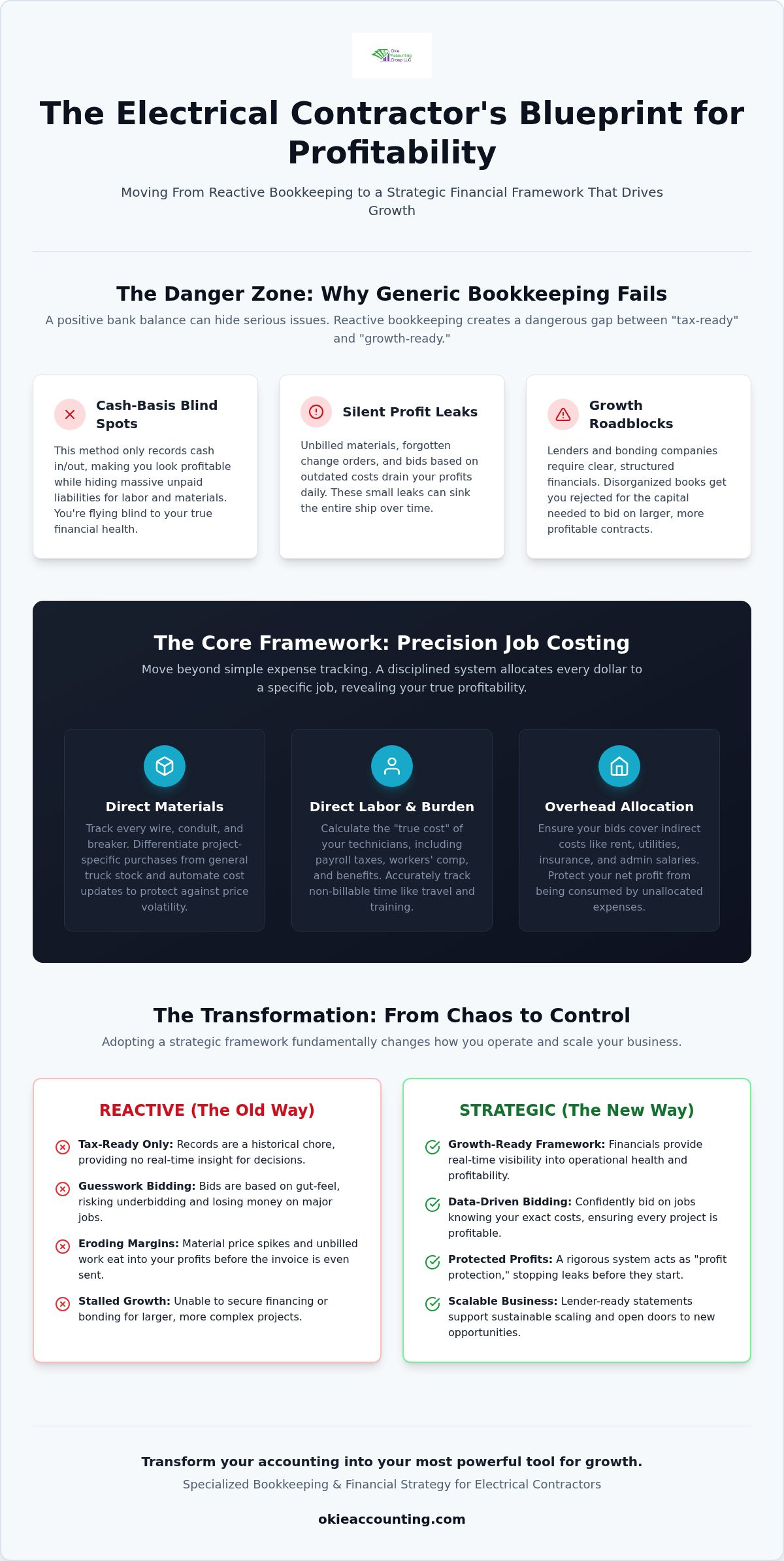
Many electrical firm owners believe that as long as their bank balance is positive and their taxes are filed, their bookkeeping is sufficient. This reactive mindset creates a dangerous gap between "tax-ready" records and "growth-ready" financial frameworks. While a generalist bookkeeper might correctly categorize a purchase of conduit as a material expense, they rarely have the specialized systems to attribute that cost to a specific residential service call or commercial build. For your firm to scale, you need a disciplined approach to bookkeeping for electrical contractors that focuses on structural integrity.
Without a rigorous system for Job Costing, your business is susceptible to silent profit leaks. These leaks often manifest as unbilled materials left on a service truck or field change orders that were performed but never made it to the final invoice. When your financial data is disorganized, it does more than just complicate your daily operations; it actively weakens your business credit rating. Lenders and bonding companies require clear, structured evidence of profitability before they'll support your expansion into larger municipal or industrial contracts.
The Complexity of Electrical Project Cycles
Electrical work rarely follows a uniform timeline. You might manage a dozen quick residential repairs in a single afternoon while simultaneously overseeing a multi-month commercial renovation. Cash-basis accounting, which only records money as it enters or leaves your bank account, often hides the true health of your firm. It can make you look profitable during a week of heavy deposits, even if you've incurred significant liabilities for labor and materials that haven't been paid yet. Transitioning to accrual-based reporting provides the professional visibility needed to understand your true obligations and project profitability at any given moment.
The High Cost of Inaccurate Data
When your financial data is messy, you're essentially guessing during the bidding process. Underbidding a project because you didn't account for the "burden" of payroll taxes or the recent fluctuations in copper prices can turn a major contract into a financial drain. Clean, professional records are a prerequisite for long-term stability. If you need to finance a new service vehicle or expand your warehouse, lenders will look for precise, reliable financial statements. Viewing your administrative tasks as "profit protection" systems rather than chores ensures that your business remains resilient and ready for strategic growth.
Mastering Job Costing: Tracking Materials, Labor, and Overhead
True project-based bookkeeping for electrical contractors relies on the precision of job costing. It isn't enough to track total monthly expenses; you must allocate every wire nut and technician hour to a specific project code. This disciplined approach creates a three-dimensional view of your financial health through three pillars: direct materials, direct labor, and labor burden. By applying specialized construction accounting methods, you move beyond simple categorization into a structural framework that tracks real-time profit margins. Indirect costs, such as shop rent or specialized diagnostic tools, must also be factored into your bids through a calculated overhead allocation rate. This ensures your "net profit" isn't actually being consumed by unallocated overhead expenses.
Tracking Materials and Inventory Fluctuations
Electrical components are notoriously volatile. Copper prices and specialized circuit breakers can shift in price between the time you bid a job and the day you pull the permit. Effective systems differentiate between "truck stock" (general inventory) and project-specific materials purchased for a single build. We help contractors use QuickBooks to automate material cost updates, ensuring your ledger reflects current market reality rather than outdated estimates. This level of detail prevents the common error of "borrowing" materials from one job to finish another. That habit inevitably distorts your project profitability data and leaves you guessing during your next bid cycle.
Labor Burden and Technician Efficiency
Your technicians are your most valuable asset, but they're also your most complex expense. The "true cost" of a field tech includes much more than their hourly rate. It encompasses payroll taxes, workers' compensation, health benefits, and even the cost of the vehicle they drive. Tracking non-billable time is equally vital for profit protection. You must account for travel between sites, training hours, and shop maintenance to understand your actual efficiency. Integrating construction payroll services allows you to automate these complex allocations. This ensures labor costs are distributed accurately across every project, providing the data you need to scale with confidence. If you're ready to build this level of precision into your firm, you can schedule a discovery call to discuss your specific needs.
Optimizing QuickBooks Online for Electrical Service and Projects
In 2026, QuickBooks Online remains the definitive industry standard for specialized bookkeeping for electrical contractors due to its robust ecosystem and automation capabilities. It's no longer just a digital ledger; it's the central hub of a structural framework that connects your field operations to your financial reporting. However, the software is only as effective as the logic behind its configuration. A generic setup often fails to distinguish between high-volume residential service calls and the long-duration commercial projects that require different revenue recognition methods. Establishing a customized Chart of Accounts that reflects your specific income streams is the first step toward gaining true operational clarity.
Integrating your field service management (FSM) software with your accounting core ensures that data flows seamlessly from the job site to the back office. When your FSM and QuickBooks are properly synced, you eliminate the manual double-entry that often leads to costly administrative errors. This integration allows for real-time visibility into project health, but it requires a precise initial configuration. Investing in a professional QuickBooks setup for contractors prevents the need for expensive data cleanup projects in the future. It ensures your financial foundation is built to support scaling rather than creating a bottleneck of disorganized information.
Essential QuickBooks Features for Electricians
To maximize the utility of your software, you must leverage advanced features like "Classes" and "Locations." These tools allow you to track the profitability of different service departments, such as residential repairs versus industrial installations, within a single report. For firms handling large-scale commercial contracts, progress invoicing is a vital feature. It allows you to bill based on completion percentages, which keeps your cash flow aligned with your material and labor outlays. Automating your bank feeds further reduces the burden of manual entry, ensuring your records stay current with minimal effort.
QuickBooks Training for Your Field Team
Your technicians are the primary source of your financial data. Training your field team to capture receipts on the job site via the mobile app ensures that emergency supply house runs are recorded immediately. When time-tracking data flows directly from the field into your project costs, you gain an accurate picture of technician efficiency without the lag of weekly timesheets. For a deep-dive into these advanced configurations, we recommend reviewing our guide on Mastering QuickBooks for Contractors. Empowering your team with these tools transforms them from simple service providers into active participants in your firm's financial health.
Beyond the Ledger: Implementing Fractional Controller Oversight
Standard bookkeeping for electrical contractors focuses on accuracy in the past; fractional controller oversight focuses on the health of your future. A fractional controller acts as a high-level strategic advisor who interprets your financial data to guide scaling decisions. While your bookkeeper ensures every invoice is recorded, a controller analyzes why certain projects consistently exceed their labor budgets. This transition from "looking backward" to "forecasting forward" is essential for firms moving from small residential crews to multi-million dollar commercial operations. It provides the disciplined methodology needed to manage complex Work in Progress (WIP) reports, ensuring you aren't accidentally financing a client's project with your own operating capital.
Beyond strategic planning, a controller establishes the internal controls necessary to protect your profit margins. In the electrical trade, material theft and unrecorded side jobs can silently erode your bottom line. A structured framework of financial oversight creates accountability, ensuring that every piece of high-value inventory is tracked from the warehouse to the job site. This level of rigorous management builds the structural integrity required to secure larger bonding capacities and more favorable lending terms. It moves your business beyond simple administration into a state of financial readiness.
Strategic Cash Flow Management
Electrical contractors often face a significant "gap" between purchasing expensive switchgear or copper and receiving the final project payment. Managing this float requires more than just a healthy bank balance. It requires a comprehensive construction cash flow management plan for 2026. By using precise project data, you can negotiate better payment terms with electrical wholesalers or adjust your progress billing cycles to keep your cash position positive. This proactive approach prevents the common "cash crunch" that stalls growth during busy seasons and ensures you always have the capital needed for the next big contract.
Monthly Financial Reviews and KPIs
Every electrical owner must monitor specific key performance indicators (KPIs) to maintain operational control. You should review your Profit & Loss statement categorized by project type, distinguishing between high-margin service calls and high-volume installations. Monitoring your labor-to-revenue ratio and gross profit margin per technician provides immediate feedback on your team's efficiency. Specialized fractional controller services bridge the gap between basic administrative tasks and high-level strategy, turning your financial reports into a roadmap for expansion. If you're ready to move beyond the ledger and take strategic control of your firm's growth, book a discovery call with our team today to discuss a customized framework for your business.
Scaling Your Electrical Business with Okie Accounting Group
Scaling a specialized trade business requires more than just keeping the lights on; it requires a financial engine that supports your ambition. At Okie Accounting Group, we provide the specialized structural framework that allows your firm to move beyond basic survival. We don't just record transactions. We act as a strategic financial partner, helping you interpret data to protect your margins and fund your next crew. By offering customized solutions for monthly bookkeeping, payroll management, and fractional controller oversight, we ensure your back office is as efficient as your best field technician. This disciplined approach transforms your financial data from a historical record into a roadmap for expansion.
A Partnership Built for Contractors
Sarah O’Quinn’s specialized approach is rooted in a deep understanding of construction and specialty trades. We provide nationwide remote support while maintaining the grounded, reliable values of our Tennessee roots. This combination of technical expertise and personal dedication is what defines our bookkeeping for electrical contractors. When you invest in professional management accounting, you gain the peace of mind that comes from knowing your data is accurate, organized, and ready for any audit or expansion opportunity. It's about moving from a state of complexity to one of operational clarity and confidence.
Your Path to Financial Readiness
Every firm’s journey starts at a different point. You might need a comprehensive QuickBooks cleanup to untangle years of messy data, or perhaps you're looking for a fresh strategic setup to support a new division. Regardless of your starting point, our goal is to move you toward lender-ready financials. These are the documents that convince banks and bonding companies that your firm is a stable, low-risk investment. Having organized systems in place means you're always ready for the next big contract or equipment purchase. If you're ready to stop guessing about your profits and start building a legacy, it's time to take the next step. Schedule a strategy session with Okie Accounting Group to build the financial foundation your business deserves.
Securing the Future of Your Electrical Firm
Transitioning from reactive record-keeping to a project-based financial framework is the defining step for any owner ready to scale. By mastering job costing and optimizing your QuickBooks configuration, you gain the real-time visibility needed to protect your profit margins. This disciplined approach ensures that every material fluctuation and labor hour is accounted for. It transforms your accounting from a back-office burden into a strategic asset that supports sustainable growth and long-term health.
Effective bookkeeping for electrical contractors requires a partner who understands the unique mechanics of the trade. With our specialized construction expertise and nationwide remote support, Okie Accounting Group builds the foundational systems your business needs for stability. Our fractional controller strategy provides the high-level oversight necessary to move from historical data to proactive forecasting. Schedule Your Strategic Financial Review with Okie Accounting to gain the clarity and control required for your next stage of expansion. You've built a reputation for quality work in the field; it's time to build a financial framework that matches it.
Frequently Asked Questions
What is the best accounting software for electrical contractors in 2026?
QuickBooks Online is the definitive industry standard for 2026 because of its ability to integrate with specialized field service management tools. It allows you to sync job site data directly with your back office, which reduces manual entry and ensures your bookkeeping for electrical contractors remains accurate. When properly configured, it provides the structural integrity needed to track diverse income streams across residential and commercial sectors.
How do I handle job costing for small electrical service calls versus large projects?
Small service calls should be grouped by department using Classes, while large projects require individual project codes for granular tracking. This distinction allows you to analyze high-volume profitability separately from long-term contract performance. By applying these different methodologies, you ensure that small leaks in service call efficiency don't get buried under the larger numbers of a commercial build.
Why is my electrical business busy but not showing a profit in my bank account?
A lack of cash despite a full schedule often points to poor cash flow management or hidden profit leaks. You might be financing material purchases long before receiving client payments; or perhaps unbilled change orders are eroding your margins. Professional financial reporting helps identify where your capital is tied up, allowing you to adjust your billing cycles and protect your operating cash.
Do I need a bookkeeper or a fractional controller for my electrical company?
You need a bookkeeper for daily accuracy and a fractional controller for strategic growth. A bookkeeper ensures your transactions are categorized correctly, but a controller interprets that data to guide your expansion. If you're struggling to understand why your margins are shrinking or need lender-ready financials for a new equipment loan, implementing fractional controller services is the next logical step.
How should I track "burdened" labor costs for my field technicians?
Tracking burdened labor requires calculating the "true cost" of a technician, including payroll taxes, benefits, and insurance. This figure is significantly higher than their base hourly wage. By integrating payroll management into your job costing, you can allocate these costs accurately across projects. This ensures your bids reflect the actual expense of having a crew in the field.
What are the most common tax deductions for electrical contractors?
Electrical contractors can typically deduct expenses related to specialized diagnostic tools, vehicle maintenance, and safety equipment. While we don't provide tax preparation, our bookkeeping services ensure these expenses are tracked and categorized throughout the year. Having organized, professional records makes it easier for your tax professional to identify every eligible deduction and protect your bottom line.
How does Work in Progress (WIP) accounting affect my financial statements?
WIP accounting ensures that revenue is recognized as it's earned rather than just when invoices are sent or payments are received. This prevents your financial statements from showing artificial peaks and valleys during long-term projects. It provides a more stable and accurate view of your firm's health, which is essential for maintaining business credit and securing bonding for larger contracts.
Can Okie Accounting help me fix a messy QuickBooks file from previous years?
Yes, we specialize in QuickBooks cleanup and strategic setup for contractors who need to restore order to their financial data. We analyze your existing file to identify errors in categorization, unreconciled accounts, and messy job costing structures. Once the data is corrected, we provide the training needed to ensure your team maintains a clean and reliable system moving forward.


Comments