Average Accounting Fees for Small Construction Companies in 2026

Updated: 6 days ago
In the construction industry, you aren't simply paying an accountant for data entry; you're investing in the structural integrity of your profit margins. Many owners find themselves searching for the average accounting fees for small construction company options because their current QuickBooks file is a mess that doesn't reflect the reality of their job sites. It's frustrating to feel like you're operating in a financial fog, unable to bid on new projects with confidence because you don't know if your last one actually made money. You've likely noticed that shrinking margins and untracked job costs are making it harder to scale, even when your crew is busier than ever.
We understand that you need more than just a history of what you spent. This guide will help you discover the real-world costs of specialized construction accounting and show you how to transition from basic administrative tasks to a strategic financial framework. We'll explore current market trends for 2026 and the specific reporting systems you need to protect your bottom line and ensure your payroll and compliance are handled with precision.
Why Construction Accounting Fees Differ from Standard Small Business Rates
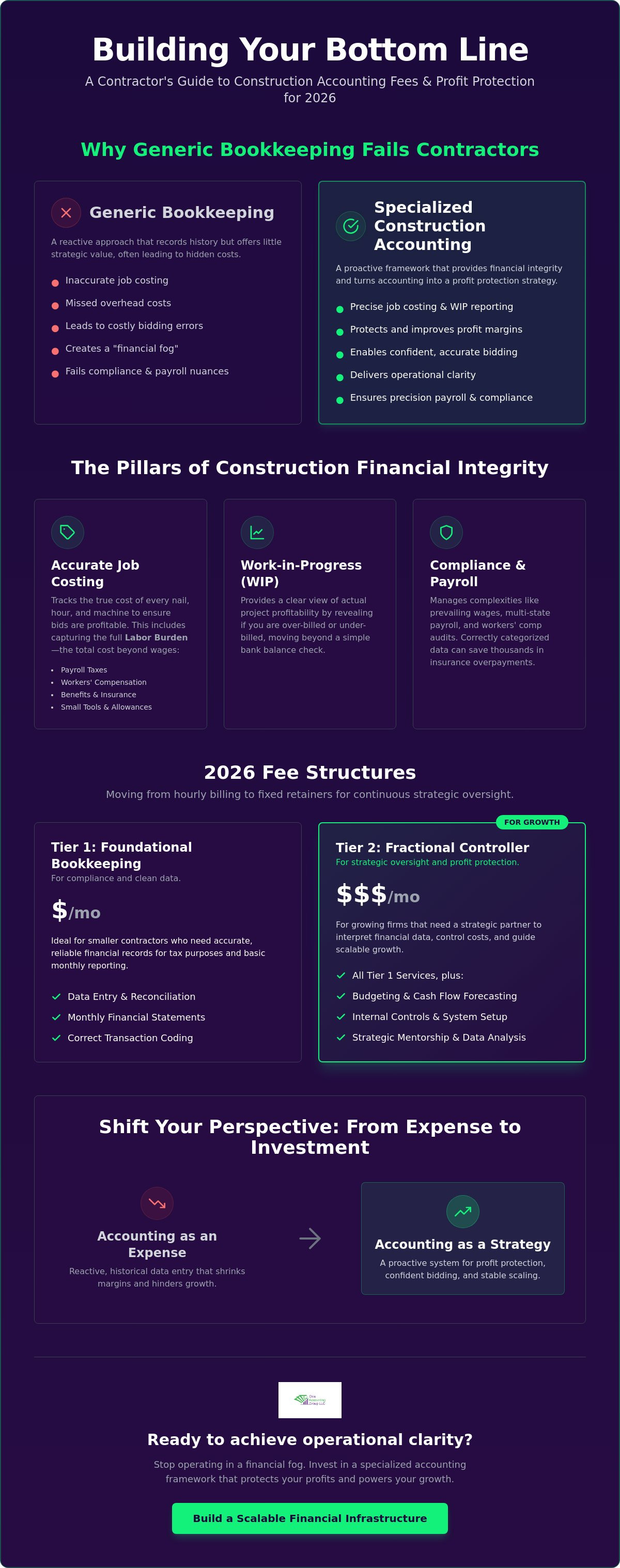
Construction accounting isn't a standard administrative task; it's a specialized discipline that requires a deep understanding of project-based financial health. Many contractors initially look for the average accounting fees for small construction company rates and compare them to what a local retail shop or consulting firm pays. This comparison is often misleading. While a generalist bookkeeper can reconcile a bank statement, they frequently lack the technical expertise to handle the intricate mechanics of job costing and revenue recognition that the industry demands.
When you hire a generalist, you aren't just saving money on monthly fees. You're often incurring hidden costs through missed overhead and inaccurate project bids. If your accounting system doesn't reflect the true cost of every nail, hour, and machine used on a site, your profit margins will inevitably shrink. In 2026, the baseline for professional oversight has shifted. Successful firms no longer settle for reactive compliance. They require a proactive strategy that treats financial data as a tool for profit protection.
The Complexity of Job Costing and WIP
Unlike a retail business where a sale is recorded instantly, construction involves long project timelines and fluctuating expenses. Construction accounting principles dictate that costs must be tracked by project to ensure accurate reporting. This is where Work-in-Progress (WIP) reports become essential. A WIP report allows you to see if you're over-billed or under-billed on a project, providing a clear view of your actual profitability rather than just your bank balance. This level of detail is a core component of management accounting for builders.
Labor burden is the total cost of an employee beyond their hourly wage.
Accurate job costing relies on capturing this figure, which includes payroll taxes, workers' compensation insurance, benefits, and small tools. Without this data, you're essentially guessing at your most significant expense. Understanding the average accounting fees for small construction company models is the first step in recognizing that specialized tracking requires more time and expertise than general business bookkeeping.
Compliance and Payroll Nuances
The administrative weight of construction payroll is significantly higher than in other sectors. You may be dealing with prevailing wage requirements on public projects or managing multi-state payroll if your crews cross borders. Professional accounting simplifies these complexities, especially during insurance audits. When your workers' compensation audit arrives, having your payroll data categorized correctly by class code can save you thousands in overpayments.
A specialized partner ensures these systems are built into your daily operations. This moves your business away from basic data entry and toward a scalable financial framework. By investing in specialized oversight, you gain the confidence that your payroll and compliance are handled with precision, allowing you to focus on the build.
2026 Fee Structures: Bookkeeping vs. Fractional Controller Services
Understanding the average accounting fees for small construction company models requires a clear distinction between administrative support and strategic leadership. In 2026, specialized firms have largely moved away from unpredictable hourly billing toward fixed monthly retainers. This model ensures continuous oversight rather than a reactive scramble at year-end. You aren't just paying for a tax return. You're paying for a clear, real-time view of your financial health that allows you to bid with confidence.
The transition from historical recording to forward-looking strategy is what separates a standard bookkeeper from a specialized partner. While a generalist simply records what happened last month, a construction-focused firm helps you predict what will happen next quarter. This shift is critical for maintaining cash flow and protecting your project-level profitability. It allows you to move from a state of financial fog to one of operational clarity. When you evaluate the average accounting fees for small construction company structures, you must determine if you're paying for simple data entry or a comprehensive financial system.
Tier 1: Monthly Bookkeeping and Reconciliations
This foundational level focuses on data accuracy and monthly financial statement preparation. It's ideal for smaller subcontractors or general contractors with low transaction volumes who need clean books for compliance. By implementing Construction Bookkeeping Services, you ensure every transaction is coded correctly to the right project. This is the first step toward true financial clarity and organized systems.
Tier 2: Fractional Controller and Strategic Oversight
For growing firms, a fractional controller provides high-level oversight, including budgeting, internal controls, and data interpretation. This professional acts as a strategic mentor, helping you understand what the numbers actually mean for your business's health. Many experts within the Construction Financial Management Association (CFMA) emphasize that this level of service moves beyond data entry into active profit protection. Utilizing Fractional Controller Services allows you to build a scalable financial framework that supports long-term health and stability.
Between these two tiers lies full-service accounting, which often includes payroll management and more frequent reporting. Choosing the right tier depends on your current revenue, the complexity of your projects, and your appetite for growth. A basic service might keep you compliant, but strategic oversight keeps you profitable. If you're unsure which level fits your current project load, you can schedule a brief conversation to assess your specific needs.
Key Factors That Drive Accounting Costs for Contractors
Pricing for specialized financial oversight isn't a random figure. While generalist platforms might suggest that location is a primary driver, modern construction-focused firms prioritize complexity and the depth of the structural framework required. When you evaluate the average accounting fees for small construction company operations, you must consider the specific demands of your project list. A firm managing five high-value commercial builds has vastly different needs than a residential remodeler juggling thirty active jobs simultaneously. The more moving parts your business has, the more rigorous the oversight needs to be.
Transaction volume is a major component, but the "clean-up" factor often dictates the initial investment. If your QuickBooks file hasn't been reconciled in six months or doesn't reflect actual job costs, a professional must first establish a reliable baseline. This foundational work ensures that future data is accurate and trustworthy. Additionally, the frequency of payroll management and the depth of financial reporting you require will directly influence the monthly retainer. Moving from a basic P&L to detailed cash flow forecasting requires a higher level of technical expertise and time.
The Impact of Project Volume on Fees
Administrative time scales with the number of active projects, not just your total revenue. A general contractor managing twenty active jobs requires significantly more documentation oversight than one with two large multi-year projects. Every job requires specific sub-contracts, material receipts, and labor allocations. This granular tracking is what protects your margins, but it also increases the workload for your accounting partner. Managing these job-specific details is essential for maintaining the structural integrity of your financial data and ensuring nothing slips through the cracks during a busy season.
Software and System Integration
The complexity of your tech stack plays a vital role in determining your costs. Legacy systems often require manual workarounds that increase labor hours and the risk of error. Conversely, modern cloud-based systems allow for automation that can reduce long-term costs by streamlining data entry. Investing in professional QuickBooks setup and training is often the most cost-effective move a contractor can make. It ensures your software is configured correctly from the start, allowing for seamless integration between your field data and your financial reports. This organized approach makes the average accounting fees for small construction company models more predictable and manageable for the long-term health of your firm.
Evaluating ROI: Is Professional Accounting Worth the Cost?
When evaluating the average accounting fees for small construction company options, it's tempting to view the monthly retainer as a drain on overhead. However, a disciplined contractor views specialized accounting as a form of profit protection. In an industry where margins are often razor-thin, a single error in job costing can erase the profitability of an entire project. For example, if you underbid a $100,000 project by just 5% due to inaccurate historical data, you've lost $5,000 before the first shovel hits the ground. That loss alone often exceeds several months of professional oversight. Investing in a specialized partner ensures that the average accounting fees for small construction company services are treated as a strategic asset rather than a sunk cost.
Beyond project-level math, consider the value of your own time. If you spend ten hours every month wrestling with QuickBooks instead of bidding on new work or managing your crews, you're incurring a significant opportunity cost. If your strategic value to the firm is $150 per hour, that's $1,500 of lost revenue every month. Professional financial reporting doesn't just provide data; it buys back your capacity to lead and grow the business. It allows you to step out of the administrative weeds and into a high-level advisory role within your own company.
Banks and bonding companies in 2026 require more than just a tax return; they demand structural financial integrity. Lender-ready financials demonstrate that your firm is managed with precision and reliability. This transparency makes it significantly easier to secure the credit lines and bonding capacity necessary for larger, more lucrative contracts. Without this foundation, your growth is capped by the limits of your current cash on hand, regardless of how much work is available in the market.
Spotting Red Flags in Low-Cost Quotes
A "dirt cheap" quote usually indicates a generalist who lacks the technical language of the construction sector. These providers often miss industry-specific nuances, leading to messy data that requires expensive clean-up later. They might record a deposit as income or fail to track retainage correctly, resulting in tax-time surprises and a distorted view of your actual cash position. You aren't just paying for a service; you're paying for the accuracy that prevents these costly disruptions and keeps your business in a state of financial readiness.
Financial Readiness for Scaling
Scaling a construction company is a high-risk endeavor. A firm can easily double in size and still face bankruptcy if its financial systems aren't prepared for the strain. Implementing a robust structural framework ensures that your business remains stable during rapid growth. Effective Cash Flow Management is the primary tool that prevents growth-related insolvency. It provides the foresight needed to manage the gap between paying for materials and receiving project draws, ensuring that your expansion is sustainable and your profits are protected. If you're ready to move from basic data entry to a strategic partnership that protects your margins, you can request a discovery call to discuss your firm's specific needs.
The Okie Accounting Approach: Building Your Financial Infrastructure
Okie Accounting Group LLC serves as a specialized partner rather than a simple service provider. We recognize that contractors don't just need someone to reconcile accounts; they need a strategic architect for their financial data. While many owners focus solely on the average accounting fees for small construction company options, the true differentiator is the depth of the structural framework provided. Our approach prioritizes financial clarity and strategic oversight for service-based entrepreneurs who are ready to move beyond administrative chaos. We provide a disciplined system that produces reliable data, allowing you to focus on the build while we focus on the bottom line.
Our team delivers remote, nationwide expertise, ensuring that firms across the US can access high-level leadership. Sarah O’Quinn’s mentor-led philosophy ensures you receive proactive guidance rather than just reactive reports. This dedication to accuracy and long-term stability distinguishes Okie Accounting Group LLC from generalist providers. We speak your language, understanding the unique mechanics of your specific market and the technical nuances of your projects. By adopting a proactive stance, we alleviate the industry-specific stresses that often keep business owners awake at night.
Beyond Basic Bookkeeping
Effective Management Accounting is the heartbeat of a disciplined operation. It moves the needle from simple compliance to active profit protection. By utilizing the fractional model, you secure expert-level oversight without the burden of a full-time executive salary. This structured approach allows you to benefit from Fractional Controller Services that adapt to your firm's growth. It's the transition from managing tasks to constructing a comprehensive system that supports your long-term health and operational confidence.
Getting Started with a Strategic Partner
The journey toward financial readiness begins with a professional setup that ensures data integrity from the start. We help you move from a state of complexity to one of operational clarity. When your systems are built correctly, you can make choices based on facts rather than abstract theories. You'll gain the confidence to bid accurately and the stability to scale without breaking your internal processes. If you're ready to stop worrying about the average accounting fees for small construction company rates and start building a framework for success, schedule a consultation with Okie Accounting Group LLC today.
Strengthening Your Firm’s Financial Foundation
Mastering your project-level profitability requires more than just a tax-ready ledger; it demands a comprehensive structural framework. We've examined how the average accounting fees for small construction company models reflect the specialized discipline required to track WIP and labor burden with precision. By shifting your perspective from viewing accounting as an overhead cost to a profit protection strategy, you ensure your firm remains stable through every growth phase. A scalable financial system provides the clarity needed to bid with confidence and the control required to protect your margins.
Okie Accounting Group LLC offers the specialized expertise in construction and real estate necessary to navigate the complexities of 2026. Through the strategic mentor-led approach of Sarah O’Quinn and our cloud-based, nationwide efficiency, we help you transition from financial fog to data-driven leadership. You don't have to manage these technical nuances alone. It's time to implement an organized system that mirrors the quality of the projects you build.
Gain financial clarity with specialized construction accounting from Okie Accounting Group LLC. Your firm deserves a partner as invested in your success as you are; let's build your financial future together.
Frequently Asked Questions
How much does a bookkeeper for a small construction company cost per month?
Monthly bookkeeping services for construction firms generally range from $250 to $499 depending on transaction volume and the complexity of the accounts. This baseline covers basic data entry and bank reconciliations but rarely includes specialized job costing or WIP reporting. When evaluating the average accounting fees for small construction company options, it's important to distinguish between simple administrative support and the robust financial systems required to protect your project margins.
Is it better to hire an in-house accountant or an outsourced service?
Outsourcing often provides a higher return on investment by giving you access to specialized expertise without the overhead of a full-time salary. An in-house hire requires benefits, equipment, and ongoing training, whereas a fractional partner offers a scalable framework. This approach allows you to leverage high-level financial leadership and advanced reporting systems while maintaining the flexibility to adjust services as your project volume fluctuates throughout the year.
What is the difference between a bookkeeper and a construction controller?
A bookkeeper focuses on recording historical transactions and maintaining accurate ledgers, while a construction controller provides strategic oversight and forward-looking analysis. Controllers implement internal controls, manage cash flow forecasting, and interpret data to improve project-level profitability. While a bookkeeper ensures your bank statements match your records, a controller builds the structural integrity necessary for scaling your business and protecting your long-term financial health.
Why are accounting fees higher for construction than for other industries?
Construction accounting is significantly more complex than standard retail or service accounting due to project-based tracking and specialized reporting requirements. Managing Work-in-Progress (WIP) reports, calculating accurate labor burden, and tracking expenses across multiple job sites require additional time and technical knowledge. These layers of detail are essential for identifying project profitability but demand a higher level of professional discipline than general business bookkeeping.
Can I use standard QuickBooks for my construction company?
You can use standard QuickBooks Online, but it requires a specialized setup to track job costs and project profitability effectively. Without a proper chart of accounts and project-level configuration, the software won't provide the visibility needed to manage a contracting business. Professional setup and training ensure that your data entry reflects the reality of your job sites, turning a basic tool into a powerful financial system that supports your growth.
How much should I expect to pay for a QuickBooks setup for my contracting business?
The investment for a professional QuickBooks setup depends on the complexity of your current operations and the depth of reporting you require. A proper configuration involves building a customized chart of accounts, establishing job costing workflows, and integrating payroll systems. This foundational work ensures your financial data is accurate from day one, preventing the need for expensive clean-up projects later and providing immediate clarity on your project margins.
Do construction accounting fees include tax preparation?
What happens if my construction books are currently a mess?
If your books are disorganized, the first step is a comprehensive clean-up project to establish a reliable financial baseline. A specialized partner will reconcile old transactions, fix misclassified expenses, and reorganize your chart of accounts for better job costing. This process clears the financial fog and creates a stable foundation, allowing you to transition from reactive troubleshooting to proactive, data-driven decision-making for your business's future.


Comments