
Bench Accounting Alternatives for Trade Contractors: Beyond Automated Bookkeeping

Generic automated bookkeeping is often marketed as a "set it and forget it" solution, but for a specialty contractor, ignoring the granular details of your books is the fastest way to erode your project margins. If you've been searching for Bench accounting alternatives for trade contractors, you've likely realized that a generalist service can't track the job costing or labor burdens that define your success. You're likely tired of explaining the difference between a mobilization fee and a progress payment to a rotating cast of bookkeepers who don't understand the mechanics of a construction site.
This guide explores why you need to shift from simple data entry to a specialized financial partnership that prioritizes project-level intelligence. You'll discover how the right framework can transform your books from a tax-time headache into a strategic tool for driving profitability. We'll break down the limitations of automated platforms, the benefits of a scalable QuickBooks Online system, and how dedicated oversight in the Tennessee and Florida markets can stabilize your cash flow between project draws.
The Limitations of Bench for Trade Contractors
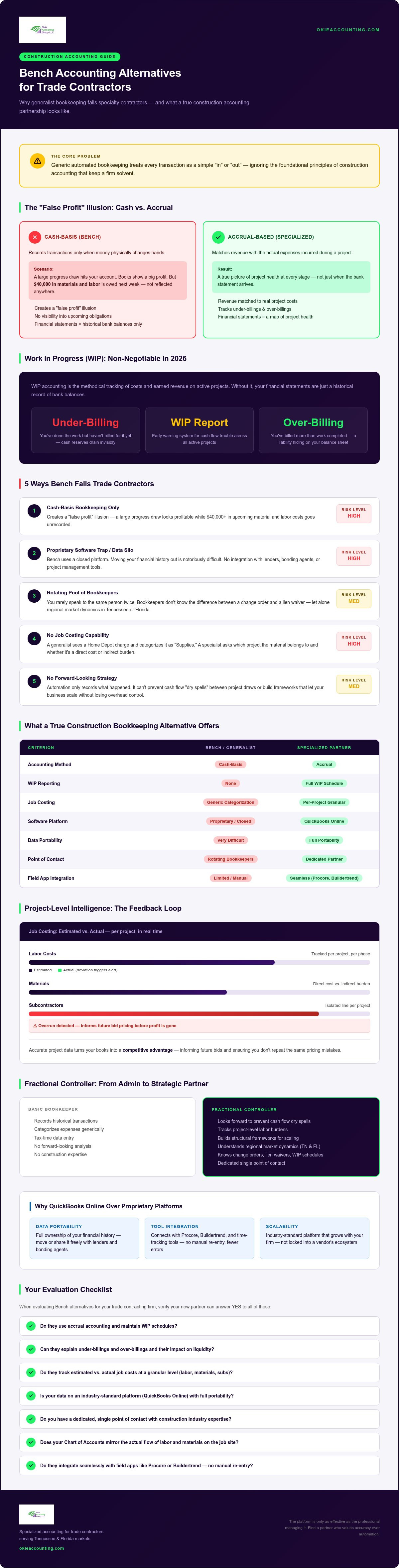
Bench is a popular choice for simple service businesses, but trade contractors operate in a world of high-risk margins and complex project cycles. When you search for Bench accounting alternatives for trade contractors, you're usually looking for more than just a place to categorize expenses. You need a system that understands the nuances of the job site. Generalist platforms often fail because they treat every transaction as a simple "in" or "out," ignoring the foundational principles of construction accounting that keep a firm solvent.
Cash vs. Accrual Accounting in Construction
The biggest danger for contractors using Bench is the reliance on cash-basis bookkeeping. Cash accounting only records transactions when money physically changes hands. This creates a "false profit" illusion. You might see a massive deposit from a progress draw and think you're flush, while failing to account for the $40,000 in materials and labor you'll owe next week. Accrual accounting is the only way to match revenue with the actual expenses incurred during a project.
In 2026, maintaining a clear Work in Progress (WIP) report is non-negotiable for trade contractors. WIP accounting is the methodical tracking of costs and earned revenue on active projects to prevent under-billings from draining your cash reserves. Without this, your financial statements are just a historical record of bank balances rather than a map of project health.
The Proprietary Software Trap
Bench operates on a closed, proprietary platform. While it looks clean, it's a data silo. If you ever decide to leave, moving your financial history into a different system is notoriously difficult. Trade contractors need the flexibility of industry-standard tools like QuickBooks Online. This software integrates with your project management tools and makes it easy to share data with lenders or bonding agents. If your current system doesn't allow for this level of portability, it's time to consider QuickBooks training and setup to regain control of your data.
Beyond the software, Bench utilizes a rotating pool of bookkeepers. You rarely speak to the same person twice, and they likely don't know the difference between a change order and a lien waiver. For a business in Tennessee or Florida, having a dedicated partner who understands regional market dynamics and construction-specific job costing is the difference between scaling up and burning out. Finding Bench accounting alternatives for trade contractors isn't just about software; it's about finding a partner who values accuracy over automation.
Key Criteria for a True Construction Bookkeeping Alternative
Selecting a partner to manage your finances requires looking beyond simple data entry. When you evaluate Bench accounting alternatives for trade contractors, your primary filter should be the firm's ability to handle the specific complexities of the job site. A generalist bookkeeper sees a Home Depot charge and categorizes it as "Supplies." A specialized partner asks which project the material belongs to and whether it's a direct cost or an indirect burden. This distinction is the difference between knowing your bank balance and knowing your project margins.
A true alternative must offer a framework that supports your growth. While Forbes provides a list of the best construction accounting software, the platform is only as effective as the professional managing it. You need a partner who understands Work in Progress (WIP) schedules and can accurately calculate under and over billings. These metrics are the early warning signs of cash flow trouble. If your bookkeeper can't explain how these impact your liquidity, they aren't the right fit for a scaling trade business.
Project-Level Intelligence
Your financial reports should act as a feedback loop for your estimating team. Effective job costing requires a granular breakdown of labor, materials, and subcontractors for every single project. By tracking "Estimated vs. Actual" costs in real time, you can identify where a job is slipping before the profit is gone. This data informs future bidding, ensuring you don't repeat the same pricing mistakes on the next contract. Accurate project data turns your books into a competitive advantage.
Fractional Oversight vs. Basic Admin
As your firm grows, your needs shift from simple administrative tasks to high-level strategy. This is where fractional controller services become essential. A controller doesn't just record what happened; they look forward to prevent cash flow "dry spells" between project draws. They build the structural frameworks that allow your business to scale without losing control of your overhead. Strategic oversight ensures that your financial readiness matches your operational capacity.
Finally, your chosen partner should facilitate seamless integration with your field apps. Whether you use Procore, Buildertrend, or a specialized time-tracking tool, your financial data must flow into QuickBooks Online without manual re-entry. This connectivity reduces errors and ensures your project managers have the data they need to make decisions on the ground. If you're ready to move beyond automated summaries and toward project-level clarity, you can schedule a discovery call to discuss a more specialized approach.
Comparing Top Bench Alternatives for Contractors
Identifying the right financial partner requires a clear understanding of your growth stage and project complexity. When evaluating Bench accounting alternatives for trade contractors, you'll generally encounter three distinct models: specialized boutique firms, generalist virtual services, and hybrid internal-external setups. Each has a different impact on your ability to track job costs and maintain financial readiness for bonding or bank draws.
Specialized boutique firms operate as a strategic extension of your business. These partners understand the technical language of the job site, including lien waivers, progress billings, and labor burdens. In contrast, generalist virtual services like Pilot or Maxim Liberty prioritize high-volume automation. While these services are efficient for a standard retail or SaaS business, they often struggle with the nuanced categorization required for specialty trades. Choosing between these models is essentially a choice between a software-led approach and an expert-led approach. For a contractor, the expert-led model provides the project-level intelligence that software alone cannot replicate.
The Cost of "Cheap" Bookkeeping
Low-cost generalist services often seem attractive because of their entry-level pricing. However, "cheap" bookkeeping frequently leads to expensive tax-time cleanups. Generalists often miss industry-specific tax credits or fail to categorize expenses in a way that maximizes your project margins. If your books aren't audit-ready, the hidden expense of re-doing an entire year of data for a bank loan or a bonding agent can be devastating. Understanding how much construction bookkeepers charge is less about the monthly fee and more about the value of having a structural framework that protects your profits.
Industry-Specific Tech Stacks
A true alternative to Bench must facilitate a modern, connected tech stack. Your accounting system shouldn't be a silo; it should be the hub for your entire operation. Specialized partners ensure that QuickBooks Online integrates seamlessly with field apps like Procore, Buildertrend, or Jobber. This connectivity ensures that data flows from the job site to the back office without manual entry errors. Data portability is a non-negotiable requirement for a growing firm. You must own your data and have the ability to export it into any format required by your strategic partners, from lenders to insurance auditors. A specialized system built on QuickBooks Online provides this stability and flexibility as you scale.
How to Transition from Bench to a Specialized Partner
Moving your financial data away from an automated platform is a significant milestone in your firm's growth. It requires a disciplined transition plan to ensure no project data is lost during the move. When evaluating Bench accounting alternatives for trade contractors, the migration process should focus on structural integrity rather than just speed. A clean break from a generalist system allows you to rebuild your books with a focus on project-level profitability.
Step 1: Audit your current Chart of Accounts. Bench often uses a generic setup that lacks construction-specific categories. You need to reorganize your accounts to reflect direct project costs like labor and materials versus administrative overhead.
Step 2: Clean up historical data. Automated systems often miscategorize construction-specific transactions. Moving to QuickBooks Online provides a fresh start with verified, accurate data.
Step 3: Establish a job costing framework. Map every active project's expenses to specific phases to ensure you're capturing the true cost of every job.
Step 4: Train your field team. Financial accuracy starts on the job site with precise time and expense tracking. Your team needs to understand how their data entry impacts the bottom line.
Step 5: Schedule your first monthly strategic review. Use this time to analyze project profitability and cash flow with your new partner.
The QuickBooks Migration Process
Exporting data from a proprietary system like Bench can be complex. You must ensure that your opening balances are accurate before importing them into a more flexible environment. Utilizing contractor-specific features in QuickBooks Online allows you to track labor burden and subcontractor certificates effectively. For many firms, professional QuickBooks Setup and Training is the best way to avoid the common pitfalls of a DIY migration. This ensures your new system is built for scalability from day one.
Establishing New Financial Habits
A specialized partnership requires a shift in your daily operations. You're moving from a "once-a-year" tax mindset to a culture of monthly financial discipline. Regular bank reconciliations are vital for maintaining an accurate view of project cash flow. This consistency ensures you aren't surprised by a lack of funds during a critical project draw. By mastering construction cash flow management, you gain the clarity needed to bid on larger contracts with confidence. If you're ready to build a financial foundation that supports your long-term goals, you can schedule a consultation to begin your transition today.
Okie Accounting: The Specialized Choice for TN and FL Contractors
Selecting a financial partner is a pivotal decision that dictates the trajectory of your firm's stability. While many Bench accounting alternatives for trade contractors offer basic bookkeeping, Okie Accounting Group LLC provides the specialized oversight that only comes from a deep focus on the construction and real estate sectors. Led by Sarah O’Quinn, our firm views financial data as the structural foundation of a business. We don't just record transactions; we build systems that protect your margins and clarify your path to growth.
Our partner mindset distinguishes us from high-volume virtual services. We are as invested in your project profitability as you are, moving beyond simple administrative support to act as a high-level advisor. For a contractor, this means having a partner who understands the difference between a progress billing and a final retention payment. Okie Accounting Group LLC bridges the gap between the field and the office, ensuring that your financial readiness matches your operational ambitions.
Local Expertise in Tennessee and Florida
Regional compliance is a significant hurdle for contractors operating in multiple jurisdictions. Tennessee and the Jacksonville, Florida market have specific sales tax and payroll requirements that generalist firms often overlook. As QuickBooks Online Certified ProAdvisors, we combine technical proficiency with local market intelligence. Whether you are navigating the Nashville growth surge or managing a service fleet in Jacksonville, Okie Accounting Group LLC provides the remote leadership necessary to maintain compliance and financial health.
Building a Structural Framework for Growth
Moving beyond simple data entry is the first step toward long-term stability. Our Fractional Controller Services are designed for firms that require more than just a history of their bank balance. We help you transition from reactive management to a proactive strategy where you control your cash flow forecasting and overhead burdens. This shift from an "admin" focus to strategic financial leadership is what allows a trade business to scale without losing its grip on project margins.
Your business deserves a partner that speaks the technical language of the trade and understands the mechanics of your specific market. If you are ready to implement a professional financial system that supports your vision, it is time to connect with a specialist. You can schedule a consultation with Okie Accounting Group LLC to discuss how we can stabilize your books and drive your profitability.
Building Your Strategic Financial Foundation
Trade contractors require a level of financial intelligence that generalist automated platforms simply can't provide. Finding the right Bench accounting alternatives for trade contractors is about more than picking new software; it's about choosing a dedicated partner who understands the high-risk nature of your project margins. By moving to a specialized framework, you ensure every labor hour and material purchase is accounted for, providing the clarity needed to bid on larger, more complex contracts with confidence.
Okie Accounting Group LLC offers the disciplined oversight and project-level reporting required to move your business from reactive survival to strategic growth. As QuickBooks Online Certified ProAdvisors with a specific focus on the Tennessee and Jacksonville, Florida markets, we provide the stability and financial readiness your firm deserves. We're committed to building the structural systems that protect your profit and support your long-term vision.
Ready for financial clarity? Schedule your strategic review with Okie Accounting Group LLC.
Your financial data should be as reliable as the structures you build. Let's work together to create a foundation that drives your success.
Frequently Asked Questions
Why is Bench Accounting not recommended for trade contractors?
Bench primarily utilizes a cash-basis model, which fails to match project revenue with the timing of labor and material costs. Trade contractors evaluating Bench accounting alternatives for trade contractors require accrual accounting and Work in Progress tracking to see their true health. Without these construction-specific frameworks, an automated service cannot identify under-billings, leaving your business vulnerable to cash flow dry spells.
Can I move my Bench data into QuickBooks Online?
You can move your financial history, but it requires a methodical migration process to maintain data integrity. Since Bench uses a proprietary system, you must export your records and reconcile them within a new QuickBooks Online environment. Okie Accounting Group LLC specializes in these transitions, ensuring that your opening balances are accurate and that your new Chart of Accounts is built for construction logic.
What is job costing, and why do trade contractors need it?
Job costing is the practice of assigning every expense, including labor, materials, and subcontractors, to a specific project. It is vital for trade contractors because it provides project-level intelligence that standard bookkeeping ignores. By tracking these costs in real time, you can identify which jobs are profitable and which are losing money. This data allows for more precise bidding and protects your overall business profitability.
Does Okie Accounting Group LLC provide fractional controller services for Florida businesses?
Yes, Okie Accounting Group LLC offers fractional controller services to contractors in Jacksonville and throughout Florida. We move beyond basic data entry to provide high-level strategy and cash flow forecasting. Our team focuses on the specific financial mechanics of the Florida market, ensuring your business maintains the structural integrity required for long-term growth and regional tax compliance.
How much does specialized construction bookkeeping cost compared to Bench?
Specialized construction bookkeeping typically involves a higher monthly investment than a generalist automated service. This is because it includes granular project tracking that Bench cannot provide. When evaluating Bench accounting alternatives for trade contractors, the value lies in the data-driven insights that protect your margins. Accurate reporting pays for itself by preventing the expensive year-end cleanups caused by miscategorized project expenses.
Is QuickBooks Online better than Bench’s proprietary software?
QuickBooks Online is the industry standard for trade contractors because of its open ecosystem and scalability. Bench’s proprietary software is a closed system, making it difficult to integrate with field apps like Procore or Jobber. QuickBooks allows for seamless data flow across your entire tech stack. This connectivity ensures that your project managers and office team are working from the same set of accurate, real-time financial data.
What happens if my books are currently a mess and I want to switch?
We begin every new partnership with a comprehensive cleanup and QuickBooks setup phase. Okie Accounting Group LLC audits your historical data to correct mis-categorizations and reconcile accounts that have been neglected. This process establishes a reliable financial foundation. Once your books are accurate, we move into a steady rhythm of monthly oversight and strategic reporting to ensure your business stays on track.
Does Okie Accounting Group LLC handle construction payroll and compliance?
Okie Accounting Group LLC manages full-cycle payroll tailored to the construction sector. We ensure labor burdens are accurately allocated to specific jobs and that your business remains compliant with Tennessee and Florida regulations. By integrating payroll with your general ledger, we provide a complete view of project-level profitability that generic services often miss during their automated categorization process.


Comments