Bookkeeping for BRRRR Real Estate: 2026 Strategy

Updated: 6 days ago
The success of your refinance isn't determined at the bank; it's decided in the messy trenches of your rehab accounting. While most investors focus on the "Buy" and "Rehab," the ability to scale your portfolio in 2026 hinges on your mastery of bookkeeping for BRRRR real estate. If you can't provide a clean, professional P&L to your lender, you're leaving your capital trapped in the walls of your property.
It's easy to lose track of receipts or mix business and personal funds when you're managing multiple contractors and navigating rising material costs. You likely feel the stress of not knowing which costs to capitalize and which to expense under the latest tax guidelines. This guide will show you how to build a foundational financial framework that automates your QuickBooks workflows and maximizes your tax deductions. We'll walk through the specific transitions from construction to rental management, ensuring your financial statements are always lender-ready and your ROI per property is crystal clear.
The Strategic Importance of BRRRR Bookkeeping in 2026
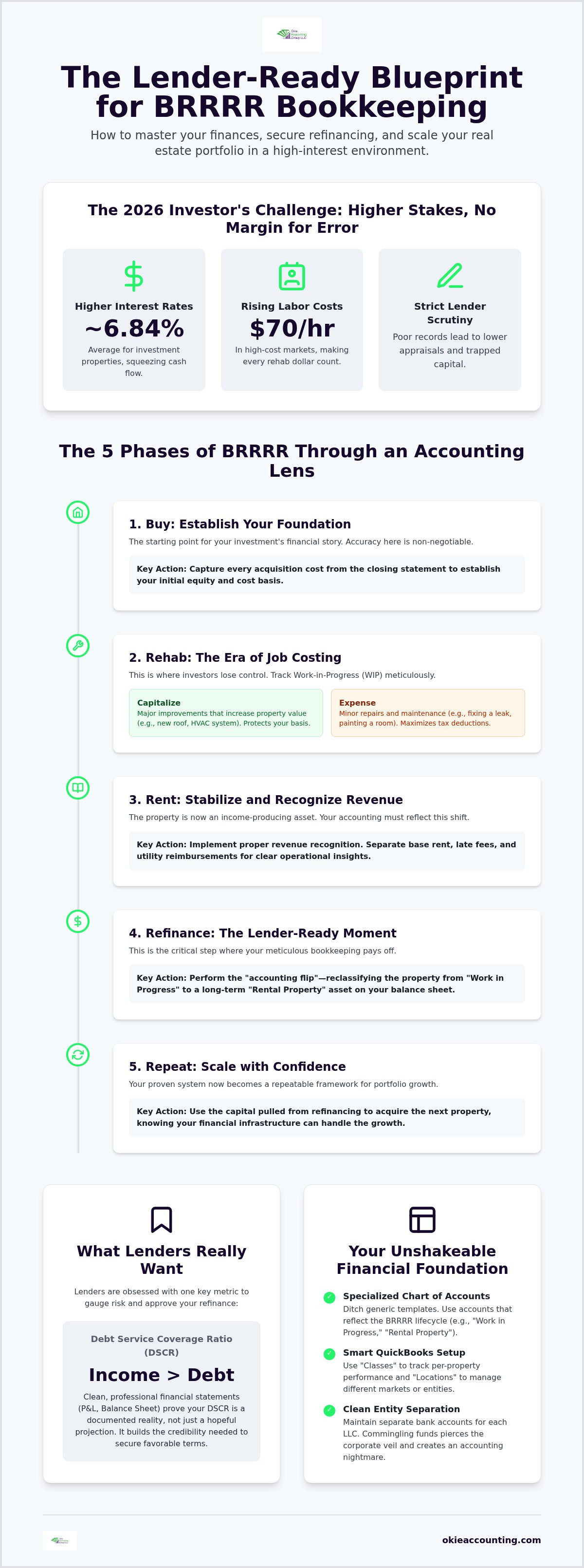
BRRRR bookkeeping isn't just about recording transactions; it's the specialized practice of tracking a property’s financial lifecycle from the initial acquisition dollar through the final long-term rental deposit. In 2026, the stakes for accurate data are higher than ever. With investment property mortgage rates averaging around 6.84% and construction labor rates in high-cost markets like California reaching $70 per hour, there's no margin for error in your financial reporting. You need to know exactly where every dollar is going to protect your margins.
The "Refinance" phase is where most investors hit a wall. If your records are a tangle of loose receipts and fragmented bank statements, you're handing the lender a reason to doubt your property's value. Poor bookkeeping for BRRRR real estate often leads to lower appraisals because you can't prove the exact dollar amount of capital improvements. When you're scaling a portfolio, relying on manual spreadsheets is a recipe for failure. You need a structural framework that grows with your assets and provides the clarity required for high-level decision-making.
The 5 Phases of BRRRR Through an Accounting Lens
Successful real estate investing requires a phased approach to data management. During the Buy phase, you must capture every acquisition cost, from the purchase price to the specific line items on the closing statement, to establish your initial equity. The Rehab phase is the era of job costing. You must track work-in-progress (WIP) and clearly distinguish between minor repairs and major capital improvements. Finally, as you move into the Rent and Refinance stages, your system must handle revenue recognition and the "accounting flip." This is where you move the property from inventory to a long-term hold on your balance sheet to prepare for the bank's scrutiny.
Why Lenders Care About Your Bookkeeping System
Lenders in 2026 are obsessed with the Debt Service Coverage Ratio (DSCR). They want to see that your property's income comfortably covers the debt service before they approve a cash-out refinance. Clean books prove your DSCR isn't just a projection; it's a documented reality. By providing "lender-ready" financials, including professional balance sheets and detailed profit and loss statements, you signal that you're a disciplined operator. This builds the credibility needed to secure favorable terms. Implementing professional Fractional Controller Services can transform your books from a basic administrative task into a strategic asset that wins over banking partners.
Designing a Chart of Accounts for the BRRRR Lifecycle
A generic Chart of Accounts (COA) is a liability for a scaling investor. While standard accounting software offers "out-of-the-box" templates, they fail to capture the nuances of bookkeeping for BRRRR real estate. You aren't just running a rental business; you're running a construction project that transitions into a long-term asset. Your COA must reflect this evolution by distinguishing between "Property Held for Sale" or "Work in Progress" during the rehab and "Rental Property" once the unit is stabilized and rented.
Precise income tracking is equally critical for your financial health. Instead of a single "Rental Income" bucket, your system should separate base rent, late fees, and utility reimbursements. This level of detail allows you to identify operational leakage and provides the granular data lenders look for during a refinance. On the expense side, your accounts should mirror the IRS Schedule E. This alignment simplifies year-end reporting and ensures you're prepared for the technical distinction between Capitalizing improvements vs. deductible repairs.
Standardizing Your QuickBooks Setup
Using Classes and Locations in QuickBooks is the most effective way to manage a growing portfolio. Classes allow you to isolate the performance of a single property, while Locations can track different geographic markets or legal entities. You should also establish sub-accounts for specific rehab categories like plumbing, electrical, and HVAC. This granular data is what makes you lender-ready and allows for accurate job costing. For those who need a professional touch, we offer specialized QuickBooks setup for real estate to ensure your foundation is solid from day one.
The Importance of Entity Separation
Clean entity separation is the bedrock of asset protection. Many investors fall into the "commingling" trap by paying for rehab costs across multiple LLCs from a single bank account. This practice creates an administrative nightmare and risks "piercing the corporate veil." You must maintain separate bank accounts for every legal entity and use an automated management umbrella to oversee the group. This structure protects your limited liability status and ensures your financial reporting remains untainted. If you're feeling overwhelmed by the complexity of multi-entity management, you can schedule a discovery call to discuss building a more robust financial framework.
Managing the Rehab Phase: Job Costing and Capital Expenditures
The rehab phase is where the financial complexity of your project peaks. Effective bookkeeping for BRRRR real estate requires a shift from simple expense tracking to rigorous job costing. This means every invoice, from a $30,000 kitchen remodel to a $25 plumbing fitting, must be assigned to a specific property and project phase. Without this level of detail, you can't accurately calculate your internal ROI or justify a higher appraisal during the refinance stage. You're effectively flying blind with your capital.
A critical component of this phase is understanding the "Capitalize vs. Expense" rule. Most costs during a major rehab aren't immediate tax deductions; they're added to your property basis. According to IRS Publication 527, improvements that add value or prolong the life of a property must be capitalized and depreciated over 27.5 years. However, the "One Big Beautiful Bill Act" of 2025 has restored 100% bonus depreciation for qualified property. This allows you to deduct the full cost of specific assets in the first year if you utilize a cost segregation study. Managing these nuances ensures you aren't overpaying on taxes while building long-term wealth.
Beyond the numbers, you must manage the administrative side of contractor relations. In 2026, with labor rates for construction averaging $48 to $70 per hour in high-cost states like California, every billable hour counts. You must track Certificates of Insurance (COI) and ensure you have a signed W-9 before any funds leave your account. If you're contributing "sweat equity," track those hours separately. While you can't deduct your own labor for tax purposes, knowing your true time investment is essential for an honest ROI analysis of your portfolio's performance.
Work-in-Progress (WIP) Accounting for Rehabs
Work-in-Progress (WIP) accounting allows you to track costs that are "in flight" before the property is placed in service. You record materials and labor as assets on your balance sheet rather than expenses on your profit and loss statement. This keeps your financial data accurate and prevents a distorted view of your cash flow. For a deeper dive into these mechanics, see our guide on Mastering Construction Cash Flow Management.
Avoiding Common Rehab Bookkeeping Mistakes
The most frequent error is misclassifying a $5,000 HVAC replacement as a simple "repair." This mistake can trigger an audit and mess up your basis calculations. Additionally, avoid "miscellaneous" entries at all costs. Every transaction needs a clear purpose and a digital receipt attached. If you can't explain an entry three years from now, it shouldn't be in your ledger. Maintaining disciplined bookkeeping for BRRRR real estate is the only way to stay protected and profitable.
Preparing for the Refinance: Transitioning to Rental Assets
The refinance is the moment of truth in the BRRRR cycle. It's when your meticulous bookkeeping for BRRRR real estate pays off by proving the value you've created to your lender. This phase requires what we call the "Accounting Flip." You must transition the accumulated costs of the property from the Balance Sheet, where they lived as Inventory or Work-in-Progress, to the Fixed Assets section. This move signifies that the property is no longer a project; it's a stabilized, income-producing asset.
Establishing the final basis is a rigorous process. You must close out the rehab job and reconcile every dollar spent against your initial projections. This final figure becomes the foundation for your depreciation schedule. When you record the new loan, you don't just enter the principal. You must correctly account for loan points, closing fees, and escrow deposits. These items have different tax treatments, and misclassifying them can lead to significant errors in your long-term financial reporting. A clean refinance entry ensures your balance sheet remains an accurate reflection of your equity.
Your books are also a powerful tool for your appraiser. By providing a "Refinance Package" that includes a detailed breakdown of all capital improvements, you provide the evidence needed to justify a higher After Repair Value (ARV). In a market where investment property mortgage rates average around 6.84%, every bit of equity you can prove translates into better terms and more capital recovered. If you want to ensure your portfolio is built on this kind of structural integrity, you should book a discovery call with our team to review your current systems.
Depreciation and the Long-Term Hold
Once the property is placed in service, you begin the standard 27.5-year depreciation schedule for residential assets. However, the "One Big Beautiful Bill Act" of 2025 has made permanent the 100% bonus depreciation for qualified property. This makes cost segregation studies an essential strategy for 2026. By identifying components that can be depreciated over a shorter period, you can significantly reduce your tax liability in the first year of rental operation. Our strategic financial oversight for real estate growth helps you navigate these complex transitions with confidence.
Tracking Post-Refinance Cash Flow
After you've recovered your initial capital, your focus shifts to long-term performance metrics. You must monitor your "Cash-on-Cash" return and consistently track your Debt Service Coverage Ratio (DSCR). A property that looked profitable during the rehab might reveal operational weaknesses once it's under management. Your bookkeeping must now transition from project-based job costing to property management accounting, focusing on tenant ledgers, maintenance reserves, and recurring operating expenses. This shift ensures the property remains a healthy, performing asset within your broader portfolio.
Scaling Your Portfolio with Fractional Controller Support
Many investors believe they can manage their own ledgers until they reach a double-digit property count. This is a strategic error. DIY bookkeeping for BRRRR real estate often leads to fragmented data and missed opportunities for profit protection. As your portfolio grows, the complexity of managing multiple rehabs, complex financing schedules, and multi-entity rental income requires more than just administrative tracking. You need a structural financial framework that allows you to step out of the daily weeds and into the role of a CEO who makes decisions based on hard data.
A Fractional Controller provides the strategic oversight necessary for rapid scaling. While a bookkeeper records what happened in the past, a controller analyzes that data to steer the future. They identify "leaks" in your rehab budget, such as material costs running 28% above national averages or labor rates creeping beyond the $70 per hour mark in high-cost sectors like California. By flagging these variances early, you protect your profit margins and ensure each property remains a viable candidate for a successful refinance. This transition from historical recording to forward-looking strategy is what separates a hobbyist from a professional operator.
The ROI of Professional Bookkeeping
The most significant return on investment comes from the recovery of your time. Every hour you spend reconciling bank statements or hunting for contractor invoices is an hour you aren't finding your next deal. Professional management accounting streamlines the "Repeat" phase of the BRRRR method by providing the clarity needed to move quickly on new acquisitions. You also save on back-end costs; providing clean, reconciled books to your CPA significantly reduces year-end tax preparation fees and audit risks. For a deeper look at this model, see our guide on Fractional Controller Services for Scaling Your Firm.
Customized Financial Reporting for BRRRR Investors
Scaling requires data-driven choices rather than abstract theories. You should review monthly performance reports that go beyond a simple profit and loss statement. Essential metrics include your current Debt Service Coverage Ratio (DSCR) across the entire portfolio and detailed Budget vs. Actual reporting for active rehab projects. These reviews allow you to adjust your strategy in real-time, ensuring that a single over-budget project doesn't derail your entire cash flow forecast. If you're ready to build a scalable financial infrastructure and stop treating your business like a spreadsheet project, you can contact Okie Accounting for specialized real estate controller services that align with your long-term goals.
Building a Foundation for Scalable Wealth
Mastering the financial lifecycle of your properties is the difference between a stagnant portfolio and a scalable empire. You've learned how a specialized Chart of Accounts and disciplined job costing protect your basis and ensure you're always lender-ready. By correctly navigating the transition from rehab to rental, you maximize your tax deductions and position yourself for a successful refinance every time. This structural integrity is what allows you to repeat the cycle with confidence and clarity.
Scaling your business requires moving beyond basic data entry. It demands a partnership with experts who understand the unique mechanics of the real estate and construction sectors. Okie Accounting Group provides national cloud-based accounting solutions and fractional controller services designed to give you the strategic oversight needed for growth. Mastering bookkeeping for BRRRR real estate is the first step toward long-term financial health and portfolio stability.
Your next deal is waiting for you. Make sure your financial foundation is ready to support it.
Frequently Asked Questions
What is the best Chart of Accounts for a BRRRR investor?
The best Chart of Accounts for a BRRRR investor is one that mirrors the IRS Schedule E while including specialized accounts for each phase of the property lifecycle. You need to distinguish between "Work in Progress" for active rehabs and "Rental Property" for stabilized assets on your balance sheet. This structure ensures your data is organized for both tax season and the specific reporting requirements of investment lenders.
Should I use QuickBooks Online or Desktop for real estate bookkeeping?
QuickBooks Online is the preferred choice for modern investors because it allows for real-time collaboration with your accounting team and integrates directly with modern property management software. It provides the mobility needed to track receipts on-site and automates bank feeds to reduce manual entry errors. Desktop lacks the cloud-based flexibility and remote accessibility required for managing a national, scaling portfolio.
How do I track rehab costs that I pay for with personal credit cards?
You should record rehab costs paid with personal funds as an "Owner's Contribution" or "Equity" entry in your ledger. While you should avoid commingling business and personal funds to protect your legal entity, you can capture these costs by creating a journal entry that increases the property basis and your equity simultaneously. Maintaining clean bookkeeping for BRRRR real estate requires keeping these receipts digitally archived and linked to the property.
What is the difference between a repair and a capital improvement in BRRRR?
A repair is a cost that keeps the property in its current working condition, such as fixing a broken window, and is typically expensed in the year it occurs. A capital improvement, like a $30,000 kitchen remodel, adds significant value or extends the property's life and must be capitalized into the basis. Distinguishing these correctly is vital for maximizing first-year deductions under current 100% bonus depreciation rules.
How do I record a cash-out refinance in my books?
To record a cash-out refinance, you must create a journal entry that recognizes the new mortgage liability and pays off the original loan balance. Any "cash out" received is recorded as a transfer to your business bank account, while loan points and closing fees are categorized according to their specific amortization rules. This ensures your balance sheet accurately reflects your new debt-to-equity ratio after the capital recovery.
Do I need a separate bank account for every property in my portfolio?
You don't necessarily need a separate bank account for every single property, but you must have a dedicated account for every legal entity or LLC you operate. Commingling funds between different LLCs can jeopardize your limited liability protection and create an administrative nightmare. Use QuickBooks Classes or Locations to track individual property performance within a single entity's bank account to maintain structural integrity.
How often should I reconcile my real estate investment books?
You should reconcile your books at least once a month to ensure your financial data is accurate and your cash flow forecasts are reliable. Monthly reconciliation allows you to catch contractor billing errors early, monitor budget variances, and stay prepared for unexpected lender requests. Waiting until the end of the year leads to "data debt" that can stall your next acquisition or prevent a timely refinance.
Can my bookkeeper help me prepare for a property appraisal?
Yes, your bookkeeper can provide a detailed "Capital Improvement Report" that lists every dollar spent on the rehab to justify your property's value to an appraiser. This professional documentation proves the extent of the work performed and helps support a higher After Repair Value (ARV) by providing a clear audit trail of expenditures. High-level bookkeeping for BRRRR real estate turns your financial data into a persuasive tool for increasing your equity.


Comments