Bookkeeping for Custom Home Builders: Track Every Project Clearly

Updated: Nov 7
What if a custom home looks profitable in your reports, yet the timing of supplier payments still feels uncertain? That gap can appear when project costs, approved changes, and cash activity aren’t recorded in a connected way. Bookkeeping for custom home builders needs to follow each build from its original budget through every approved change and final closeout.
You already know each home has its own plans, selections, vendors, and cost pressures. The challenge is keeping those moving parts aligned with estimates and budgets while distinguishing committed costs from recorded expenses. When change orders aren’t reflected clearly, forecasts can lose their usefulness, and reported profitability may not match the cash available to run the build.
This article explains how to organize project records so you can see costs, revenue, and cash timing more clearly. You’ll learn how to track committed and recorded costs by project, account for approved change orders in your records and forecasts, and use timely financial reporting to guide decisions. The goal is a consistent framework that makes each project’s financial position easier to understand, not just a set of books updated after the fact.
Why bookkeeping for custom home builders must follow each project
A company-wide profit-and-loss statement shows overall income and expenses, but it may not show whether a particular home is tracking to budget, has unbilled approved changes, or is waiting on customer payments. Bookkeeping for custom home builders organizes financial activity by build, then brings those project records together with the builder’s company-wide accounts. Project-level bookkeeping organizes each build’s financial activity so its costs, billing, and cash position can be reviewed separately.
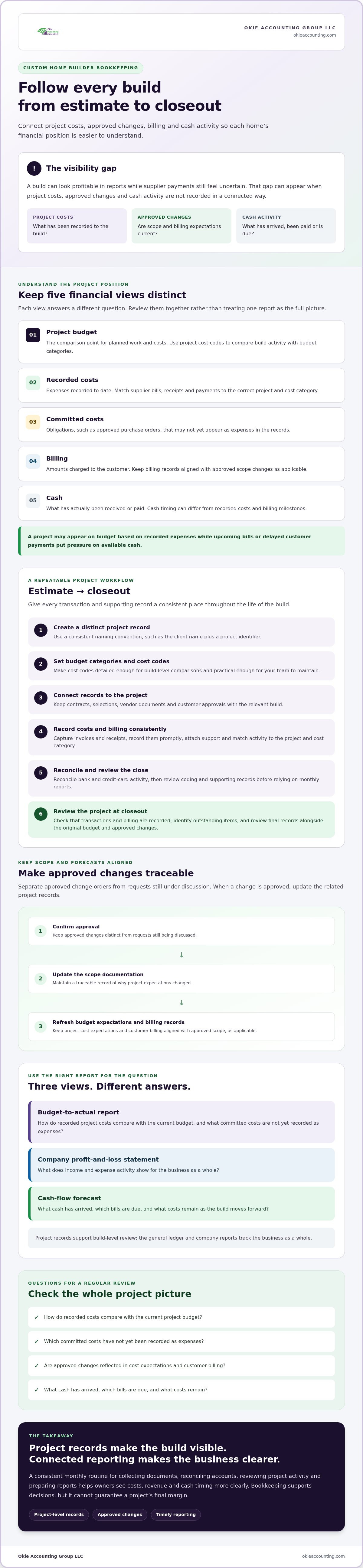
These are related but distinct views. Actual costs are expenses recorded to date. Committed costs reflect obligations, such as approved purchase orders, that may not yet appear as expenses. The project budget provides a comparison point, while billing records amounts charged to the customer and cash records what has been received or paid. Together, these views inform decisions, but bookkeeping alone can’t guarantee a project’s final margin.
What makes bookkeeping for custom home builders different?
Custom builds can span long timelines, with individualized specifications and selections that change as work progresses. Each revision may affect expected costs and customer billing, so the project record needs to reflect the current approved scope. Shared costs, such as company-wide expenses used across multiple builds, also need a consistent assignment method. The project ledger supports build-level review; the general ledger and company reports track the business as a whole.
Which financial questions should the records answer?
Useful records connect cost classification with project review. Applying cost accounting principles helps organize costs for analysis by project. At a regular review, ask:
How do recorded costs compare with the current project budget, and what committed costs haven’t yet been recorded as expenses?
Are approved changes reflected in the project’s cost expectations and customer billing?
What cash has arrived, which bills are due, and what costs remain as the build moves forward?
These questions help separate margin signals from cash timing. A project may appear on budget based on recorded expenses while upcoming bills or delayed customer payments put pressure on available cash. Conversely, a billing milestone may bring in cash before all related costs have been recorded. Reviewing project costs, billing, commitments, and cash together gives owners a clearer basis for follow-up and forecasting. Final profitability still depends on how the work and remaining costs unfold.
Custom Home Builder Bookkeeping: Estimate to Closeout
A dependable bookkeeping workflow follows a build from setup through closeout: create a project record, define cost categories, record transactions and billing, reconcile accounts, then review the project against its budget. This sequence gives each transaction a place and makes missing or misclassified activity easier to spot. For bookkeeping for custom home builders, consistency matters more than an elaborate coding system that staff won’t use.
Set up project budgets, cost codes, and supporting records
Give each build a distinct project record and use a consistent naming convention, such as the client name plus a project identifier. Map budget categories to practical cost codes. Include enough detail to compare areas of work without creating more codes than your team can maintain. The chart of accounts classifies activity for company-wide financial statements; project cost codes organize costs for build-level reporting. Keep contracts, selections, vendor documents, and customer approvals connected to the relevant project.
Record costs, billing, and change orders consistently
Match supplier bills, receipts, and payments to both the correct project and cost category. Keep approved change orders distinct from requests still under discussion. Once a change is approved, update the project’s scope documentation, budget expectations, and customer billing records as applicable. This creates a traceable record of why project expectations changed, instead of leaving the original estimate as the only reference point.
Use a repeatable document path: capture invoices and receipts, record them promptly, attach supporting documents, and reconcile bank and credit-card activity before relying on monthly reports. Reconciliation can identify missing transactions or incorrect amounts, but it doesn’t determine whether a cost belongs to the right project. Review coding and supporting records as part of the close.
At closeout, check that project transactions and billing are recorded, outstanding items are identified, and final project records can be reviewed alongside the original budget and approved changes. If you're setting up the software workflow, QuickBooks setup and training can help establish a consistent structure for project records and reporting.
Builders who want help maintaining records and interpreting project reports can discuss bookkeeping and controller support.
Which custom-home project reports reveal budget and cash-flow issues?
No single report tells the whole story of a custom build. A project budget-to-actual view helps assess cost performance, a company profit-and-loss statement summarizes business income and expenses, and a cash-flow forecast looks ahead to expected receipts and payments. In bookkeeping for custom home builders, these views work together, but they aren’t interchangeable. A project may appear profitable on paper while payment timing leaves too little cash available for upcoming bills.
Budget-to-actual reporting: are costs tracking to plan?
Review budgeted amounts against recorded costs by project and category. A variance is a prompt to investigate, not proof of a loss. Check for coding errors, late invoices, unrecorded commitments, or a change in scope. Separate approved changes, which may require revised project expectations and billing, from unexplained overages. This helps owners identify what changed and decide whether the budget or the work plan needs attention.
Cash flow and work in progress: what each view can show
A cash-flow forecast organizes expected inflows and outflows by timing. Customer cash received isn’t automatically the same as revenue earned, just as an expense recorded may not have been paid yet. Comparing expected receipts with supplier bills, payroll, and other due payments can reveal a timing gap before it becomes urgent. For more detail on forecasting and financial oversight, see management accounting support.
Work in progress (WIP) is a reporting concept for understanding activity on projects that haven’t reached completion. It isn’t one universal calculation: how WIP is prepared depends on the builder’s accounting approach and the information available. Ask a qualified accounting professional to review the method and applicable reporting requirements before relying on WIP figures for decisions.
For a practical monthly review, read the reports in sequence:
Budget-to-actual: Which project and cost-category variances need investigation?
Profit and loss: How is the company performing overall during the reporting period?
Cash-flow forecast: Do expected receipts align with upcoming payments, and where might timing create pressure?
Then connect the findings. A cost variance may reflect an approved selection change rather than overspending. A positive project margin may still coincide with near-term cash strain if customer payments are delayed. Clear records help explain these differences and support informed follow-up, while management judgment is still needed to interpret forecasts and project performance.
How to build a dependable monthly bookkeeping routine for custom builds
A monthly close works best as a repeatable process, not a last-minute search for missing paperwork. For bookkeeping for custom home builders, assign routine recordkeeping to a clear owner, then reserve project interpretation and financial decisions for the builder or controller. The steps below can serve as a practical monthly checklist. Adjust responsibility to fit your team.
A monthly close sequence builders can repeat
Collect project invoices, receipts, customer deposits, and payroll records. Categorize transactions by project and cost code, reconcile bank and credit-card accounts, and investigate unresolved differences before relying on reports. Then review each active build’s budget, customer billing, open commitments, and change-order documentation. Flag unmatched transactions, missing approvals, and unusual variances for follow-up instead of treating them as settled facts.
Controls that make project records more dependable
Keep responsibilities clear: the person entering a bill shouldn’t assume an approval that isn’t documented, and customer changes should be supported by recorded authorization. Use consistent file names that identify the project, document type, and date. Preserve invoices, receipts, approvals, and reconciliation support alongside the transaction record. Note estimates, assumptions, and corrections so future reviewers understand why an entry or forecast changed.
Routine bookkeeping checks establish whether records are complete and reconciled. Deciding whether a cost variance signals a scope issue, whether a forecast needs revision, or how to respond to a margin concern requires owner or controller judgment. A written review trail keeps these responsibilities distinct and makes follow-up easier. If you need help building a dependable close and project review process, schedule a discussion about bookkeeping support.
When custom home builders may need bookkeeping and controller support
Delayed monthly closes, project margins that are hard to explain, or reports you don’t feel confident using are signs your financial process may need attention. The right support depends on the gap. If transactions are missing, reconciliations are behind, or project costs aren’t consistently recorded, bookkeeping may be the priority. If records are current but budgets, controls, or project results still need interpretation, controller support may be a better fit.
Monthly bookkeeping or fractional controller support?
Monthly bookkeeping maintains transaction records, reconciles accounts, and prepares financial statements. Fractional controller support addresses a different layer: budgeting, internal controls, and interpreting financial information to inform decisions. These functions can work together, but they aren’t interchangeable. Okie Accounting Group LLC provides construction-focused bookkeeping and fractional controller support for businesses in Tennessee and Jacksonville, Florida. The appropriate scope depends on the builder’s records and reporting needs, not on a guaranteed result. Learn more about fractional controller services.
Before discussing support, prepare a current project list, the accounting software you use, and recent financial statements. Note recurring problems, such as unmatched transactions, unclear job costs, billing that’s difficult to tie to approved work, or reports that arrive too late to guide decisions. Specific examples help clarify whether the main need is consistent record maintenance, stronger project reporting, or financial interpretation.
What to prepare before discussing bookkeeping support
Bring questions about who will handle transaction recording, reconciliations, project-level tracking, and report review. Ask how responsibilities will be defined, what reporting cadence is available, and what information your team must provide. Clarify how approved changes and open project costs will be reflected in records, and how unusual variances will be surfaced for owner review.
For custom home builders, bookkeeping support should create dependable records, while controller support can help connect those records to budgets and management decisions. A firm focused on construction may be relevant if your projects require consistent job-cost tracking and organized monthly reporting. Confirm the service scope and availability for your location directly.
If you’re ready to discuss what your current process needs, schedule a discovery call with Okie Accounting Group LLC. Bring your project list and questions so the conversation can focus on the bookkeeping or controller support that fits your reporting needs.
Build clearer financial visibility into every project
Custom builds need financial records that follow each project from its original budget through approved changes and closeout. Consistent cost coding and monthly reconciliations help keep project information dependable, while budget-to-actual reports and cash-flow forecasts answer different questions about performance and timing. Together, these practices make bookkeeping for custom home builders a practical foundation for better-informed decisions, not a guarantee of a particular project margin.
When monthly closes are delayed or project results are difficult to interpret, the next step may be support that fits the gap. Okie Accounting Group LLC specializes in construction and real estate businesses, with monthly bookkeeping, fractional controller support, QuickBooks setup and training, and cash-flow forecasting. These services can support organized records and clearer financial discussions for builders in Tennessee and Jacksonville, Florida.
Schedule a discovery call to discuss your construction bookkeeping needs and explore what support may fit your current process. With a consistent structure and the right financial insight, you can move forward with greater confidence in the numbers behind each build.
Frequently Asked Questions
What does a bookkeeper do for a custom home builder?
A bookkeeper records and organizes financial activity so the builder can review company accounts and individual project records. Typical tasks include recording transactions, maintaining the general ledger, reconciling bank accounts, and preparing monthly financial statements. For custom home builders, project coding connects costs to the correct build. This gives owners more useful records for comparing project activity with budgets, reviewing billing, and discussing cash flow.
How should custom home builders track costs by project?
Set up a distinct record for each build and use consistent project cost codes to classify costs, such as labor, materials, or subcontractor expenses. Match invoices, receipts, and payments to both the project and the appropriate category. Keep approved change orders and supporting documents connected to the project record. Reconcile accounts regularly, then review recorded costs against the current budget and identify unexplained differences for follow-up.
Can QuickBooks track costs for multiple custom home projects?
QuickBooks can be set up to organize transactions and reports by project, but the results depend on the software version, configuration, and consistency of data entry. Establish a distinct project record for each home, use practical cost categories, and check that bills and payments are assigned correctly. Before relying on reports, confirm the setup supports your business’s job-cost and financial reporting needs. QuickBooks setup and training can help establish an appropriate structure.
How do change orders affect bookkeeping for custom home builders?
Approved change orders can affect a project’s expected costs, budget, and customer billing, so update the relevant records once approval is documented. Keep approved changes separate from requests still under discussion; otherwise, forecasts may include work that hasn’t been authorized. Preserve the approval and related vendor documents with the project file. Reviewing changes alongside actual costs helps explain budget variances and keeps the project record connected to the current scope.
What reports should a custom home builder review each month?
Review project budget-to-actual reports, the company profit-and-loss statement, and a cash-flow forecast. Budget-to-actual reporting highlights cost variances by project, while the profit-and-loss statement summarizes company performance. A cash-flow forecast helps assess expected receipts against upcoming payments. These reports answer different questions: recorded profitability doesn’t necessarily show when cash will arrive or bills are due. Investigate unexplained variances and review forecasts before making decisions.
When should a custom home builder outsource bookkeeping?
Consider outside bookkeeping support if monthly closes are delayed, reconciliations remain unresolved, project costs are difficult to review, or financial reports don’t arrive in time to guide decisions. Before choosing support, identify whether the need is transaction recording and reconciliations or broader budgeting and financial interpretation. Okie Accounting Group LLC serves construction businesses, including builders in Tennessee and Jacksonville, Florida. Confirm current service availability and scope directly.
Does bookkeeping for custom home builders include payroll and tax preparation?
Bookkeeping may include payroll records when payroll management is part of the agreed service scope. Okie Accounting Group LLC lists payroll management among its offerings, but income tax preparation is not a service it sells. Builders should clarify which payroll tasks are included and who handles any separate tax preparation needs. Organized payroll records can support clearer financial reporting, while project bookkeeping keeps each home’s costs and activity distinguishable from company-wide accounts.


Comments