Bookkeeping for Electricians: A Strategic Framework for Profit Protection in 2026

Updated: Nov 7
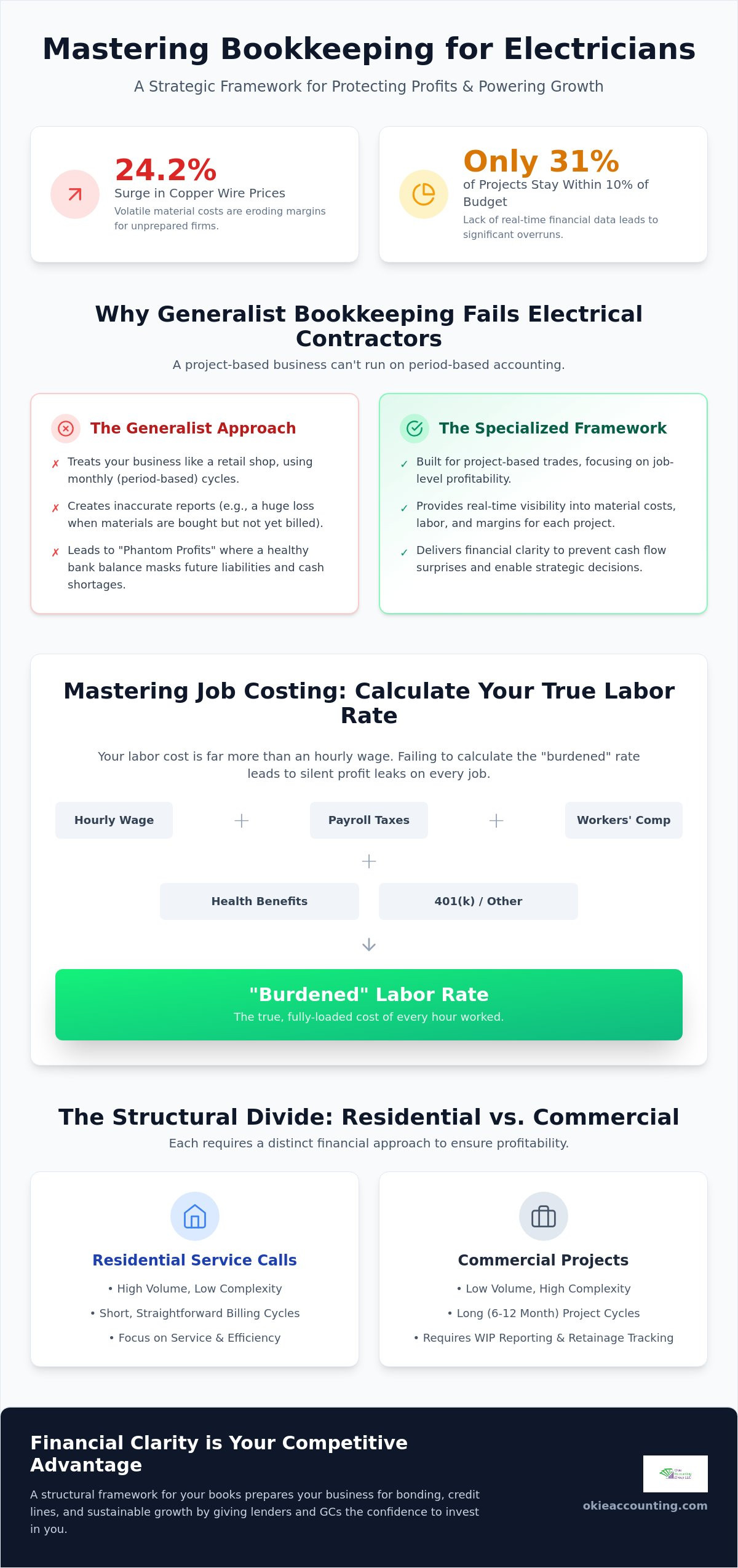
With copper wire prices surging 24.2% this year and only 31% of construction projects staying within 10% of their original budget, your electrical firm's profitability is under constant pressure. You understand that running a successful trade business requires more than technical skill; it demands a rigorous approach to the financial circuits that power your operations. Losing track of material costs on multi-phase jobs or facing surprise tax bills due to poor cash flow management can stall your growth faster than a blown transformer.
Mastering bookkeeping for electricians is about building a structural framework that protects your hard-earned margins. This article outlines a strategic roadmap to help you gain real-time visibility into job profitability and manage complex requirements like Work in Progress (WIP) and the new 5% retainage caps. You'll learn how to transition from basic administrative tasks to a scalable system that produces lender-ready financial statements. We will explore the methodology of financial oversight that allows you to move beyond the service van and into a position of disciplined, long-term stability.
Why Generalist Bookkeeping Fails the Modern Electrical Contractor
Generalist bookkeeping services often treat your electrical firm like a retail shop or a standard service business. They focus on period-based accounting, which tracks money in and money out on a monthly cycle. This approach creates a fundamental conflict for trades that operate on a project basis. Your costs rarely align with your revenue in a neat 30-day window. If you purchase $50,000 in conduit and copper wire for a commercial project today but don't bill the client until the next month, your monthly report shows a massive loss that isn't accurate. This disconnect makes it impossible to judge the true health of your business.
This lack of precision leads to the danger of "Phantom Profits." You might see a healthy bank balance and assume your firm is thriving, but messy books can hide looming liabilities. Large deposits for future work can feel like profit, yet those funds are often already committed to upcoming payroll and vendor invoices. Without a system that accounts for these commitments, you'll likely face tax surprises and cash flow shortages. Effective bookkeeping for electricians requires a shift toward management accounting principles. This isn't just about recording history; it's about building a structural framework that informs your future strategy. We define specialized construction bookkeeping services as the prerequisite for scaling, providing the financial infrastructure needed to track every dollar at the job level.
The Structural Divide: Residential vs. Commercial Accounting
Residential service calls are typically high-volume but low-complexity. You might run ten calls a day, and the billing is straightforward. Commercial projects are a different circuit entirely. These jobs involve 6-12 month cycles, multi-phase billing, and complex material draws. You must be able to prove financial readiness to general contractors and bonding agents during the bid process. If your books don't show a clear history of managing project-level finances, you won't pass the pre-qualification hurdles required for high-ticket commercial contracts.
The Role of Financial Clarity in Risk Mitigation
Real-time data is your best defense against over-extending your resources. When you have total clarity, you won't accidentally use funds from one contract to cover material purchases for another. This visibility also helps you identify "project fade" before it's too late. Project fade happens when labor hours or material waste slowly erode your anticipated margin. If you don't spot this trend in real-time, your entire quarterly profit could vanish. Maintaining clean books serves as a competitive advantage; it gives lenders the confidence to offer credit lines, ensuring you have the capital to power your next stage of growth.
Mastering Job Costing: Tracking Every Wire, Breaker, and Labor Hour
Job costing is the disciplined process of assigning every specific expense directly to a customer project. In the context of bookkeeping for electricians, this means moving beyond general expense categories and attributing every wire nut, breaker, and labor hour to a specific job number. This level of granular oversight is the only way to ensure your bids remain profitable in a volatile market. Construction input prices rose 9.6% year-over-year as of May 2026, with copper wire and cable prices specifically surging by 24.2%. If your accounting system does not track these costs in real-time, you are likely working with outdated margins that no longer reflect market reality.
Precision in job costing also requires allocating indirect costs that many contractors overlook. Warehouse rent, vehicle insurance, and specialized tool depreciation must be factored into your project margins to provide a true picture of business health. Job costing serves as the essential diagnostic tool for identifying which service lines generate the highest margins and which are draining your resources. If you need assistance building these foundational tracking systems, you can schedule a strategy session to review your current setup.
Calculating Your True "Burdened" Labor Rate
Your labor cost is significantly higher than the hourly wage you pay your journeymen or apprentices. To protect your profits, you must calculate the "burdened" labor rate, which includes payroll taxes, workers' compensation insurance, health benefits, and 401(k) contributions. Ignoring this burden leads to "silent" profit leaks where you appear profitable on paper but lack the cash flow to cover actual employment costs. Integrating your time-tracking data with specialized construction payroll services ensures that every hour spent on a job site is accurately loaded with these additional costs, giving you a transparent view of your project spend.
Material Management and Change Order Tracking
Scope creep is a primary driver of margin erosion in the electrical trade. Unrecorded change orders and "emergency" supply runs often go untracked, directly eating into your bottom line. Every field purchase must be coded correctly to the corresponding project. This data ultimately feeds into your broader financial reporting, as detailed in the Work in Progress (WIP) guide for electrical contractors. When your field staff understands that coding a receipt is as critical as pulling wire, you create a culture of financial accountability. This structural approach ensures that every change in project scope results in a corresponding change in billing, preserving your firm's long-term stability.
Managing the Commercial Circuit: Retainage and WIP Management
Commercial projects introduce a layer of financial complexity that standard accounting software can't handle without proper configuration. For the scaling contractor, bookkeeping for electricians must evolve to track long-term project health through the Work-in-Progress (WIP) report. This document acts as your firm's central nervous system, providing a clear view of how much work you've completed versus how much you've billed. To maintain accuracy, you must move from a simple cash basis to the Percentage-of-Completion Method (PCM). This ensures your revenue recognition aligns with the actual costs incurred on the job site, preventing the distortion of your financial statements.
Retainage adds another variable to your cash flow equation. While historically set at 10%, many states have moved to cap this at 5%. For example, in California, private construction contracts entered into on or after January 1, 2026, now face a 5% cap on retainage. We define retainage as a specialized asset that requires a dedicated aging schedule to ensure eventual collection once the project reaches close-out.
Over-Billings and Under-Billings: Spotting the Red Flags
Under-billings, or "Costs in Excess of Billings," are a significant red flag for any electrical firm. They indicate that you've purchased materials and paid labor but haven't yet invoiced the client, often signaling a looming cash flow crisis. Conversely, over-billings can create a false sense of security. It's tempting to use that "excess" cash to fund other projects, but this creates a dangerous cycle of borrowing from one job to pay for another. By applying principles of management accounting, you can interpret WIP data to identify these trends early and adjust your billing strategy before your margins erode.
Navigating Progress Billings and AIA Documents
Commercial general contractors typically require standardized AIA documents, specifically the G702 and G703 forms. These forms demand a detailed breakdown of the "Schedule of Values," which must be perfectly synced with your internal job costing. If your bookkeeping system doesn't support this level of detail, the administrative burden of progress billing will quickly overwhelm your office staff. Given that commercial payment cycles often stretch to 60 or 90 days, your system must provide the data needed for accurate cash flow forecasting. This foresight allows you to manage vendor payments and payroll without jeopardizing the firm's structural integrity.
Building Your 2026 Tech Stack: The Integrated Financial Hub
A robust financial hub is the bridge between job-site operations and executive decision-making. While some generalist providers offer closed systems that isolate your data, effective bookkeeping for electricians relies on an open ecosystem that communicates across your entire business. QuickBooks Online, particularly with the specialized Construction Edition added in February 2026, serves as the core for modern QuickBooks for contractors. Connecting field service management software like Jobber or ServiceTitan to your accounting system creates a "Field-to-Finance" bridge. This automation ensures that work orders and material usage flow directly into your ledger without the risk of manual entry errors.
AI-driven tools now allow you to automate accounts payable by coding invoices directly to specific job phases. Instead of your office manager spending hours manually entering vendor bills, these systems recognize the project and the cost code automatically. However, the integrity of this automation depends entirely on the initial configuration. Investing in professional software training is essential to prevent "garbage in, garbage out" data issues that can derail your financial reporting. If you are ready to modernize your financial systems, book a QuickBooks diagnostic call to ensure your tech stack is built for structural scale.
Customizing Your Chart of Accounts for Electricians
Your Chart of Accounts must mirror the way you estimate and execute work. Organizing Cost of Goods Sold (COGS) to align with categories like "Rough-in" versus "Trim-out" allows you to see exactly where a project is losing money. We recommend setting up sub-accounts for high-volatility materials to track price fluctuations in copper and components closely. This structural precision supports detailed construction cash flow management, giving you the foresight to buy materials before the next price surge. With QuickBooks Online Plus increasing to $140 per month on August 1, 2026, maximizing these specialized features is critical for your return on investment.
Real-Time Dashboards and Project Profitability
Modern cloud-based systems enable real-time dashboards that give foremen visibility into their specific project budgets without granting access to the firm's entire sensitive financial history. Capturing labor hours and material receipts on the job site via mobile devices eliminates the "Friday afternoon paperwork" bottleneck. This shift toward mobile-first data entry ensures your books stay current daily rather than monthly. Maintaining these "lender-ready" financials at all times positions your firm as a disciplined and reliable partner for banks and bonding agents, facilitating easier access to credit lines when opportunities for expansion arise.
Scaling Beyond the Service Van: The Fractional Controller Advantage
There is a specific ceiling that electrical contractors hit when their growth outpaces their administrative capacity. You might find that your current system for bookkeeping for electricians is accurate in recording history, but it's failing to help you predict the future. When you're managing multiple crews and balancing high-value commercial contracts, you need more than just a record of what happened last month. You need a structural mentor who can translate complex data into a clear roadmap for expansion. This is where the transition from historical recording to forward-looking strategy becomes the defining factor in your firm's long-term stability.
A fractional controller provides the high-level oversight necessary to protect your bottom line during periods of rapid growth. They move beyond basic reconciliations to conduct deep overhead analysis and strategic budgeting. These specialized fractional controller services act as a foundational system for your business, ensuring that every financial decision is backed by data rather than intuition. By establishing these rigorous management practices, you transform your role from a technician managing a business into a strategic partner leading a scalable firm.
Strategic Financial Oversight for Expansion
Expanding your fleet or investing in specialized equipment requires a clear understanding of your Return on Investment (ROI). A fractional controller analyzes the financial implications of adding a second service van or upgrading your heavy-duty tools, ensuring the debt service doesn't jeopardize your cash flow. They also implement essential internal controls to prevent common industry risks like material theft and payroll fraud. This level of oversight builds the financial infrastructure required to sustain a multi-million dollar firm, providing the structural integrity needed to handle increased operational complexity.
Next Steps: Evaluating Your Financial Health
The first step toward strategic growth is identifying the hidden leaks in your current electrical books. A comprehensive Financial Health Audit can reveal where your job costing is failing or where your billing cycles are lagging behind your expenses. Choosing specialized construction accounting over a generalist provider gives you a competitive advantage; you gain a partner who speaks the language of project phases, material draws, and burdened labor. If you are ready to build a strategic financial framework that supports your vision for 2026 and beyond, schedule a discovery call with Okie Accounting Group today.
Building a Foundation for Sustainable Growth
Protecting your electrical firm's profitability in a volatile market requires more than technical expertise; it demands a disciplined financial infrastructure. You've seen how generalist accounting fails to capture the project-based complexities of your trade. By mastering job costing and implementing rigorous WIP reporting, you ensure your bank balance reflects actual profit rather than temporary cash flow. This structural approach allows you to combat material price surges and manage commercial retainage with confidence.
Effective bookkeeping for electricians is the cornerstone of a scalable business. It transforms your financial data from a historical record into a strategic tool for forward-looking leadership. As you integrate your field operations with a centralized financial hub, you gain the clarity needed to make data-driven decisions about equipment, labor, and new contracts. This level of oversight is essential for moving beyond the service van and into a position of market leadership.
If you are ready to transition from basic administrative tasks to high-level strategic oversight, we are here to partner with you. Our team provides nationwide cloud-based solutions and specialized fractional controller oversight tailored to the construction trades. Master Your Electrical Firm’s Finances with a Strategic Discovery Call today. Your path to long-term stability and profit protection starts with a single, focused conversation.
Frequently Asked Questions
What is the best accounting software for electricians in 2026?
QuickBooks Online remains the most reliable accounting software for electricians in 2026. The Plus and Advanced plans are particularly effective because they support the complex job costing and class tracking required for project-based work. With the introduction of the Construction Edition in February 2026, contractors now have access to specialized inventory features that help manage material price volatility directly within their primary financial hub.
How do I handle retainage in my electrical bookkeeping?
You should record retainage as a non-current asset on your balance sheet to avoid inflating your immediate cash flow expectations. Creating a dedicated "Retainage Receivable" account allows you to track these funds separately from standard invoices. This is especially important given that many jurisdictions, including California, have capped private project retainage at 5% for contracts starting in January 2026, requiring precise aging schedules for eventual collection.
What is a "burdened labor rate" and why does it matter for my bids?
A burdened labor rate represents the total cost of keeping an electrician on the job, encompassing wages, payroll taxes, workers' compensation, and benefits. It's the only way to ensure your bids are truly profitable. If you only account for hourly wages, you'll likely under-bid projects and suffer from "silent" profit leaks. Incorporating these costs into your bookkeeping for electricians provides a realistic foundation for every estimate you send.
Should I use cash or accrual accounting for my electrical business?
Accrual accounting is the superior choice for most electrical firms, particularly those scaling into commercial work. While cash accounting is simpler, it fails to match expenses with the revenue they generate. Accrual accounting provides a more accurate view of your financial health by recognizing income when it's earned and expenses when they're incurred. This methodology is essential for generating the lender-ready financial statements needed for credit lines.
How often should I review my project profitability reports?
You should conduct a formal review of your project profitability reports at least once a week. This frequency allows you to identify "project fade" or labor overages before they become irreversible. Modern cloud-based systems make this process easier by providing real-time dashboards that your foremen can access. Consistent oversight ensures that your actual job site performance aligns with your original estimates, protecting your quarterly margins from unexpected erosion.
What is a WIP report and why do commercial electricians need one?
A Work-in-Progress (WIP) report is a strategic document that calculates earned revenue based on the percentage of completion for each project. Commercial electricians rely on WIP reports to spot over-billings and under-billings that could lead to cash flow crises. It's the most critical document for proving your firm's stability to bonding agents and general contractors, as it demonstrates a disciplined approach to managing long-term project cycles.
Can I use QuickBooks Online for job costing in the electrical trade?
QuickBooks Online is a powerful tool for job costing when it's integrated with your field service management software. By using the "Projects" feature, you can assign every material purchase and labor hour to a specific job site. This integration eliminates manual data entry and provides a real-time view of your project spend. We emphasize professional setup to ensure your Chart of Accounts is structured to mirror your estimating categories.
How do I separate my personal and business expenses effectively?
You must establish separate legal entities for your business and personal finances by using dedicated bank accounts and credit cards. Mingling these expenses makes bookkeeping for electricians unnecessarily complex and puts your personal assets at risk during an audit. Using automated bank feeds within your accounting software ensures that only business-related transactions are recorded, maintaining the structural integrity of your financial data and simplifying your year-end reporting.


Comments