Bookkeeping for Excavation Contractors: 2026 Framework

Updated: 6 days ago
Your project bids show healthy margins, but your bank account tells a completely different story. If that gap feels familiar, you're not dealing with a math problem; you're dealing with a structural one. Bookkeeping for excavation contractors demands a level of precision that generic accounting simply can't deliver, because the costs that quietly destroy your margins, think equipment mobilization, untracked maintenance cycles, and fuel burn per job, rarely show up clearly until the damage is already done.
You already know earthmoving work is financially complex. Every project carries a unique cost profile, equipment moves between sites, and a single unexpected repair on a dozer can quietly erase the profit from an entire contract. That frustration is real, and it's shared by contractors across the country who are running profitable-looking projects while watching their cash reserves stagnate.
This framework is built to change that. You'll walk away with a clear methodology for excavation-specific job costing, equipment lifecycle tracking, and financial reporting that holds up under lender scrutiny. From establishing a scalable chart of accounts to building real-time project profitability visibility, what follows is the structured foundation your operation needs to protect its margins and grow with confidence.
The Unique Financial Landscape of Excavation Contracting
Excavation contracting sits in a category of its own within the construction trades. Unlike electrical or plumbing work, where the primary cost variable is labor hours and material quantities, earthmoving operations carry a capital intensity that fundamentally changes how financial data needs to be structured, tracked, and interpreted. A single excavator can represent $300,000 or more in asset value. That machine burns fuel at variable rates depending on soil conditions, requires maintenance cycles tied to hours rather than calendar dates, and may move between three different job sites in a single month. No generic bookkeeping system is designed to account for that complexity.
Bookkeeping for excavation contractors is, at its core, a specialized subset of construction accounting built around project-based cost tracking, equipment asset management, and site-variable overhead allocation. The distinction matters because the financial risks specific to this trade don't announce themselves on a simple profit and loss statement. They accumulate quietly, buried inside mobilization costs that weren't allocated to the right job, fuel charges that hit the company card without a project code, and repair invoices that get expensed in the wrong period.
Why Generalist Bookkeeping Fails the Earthmoving Industry
The mismatch between high-value equipment assets and basic cash-basis reporting creates a structural blind spot. When a bookkeeper records a dozer repair as a flat operating expense without tying it to the project that drove the wear, the true cost of that job becomes invisible. This is what's often called "profit bleed," a gradual erosion of margin that doesn't show up as a single loss event but as a persistent gap between estimated and actual profitability. Site preparation and grading contracts are especially vulnerable because their cost profiles shift with ground conditions, weather delays, and scope changes that never make it into the original estimate. Without a financial framework built to capture those variables in real time, the damage is only visible in hindsight.
The Role of Financial Clarity in Fleet Scaling
Accurate, job-level financial data is the foundation of every sound equipment acquisition decision. When you can see the actual cost-per-hour of a machine across multiple projects, you're not guessing about replacement timing or utilization thresholds; you're working from evidence. That same data quality directly affects your access to capital. Lenders evaluating equipment financing applications look for clean, consistent financial records that demonstrate both profitability and cash flow discipline. Financial readiness, for an excavation firm looking to scale, means having books structured well enough that a lender, a bonding agent, or a new project partner can review your financials and immediately understand the health of your operation. That standard isn't aspirational; in 2026, with cloud-based platforms like QuickBooks Online enabling real-time reporting transparency, it's the baseline expectation for competitive firms.
Mastering Job Costing and WIP for Earthmoving Projects
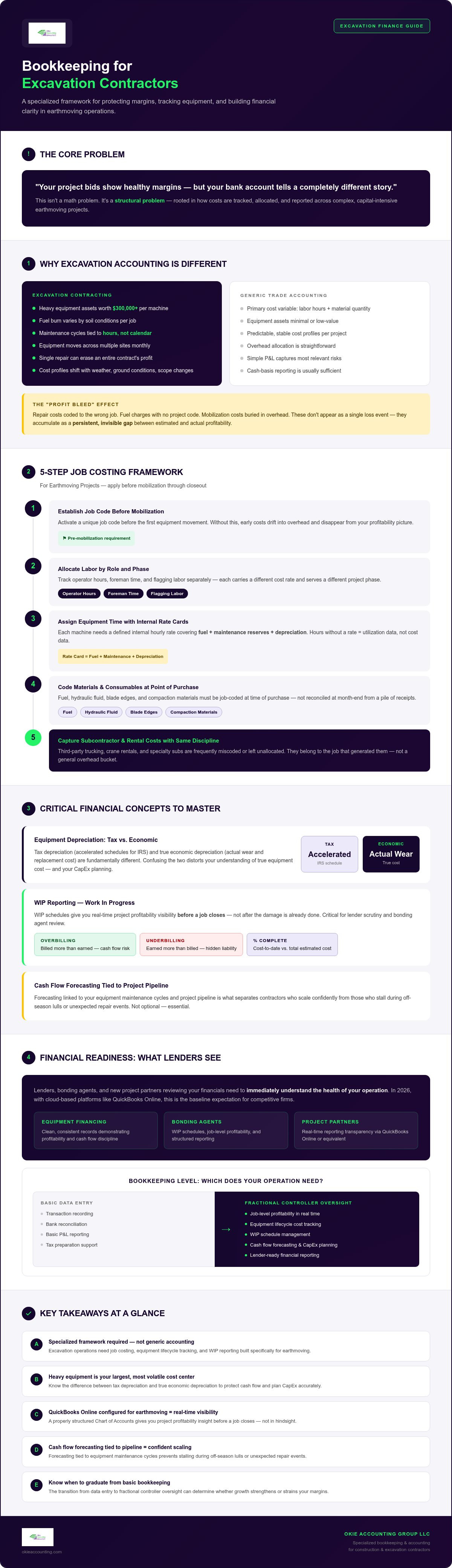
Accurate job costing isn't a bookkeeping preference for excavation firms; it's the structural mechanism that determines whether your estimated margin survives contact with the actual project. The five-step process below reflects what effective bookkeeping for excavation contractors actually looks like in practice, not the simplified version designed for general contractors.
Establish a unique job code before mobilization begins. Every cost incurred from the first equipment movement forward needs a destination. Without a job code active at project initiation, early costs drift into overhead and disappear from your profitability picture.
Allocate labor by role and phase. Operator hours, foreman time, and flagging labor carry different cost rates and serve different project phases. Tracking them as a single "labor" line eliminates the data you need to identify where overruns actually occur.
Assign equipment time using internal rate cards. Each machine should carry a defined internal hourly rate that accounts for fuel, maintenance reserves, and depreciation. Logging hours to a job code without a rate attached produces utilization data, not cost data.
Code materials and consumables at point of purchase. Fuel, hydraulic fluid, blade edges, and compaction materials need to be assigned to a job at the time of purchase, not reconciled at month-end from a pile of receipts.
Capture subcontractor and rental costs with the same discipline. Third-party trucking, crane rentals, and specialty subcontractors are frequently miscoded or left unallocated. They belong to the job that generated them, not to a general overhead bucket.
Mobilization and Site-Specific Cost Allocation
Moving a 90,000-pound excavator to a job site isn't free, and it rarely shows up accurately in a project's cost record. Lowboy transport, escort fees, permit costs, and operator travel time can represent a meaningful portion of a contract's total cost on shorter-duration projects. These mobilization and demobilization expenses must be coded directly to the project that triggered them, not absorbed into company-wide overhead where they silently compress your reported margins.
Site-specific variables add another layer of complexity. Rocky substrate that slows production, unexpected groundwater requiring dewatering equipment, or a two-week weather delay that keeps machines on-site without generating billable progress; each of these shifts the actual cost profile away from your original estimate. Capturing these costs in real time, tied to the job code, gives you the data to support change order requests and to recalibrate future bids on similar site conditions. Specialized construction bookkeeping services are built to track exactly these variables, because generalist systems aren't structured to recognize them as distinct cost events.
Implementing Work in Progress (WIP) Reporting
For excavation companies running long-term grading or site development contracts, the WIP report is the single most important financial document you can produce. It answers the question that a standard profit and loss statement cannot: on every active project right now, are you ahead of your billing or behind it?
The percentage-of-completion method drives WIP accuracy. By dividing costs incurred to date by total estimated project costs, you get a completion percentage that, when applied to the contract value, tells you what revenue you've legitimately earned. Compare that figure to what you've actually billed, and you'll see either an under-billing (you've done the work but haven't invoiced for it, a cash flow risk) or an over-billing (you've collected more than your earned value, a liability that can create serious problems if the project stalls).
WIP data also functions as a bidding calibration tool. When your completed project records show a consistent pattern of cost overruns in specific phases, say, finish grading or erosion control installation, that pattern belongs in your next estimate. If you'd like to build this reporting structure into your operation before your next project cycle, scheduling a discovery call is a practical first step toward getting it configured correctly.
Equipment Management: Tracking Depreciation, Maintenance, and Fuel
Your fleet isn't just your largest asset; it's your most financially complex one. A single excavator or dozer carries costs that extend far beyond the purchase price, and if your bookkeeping system treats that machine as a static line item on a balance sheet, you're missing the financial data that actually drives sound fleet decisions. Effective bookkeeping for excavation contractors requires a dynamic equipment management framework, one that tracks what each machine truly costs to own and operate across its entire working life.
The Equipment Lifecycle and Your Balance Sheet
The distinction between tax depreciation and economic depreciation is one of the most consequential concepts in construction equipment accounting, and it's one that generalist bookkeepers routinely overlook. Tax depreciation, accelerated through mechanisms like Section 179 expensing, reduces your taxable income in the near term. That's valuable. But it doesn't reflect the actual rate at which a machine is losing productive value, which is what economic depreciation measures. When your books show a fully depreciated excavator still generating revenue, your balance sheet understates replacement liability. That gap distorts your true cost of ownership and can lead to underpriced bids and delayed capital planning.
True cost of ownership (TCO) for heavy equipment includes acquisition cost, financing interest, insurance, scheduled maintenance, unscheduled repairs, and the opportunity cost of downtime. When you track maintenance costs per machine, a clear pattern often emerges: some equipment consistently consumes disproportionate repair dollars relative to its productive hours. That's your financial signal to replace, not repair. Without machine-level cost records, that decision gets made on intuition rather than evidence.
The repair-vs-replace threshold isn't a fixed number. It depends on the machine's remaining useful life, current market value, and the cost trajectory of its maintenance history. Your balance sheet should reflect realistic fleet valuations, not accounting artifacts, so that lenders and bonding agents see an accurate picture of your capital position.
Fuel and Fluid Tracking for Margin Protection
Fuel is one of the most volatile and frequently misallocated cost categories in earthmoving operations. Without a structured capture system, fuel charges hit a company card and disappear into overhead, invisible to your job costing reports. The solution is straightforward but requires discipline: every fuel transaction needs a project code assigned at the point of purchase, whether that's through fleet cards with job-level reporting, on-site tank logs, or mobile receipt capture synced to your accounting platform.
Managing fuel price volatility through bookkeeping means tracking consumption rates per machine per project, not just total fuel spend. When you know a specific dozer is burning more fuel per productive hour than its baseline rate, that's both a maintenance signal and a cost recovery opportunity. Fuel surcharges on client invoices should be structured as a separate line item tied to a defined escalation formula, not absorbed silently into your base contract rate. That invoicing discipline protects your margin when diesel prices spike and gives clients a transparent, defensible number rather than an unexplained cost increase.
For firms looking to build this level of equipment cost visibility into their existing QuickBooks environment, specialized QuickBooks setup and training is the most direct path to getting the right account structure and tracking workflows in place from the start.
Building a Scalable Financial Infrastructure with QuickBooks Online
A properly configured accounting platform isn't a convenience; it's the operational backbone that makes every other financial discipline in this framework actually function. QuickBooks Online, when set up correctly for earthmoving operations, transforms from a general ledger tool into a real-time project intelligence system. The keyword phrase "bookkeeping for excavation contractors" implies a specialized need, and the platform configuration has to match that specificity from the ground up.
QuickBooks Setup for Earthmovers
The most consequential configuration decision in QBO is how you structure Classes and Locations. Classes should map to individual projects or contracts, while Locations can represent distinct operating regions or yard sites. This two-dimensional structure lets you filter any financial report by project, by region, or by both simultaneously, giving you the kind of granular visibility that a single-dimension chart of accounts simply can't produce.
A Chart of Accounts built for excavation operations needs to reflect the actual cost categories that drive your margins. That means moving beyond generic construction templates and building account-level distinctions for categories like these:
Equipment operating costs broken out by machine type, not consolidated into a single "equipment expense" bucket
Mobilization and demobilization as a distinct cost category, separate from general site labor
Fuel and consumables tracked at the job level, not absorbed into overhead
Subcontractor costs separated from direct labor to preserve your gross margin clarity
Equipment rental as its own line, distinct from owned-fleet operating costs
The most common mistake contractors make in QBO is what experienced construction accountants call "bucket accounting," collapsing multiple distinct cost types into one account because it's faster at entry time. That shortcut costs you the analytical resolution you need at job close. For a deeper look at platform configuration strategy, Mastering QuickBooks for Contractors provides a structured walkthrough built specifically for the trades.
The Importance of Software Training
Professional setup is only half the equation. A correctly configured QBO environment degrades quickly if the people entering field data don't understand why the structure exists. Operators submitting time cards without job codes, office staff coding vendor invoices to the wrong class, or project managers skipping the location field on purchase entries; each of these breaks the reporting chain that the entire framework depends on.
Training your team to input accurate, job-coded data at the point of transaction is what protects the integrity of your financial reporting over time. This isn't a one-time orientation; it's an ongoing discipline that needs reinforcement as your crew changes and your project volume grows. Specialized QuickBooks software training designed for construction operations addresses exactly this gap, building field-to-office data accuracy into the daily workflow rather than treating it as an afterthought.
When your platform is configured correctly and your team is trained to use it with precision, the financial reporting that emerges stops being a backward-looking summary and starts functioning as a forward-looking management tool. That's the infrastructure shift that enables confident growth. If you're ready to build it, schedule a discovery call to discuss what a properly structured QBO environment looks like for your specific operation.
Strategic Financial Oversight: Beyond Basic Data Entry
There's a meaningful difference between having your books maintained and having your finances managed. Administrative bookkeeping keeps your records current and your tax filings defensible. Strategic financial oversight tells you where your margins are eroding before the damage compounds, which projects are quietly underperforming, and when your cash position will create a constraint on growth. For excavation firms past the startup phase, that distinction is the line between stalling and scaling.
Bookkeeping for excavation contractors, done at the administrative level, captures what happened. Controller-level oversight interprets what it means and positions you to act on it. The gap between those two functions is where most growing firms lose ground.
Fractional Controller Services for Growing Firms
A fractional controller brings the analytical depth of a full-time financial executive without the fixed overhead of that hire. In practice, this means someone is reviewing your job cost reports for patterns that a bookkeeper wouldn't flag: a consistent labor overrun in a specific project phase, a subcontractor cost category that's trending upward across multiple contracts, or a fleet maintenance line that's quietly consuming margin that your bids assumed would stay flat.
Strategic budgeting for fleet expansion is one area where this oversight pays for itself clearly. When you're evaluating whether to add a second excavator or extend the life of an existing machine, that decision requires a forward-looking cash flow model tied to your project pipeline, not just a review of last quarter's bank balance. A fractional controller builds that model, runs the scenarios, and gives you a defensible answer. For a detailed look at how this service tier functions operationally, Fractional Controller Services: The Strategic Framework for Scaling Your Firm provides a structured breakdown worth reviewing before your next capital decision.
Cash flow forecasting tied to your project pipeline also addresses the off-season problem directly. Earthmoving revenue isn't linear. Winter slowdowns, wet-season delays, and the gap between project closeout and final billing create predictable cash flow troughs that catch underprepared firms short. A rolling 13-week cash flow forecast, updated against your active project schedule and equipment maintenance calendar, converts that seasonal uncertainty into a manageable planning variable rather than an annual crisis.
Lender-ready financials are another deliverable that controller oversight produces as a byproduct of disciplined reporting. Clean WIP schedules, accurate equipment valuations, and consistent job-level profitability records give lenders and bonding agents the clarity they need to approve financing quickly. That financial readiness isn't something you assemble when you need capital; it's something you maintain continuously so the opportunity doesn't wait on your paperwork.
Partnering with Okie Accounting Group
Okie Accounting Group, led by Sarah O'Quinn, is built specifically for excavation and construction firms that have outgrown generic bookkeeping and need a financial partner who understands the operational realities of earthmoving work. The approach isn't to hand you a report at month-end and move on; it's to build the financial infrastructure that makes every management decision you face more grounded and less reactive.
The transition from "getting by" to data-driven management doesn't happen through a single software upgrade or a chart of accounts restructure. It happens when every layer of your financial operation, from field data entry to executive-level reporting, is aligned around the same job-level accuracy standards. That's the structural shift our management accounting services are designed to deliver, and it's the foundation that separates firms that grow confidently from those that grow into financial complexity they can't see clearly enough to manage.
Turn Financial Clarity Into Your Competitive Advantage
Bookkeeping for excavation contractors isn't a back-office function you can afford to treat as an afterthought. The framework covered here connects three disciplines that most growing firms handle in isolation: job-level cost accuracy, fleet lifecycle tracking, and the kind of strategic financial oversight that tells you where your margins are heading before a project closes. When those three systems work together, the gap between your estimated and actual profitability starts to close.
The firms that scale confidently in 2026 aren't the ones with the most equipment or the most contracts. They're the ones with financial infrastructure that's built to match the complexity of earthmoving operations, supported by specialists who understand the difference between recording transactions and protecting margins.
Okie Accounting Group brings specialized construction accounting expertise, cloud-based systems that support your operation nationwide, and proactive profit protection strategies designed specifically for firms like yours. Schedule your discovery call today and build the financial foundation your next phase of growth actually requires.
Frequently Asked Questions About Bookkeeping for Excavation Contractors
How does excavation bookkeeping differ from general construction accounting?
Excavation bookkeeping is built around capital-intensive equipment assets and site-variable cost structures that general construction accounting isn't designed to handle. Where a general contractor's primary variables are labor and materials, an earthmoving operation adds machine-level cost tracking, mobilization expenses, fuel consumption by project, and maintenance cycles tied to hours rather than calendar dates. Each of those variables needs its own account structure and allocation discipline to produce accurate job-level profitability data.
The practical consequence of using a generalist system is that costs blur together in ways that make margin analysis unreliable. A repair invoice coded to general overhead rather than the project that drove the wear is invisible to your job costing reports. That invisibility compounds across a full project season and produces the persistent gap between estimated and actual profitability that many excavation owners recognize but can't easily trace.
What is the best way to track fuel costs for multiple job sites?
The most reliable method is assigning a project code to every fuel transaction at the point of purchase, not during month-end reconciliation. Fleet cards with job-level reporting fields, on-site tank logs tied to equipment hours, and mobile receipt capture synced to your accounting platform are the three most practical systems for doing this consistently across multiple active sites.
Tracking by machine per project, rather than total fuel spend, gives you the consumption rate data that matters most. When a specific piece of equipment is burning more fuel per productive hour than its baseline, that's simultaneously a maintenance signal and a cost recovery opportunity. Fuel surcharges on client invoices should be structured as a separate line item with a defined escalation formula so price volatility doesn't silently compress your contract margin.
Do excavation contractors need to use WIP (Work in Progress) accounting?
Yes, particularly on any contract extending beyond a single billing period. WIP accounting using the percentage-of-completion method is what tells you whether your billings accurately reflect the work you've actually performed. Without it, you can't distinguish between revenue you've earned and cash you've collected in advance, and that distinction matters enormously for understanding your true financial position on active projects.
For site development and grading contracts that run weeks or months, a WIP schedule also functions as an early warning system. Consistent under-billings signal a cash flow risk building in your receivables. Consistent over-billings create a liability that becomes a serious problem if a project stalls or a client disputes scope. Neither condition is visible on a standard profit and loss statement without WIP reporting in place.
How should I track depreciation on my heavy equipment for tax purposes?
Tax depreciation for heavy equipment is typically handled through MACRS (Modified Accelerated Cost Recovery System), with Section 179 expensing available for qualifying assets placed in service during the tax year. Section 179 allows you to deduct the full purchase price of eligible equipment in the year of acquisition rather than spreading it across the asset's useful life, which can significantly reduce your near-term tax liability. Consult your tax advisor to confirm current limits and eligibility rules, as these figures are subject to annual legislative adjustment.
The critical discipline is maintaining a separate internal depreciation schedule that reflects economic reality rather than just your tax position. A machine that's fully depreciated on your books for tax purposes may still carry substantial replacement value and ongoing maintenance costs. Tracking both schedules gives you an accurate balance sheet for lenders and bonding agents while still optimizing your tax strategy. These are distinct objectives that require distinct records.
Can QuickBooks Online handle the complex job costing required for excavation?
QuickBooks Online can handle excavation-level job costing when it's configured correctly for the trade. The platform's Classes and Locations features, combined with a chart of accounts built around earthmoving cost categories, create the multi-dimensional reporting structure that project-based costing requires. Out of the box, QBO's default setup isn't designed for this level of specificity, which is why configuration matters as much as the platform choice itself.
Bookkeeping for excavation contractors in QBO works best when equipment operating costs are broken out by machine type, mobilization is tracked as a distinct cost category, and fuel is coded at the job level rather than absorbed into overhead. The system degrades quickly if field staff aren't trained to enter job codes consistently at the point of transaction. Professional setup paired with team training is what makes the platform function as a real-time project intelligence tool rather than a basic ledger.
What financial reports should an excavation company owner review monthly?
Five reports deserve consistent monthly attention: a job cost summary comparing estimated versus actual costs by project, a WIP schedule showing earned value against billings on active contracts, a profit and loss statement filtered by job class, an equipment cost report broken out by machine, and a cash flow statement reconciled against your project billing schedule. Together, these give you both backward-looking accuracy and forward-looking visibility.
The job cost summary and WIP schedule are the two most operationally critical. They tell you which active projects are tracking toward margin erosion before the project closes, when there's still time to act. The equipment cost report catches maintenance trends that would otherwise stay buried in general operating expenses until they've already compressed your profitability across multiple contracts.
Why is mobilization often a source of profit loss in earthmoving?
Mobilization costs are frequently underestimated in bids and misallocated in bookkeeping, which creates a double problem. Lowboy transport, oversize load permits, escort fees, and operator travel time can represent a meaningful percentage of total project cost on shorter-duration contracts, yet they're often absorbed into company-wide overhead rather than coded to the specific project that triggered them. When that happens, the project looks more profitable than it actually was, and your bidding data for similar work stays permanently miscalibrated.
The fix is straightforward in principle: every mobilization and demobilization cost gets assigned to a job code at the time of the expense, not estimated at bid time and forgotten. When you build a historical record of actual mobilization costs by project type and site distance, your future bids reflect real data. That's the kind of margin protection that accumulates quietly over time and shows up clearly in your year-end profitability.
When should an excavation firm hire a fractional controller instead of just a bookkeeper?
The transition point is typically when your operation has enough active projects, equipment assets, and financial complexity that administrative bookkeeping can't answer the questions your growth requires. If you're making fleet acquisition decisions based on gut feel rather than machine-level cost data, evaluating project bids without reliable historical job cost records, or finding that your lender requests are slowed by disorganized financials, those are structural signals that controller-level oversight is the right next step.
A fractional controller brings the analytical depth of a full-time financial executive without the fixed overhead of that hire. In practice, that means forward-looking cash flow models tied to your project pipeline, strategic budgeting for equipment expansion, and lender-ready financial packages maintained continuously rather than assembled under deadline pressure. For a growing excavation firm, that level of oversight pays for itself in the decisions it improves and the margin erosion it catches early.


Comments