Bookkeeping for HVAC Contractors: A Strategic Framework for Profit Protection

Updated: 6 days ago
Why does your bank account often look so thin when your technicians haven't stopped running calls for three weeks straight? If you're struggling with unpredictable seasonal cash flow or the heavy burden of unallocated labor, you aren't alone. Most owners find it difficult to track inventory across multiple trucks while managing a growing team. Implementing a specialized system for bookkeeping for hvac contractors is the only way to stop the leak and ensure that every service call contributes to your bottom line.
We're going to show you how to transform your raw financial data into a structural framework built for profit protection and scaling. This article outlines a clear path from basic data entry to sophisticated job costing and fractional controller oversight. You'll learn how to establish a scalable system for managing payroll and field expenses, giving you the real-time visibility needed to make confident hiring decisions. By the end, you'll have a blueprint for turning your financial records into a strategic asset for your business.
The Unique Challenges of Bookkeeping for HVAC Contractors
Many generalist bookkeepers view their role as a historical record of what has already happened. For an HVAC owner, this reactive approach is dangerous. Effective bookkeeping for hvac contractors must function as a specialized, project-based financial system that tracks the movement of every dollar from the initial service call to the final invoice. This shift relies heavily on managerial accounting principles to ensure that every job is actually contributing to the company's overhead and profit margins. It's not just about balancing books; it's about building a structural framework for your business.
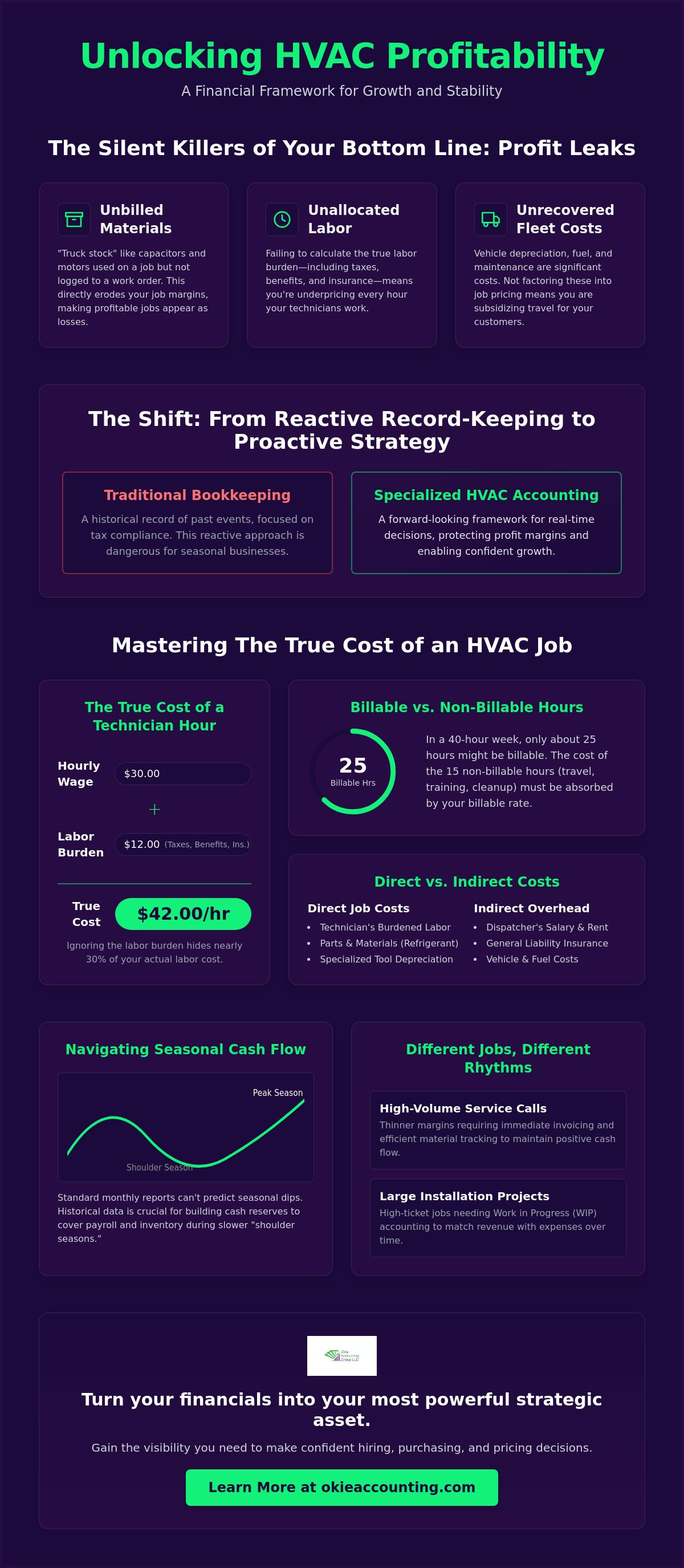
In the service trades, "profit leaks" are the silent killers of growth. These leaks occur when materials aren't billed, labor hours aren't allocated to specific jobs, or equipment depreciation isn't factored into pricing. Moving beyond simple compliance bookkeeping allows you to identify these gaps before they compromise your stability. Transitioning to growth-focused management accounting transforms your financial data into a tool for real-time decision-making. You stop guessing about your bank balance and start knowing exactly where your money is working.
Inventory and Material Management Across the Fleet
Your inventory isn't just sitting in a warehouse. It's scattered across a fleet of trucks, often in various states of organization. Unrecorded "truck stock" creates significant black holes in a balance sheet. When a technician grabs a capacitor or a motor without logging it to a specific work order, your job costing becomes inaccurate immediately. Cloud-based systems are now essential for reconciling these material costs. These tools allow you to track parts from the warehouse to the individual service truck, ensuring that every piece of hardware is accounted for and billed to the correct client. Without this visibility, you're essentially subsidizing your customers' repairs with your own margins.
Managing Seasonal Cash Flow Fluctuations
The HVAC industry is defined by its peaks and valleys. While summer heatwaves drive high revenue, the "shoulder seasons" can drain cash reserves quickly if you aren't prepared. Standard monthly reporting often fails to provide the foresight needed to navigate these dips. You need historical data to build a cash reserve that covers equipment inventory and payroll during slower months. Data from March 2026 indicates that repair revenue share reached 31.3% in late 2025, highlighting the growing importance of service calls over replacements. Tracking these shifts allows you to adjust your strategy. Real-time data gives you the confidence to make informed equipment purchasing decisions before the busy season hits, protecting your cash flow year-round.
Mastering HVAC Job Costing and Labor Burden
If inventory management is the bones of your business, job costing is the circulatory system. Without it, you can't see which projects are actually generating cash and which are merely consuming it. One of the most significant oversights in bookkeeping for hvac contractors is failing to calculate the true labor burden of field staff. Labor burden is the total cost of an employee beyond their hourly wage, including taxes, benefits, and insurance. When you ignore these hidden costs, your gross margins disappear before the job is even finished.
A successful financial plan for an HVAC business requires a strict distinction between direct job costs and indirect overhead. Direct costs include the copper tubing, refrigerant, and the burdened labor hours spent on-site. Indirect overhead encompasses your dispatcher's salary, warehouse rent, and general liability insurance. To protect your profits, you must also allocate vehicle maintenance and fuel costs to specific projects. For instance, with the 2026 standard mileage rate at 72.5 cents per mile, failing to track truck travel can lead to thousands in unrecovered expenses annually.
Service Calls vs. Installation Projects
Managing high-volume service work requires a different accounting rhythm than long-term installations. Service calls often have thinner margins and require immediate invoicing to maintain cash flow. Conversely, installation projects involve high-ticket equipment and can span several days or weeks. This necessitates Work in Progress (WIP) accounting to ensure revenue matches the timing of your expenses. Determining the break-even point for every truck on the road allows you to set pricing that covers both the technician's time and the operational costs of the vehicle.
The True Cost of a Technician Hour
Your technicians' billable time is your most perishable inventory. However, the true cost of an hour includes non-billable activities like travel, safety training, and shop cleanup. If a tech works 40 hours but only bills 25, the cost of those 15 unbilled hours must be absorbed by your billable rate. You must also factor in specialized tool depreciation, such as vacuum pumps and recovery machines, into your job costs. Linking your payroll management directly to project profitability ensures that you aren't just paying for time, but investing in results. This level of oversight is what separates a struggling service provider from a scalable enterprise.
QuickBooks for HVAC: Building a Scalable Infrastructure
Choosing the right accounting platform is the first step in creating a resilient financial foundation. For most modern service businesses, QuickBooks Online has become the industry standard for specialized bookkeeping for hvac contractors. This shift is partly driven by necessity. Intuit stopped selling new subscriptions to QuickBooks Desktop Pro and Premier in 2024, leaving Enterprise as the only desktop option for new users. As of 2026, QuickBooks Online Plus is priced at $115 per month, providing the essential class tracking and project profitability tools that contractors need to scale.
A generic setup won't suffice for a complex trade. You need a customized Chart of Accounts that mirrors the physical reality of your operations. Instead of broad categories, your system should feature specific accounts for equipment sales, service labor, and various material types. Integrating field service management (FSM) software with your accounting system bridges the gap between the technician's van and the front office. When these systems talk to each other, data flows seamlessly, eliminating the need for manual entry and reducing the risk of human error.
Using QuickBooks classes allows you to segment your business into distinct revenue streams, such as residential service, commercial maintenance, and new construction. This granular visibility helps you identify which departments are carrying the company and which are dragging down your overall margin. You can't fix what you can't see. A structured setup ensures that every transaction is categorized correctly from the moment it enters the system.
Automating the Quote-to-Invoice Workflow
The time between completing a repair and receiving payment is a critical metric. High "days sales outstanding" (DSO) numbers can choke your cash flow, even if your technicians are busy. Mobile invoicing allows your team to collect payments on-site, effectively reducing your DSO to zero for many service calls. By syncing field estimates with your back-office bookkeeping, you prevent the data gaps that often lead to unbilled materials. For a deeper look at these configurations, check out our guide on QuickBooks for contractors.
Professional QuickBooks Setup and Training
Many owners treat software configuration as a DIY project, but a "standard" setup often leads to messy data that is difficult to untangle later. Professional QuickBooks Setup & Training ensures that your team understands the "why" behind the workflows. When your office staff is empowered to maintain data integrity, your reports become reliable tools for strategy rather than just a source of confusion. Investing in proper configuration today prevents the financial "black holes" that can derail your long-term growth.
Scaling Your HVAC Firm with Fractional Controller Services
Once your infrastructure is in place, the focus shifts from merely maintaining records to leveraging them for growth. This is the vital transition from standard bookkeeping for hvac contractors to strategic financial oversight. While a bookkeeper ensures your transactions are accurately categorized, a fractional controller interprets those numbers to protect your bottom line. A fractional controller provides the high-level strategy of a full-time executive at a fraction of the cost. They identify the subtle profit leaks that standard systems often miss, such as creeping indirect overhead or inefficient technician routing that eats into your fuel budget.
Cash flow forecasting becomes your most powerful tool during this phase. Instead of looking at last month's profit and loss statement, you're looking six months ahead. This foresight is critical when planning for fleet expansion or navigating the A2L refrigerant transition. With the U.S. HVAC market projected to reach $165 billion in 2026, the opportunity for growth is immense. However, expansion requires liquidity. A controller helps you determine exactly when you can afford that next service van or when to increase your recruitment budget to address the industry's technician shortage. They ensure you have the capital ready to take advantage of the restored 100% bonus depreciation for qualifying assets placed in service this year.
Data-Driven Decision Making for HVAC Growth
Scaling requires knowing exactly which parts of your business are the most lucrative. By analyzing profit margins by service type, you might discover that your residential maintenance agreements provide more stability than high-ticket new construction installs. This data allows you to allocate your marketing dollars where they will yield the highest ROI. Our approach to Fractional Controller Services focuses on providing this level of granular insight. We help you budget for recruitment and marketing based on real-time performance rather than historical guesswork.
Lender-Ready Financials and Long-Term Stability
If you plan to seek financing for large equipment purchases or eventually sell your firm, your books must be impeccable. Lenders and private equity buyers look for "lender-ready" financials that demonstrate consistent profitability and strong internal controls. These controls are vital as your team grows. They prevent the simple errors and potential fraud that can occur when one person has too much unchecked authority over your accounts. Implementing professional Controller Services establishes the rigorous management needed for long-term health. If you're ready to move beyond basic data entry and start building a more resilient firm, book a discovery call with our team to discuss your strategic framework.
The Okie Accounting Advantage: Specialized Support for HVAC
Many generalist bookkeepers fail to capture the nuances of construction accounting because they don't understand the physical reality of a service call. They might see an invoice for copper pipe as a simple expense; we see a direct job cost that must be allocated to a specific truck's margin to ensure profitability. This lack of specialization is exactly how the profit leaks discussed earlier go unnoticed for years. At Okie Accounting Group LLC, we focus on building a comprehensive structural framework for your business. As a national partner for contractors across the U.S., we stay current on critical updates, such as the 2026 standard mileage rate of 72.5 cents or the restored 100% bonus depreciation rules, ensuring your business remains compliant and competitive.
Generalist providers often treat bookkeeping for hvac contractors as a secondary administrative task. We treat it as the foundation of your growth. By choosing a partner who understands the technical language of your sector, you gain a strategic advisor who is as invested in your success as you are. We bridge the gap between field operations and financial reporting, providing the disciplined oversight necessary to protect your margins in a fragmented and consolidating market.
A Proactive Partnership for HVAC Success
Most owners only engage with their financials when tax season approaches. We believe that your reporting should be "growth-ready" every day of the year. This proactive approach provides the reassurance of a strategic mentor who focuses on profit protection and long-term stability. Whether you are managing a local fleet or scaling a regional enterprise, our Monthly Bookkeeping services ensure your data is clean, categorized, and ready for high-level analysis. We move beyond basic data entry to provide the clarity you need to lead your technicians with confidence.
The Okie Accounting Group LLC Methodology
Our commitment to accuracy and stability is reflected in our rigorous management style. We don't just record your history; we help you build a future based on data-driven choices. Our specialized Construction Bookkeeping Services cover the full spectrum of your operational needs, from payroll management to fractional controller oversight. We understand the intricacies of WIP reports, labor burden calculations, and seasonal cash flow management. This specialized focus distinguishes Okie Accounting Group LLC from generalist firms. By establishing foundational systems today, we help you transition from a service provider to a strategic market leader.
Protect Your Margins and Build a Scalable Future
Scaling a service business requires more than just high call volume; it demands a structural framework that accounts for every technician hour and every piece of inventory. By mastering job costing and calculating your true labor burden, you move from reactive management to proactive profit protection. Implementing specialized bookkeeping for hvac contractors ensures that your QuickBooks infrastructure is built for growth rather than just tax compliance. This strategic oversight allows you to make hiring and equipment decisions based on real-time data rather than seasonal guesswork. Your numbers should work as hard as your technicians do.
Okie Accounting Group LLC provides the specialized expertise in construction and specialty trades needed to navigate these complexities. Led by Sarah O'Quinn, a strategic accounting professional, our team offers nationwide service across the United States to help contractors reclaim control of their financial data. We don't just record your history; we act as a strategic partner to ensure your firm remains resilient and lender-ready. Secure your profits with specialized HVAC bookkeeping from Okie Accounting Group LLC. You've built a strong business through hard work; it's time to build the systems that ensure it thrives for years to come.
Frequently Asked Questions
What is the difference between general bookkeeping and HVAC bookkeeping?
HVAC bookkeeping is a specialized project-based system that focuses on job costing, labor burden, and seasonal inventory management rather than just categorizing income and expenses. It requires tracking materials across a mobile fleet and allocating indirect overhead to specific service calls. This specialized approach ensures that every job contributes to the company's structural integrity and long-term health.
How do I calculate labor burden for my HVAC technicians?
You calculate labor burden by adding all costs associated with an employee beyond their gross hourly pay, including payroll taxes, workers' compensation, health insurance, and retirement contributions. You then divide this total annual cost by the number of billable hours the technician actually performs. This resulting figure represents the true hourly cost of having that technician in the field.
Can I use QuickBooks Online for my HVAC business?
Yes, QuickBooks Online is the industry standard for specialized bookkeeping for hvac contractors, particularly since Intuit ceased selling many desktop subscriptions in 2024. The Plus and Advanced versions offer class tracking and project profitability tools that allow you to segment revenue by residential or commercial service. It also integrates with most modern field service management software to streamline data flow.
Why is job costing so important for HVAC contractors?
Job costing is essential because it reveals the actual gross margin of every repair and installation by matching direct labor and material costs to specific revenue. Without it, you cannot identify which trucks or service types are losing money. This visibility allows you to adjust pricing and protect your profits against rising equipment costs and the current skilled labor shortage.
How often should I review my HVAC financial statements?
You should review your Profit and Loss and Balance Sheet at least once a month, though high-growth firms often benefit from weekly flash reports on billable hours. Monthly reviews allow you to identify seasonal trends and adjust your cash reserves before the shoulder seasons arrive. Regular oversight ensures that minor profit leaks don't turn into major financial crises for your firm.
When should an HVAC contractor hire a fractional controller?
You should consider hiring a fractional controller when your business reaches a level of complexity where basic data entry no longer provides the strategic insight needed for scaling. This typically happens when you manage multiple crews or plan for significant fleet expansion. A controller moves you from looking at historical records to using cash flow forecasting for proactive decision-making.
What are the most common bookkeeping mistakes HVAC owners make?
The most common mistakes include failing to account for unbilled truck stock inventory, ignoring non-billable technician time, and using a generic Chart of Accounts. Many owners also neglect to update their mileage rates or depreciation schedules, which leads to inaccurate tax planning. These errors create black holes in the balance sheet that hide the true financial health of the business.
How does inventory tracking affect my HVAC company's profitability?
Inventory tracking directly affects profitability by ensuring that every part used on a service call is billed to the customer and replenished correctly. Lost or unrecorded materials represent pure profit that has vanished from your bottom line. Cloud-based reconciliation tools help maintain accuracy across your fleet, preventing the waste that often occurs with unmanaged or unorganized truck stock.


Comments