Bookkeeping for Landscape Contractors: Profit Framework

Updated: 6 days ago
Why does a $184.1 billion industry like landscaping still leave so many firm owners wondering where their cash went at the end of a busy month? You've likely experienced the stress of a seasonal cash flow valley that threatens your payroll, or perhaps you've struggled to calculate the true labor burden on a complex hardscape installation. Professional bookkeeping for landscape contractors is the only way to move past these uncertainties. It's not just an administrative chore. It's the structural framework required to protect your project margins and manage your capital with precision.
We understand that you need more than just a list of expenses; you need data that drives growth. You're likely looking for a way to track equipment depreciation accurately and ensure your bids are based on reality rather than intuition. This article will provide the roadmap to master your financial systems. You'll learn how to transform your books into a strategic asset that allows for scaling, provides lender-ready statements, and gives you back control over your firm's long-term health.
Why Landscape Bookkeeping Requires a Specialized Construction Framework
Landscape bookkeeping is the process of tracking project-based costs to ensure every crew and truck generates a profit. While a retail shop manages static inventory on a shelf, your landscaping firm manages a moving target of variable labor, fluctuating material costs, and heavy equipment depreciation. You aren't just selling a product; you're selling a complex combination of time, expertise, and machinery. This complexity demands a system that goes beyond simple income and expense tracking.
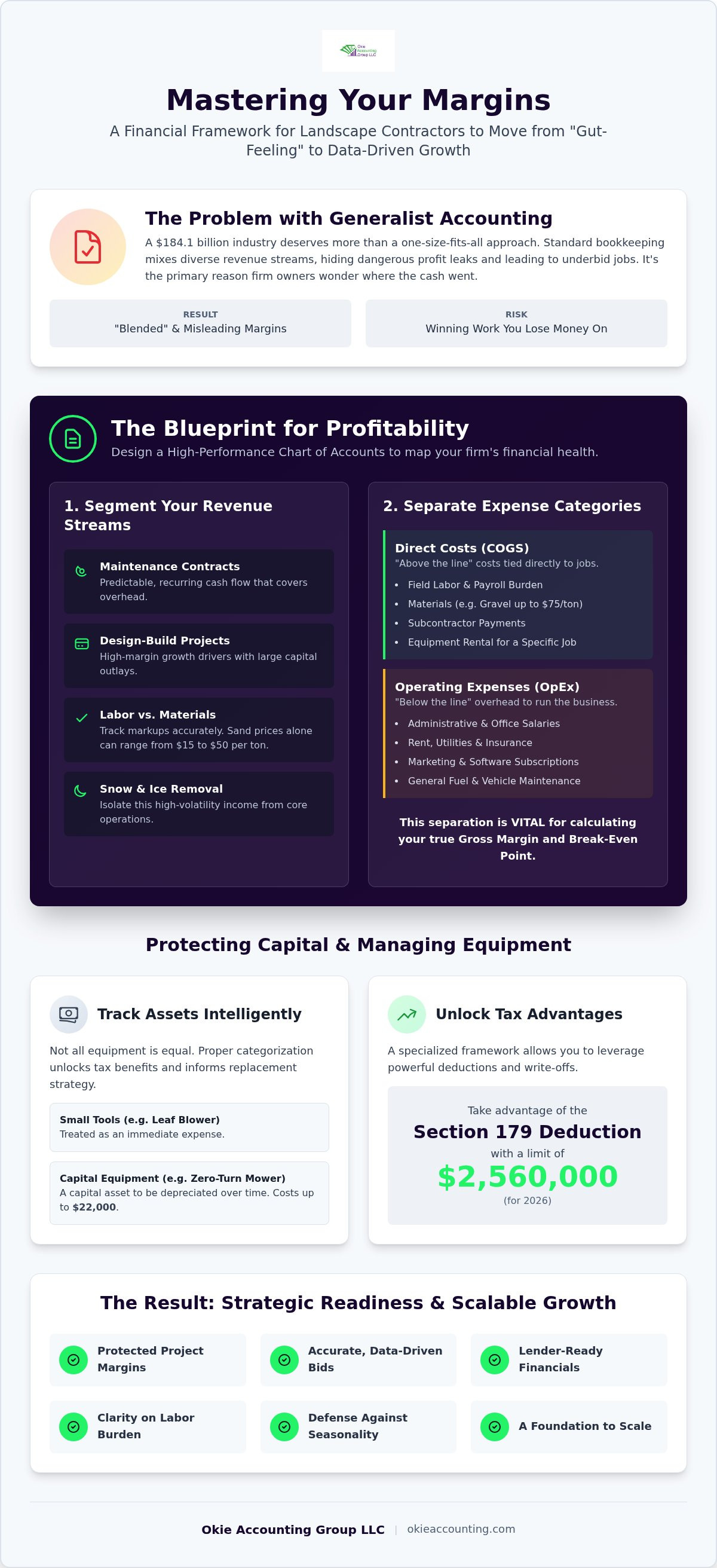
Standard accounting practices often fail to capture the nuances of the green industry. To protect your margins, you must adopt principles of specialized construction accounting. This framework allows you to distinguish between "above-the-line" project costs, like the surging price of gravel which now reaches up to $75 per ton, and "below-the-line" overhead. Without this distinction, you can't see which jobs are actually padding your bank account and which are draining it. A specialized framework moves your firm from a state of constant crisis mode into a posture of strategic readiness for 2026 growth.
The Problem with "Generalist" Accounting
Generalist bookkeepers often produce Profit and Loss statements that look clean but hide dangerous leaks. If your financials mix your recurring maintenance revenue with high-stakes design-build projects, your true job profitability remains a mystery. Maintenance requires high labor volume with low material costs, while hardscaping involves massive capital outlays for stone and heavy equipment. Mixing these service lines leads to a distorted view of your margins. When you don't separate these financials, you'll likely find yourself underbidding future contracts because you're using "average" costs that don't apply to specific project types. It's a fast track to winning work that you eventually lose money on.
Transitioning to a Data-Driven Business Model
Scaling your firm requires moving away from "gut-feeling" management. You need data-backed decisions to handle the 25-35% price increase for new commercial mowers that we've seen recently. Financial clarity is also the primary factor when you need to secure equipment financing or credit lines to expand your fleet. Lenders don't want to see a messy shoebox of receipts; they want to see a disciplined system that accounts for every man-hour and every yard of mulch. Landscape bookkeeping is the structural foundation for profit protection. By treating your bookkeeping for landscape contractors as a strategic asset, you build the financial infrastructure necessary to support long-term stability and aggressive scaling.
Designing a High-Performance Chart of Accounts for Landscapers
The Chart of Accounts (COA) acts as the DNA of your financial reporting system. If this foundation is flawed, every report you generate will be misleading. For effective bookkeeping for landscape contractors, the COA must be granular enough to reveal the health of individual divisions. You can't manage what you don't measure. A high-performance COA allows you to see exactly where your profit is generated and where it's leaking. It transforms a simple list of transactions into a strategic map of your business operations.
Revenue Stream Segmentation
You must separate recurring maintenance from one-off installation projects. Maintenance revenue provides the predictable cash flow that covers your overhead, while design-build projects drive high-margin growth. Mixing these two creates a "blended" margin that obscures the true performance of each team. You should also track "Snow and Ice" revenue as a distinct, high-volatility category. This ensures that a mild winter doesn't look like a failure of your core landscaping operations. Setting up sub-accounts for material sales versus labor revenue is equally critical. With sand prices ranging from $15 to $50 per ton in 2026, you need to know if you're actually capturing a markup on materials or just breaking even on the haul.
Expense Categorization for Margin Protection
Direct Costs (COGS) must be strictly separated from Operating Expenses (OpEx) to track your Gross Margin accurately. Field labor belongs in COGS; administrative labor belongs in OpEx. This distinction is vital for calculating your breakeven point and ensuring your crews are efficient. You should also distinguish between "Small Tools" and "Capital Equipment." While a leaf blower might be an immediate expense, a new commercial zero-turn mower costing up to $22,000 is a capital asset. Tracking these correctly allows you to take advantage of the Section 179 deduction, which has a limit of $2,560,000 for 2026. Learn more about our Management Accounting services to see how we structure these frameworks for growth.
Don't stop at broad categories. Ensure equipment-related expenses are tracked by specific sub-categories like fuel, repairs, and insurance. This level of detail helps you identify "gas-guzzling" assets or older machines that cost more to maintain than they earn. If a used mower with 1,000 hours is costing you thousands in monthly repairs, your COA will highlight that it's time to trade up. Building this level of visibility is the first step toward long-term stability. If you're ready to build a more resilient financial structure, you can schedule a discovery call with our team to discuss your specific needs.
Job Costing and Labor Burden: The Profit Protection Framework
Effective bookkeeping for landscape contractors requires viewing each project as an independent business unit. Job costing is the practice of assigning every dollar spent directly to a specific landscape project, from the initial site clearing to the final mulch application. Without this granular data, you can't identify which crews are efficient and which are lagging. If you treat your expenses as a single lump sum, you lose the ability to see the "profit leaks" that occur when a project takes longer than estimated or requires more materials than budgeted.
Labor is your most significant variable cost. However, many owners make the mistake of only accounting for the base hourly wage. In May 2023, the median hourly wage for landscaping workers was $17.96, but that number doesn't reflect the true cost to your firm. To protect your margins, you must account for labor burden. This is the "hidden" cost of an employee beyond their check. Failure to calculate this burden often results in estimated profit margins that are inflated by 15-30%, leading to bids that look profitable on paper but lose money in reality.
Calculating Your True Labor Burden
Your actual hourly cost per crew member is significantly higher than their base rate. To find the true cost, you must add payroll taxes, workers' compensation insurance, and any benefits or paid time off to the base wage. You then divide this total by the actual billable hours worked. For example, a tree trimmer earning a median wage of $23.59 might actually cost your firm closer to $32.00 per hour once all burden factors are applied. Mastering Construction Payroll and Compliance is essential for ensuring these estimates remain accurate and your firm stays compliant with shifting regulations.
Include state and federal unemployment taxes in every project estimate.
Allocate workers' comp premiums based on specific task risk levels.
Factor in non-billable time like morning shop prep and drive time between sites.
WIP Accounting for Design-Build Projects
Design-build installations often span several months, which can create misleading "revenue spikes" on your financial statements. Work in Progress (WIP) accounting allows you to recognize income based on project completion rather than just when you send an invoice. This method provides a steady, accurate view of your monthly performance. It also helps you track material deposits as unearned revenue, keeping your balance sheet from looking artificially inflated before the work is performed.
Using WIP reporting helps you identify "profit fade" before a project concludes. Profit fade occurs when the estimated costs of a project gradually increase while the contract price remains fixed. By reviewing your WIP reports monthly, you can spot these trends early and adjust your field operations or change order processes before your margin disappears entirely. This level of oversight transforms your bookkeeping from a historical record into a proactive management tool.
Managing Seasonal Cash Flow and Equipment Cycles
Landscaping is a "feast or famine" industry where cash flow isn't just a metric; it's your primary survival tool for 2026. While generalist providers focus on recording what already happened, strategic bookkeeping for landscape contractors prioritizes what will happen next. You need to anticipate the lean winter months long before the first frost hits. By building a "Winter Reserve" fund based on your historical burn rates, you ensure that payroll and overhead remain covered even when the mowers are in storage. This proactive stance transforms your financial department from a historical archive into a command center for seasonal stability.
The 12-Month Cash Flow Forecast
Predicting your cash position requires a disciplined, four-step approach. First, analyze your historical monthly spending from the last three years to identify recurring patterns. Second, project your guaranteed maintenance revenue for the upcoming season, as this forms the floor of your financial security. Third, overlay your planned capital expenditures. With new commercial zero-turn mowers now costing between $18,000 and $22,000, these investments must be timed perfectly to avoid draining your liquidity. Finally, identify your "Cash Valley" months. Recognizing these dips early allows you to secure lines of credit or adjust your hiring schedule before the crunch arrives. Mastering Construction Cash Flow Management is the difference between a stressed owner and a confident leader.
Equipment Depreciation and Maintenance Tracking
Your fleet is your most significant asset, but it's also a major source of hidden costs. Tracking repairs by specific asset reveals which machines are profitable and which are "gas-guzzlers" draining your margins. When repair costs on a used mower with 1,000 hours begin to climb, your data should tell you exactly when it's more tax-efficient to sell than to fix. For 2026, the Section 179 deduction limit is $2,560,000, allowing you to expense the full purchase price of qualifying equipment immediately. Additionally, trucks with a GVWR over 6,000 lbs qualify for a deduction of up to $32,000 this year. Integrating your QuickBooks data with field management software ensures you capture this equipment usage in real-time, providing the clarity needed to optimize your fleet lifecycle.
Success in this industry requires a partner who understands the mechanics of your trucks as well as the mechanics of your balance sheet. We help you build the financial infrastructure to manage these cycles with precision. If you're ready to move beyond basic record-keeping and implement a professional forecasting system, you can book a discovery call to start your cash flow transformation.
Scaling Your Firm with Fractional Controller Oversight
Many landscape owners hit a "ceiling" when they attempt to act as their own bookkeeper while managing crews in the field. You've likely mastered the art of hardscape installation or maintenance routing, but your back office shouldn't be a bottleneck for your growth. Professional bookkeeping for landscape contractors is the first step, but scaling a multi-million dollar firm requires a transition from simple record-keeping to strategic financial leadership. You need a system that doesn't just tell you what happened yesterday, but predicts what you can achieve next season.
Breaking through this plateau often requires fractional controller services. This model provides high-level financial strategy without the prohibitive cost of a full-time CFO. A controller acts as your strategic partner, interpreting the data within your financial infrastructure to identify where you should invest and where you should cut back. They ensure your financials are lender-ready, providing the accuracy required to secure the credit lines or equipment financing needed for aggressive expansion. By leveraging Strategic Growth with Fractional Controller Services, you gain an advisor who looks beyond the bank balance to protect your long-term stability.
From Data Entry to Strategic Leadership
A controller identifies underperforming service lines that might be hidden by your overall revenue numbers. While your maintenance division might be steady, a controller can reveal if your irrigation or design-build projects are suffering from "profit fade" due to unmanaged change orders. They also implement essential internal controls. These systems prevent "leakage" and fraud in the field, ensuring that material purchases and labor hours are strictly tied to specific jobs. This level of oversight moves your firm from a state of reactive management to one of disciplined, data-backed leadership.
The 2026 Tech Stack for Modern Landscapers
Implementing a modern tech stack is non-negotiable for firms aiming to scale in 2026. QuickBooks Online has become the industry standard for cloud-based bookkeeping for landscape contractors because it allows for real-time collaboration and seamless integration. We specialize in Professional QuickBooks Setup and Training to ensure your team is empowered by the data they enter rather than frustrated by it.
Modern firms gain a competitive edge by integrating field apps like Aspire or LMN directly with their accounting system. This integration ensures that data flows from the crew leader's tablet straight into your financial reports. It eliminates double entry, reduces clerical errors, and provides the granular job costing data discussed earlier in this framework. When your field operations and financial systems speak the same language, you gain the clarity and control necessary to lead your firm with precision.
Build Your Financial Infrastructure for 2026
Transitioning from a reactive service provider to a strategic landscape firm requires more than just hard work; it demands a specialized financial infrastructure. By implementing a granular chart of accounts and mastering labor burden calculations, you protect your margins from the profit fade that often plagues complex design-build projects. Proactive cash flow forecasting ensures you have the liquidity to manage seasonal valleys and invest in high-value equipment when the timing is most tax-efficient. This disciplined approach transforms your books from a historical record into a roadmap for growth.
Effective bookkeeping for landscape contractors is the foundation, but strategic oversight is what drives sustainable scaling. At Okie Accounting Group, we provide the specialized construction and real estate expertise your business deserves. Our team offers proactive fractional controller oversight and nationwide strategic support to help you move beyond basic administrative tasks. If you're ready to lead with data-backed confidence and secure your firm's future, we are ready to partner with you. Gain financial clarity and scale your firm with Okie Accounting Group. Your path to operational clarity starts with a single strategic choice.
Frequently Asked Questions
Do I need a specialized bookkeeper for a landscaping business?
Specialized bookkeeping for landscape contractors is essential because generalist providers often lack experience with project-based construction frameworks. You need a partner who understands equipment depreciation, labor burden, and the complexities of seasonal flux. This specialized expertise ensures your financial statements are lender-ready and your margins are shielded from the hidden costs that generalists frequently overlook.
What is the best accounting software for landscape contractors?
QuickBooks Online is the preferred choice for bookkeeping for landscape contractors because it offers seamless integration with field management software like Aspire or LMN. It provides the flexibility required for cloud-based oversight and real-time data entry from the field. This ecosystem allows you to track project expenses on the go and maintains a clean, professional audit trail for your growing firm.
How do I calculate labor burden for my landscaping crew?
Total your annual costs for payroll taxes, workers' compensation insurance, and benefits, then add this sum to the employee's gross annual wages. Divide the resulting total by the number of actual billable hours they work each year. This calculation provides your true hourly cost, which is often 20% to 30% higher than the base wage you see on a paycheck.
What is the difference between cash and accrual accounting for landscapers?
Accrual accounting records income when it's earned and expenses when they're incurred, providing a precise picture of project profitability. Cash accounting only tracks when money physically enters or leaves your bank account. For landscape firms managing long-term design-build installs, accrual is the only reliable way to track Work in Progress (WIP) and avoid misleading profit spikes that don't reflect actual progress.
How often should I review my landscape business financial statements?
You should conduct a deep-dive review of your financial statements every month. This consistent rhythm allows you to identify trends in material costs or labor overages before they become systemic problems for your firm. Weekly reviews of your aging accounts receivable and cash flow forecasts are also vital to ensure your liquidity remains steady during the high-demand peak seasons.
Can I track job costing directly in QuickBooks Online?
You can track job costing in QuickBooks Online by utilizing the "Projects" feature found in the Plus and Advanced tiers. This specialized tool allows you to tag every expense, billable hour, and material purchase to a specific project. It generates instant reports that show you exactly where you're making or losing money on every job site, empowering better bidding.
What are the most important financial KPIs for a landscaping company?
Prioritize tracking your Gross Profit Margin, Days Sales Outstanding (DSO), and Revenue per Man-Hour. Gross Margin reveals the health of your bidding and estimating process, while DSO measures how efficiently you collect payments. Monitoring revenue per man-hour is the most effective way to evaluate the productivity of your field crews and identify training needs or equipment gaps.
How do I manage cash flow during the winter off-season?
Implement proactive cash flow forecasting to set aside a specific percentage of revenue during your peak spring and summer months. This reserve should cover your fixed overhead and core payroll during the winter off-season. You can also use this time to perform preventative maintenance on your fleet, which prevents costly breakdowns and lost revenue during the busy spring rush.


Comments