Bookkeeping for Multifamily Real Estate: A Strategic Framework for Scaling Portfolios

Updated: 6 days ago
Most multifamily investors treat their ledgers as a simple historical record of rent checks, but for those scaling toward a larger portfolio, that approach is a recipe for stalled growth. It's one thing to manage a single duplex; it's another to maintain structural integrity across dozens of units while navigating the 100% bonus depreciation rules and 23% QBI deductions active in 2026. You likely understand the frustration of untangling commingled funds or the stress of a lender questioning your inconsistent expense allocations. Accurate bookkeeping for multifamily real estate shouldn't be a reactive administrative chore. It must be a proactive strategic asset.
We believe that clarity over your financial data is the foundation of investor confidence and long-term stability. This article outlines a framework to help you move beyond basic data entry toward a sophisticated system that protects your profits. You'll discover how to automate your accounting workflows to generate lender-ready financial statements and clear unit-level profitability insights. We'll preview the essential steps to transform your messy spreadsheets into a scalable engine for growth, ensuring you're always prepared for the next acquisition.
The Complexity Gap: Why Multifamily Real Estate Bookkeeping Requires a Specialized Approach
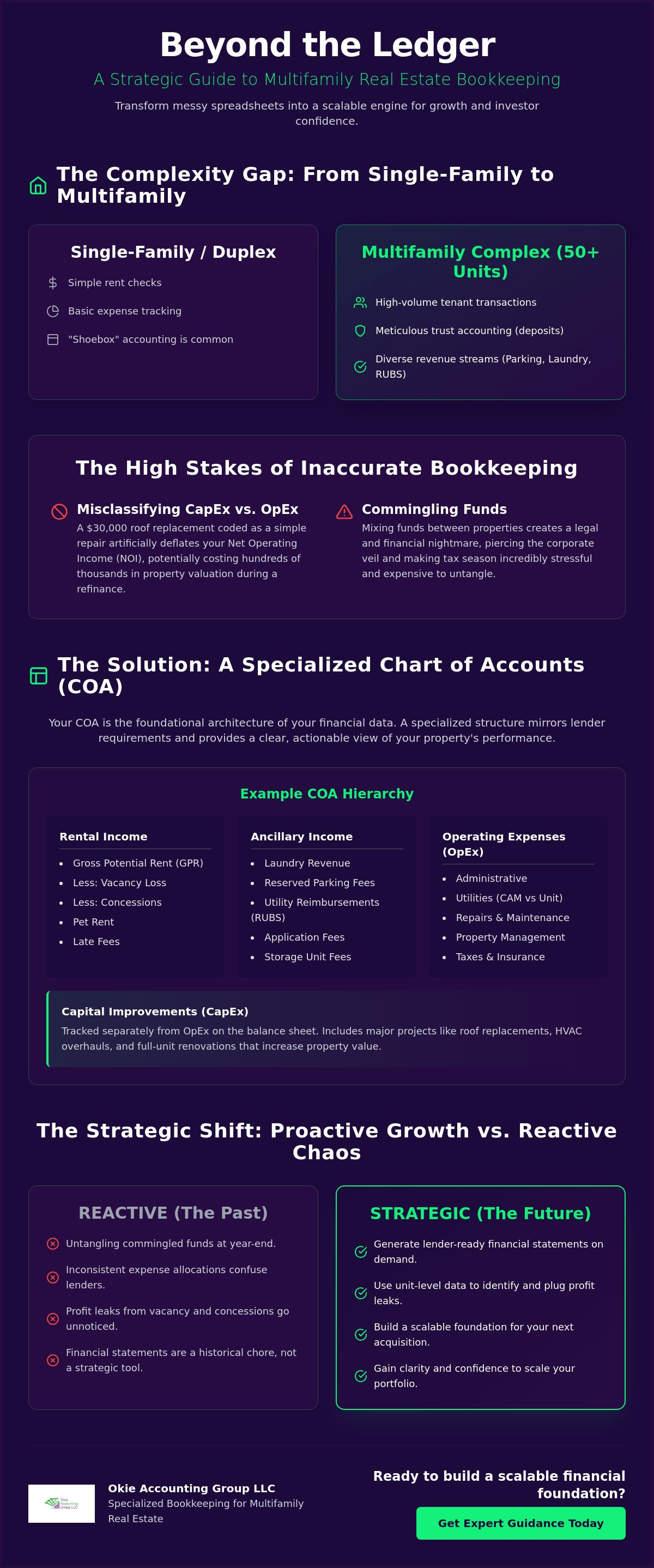
Transitioning from a handful of single-family rentals to a 50-unit complex isn't a linear step. It's a quantum leap in operational volume. You're no longer just tracking a single monthly rent check; you're managing a high-frequency stream of transactions. Effective bookkeeping for multifamily real estate requires capturing diverse revenue sources like laundry income, reserved parking fees, and pet rent. If you utilize RUBS (Ratio Utility Billing Systems), you must track those reimbursements with surgical precision to ensure your utility recovery is actually hitting your pro forma targets.
Generalist bookkeepers often struggle in this sector because they don't understand the high stakes of CapEx versus OpEx. A misclassified $30,000 HVAC overhaul or a roof replacement can artificially depress your Net Operating Income (NOI). Since multifamily valuations are tied directly to income performance, a simple coding error could cost you hundreds of thousands in perceived property value during a refinance. Foundational Real Estate Investing Principles dictate that your financial data must be audit-ready to satisfy sophisticated lenders and equity partners who demand structural integrity in your reporting.
Moving Beyond Single-Family Accounting Habits
Many investors start with "shoebox" accounting, but scaling requires a professional management accounting approach. Commingling funds across different property entities is a common trap that creates a legal and financial mess during tax season. It's also vital to reconsider the limitations of cash-basis accounting. While it's simple, it often obscures your true financial health by ignoring the timing of large vendor payments and prepaid rents. Transitioning to a professional mindset means viewing each complex as a standalone business entity that requires its own rigorous, dedicated oversight.
Identifying Multi-Unit Financial Pain Points
Managing a large-scale complex introduces unique stressors that don't exist in the single-family world. You must track vacancy losses and concessions at the unit level to understand exactly where your profit leaks are occurring. Security deposits present another significant challenge; they aren't your money. They require meticulous trust accounting to ensure you stay in compliance with strict state-specific regulations for tenant fund handling. If your current system can't handle the administrative burden of managing dozens of tenant ledgers simultaneously, you'll face significant friction. Specialized bookkeeping for multifamily real estate solves this by building a framework that scales long before you sign the papers on your next acquisition.
Building a Structural Framework: The Multifamily Chart of Accounts
A multifamily Chart of Accounts (COA) is a specialized organizational map of every financial category specific to apartment operations. It isn't merely a list of labels; it's the foundational architecture that determines how clearly you see your profit. Without a tailored COA, your financial data remains a disorganized pile of transactions. When you implement professional bookkeeping for multifamily real estate, you're building a system that mirrors lender requirements and industry benchmarks from the start. This alignment is critical because banks and equity partners expect to see your data presented in a format that makes Understanding Multifamily Investments easy for their underwriting teams.
For those using QuickBooks, the structural integrity of your reporting relies on the strategic use of 'Classes' and 'Locations.' We use Classes to track specific departments or cost centers, while Locations allow for seamless multi-entity reporting across a diverse portfolio. Your COA should be built around essential parent accounts: Rental Income, Operating Expenses (OpEx), and Capital Improvements (CapEx). This hierarchy ensures that your day-to-day costs don't get buried in your long-term investment data, keeping your balance sheet clean and your income statement actionable.
Revenue Categories That Drive Insight
Your revenue tracking must go beyond a single "Rent" line item. You need to separate Gross Potential Rent (GPR) from your actual collected income to visualize vacancy loss and concessions clearly. Tracking ancillary income, such as pet fees, reserved parking, and laundry revenue, is the secret to boosting your property's valuation. Every dollar of miscellaneous income you capture increases your property's value when calculated against market cap rates. A logically organized Chart of Accounts ensures that every dollar is accounted for, providing a transparent view of your Net Operating Income that directly correlates to your property's market value.
Expense Allocation for Precision Management
Precision in expense allocation separates the amateur investor from the professional operator. You must standardize how you track utilities and bill-back reconciliations (RUBS) to ensure your recovery rates stay on target. It's equally vital to categorize repairs versus improvements correctly. Misclassifying a capital expenditure as a simple repair can skew your NOI and lead to missed tax benefits. We specialize in helping investors see how we build management accounting frameworks that turn these granular details into high-level strategy. If your current setup feels like it's holding you back, it might be time to schedule a discovery call to review your structural framework.
Operational Excellence: Managing Unit-Level Income and Expense Allocation
Operational excellence in bookkeeping for multifamily real estate isn't about working harder; it's about building repeatable systems that eliminate human error. At the core of this effort is a standardized monthly rent roll reconciliation. You don't just want to see that rent was paid. You need to verify that every credit, concession, and late fee matches your ledger exactly. This level of granular oversight ensures that your property management reports align perfectly with your financial statements, providing a single source of truth for your stakeholders.
Automating the allocation of common area maintenance (CAM) charges and tracking unit-specific renovation costs during turnovers are equally vital. When a unit turns, you must distinguish between routine maintenance and value-add improvements. Failure to track these costs accurately at the unit level can obscure your true ROI on renovation projects. Implementing a rigorous month-end close checklist provides the oversight necessary to maintain lender-ready books. This disciplined approach aligns with Deloitte's analysis of commercial real estate accounting, which emphasizes the need for robust internal controls to manage the complexities of modern real estate portfolios.
The Security Deposit Trap: Best Practices for Compliance
Security deposits are a frequent source of legal friction and administrative headache. You must maintain separate escrow accounts to keep these tenant funds isolated from your operating capital. A structured workflow for move-out inspections and deposit dispositions isn't just good business; it's a legal safeguard. Meticulous record-keeping of tenant claims and repair deductions protects you against potential litigation and ensures you remain in full compliance with state-specific regulations. Don't let a simple administrative oversight turn into a costly legal dispute.
Utility Bill-Backs and RUBS Management
Managing utility bill-backs through Ratio Utility Billing Systems (RUBS) requires specialized attention to ensure you aren't leaving money on the table. You should record utility reimbursements as revenue rather than simple expense offsets to provide a clearer picture of your property's performance. Reconciling master meter bills against tenant allocations allows you to identify discrepancies quickly. This data-driven approach often reveals hidden issues, such as water leaks or inefficient HVAC systems, that would otherwise silently erode your Net Operating Income. By treating your utility data as a strategic asset, you turn a complex administrative task into a tool for operational efficiency.
Beyond Data Entry: Leveraging Fractional Controller Insights for Growth
Effective bookkeeping for multifamily real estate often stops at the point of data entry, but that is where strategic growth should actually begin. Administrative bookkeeping records what happened in the past. Strategic oversight explains why it happened and how to improve the future outcome. A Fractional Controller doesn't just reconcile accounts; they identify profit leaks that property managers might overlook. This includes spotting excessive maintenance markups or identifying recurring repair costs that signal a need for a capital replacement rather than another temporary fix. By moving beyond the ledger, you turn your financial records into a roadmap for portfolio expansion.
When it's time to refinance or acquire new assets, having a controller-led financial package is a significant competitive advantage. Lenders in 2026 are increasingly meticulous, prioritizing properties with high structural integrity in their financial reporting. By utilizing fractional controller services, you ensure your debt coverage ratios and operating margins are presented with professional precision. This proactive stance transforms your financial data from a compliance burden into a powerful tool for capital attraction. It's about presenting a narrative of stability and professional management to your equity partners.
Data-Driven Decision Making for Investors
You need to know if a $5,000 kitchen upgrade actually yields the target rent premium before rolling it out across 100 units. A controller uses historical data to analyze the ROI of specific renovations, ensuring your capital is deployed effectively. They use cash flow forecasting to plan for major 2026 expenses, such as the energy-efficient HVAC systems that are becoming critical for resident retention and operational cost reduction. Evaluating property manager performance through financial KPIs like "days to turn" and "collection loss" keeps your boots-on-the-ground team accountable to your bottom line.
Scaling Through Systems and Oversight
Scaling a portfolio requires more than just more units; it requires more robust systems. Establishing internal controls is essential to prevent fraud and mismanagement as your team and vendor list expand. Regular monthly financial reviews provide the transparency needed to maintain investor confidence, especially when navigating the complexities of accounting for real estate investors. These systems create a sense of order and predictability that mirrors the organized growth you're striving to achieve. If you're ready to transition from recording the past to planning your future, book a discovery call today to see how we can strengthen your financial oversight.
Scaling Your Portfolio with Specialized Bookkeeping Systems
Selecting the right tech stack is the foundational decision that determines how effectively you can scale. While specialized property management software is often excellent for tenant communications and maintenance requests, these platforms sometimes lack the robust general ledger capabilities found in QuickBooks Online. For many investors, the ideal solution is a hybrid approach where rent roll data flows directly into a centralized accounting system. This integration eliminates the manual entry errors that frequently plague growing portfolios and ensures your financial data remains the single source of truth. If your team needs to master these tools, professional QuickBooks setup and training ensures your software works for you, rather than the other way around.
Standardizing reporting across your entire multifamily portfolio is the only way to compare performance accurately across different assets. If one property tracks "repairs" as a single line item while another breaks it down by unit, your high-level analysis will be flawed. Specialized bookkeeping for multifamily real estate requires a uniform data structure across every entity you own. This uniformity allows you to spot regional trends, such as rising utility costs in a specific market or a property manager who is consistently over-budget on turnover costs. When every property speaks the same financial language, you can make acquisition or disposition decisions with far greater speed and confidence.
Implementing a Scalable Accounting Workflow
Building a workflow that grows with your portfolio requires three foundational steps to move from administrative chaos to operational order:
Step 1: Standardize your Chart of Accounts across all properties. Using the same map for every asset ensures your consolidated reports are accurate and meaningful. This allows for "apples-to-apples" comparisons that lenders and partners value.
Step 2: Automate data entry via bank feeds and software integrations. Manual data entry is a bottleneck that invites error. By connecting your bank accounts and property management software to your general ledger, you reduce administrative overhead and improve real-time data accuracy.
Step 3: Establish a monthly reporting cadence for all stakeholders. Consistency builds trust. Delivering a standard financial package by a set date every month keeps your investors informed and your lenders satisfied with your professional management.
The Path to Financial Clarity
Professional oversight is the bridge between owning a building and running a sophisticated business. It's the difference between reactive firefighting and proactive wealth management. During market shifts, such as the moderate rent growth and 6.8% vacancy rates seen in early 2026, specialized bookkeeping protects your profit margins by highlighting inefficiencies before they become crises. You gain the clarity needed to adjust concessions or pivot your CapEx strategy based on hard data rather than intuition. If you're ready to build this level of structural integrity, explore our guide on fractional controller services to see how we help firms scale with precision.
Building a Legacy of Financial Stability
Scaling a portfolio requires a shift from viewing your ledger as a historical record to treating it as a strategic engine for growth. By implementing a specialized Chart of Accounts and automating your rent roll reconciliations, you move beyond basic administrative tasks. You establish a structural framework that protects your profit margins and satisfies the most meticulous lenders. Professional bookkeeping for multifamily real estate provides the unit-level clarity needed to identify profit leaks and optimize your capital expenditures. When your financial data is organized and audit-ready, you aren't just owning buildings; you're running a disciplined business entity.
Our team brings deep expertise in the construction and real estate sectors to every partnership. We provide specialized QuickBooks Online systems and nationwide fractional controller support designed to help you scale with confidence. If you're ready to transition from reactive data entry to proactive financial oversight, we're here to help. Schedule a consultation to build your strategic financial framework and take control of your portfolio's future. You've built the assets; now it's time to build the systems that protect them.
Frequently Asked Questions
What is the best accounting software for multifamily real estate?
QuickBooks Online remains the gold standard for its robust general ledger capabilities and wide integration options. While many property management platforms offer basic ledgers, they often lack the structural depth required for complex multi-entity reporting. Using QuickBooks alongside specialized management tools provides the best balance of operational efficiency and financial accuracy for a scaling firm.
How do I handle security deposits in my bookkeeping system?
You must record security deposits as a liability on your balance sheet because these funds don't belong to the property owner. These deposits should be held in a dedicated escrow bank account to ensure legal compliance. When a tenant moves out, you record the disposition by either refunding the liability or reclassifying it as income if you're covering damages.
What is the difference between CapEx and OpEx in multifamily accounting?
Operating Expenses (OpEx) are the daily costs of running the property, like minor repairs or landscaping, while Capital Expenditures (CapEx) are investments that extend the property's life. A new roof or a complete unit renovation is CapEx. Correctly distinguishing these protects your Net Operating Income (NOI) and ensures you maximize tax benefits like the permanent 100% bonus depreciation available in 2026.
Should I use cash or accrual accounting for my apartment complex?
Accrual accounting is the superior choice for investors scaling their portfolios. It records income when it's earned and expenses when they're incurred, providing a much clearer picture of your actual profitability. Most lenders and equity partners require accrual-basis reporting to evaluate your property's performance during the underwriting process for bookkeeping for multifamily real estate.
How do I track utility bill-backs (RUBS) in my books?
Track utility bill-backs by recording reimbursements as a separate revenue line item on your income statement. Don't simply offset your utility expense accounts; this obscures your true operating costs. By tracking these as income, you can easily compare your master meter bills against tenant recoveries to identify inefficiencies or water leaks that silently erode your profit.
What financial reports do lenders require for multifamily refinancing?
Lenders typically require a current rent roll, a Trailing 12-Month (T-12) income statement, a balance sheet, and a detailed CapEx schedule. They look for structural integrity in your data to verify your Debt Service Coverage Ratio (DSCR). Having these reports ready and reconciled is essential for a smooth refinancing or acquisition process in a competitive market.
Can my property management software replace a bookkeeper?
Property management software cannot replace a professional bookkeeper because it focuses on operations rather than financial structural integrity. These platforms are excellent for collecting rent and managing maintenance, but they don't provide the high-level oversight needed for bookkeeping for multifamily real estate. A dedicated professional ensures your general ledger aligns with your tax strategy and lender requirements.
How often should I reconcile my multifamily property accounts?
You should reconcile your property accounts at least once every month as part of a disciplined month-end close. High-volume portfolios often benefit from weekly reconciliations to catch discrepancies in rent collection or vendor payments early. Regular oversight prevents small errors from compounding into significant financial headaches during tax season or a property sale.


Comments