Bookkeeping for Plumbers: A Strategic Framework to Plug Financial Leaks

Updated: 6 days ago
Why does your bank balance rarely reflect the hard work your team puts in on the job site? You're likely tired of the cash flow gaps that open up between paying for expensive inventory and finally receiving customer payments. Implementing specialized bookkeeping for plumbers is the only way to stop profits from disappearing into untracked truck stock or underquoted labor hours. You shouldn't have to guess which projects are actually hitting your margin targets.
This article provides a strategic framework to transform your financial chaos into a disciplined, high-margin operation. We'll show you how to plug the "hidden leaks" in your business by using systems designed for the unique mechanics of the plumbing industry. This isn't about simple data entry; it's about building foundational structures that ensure long-term stability and profit protection.
We'll explore how to achieve real-time visibility into project profitability, prepare lender-ready statements for your next equipment purchase, and build a scalable system. By the end, you'll understand how to transition from a service provider to a strategic owner who leads with data-driven confidence.
Why Bookkeeping for Plumbers Requires a Specialized Approach
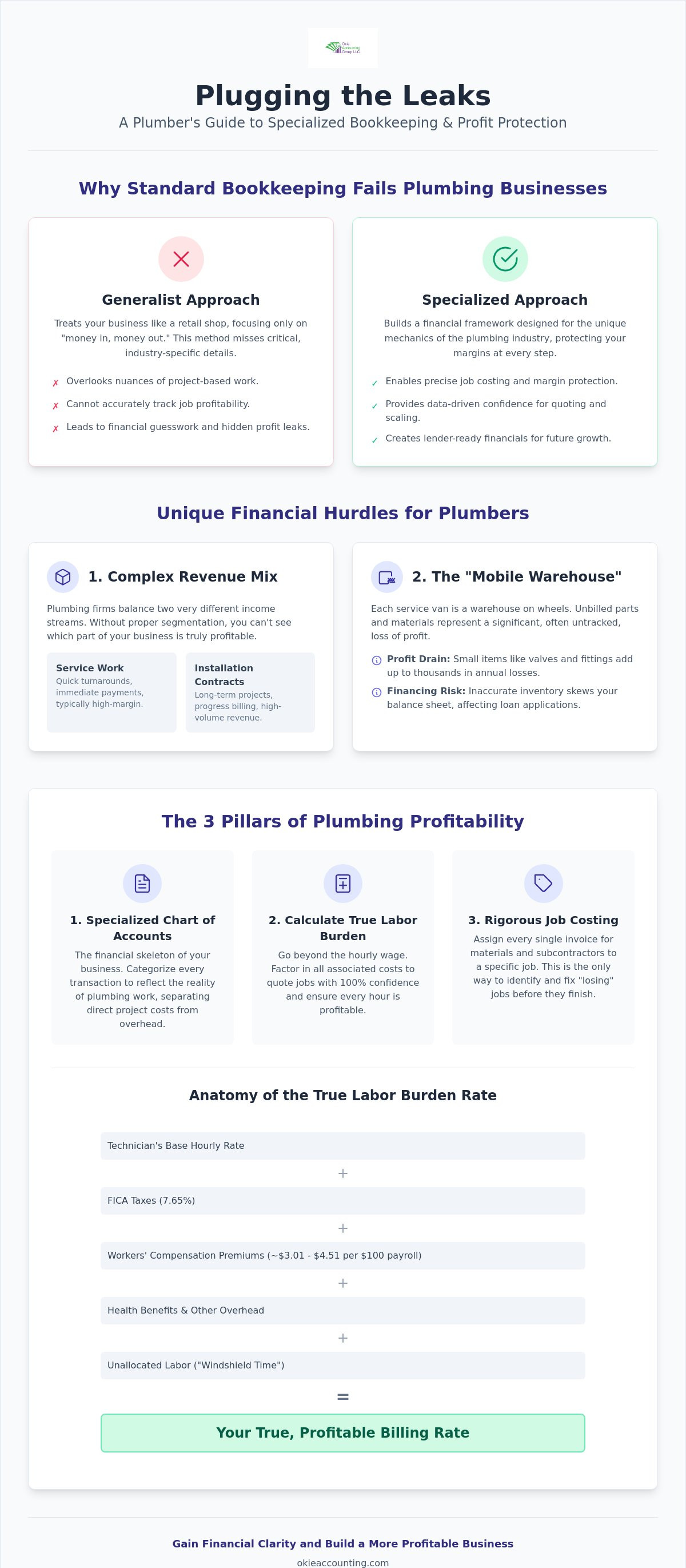
Generalist bookkeepers often treat a plumbing business like a standard retail shop. They record money in and money out without considering the granular details of field operations, such as how unallocated labor hours can skew your perceived profitability. While standard methods of bookkeeping provide the basic rules for recording transactions, they don't naturally account for the "hidden leaks" unique to the trades. For a plumbing owner, profitability isn't just about the total revenue at the end of the month; it's about knowing exactly which service calls paid for the technician's time and which large-scale installations actually eroded your cash reserves.
Effective bookkeeping for plumbers requires moving beyond simple administrative tasks. It's about building a structural framework that protects your margins from the moment a technician opens a work order. Relying on "checkbook accounting" only tells you if you have enough money to cover today's bills. It doesn't tell you if you're quoting projects accurately or if your overhead is swallowing your hard-earned profit. A specialized approach ensures that every dollar spent on materials and every hour spent in a crawlspace is accounted for and billed correctly.
The Complexity of the Service vs. Installation Mix
Plumbing firms operate in two distinct financial worlds. You have high-margin service work characterized by quick turnarounds and immediate payments. Then, you have high-volume construction contracts that involve progress billing, retainage, and long-term labor commitments. Revenue segmentation is the first step to plumbing profitability. Without it, you can't see if your service department is unintentionally subsidizing poorly quoted installation projects. By segmenting your income, you gain the clarity needed to adjust your pricing or shift your focus toward the most profitable departments.
Managing the "Mobile Warehouse": Truck Stock and Inventory
Every van in your fleet is essentially a mobile warehouse. Managing this inventory is where many firms lose their grip on financial accuracy. Truck stock shrinkage, often caused by unbilled parts like valves and fittings, can quietly drain thousands from your bottom line each year. Tracking these small items without slowing down your field team is a balance of technology and process. Accurate inventory tracking ensures your year-end financial statements reflect your true assets, which is critical for maintaining management accounting standards that lenders respect when you apply for equipment financing.
When your bookkeeping reflects the reality of the field, you stop reacting to financial surprises. You begin to lead with confidence, knowing that your data is accurate and your margins are secure. This specialized oversight is the difference between a business that just survives and one that scales with structural integrity.
Building a Structural Framework for Plumbing Profitability
A specialized Chart of Accounts is the skeletal system of your financial health. To maintain proper bookkeeping, you must categorize every transaction into buckets that reflect the physical reality of plumbing work. This means separating direct costs like pipe and fittings from indirect overhead like office rent. When your Profit and Loss statement is organized by project rather than just by date, you gain the ability to spot trends that a standard report would hide. This level of detail is exactly why specialized construction bookkeeping services are vital for protecting your bottom line as you scale.
The True Cost of Labor: Calculating Your Burden Rate
Most plumbing owners know their technicians' hourly rates, but few understand the true labor burden. This figure includes the 7.65% FICA tax rate for 2026, workers' compensation premiums, and health benefits. For example, workers' compensation rates for plumbers outside of California typically range from $3.01 to $4.51 per $100 of payroll. If you don't factor these costs into your hourly requirements, you're underquoting every project. Unallocated labor, often called "windshield time," is the silent profit killer in this industry. If your bookkeeping for plumbers doesn't account for the hours spent driving between calls, your project margins are likely inflated on paper while your bank account remains stagnant. Using accurate labor burden data allows you to quote jobs with 100% confidence, ensuring every billable hour covers its share of the company's total costs.
Job Costing for Plumbers: Tracking Materials and Subs
Assigning every supply house invoice to a specific job number is non-negotiable for a high-margin operation. When you purchase a water heater or a crate of PVC, that cost must be linked to the project it serves. The same discipline applies to subcontractors. If you hire a backhoe operator for a sewer line replacement, their invoice must be tracked against that specific job to ensure they don't eat your project profit. Job costing is the only way to identify "losing" jobs before they finish, allowing you to pivot your strategy before the project drains your reserves. If your current system feels like a series of disconnected spreadsheets, you might benefit from a brief discussion about your financial structure.
By moving from "guessing" to "knowing" your project margins, you transform your business from a chaotic cash-flow struggle into a disciplined machine. This structural framework provides the clarity needed to make data-driven choices about which types of projects to pursue and which to leave for your competitors.
Optimizing the Plumbing Tech Stack: QuickBooks and Field Software
QuickBooks Online has established itself as the industry standard for bookkeeping for plumbers because of its robust cloud infrastructure and deep integration capabilities. As of August 2026, QuickBooks Online pricing reflects its status as a professional-grade tool, with the Plus plan at $140 per month and the Advanced tier at $340 per month. These platforms provide the structural integrity needed to track complex project data, but the software is only as effective as the data feeding it. Without a "Single Source of Truth," you're forced to reconcile conflicting reports from your field app and your accounting ledger, leading to dangerous blind spots in your cash flow. To ensure your tech stack is working for you, explore our guide on Mastering QuickBooks for Contractors for deeper software insights tailored to the 2026 landscape.
The primary goal of your tech stack should be the elimination of manual data entry. Every time an office manager has to re-type an invoice from a field app into your accounting software, the risk of error increases. This "Garbage In, Garbage Out" trap often results in skewed profitability reports that can lead to poor strategic choices. By automating the flow of data, you ensure that your financial statements reflect the physical reality of your jobs, from the number of fittings used to the exact hours a technician spent on a service call.
Seamless Integration with Field Service Software
Integrating field service management (FSM) software like ServiceTitan, Housecall Pro, or Jobber with your books is essential for real-time visibility. While ServiceTitan remains a premium, quote-based option with implementation fees that can range from $5,000 to over $50,000, many growing firms find the Jobber Connect plan ($149 - $199 per month) or the Grow plan ($249 - $399 per month) to be highly effective. These integrations automate the invoicing process, significantly reducing your "time-to-cash" cycle. When a technician captures a signature and completes a repair on their mobile device, the data should sync instantly, ensuring your books capture actual material costs before the van even leaves the driveway.
Professional QuickBooks Setup and Training
A generic "out-of-the-box" setup is a recipe for messy data and expensive year-end cleanups. Plumbing founders need a dashboard that highlights specific KPIs, such as gross profit per technician and unallocated labor costs. Investing in professional software training for your office managers and dispatchers ensures that everyone understands how their data entry impacts the final financial reports. This proactive discipline prevents the accumulation of "financial debt" in your books, turning your accounting software from a simple digital ledger into a strategic decision-making tool that supports long-term stability.
Strategic Financial Oversight: From Bookkeeper to Controller
Many plumbing founders view their financial records as a historical archive. While having reconciled accounts is necessary for compliance, growth-minded firms require a forward-looking perspective to scale effectively. Moving beyond basic bookkeeping for plumbers means embracing a framework where data drives every major decision. This is where the role of a Fractional Controller becomes essential. Instead of just telling you how much you spent on copper last month, a controller interprets that data to help you navigate the next six months of growth.
Strategic oversight allows you to manage the "Cash Gap," which is the period between paying for materials and collecting from the customer. Without predictive insights, a sudden fleet expansion or a large material purchase can leave you scrambling to make payroll. When your financial data is structured correctly, it serves as a powerful tool to justify equipment financing. Lenders don't just want to see that you're busy; they want to see that your operation is structurally sound and capable of servicing debt even during slower months.
Cash Flow Forecasting for Seasonal Fluctuations
Plumbing businesses often face "shoulder seasons" in the spring and fall when emergency service calls tend to dip. Effective cash flow management ensures you have the reserves to maintain your team during these fluctuations. Forecasting is about looking through the windshield, not the rearview mirror. By predicting these cycles, you can strategically time large material purchases or marketing pushes to maintain a steady flow of work. If you're ready to move from reactive bookkeeping to proactive strategy, schedule a discovery call to discuss your firm's oversight needs.
Key Performance Indicators (KPIs) for Plumbing Success
To lead a high-margin operation, you must track the metrics that actually move the needle. These include:
Average Ticket Value: This reveals if your service team is upselling effectively or just performing the bare minimum on every call.
Gross Profit Margin per Technician: This KPI helps you identify your top performers and those who might need additional field training.
Customer Acquisition Cost (CAC) vs. Lifetime Value (LTV): Understanding how much you pay to win a customer versus how much they spend over years of service is vital for marketing efficiency.
By focusing on these strategic markers, you transition from being a technician who owns a business to a CEO who leads a scalable firm. Your financial data becomes the foundation for every strategic move you make, ensuring that every van you add to the fleet is a calculated investment rather than a gamble.
Implementing a Scalable Financial System with Okie Accounting Group LLC
Building a plumbing business that operates without your constant physical presence requires more than just a full dispatch board. It demands a financial foundation as reliable as your best lead technician. Okie Accounting Group LLC specializes in constructing these systems, moving your firm from a state of reactive "checkbook accounting" to one of proactive growth. We don't just record transactions; we build the structural framework that allows you to transition from a daily service provider to a strategic owner. By implementing specialized bookkeeping for plumbers, we ensure that every financial leak is plugged before it can erode your hard-earned margins.
The transition from messy receipts and disconnected spreadsheets to lender-ready financial reporting is a critical milestone for any trade business. Whether you're looking to take advantage of the 2026 Section 179 deduction limit of $2,560,000 for new equipment or seeking a line of credit for fleet expansion, your books must be beyond reproach. Our management accounting approach focuses on profit protection, ensuring that your overhead stays lean and your project margins remain healthy as you scale.
Nationwide Specialized Support for Plumbing Contractors
Working with a generalist bookkeeper often leads to missed industry-specific risks. At Okie Accounting Group LLC, we understand the nuances of the construction and trade landscape, from tracking retainage on long-term contracts to managing the dual nature of service and installation work. We take a proactive stance on compliance, staying ahead of regulatory shifts like the 2026 increase in the 1099-NEC reporting threshold to $2,000. Our team manages the complexities of payroll and compliance, protecting you from the steep 2026 penalties for late filings, which can reach $340 per form for submissions after August 1. This specialized oversight allows you to focus on field operations while we ensure your back office remains structurally sound.
Your Path to Financial Clarity and Control
The journey to clarity begins with a comprehensive cleanup of your current records and the establishment of rigorous job costing protocols. We align your field data with your accounting ledger, ensuring that your tech stack provides a single source of truth. As your business grows, you can leverage our controller services to gain high-level strategic insights, such as cash flow forecasting and departmental profitability analysis. This partnership provides the disciplined mentorship needed to navigate the complexities of a scaling firm. You deserve a partner as invested in your success as you are. Schedule your consultation with Okie Accounting Group LLC today.
Secure Your Firm's Financial Future
Building a high-margin plumbing operation requires more than just technical skill in the field; it demands a rigorous, data-driven approach to your back office. We've explored how a specialized Chart of Accounts and accurate labor burden calculations protect your profit from hidden leaks. By integrating your field service software with QuickBooks Online, you create a single source of truth that informs every strategic move you make. Implementing effective bookkeeping for plumbers is the first step in moving from a chaotic cash-flow struggle to a structured, scalable business.
Okie Accounting Group provides the expertise in construction and trade accounting needed to transform your financial data into a roadmap for growth. With our nationwide cloud-based support and strategic fractional controller oversight, you gain the clarity to lead with confidence. It's time to stop guessing your margins and start building a legacy of stability. Gain Financial Clarity with Specialized Plumbing Bookkeeping. Your business deserves a partner as dedicated to its success as you are.
Frequently Asked Questions
Why is plumbing bookkeeping different from regular small business bookkeeping?
Plumbing bookkeeping differs because it must account for the dual nature of high-volume service calls and long-term installation contracts. Unlike a standard retail business, you have to track mobile inventory across multiple vans and manage the "Cash Gap" between material purchases and customer payments. Specialized bookkeeping for plumbers ensures that unallocated labor and small parts shrinkage don't quietly erode your project margins.
How does job costing help my plumbing business become more profitable?
Job costing transforms your financial data into a roadmap for profitability by linking every material invoice and labor hour to a specific project. This granular visibility allows you to identify exactly which jobs are hitting your margin targets and which are underquoted. By analyzing this data, you can adjust your pricing strategy and focus your team's efforts on the most profitable types of work.
What is the best accounting software for plumbing contractors in 2026?
QuickBooks Online remains the industry standard for plumbing contractors due to its robust cloud infrastructure and its ability to integrate with specialized field service management tools. It provides the structural integrity needed for complex job costing while allowing for real-time collaboration with your financial team. Its extensive ecosystem ensures that your data flows seamlessly from the field to your permanent financial records.
Do I need a specialized bookkeeper if I already use field service software?
Yes, because field service software is an operational tool rather than a comprehensive accounting system. While these apps are excellent for dispatching and invoicing, they don't handle complex tasks like indirect overhead allocation, payroll compliance, or structural financial reporting. A specialized bookkeeper ensures that your field data is accurately reflected in your general ledger and resolves the technical sync errors that often occur.
What is labor burden, and why should a plumber care about it?
Labor burden is the total cost of employing a technician beyond their base hourly wage, including taxes, workers' compensation, and health benefits. Plumbers must understand this figure because it represents the true cost of every billable hour. If your quotes only account for raw wages, you're likely underestimating your costs and leaving significant profit on the table during every project.
How can bookkeeping help me manage my plumbing company’s cash flow?
Effective bookkeeping provides the predictive insights needed to manage the fluctuations in your bank balance. By tracking the timing of material expenses against your accounts receivable, you can identify potential shortages before they impact your ability to make payroll. This proactive oversight allows you to build cash reserves during busy seasons and plan for large equipment purchases without jeopardizing your daily operations.
When should a plumbing business owner hire a fractional controller?
You should consider a fractional controller when your business is scaling and basic reconciled accounts are no longer sufficient for making strategic choices. If you're managing multiple departments, seeking equipment financing, or planning a major expansion, a controller provides high-level oversight. They offer the strategic mentorship needed to interpret your data for long-term stability and growth rather than just historical tracking.
What are the most important financial reports for a plumbing company to review monthly?
The most vital reports are your Profit and Loss statement segmented by project, your Accounts Receivable Aging report, and your Statement of Cash Flows. Reviewing your P&L by project reveals which departments are actually paying the bills, while the AR Aging report highlights stagnant invoices that need attention. Together, these reports provide the clarity required to protect your margins and ensure your operation remains structurally sound.


Comments