Bookkeeping for Real Estate Developers: The 2026 Strategic Framework

Updated: Nov 7
Most real estate developers treat their books like a property management ledger, but in 2026, successful development is actually a high-stakes manufacturing process where every misallocated dollar erodes your terminal value. You likely already know that generic accounting isn't enough when you're balancing multi-year timelines, complex construction draws, and the rigorous new requirements of the "One Big Beautiful Bill Act." It's exhausting to manage the constant tension between capitalizing costs and expensing them while trying to maintain the transparency your lenders require. Specialized bookkeeping for real estate developers is no longer just an administrative task; it's the structural foundation of your firm's growth.
This strategic framework will show you how to master project-based accounting and lender-ready reporting to scale your firm with absolute confidence. We'll examine the shift toward AI-native platforms, the impact of permanent 100% bonus depreciation, and the specific workflows needed to ensure real-time visibility into project profitability. By the end of this guide, you'll have a roadmap to replace administrative burden with a disciplined system that protects your margins and secures your next round of capital.
The Strategic Importance of Specialized Bookkeeping for Real Estate Developers
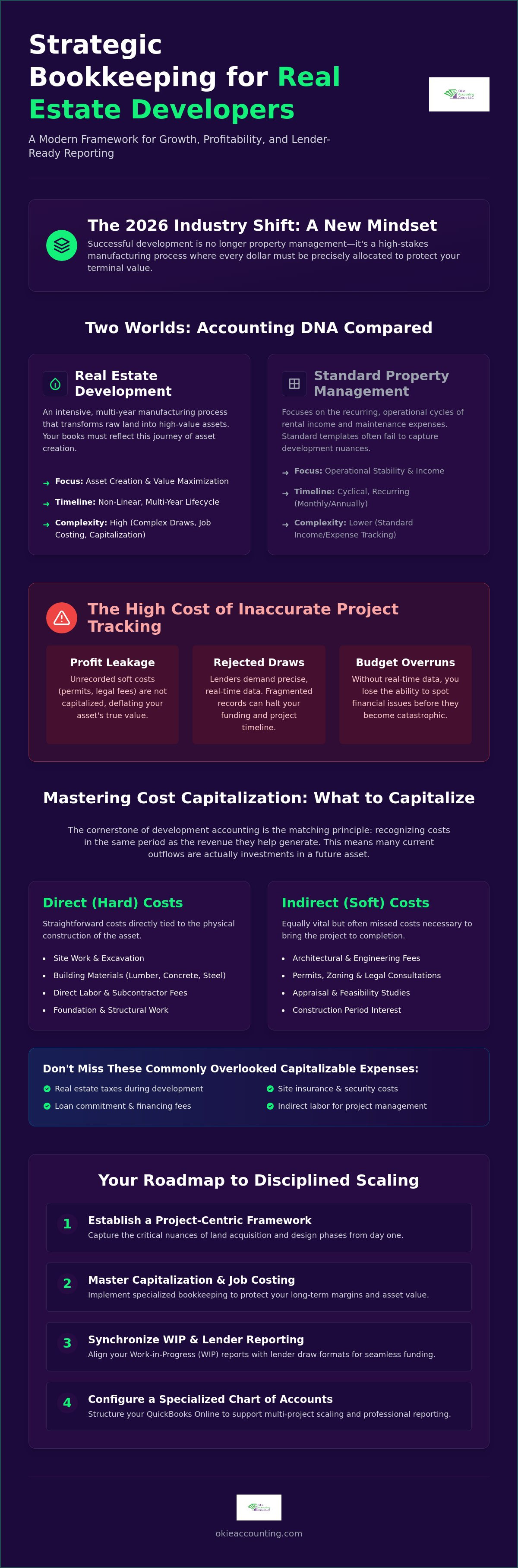
Bookkeeping for real estate developers isn't just about recording expenses; it's about building a project-centric financial framework that mirrors the complexity of the physical assets you're creating. While a generalist bookkeeper might track a utility bill or a lease payment with ease, they often struggle with the multi-layered nature of land acquisition and design phases. These early stages involve heavy capital outflows and intricate soft costs that must be accurately categorized to ensure your balance sheet reflects the true value of your work-in-progress.
Without this specialized oversight, your financial statements become a liability rather than a tool for growth.
In 2026, the industry standard has shifted toward cloud-based transparency and "continuous readiness." Meticulous records aren't just for internal use; they're the primary vehicle for building trust with equity partners and sophisticated lenders who now expect integrated, AI-native reporting. By establishing a rigorous bookkeeping foundation, you signal to stakeholders that your firm operates with professional discipline and long-term stability.
Development vs. Property Management: Key Differences
The real estate development process is a non-linear lifecycle that demands a different accounting DNA than standard property management. Property management focuses on the recurring cycles of rental income and maintenance expenses. In contrast, development is an intensive manufacturing process that transforms raw land or underutilized structures into high-value assets over several years. Standard real estate templates usually fail developers because they aren't built to handle the transition from pre-development to construction and eventual stabilization. You aren't just managing a building; you're creating one, and your books must reflect that multi-year journey of asset creation.
The High Cost of Inaccurate Project Tracking
Inaccurate tracking leads to "profit leakage," where unrecorded soft costs like permit fees, legal consultations, or architectural revisions aren't properly capitalized. This oversight doesn't just lower your reported asset value; it can cause your construction draw requests to be rejected by lenders who demand precise, real-time data. When your data is fragmented, you lose the ability to spot budget overruns before they become catastrophic. For the 2026 developer, financial clarity serves as a rigorous risk mitigation tool that protects margins against market volatility.
Many firms now utilize Fractional Controller Services to ensure this level of precision without the overhead of a full-time executive hire. Effective bookkeeping for real estate developers ensures that every dollar spent is accounted for, capitalized correctly, and ready for audit at a moment's notice.
Mastering Cost Capitalization and Job Costing Frameworks
The distinction between a period expense and a capitalized asset is the cornerstone of effective bookkeeping for real estate developers. While a standard business might expense most of its monthly outlays, your firm's financial health depends on the matching principle. This concept dictates that costs should be recognized in the same period as the revenue they help generate. In the context of development, this means many of your current outflows are actually investments in a future asset. Without a disciplined approach to capitalization, your profit margins will look artificially low during construction and artificially high upon sale, leaving you with a distorted view of your firm's actual performance.
Job costing acts as the pulse of this entire operation. It involves tracking every dollar across the distinct phases of acquisition, pre-development, and construction. By maintaining this granular level of detail, you can compare actual costs against your initial pro forma in real time. This level of precision is essential for adhering to AICPA guidance on real estate accounting, which provides the authoritative framework for how these costs should be handled on your balance sheet. It's not just about compliance; it's about having the data necessary to make informed decisions before a budget overrun becomes unmanageable.
Direct vs. Indirect Costs: What to Capitalize
Capitalization rules require a clear separation between hard and soft costs. Hard costs, such as site work, materials, and direct labor, are straightforward to capitalize. Soft costs, including architectural fees, permits, and legal consultations, are equally vital but often overlooked by generalist bookkeepers. You should continue to capitalize these costs until the project reaches the "ready for intended use" milestone, at which point you transition to expensing operational costs. Common capitalizable expenses that developers frequently miss include:
Construction period interest and loan commitment fees.
Real estate taxes incurred during the development phase.
Site insurance and specialized security costs.
Indirect labor costs specifically related to project management.
Implementing Revenue Recognition under ASC 606
Revenue recognition for multi-phase developments is governed by the five-step model of ASC 606. This requires you to identify the contract, determine performance obligations, and allocate the transaction price before recognizing revenue. For developers, the choice between "over-time" and "point-in-time" recognition is critical. If you're selling parcels or completed units, you likely recognize revenue at the point of closing. However, certain pre-sale structures might allow for over-time recognition as construction progresses. Our guide on Mastering Construction Bookkeeping Services explores how to build the infrastructure needed to manage these complex rules effectively. If you're feeling overwhelmed by these technical requirements, it might be time to schedule a discovery call to discuss a structured framework for your firm.
Managing Cash Flow and Construction Draw Complexity
Cash flow management in development is a high-stakes balancing act where timing is everything. Unlike traditional businesses with steady revenue, developers often face long periods of capital outflow followed by significant liquidity events. This makes Work-in-Progress (WIP) reporting a vital visibility tool rather than just a balance sheet requirement. Accurate WIP reports allow you to see exactly how much capital is tied up in each project phase and how much remains in your contingency fund. Without this clarity, you're essentially flying blind, unable to predict when you'll need to inject more equity or when you can safely start your next project.
A common friction point arises when internal bookkeeping entries don't align with lender draw request formats. Lenders require specific documentation and budget tracking to release funds; if your records are disorganized, funding delays follow. Effective bookkeeping for real estate developers ensures that every transaction is categorized to match the lender's schedule of values from day one. This alignment streamlines the inspection process and ensures that your construction team has the liquidity they need to stay on schedule. In 2026, where interest rates and material costs remain dynamic, having real-time data is essential for making high-stakes pivot decisions mid-project.
The Art of Draw Management and WIP Reporting
The workflow for successful draw management begins with correlating every vendor invoice to a specific budget line item. This granular tracking allows you to generate WIP reports that identify budget variances before they become crises. If a site work invoice comes in 10% over the pro forma, you need to know immediately so you can adjust your downstream spending. Automated draw tracking prevents project delays by ensuring that all supporting documentation, such as lien waivers and insurance certificates, is collected and organized in real time. This proactive approach transforms the draw process from a monthly headache into a predictable, administrative routine.
Multi-Entity Consolidation for Diverse Portfolios
Most developers utilize a "one project, one LLC" structure to isolate risk and satisfy lender requirements. While this is a smart legal strategy, it creates a complex web of intercompany transfers and fragmented data. Consolidating these entities into a single view of your firm's total financial health is often the biggest challenge for growing teams. You need a system that can handle the nuances of each project while providing an executive-level summary of your total exposure and liquidity. Our Fractional Controller Services are specifically designed to manage these complex entity structures, providing the strategic oversight needed to maintain structural integrity across your entire portfolio. By integrating your bookkeeping for real estate developers across all LLCs, you gain the confidence to scale your operations without losing control of the granular details.
Building a Scalable Infrastructure with QuickBooks Online
Many developers believe they've outgrown QuickBooks Online (QBO) once their portfolio expands, but the reality is that they've usually just outgrown their initial configuration. When configured by specialists who understand the manufacturing nature of development, QBO becomes a robust engine for bookkeeping for real estate developers. It offers a level of cloud-based agility that traditional enterprise systems often lack, allowing your field teams to upload data and your stakeholders to view reports from any location. The software isn't a silver bullet; it's a tool that's only as effective as the underlying Chart of Accounts and the workflows you establish around it.
Establishing this digital foundation is a multi-step process that begins with a solid understanding of construction-specific workflows. We recommend Mastering QuickBooks for Contractors as a foundational step before layering on the complex capitalization and multi-entity requirements of a developer. By starting with a clean, project-based setup, you ensure that your data remains organized as your firm scales from a single project to a diverse portfolio.
Configuring Your Chart of Accounts for Development
Your Chart of Accounts (COA) is the blueprint of your financial infrastructure. While a standard business uses Cost of Goods Sold (COGS) to track expenses, a developer must utilize "Assets under Development" accounts to track capitalized costs on the balance sheet. In QBO, you should use the Projects and Classes features to isolate data for each specific project, ensuring that your overhead doesn't get mixed with your direct construction costs. It's also vital to track retainage—the portion of a contract price withheld until completion—within the general ledger to maintain an accurate picture of your liabilities and project health. This level of structural integrity prevents the "profit leakage" discussed in earlier sections.
Automating Data Entry and Financial Reporting
Cloud-based infrastructure allows you to integrate specialized tools for receipt management and AP automation, which drastically reduces the administrative burden on your team. These integrations ensure that invoices are coded correctly to project line items the moment they arrive, providing the real-time data needed for the construction draws mentioned previously. You can also configure QBO to generate automated monthly reporting packages for your investors, providing the transparency they expect without the manual effort of spreadsheet consolidation. To ensure your internal team is utilizing these systems to their full potential, we provide specialized Software Training tailored to the development industry. If you want to move beyond basic data entry and build a truly scalable system, book a discovery call to discuss a custom QBO configuration for your firm.
Transitioning from Data Entry to Strategic Financial Oversight
As your development firm scales beyond a single project, the primary challenge you face is rarely the volume of transactions. Instead, it's the escalating complexity of intercompany transfers, the necessity for lender-ready reporting, and the urgent need for a unified view of your capital stack. At this inflection point, standard bookkeeping for real estate developers must evolve from a passive record-keeping function into a proactive management tool. You don't just need a clerk to record where the money went; you need a strategic partner to explain what those numbers mean for your next acquisition. Professional oversight ensures that your financial data acts as a roadmap rather than a rearview mirror.
The transition to strategic oversight is about moving from administrative survival to profit protection. Generalist bookkeepers often lack the specialized knowledge to identify the subtle "profit leakage" that occurs when soft costs aren't capitalized correctly or when construction draws aren't meticulously tracked. By implementing a disciplined structural framework, you protect your terminal value and build the transparency required by sophisticated equity partners. This shift allows you to focus on your core competency—building and developing—while having quiet confidence that your financial foundation is being managed with rigorous precision.
The Role of a Fractional Controller in Scaling
A Fractional Controller acts as a disciplined mentor for your firm's financial health. Unlike a bookkeeper who focuses on historical accuracy, a controller looks forward to the broader implications of your data. They interpret your project-specific data to guide high-level land acquisition and capital structure decisions. This role is critical for distinguishing between looking at past transactions and forecasting future cash needs. By identifying potential liquidity gaps months in advance, a controller allows you to move from a defensive posture to a proactive growth strategy. For deeper insight into how this role functions within your firm, refer to our guide on Fractional Controller Services.
Why Specialized Partnership Outperforms Generalist Bookkeeping
Generalist providers typically take a "check-the-box" approach that misses the nuances of the 2026 regulatory environment. They might miss the specific reporting requirements of the "One Big Beautiful Bill Act" or fail to align your books with the manufacturing-style workflows of a developer. In contrast, a specialized partnership offers a proactive strategy designed for the unique mechanics of the development market. This is especially valuable for US-based developers who benefit from nationwide, remote expertise that understands specialized tax codes and construction-specific workflows. Okie Accounting Group LLC provides the structural integrity and long-term stability your business demands. If you're ready to stop reacting to budget overruns and start scaling with data-driven confidence, schedule a strategy session with Okie Accounting Group LLC today.
Securing the Future of Your Development Firm
Transitioning from financial complexity to operational clarity requires a fundamental shift in how you view your project data. By mastering job costing and aligning your draws with lender requirements, you transform your books from a monthly burden into a strategic asset. Specialized bookkeeping for real estate developers isn't just about tracking costs; it's about protecting your profit margins and ensuring you're always ready for the next round of capital. You've built your reputation on the quality of your projects, and your financial systems should reflect that same level of excellence.
Okie Accounting Group LLC provides the specialized expertise in construction and real estate development needed to build these scalable systems. We offer nationwide remote service across the United States, focusing on cloud-based accounting that keeps your stakeholders connected. You don't have to navigate these technical complexities alone. Gain financial clarity for your next project with Okie Accounting Group LLC. Your firm's growth depends on the strength of your foundation, and it's time to build it with confidence.
Frequently Asked Questions
How is bookkeeping for real estate developers different from property management?
Real estate development bookkeeping focuses on the project-centric manufacturing lifecycle of an asset, whereas property management tracks recurring rental income and operational maintenance. Development involves multi-year timelines and complex cost capitalization of land and soft costs. In contrast, property management records period-specific expenses that don't increase the asset's long-term value. This distinction is critical for ensuring your balance sheet reflects the true work-in-progress value during construction.
Can I use QuickBooks Online for complex real estate development job costing?
Yes, QuickBooks Online is a powerful tool for bookkeeping for real estate developers when it's configured with a specialized Chart of Accounts. By utilizing the Projects and Classes features, you can isolate costs for specific developments and track them against your pro forma. The platform's cloud-based nature also allows field teams to upload invoices in real time. However, the software is only as effective as the underlying structural framework established by a specialist.
What costs should a real estate developer capitalize versus expense?
You should capitalize hard costs like materials and labor, alongside soft costs such as architectural fees, permits, and construction-period interest. These costs are added to the asset's value on the balance sheet until the project is ready for its intended use. General administrative costs, marketing for finished units, and post-stabilization maintenance should be expensed. Proper categorization ensures your profit margins are accurately reflected upon the eventual sale or refinancing of the property.
How often should a real estate developer review their financial statements?
You should review your full financial reporting package at least once a month to maintain structural integrity over your portfolio. However, project-specific data like Work-in-Progress (WIP) reports and construction draw statuses require more frequent oversight, often weekly. Regular reviews allow you to spot budget variances early and make data-driven pivot decisions. This disciplined rhythm ensures you remain lender-ready and provides the transparency necessary for managing equity partner expectations.
What is draw management in real estate development accounting?
Draw management is the systematic process of coordinating construction invoices and budget line items to request fund releases from a lender. It involves gathering lien waivers, insurance certificates, and inspection reports to prove project progress. Accurate draw management ensures that your bookkeeping entries align perfectly with the lender’s schedule of values. This reduces funding delays and ensures your construction team has the liquidity needed to maintain the project's momentum.
When should a real estate developer hire a fractional controller?
You should consider a fractional controller when your firm outgrows basic data entry and requires strategic financial oversight across multiple project LLCs. If you're struggling with intercompany transfers, complex capital stacks, or sophisticated investor reporting, a controller provides the necessary expertise. They act as a strategic mentor, helping you interpret data to guide land acquisition and future cash flow forecasting. This partnership offers high-level guidance for bookkeeping for real estate developers without the overhead of a full-time executive.
How do I handle intercompany transfers between different project LLCs?
Intercompany transfers should be managed through "Due To" and "Due From" accounts on each entity's balance sheet to ensure every dollar is tracked. It's vital to document these transfers with clear descriptions to prevent confusion during year-end reconciliation or audits. Automated systems can help synchronize these entries across your project LLCs, maintaining a clean audit trail. This level of precision protects the structural integrity of each individual entity while allowing for consolidated reporting across your entire portfolio.
What are the most important KPIs for a real estate development company?
The most critical KPIs include Budget Variance, which tracks actual costs against your pro forma, and Work-in-Progress (WIP) percentage of completion. You should also monitor your Net Liquidity to ensure you can cover upcoming construction draws and unexpected contingencies. For firms involved in sales, tracking the Absorption Rate and Cost to Complete provides essential insight into terminal value. These metrics offer real-time visibility into project profitability and help mitigate the risks of multi-year development cycles.


Comments