Bookkeeping for Remodeling Contractors: A Strategic Framework for Profit Protection

Updated: 6 days ago
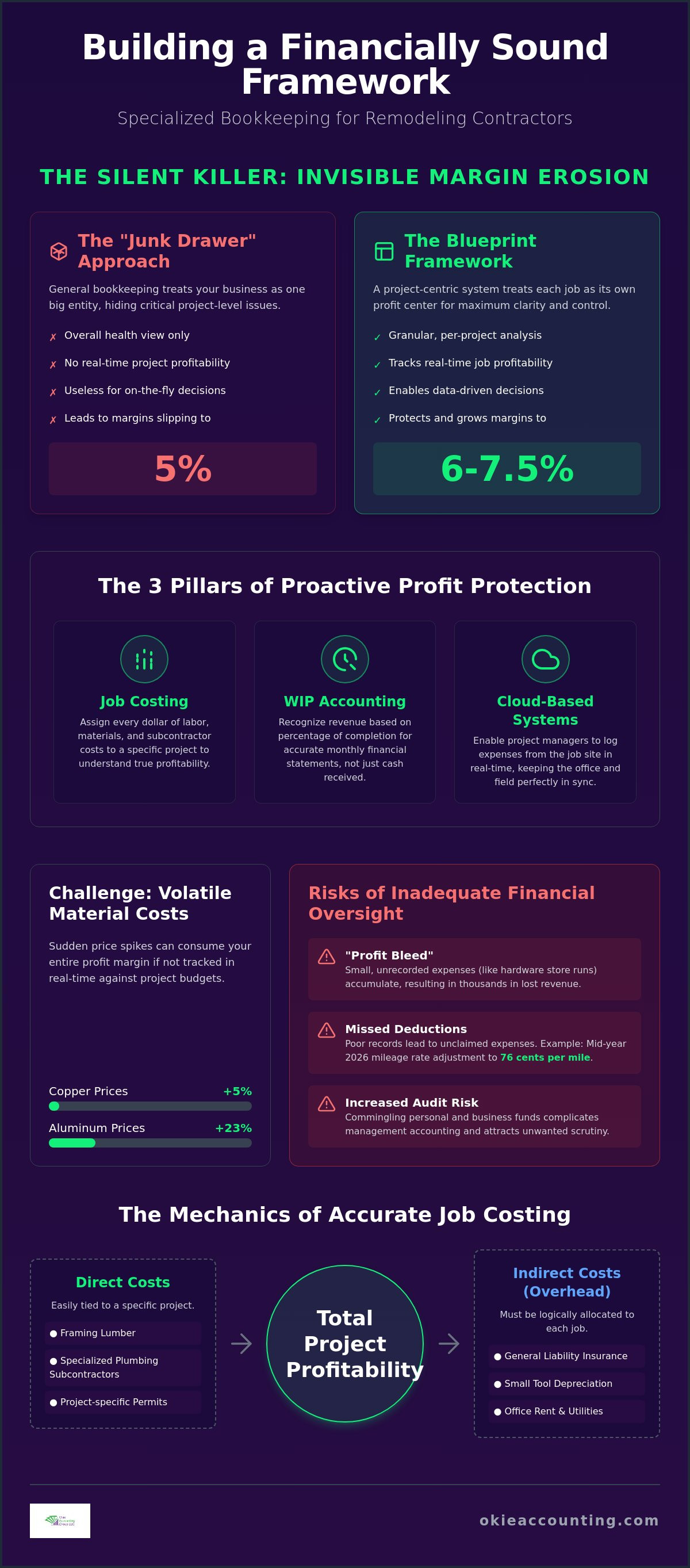
Your financial records should be as structurally sound as the homes you renovate; yet, many contractors treat their ledger like a junk drawer of receipts and missed opportunities. If your schedule is overflowing but your bank account remains stagnant, you're likely facing the industry's most common silent killer: invisible margin erosion. It's frustrating to manage a full crew and complex project timelines only to realize your net profit margins are slipping toward 5% due to rising labor and material costs. You need more than a basic record of expenses to scale in this climate.
We understand that effective bookkeeping for remodeling contractors isn't just about administrative compliance. It's about building a structural framework that protects your profit and provides the financial clarity required for national-scale growth. In this article, you'll learn how to master specialized systems that track real-time project profitability and automate subcontractor compliance. We'll also preview how to leverage the 2026 "One Big Beautiful Bill Act" and restored 100% bonus depreciation to ensure your business remains lender-ready. We're moving beyond simple data entry to establish a disciplined, strategic approach to your firm's long-term financial health.
The Foundation: Why Remodeling Bookkeeping Requires a Specialized Structural Framework
Bookkeeping for remodeling contractors isn't just about balancing a checkbook or categorizing office supplies. It's the creation of a specialized structural framework for remodeling bookkeeping that treats every renovation as its own independent profit center. While general accounting focuses on the health of the entire entity, remodeling requires a project-centric approach. If you don't know exactly how much you're spending on lumber for the Smith kitchen versus the Jones bathroom, your financial data is essentially useless for decision-making.
Accurate data entry is the first line of defense in what we call Profit Protection. It's the process of capturing every receipt, invoice, and labor hour in real-time to prevent the slow erosion of your margins. Because the remodeling industry moves quickly, you cannot wait until the end of the month to see your numbers. Cloud-based systems are no longer optional. They provide the mobile accessibility your project managers need to log expenses from the job site, ensuring that the office and the field are always in sync.
Remodeling vs. General Construction: The Financial Nuances
Remodeling projects are notoriously fluid. Unlike ground-up builds with fixed blueprints, renovations involve frequent change orders that derail budgets quickly. Material costs are another variable. In a short-term renovation, spikes in copper or aluminum prices, which increased nearly 5% and 23% respectively, can consume your entire profit margin if not tracked immediately. High-volume residential remodeling requires granular oversight that general firms often overlook.
The Risks of Inadequate Financial Oversight
Without a structured system for bookkeeping for remodeling contractors, "Profit Bleed" becomes inevitable. Small, unrecorded project expenses, like hardware store runs, add up to thousands in lost revenue over time. Commingling personal and business funds is another danger, as it complicates your management accounting and increases audit risks. Poor records also lead to missed deductions, such as the mid-year 2026 mileage rate adjustment of 76 cents per mile.
Mastering Job Costing and WIP: Tracking Profitability in Real-Time
Job costing is the heartbeat of a successful remodeling firm. It's the disciplined process of assigning every dollar spent to a specific project, providing the granular data you need to protect your margins. Modern bookkeeping for remodeling contractors moves beyond simple expense tracking; it requires a deep dive into the specific costs of labor, materials, and subcontractors for every renovation. Without this level of detail, you're essentially flying blind, unable to see which projects are fueling your growth and which are draining your resources.
The Work-in-Progress (WIP) accounting method is essential for accurate monthly reporting in this industry. It allows you to recognize revenue based on the percentage of completion rather than just the cash hitting your bank account. This is particularly vital in 2026, as the "One Big Beautiful Bill Act" (OBBBA) has expanded exceptions to the percentage-of-completion method for residential contracts. Establishing a disciplined routine for bookkeeping for remodeling contractors ensures that your financial statements reflect the true state of your active builds, allowing for mid-course corrections before a budget overrun becomes a permanent loss.
The Mechanics of Accurate Job Costing
To achieve financial clarity, you must distinguish between direct and indirect costs. Direct costs, such as framing lumber or specialized plumbing subcontractors, are easily tied to a specific site. Indirect costs, like general liability insurance or small tool depreciation, require a logical allocation method to ensure each project carries its fair share of overhead. Integrating cash flow forecasting for construction into your monthly workflow allows you to predict these needs weeks in advance, preventing the liquidity crunches that often stall production.
Managing Change Orders and Variable Costs
Change orders are the most common source of profit bleed in remodeling. If a client requests a high-end tile upgrade and the cost difference isn't recorded in your software immediately, your job costing data becomes obsolete. You must ensure that your progress billing reflects the current scope of work to maintain healthy compliance and labor costs. When you update your budgets in real-time, you maintain control over your 6% to 7.5% net profit margins. If you're struggling to keep these records updated while managing a full project schedule, you can schedule a discovery call to discuss how specialized oversight can stabilize your operations.
Managing the Variable: Subcontractors, Compliance, and Labor Costs
Subcontractors represent a significant variable in the remodeling budget. Managing them effectively is less about the work they perform and more about the administrative framework that governs their involvement. Professional bookkeeping for remodeling contractors ensures that every trade partner provides a W-9 before the first payment is issued. This proactive step eliminates the year-end scramble for 1099 compliance. Without these systems, you risk significant penalties and the stress of incomplete financial records during a high-stakes audit.
A structured approach to these variables is a core component of Construction Accounting 101. It allows you to maintain control over your project-based financial tracking while protecting against liability. Proper bookkeeping also simplifies workers' compensation audits by providing clear, categorized records of subcontractor insurance certificates. When your data is organized, an audit becomes a routine verification rather than a source of professional anxiety. This disciplined oversight ensures that your business remains a stable partner for lenders and stakeholders alike.
Subcontractor Documentation and Profit Protection
Every new subcontractor should go through a standardized compliance checklist. This includes verifying their license, insurance, and tax status before they ever step onto a job site. Tracking retainage is another critical strategy for profit protection. By withholding a small percentage of the final payment until the punch list is complete, you ensure quality and project finalization. For a deeper look at managing these complexities, see our guide on construction payroll services to understand how compliance and profitability intersect.
Labor Burden: Calculating the True Cost of Your Crew
With labor costs in many markets rising by 15% to 20% in 2026, understanding your labor burden is essential. Labor burden is the total cost of an employee beyond their gross salary. This includes payroll taxes, workers' compensation insurance, health benefits, and even vehicle allowances. If you only track hourly wages, your job costing reports will be inaccurate. Your bookkeeping for remodeling contractors must reflect these additional costs to ensure your bids remain profitable. Accurate payroll isn't just a compliance task; it's a tool for project stability and employee retention in a competitive market where skilled labor is increasingly scarce.
Scaling Your Remodeling Firm: From Administrative Tasks to Strategic Oversight
Scaling a remodeling business requires a fundamental shift in how you view your financial data. Most owners start by handling their own books, but this eventually creates a "Growth Ceiling" where administrative tasks consume the time needed for high-level business development. When you transition from simply recording history to leveraging strategic oversight, you unlock the ability to make data-driven choices. Professional bookkeeping for remodeling contractors should provide the clarity needed to identify which project types, whether kitchen gut-renovations or whole-home additions, yield the highest returns for your specific crew.
Strategic oversight is the primary differentiator between a contractor who is "busy" and one who is profitable. By contrasting basic bookkeeping with fractional controller services, you move beyond mere data entry into the realm of financial leadership. This level of management ensures your financials are always "Lender-Ready." If you need to secure a line of credit to fund a massive material purchase or capitalize on the 100% bonus depreciation restored for 2026, your records must be impeccable. Banks and investors look for structured reporting that proves your business is a low-risk, high-stability investment.
When to Move Beyond Basic Bookkeeping
You'll know it's time for advanced oversight when your cash flow becomes too complex to track on a simple spreadsheet. If you're managing multiple crews across several zip codes, a fractional controller provides the internal controls and budgeting precision you lack. This transition is about moving from a reactive state of "recording history" to a proactive state of "predicting the future." Instead of wondering where the profit went at the end of a job, you'll have the foresight to adjust your strategy in real-time.
QuickBooks as a Strategic Asset
QuickBooks is a powerful tool, but it's only as effective as the person operating it. Professional QuickBooks training for contractors is essential for customizing your Chart of Accounts to include remodeling-specific categories like permits, site prep, and finishing trades. When your accounting system is properly configured, it integrates seamlessly with field tools like Buildertrend or CoConstruct. This creates a unified data stream that eliminates double entry and ensures your bookkeeping for remodeling contractors remains accurate from the first estimate to the final invoice.
If you're ready to break through your current growth ceiling and establish a more robust financial foundation, book a discovery call today to explore how our strategic oversight can protect your profits.
The Okie Accounting Approach: Proactive Profit Protection for Remodelers
Okie Accounting Group LLC operates as a specialized strategic partner rather than a transactional service provider. We recognize that the remodeling lifecycle is unique, requiring a rigorous focus on management accounting to maintain healthy margins. Our nationwide remote model, led by Sarah O’Quinn, delivers high-level financial leadership to firms across the US without the overhead of a full-time in-house executive. We move beyond simple record-keeping to provide the clarity, control, and confidence needed to safeguard your hard-earned equity. This proactive stance ensures that your bookkeeping for remodeling contractors is a tool for future growth rather than a source of administrative stress.
We understand that remodelers face distinct challenges, from volatile material pricing to complex subcontractor relationships. Our methodology is designed to alleviate these industry-specific stresses by promising total control over your financial data. We don't just categorize transactions; we build an atmosphere of trust where you feel that your complex needs are understood by experts who are as invested in your business's success as you are. By establishing this high-level advisor relationship, we help you navigate the transition from a service-based operator to a strategic business leader.
Building a Scalable Financial Infrastructure
We specialize in constructing the structural framework your firm needs to support rapid growth without sacrificing operational stability. A core element of our process is the monthly financial review. During these sessions, we analyze your project-specific data to convert raw numbers into actionable business intelligence. We look at your job costing trends, review your cash flow forecasts, and identify potential profit bleed before it impacts your bottom line. This collaborative approach encourages you to evolve from a hands-on service provider into a strategic partner, focusing on the long-term health of your organization rather than day-to-day administrative fires.
Ready to Protect Your Profits?
It's time to transition from administrative complexity to operational clarity. We offer the comprehensive oversight your business requires, including fractional controller services and specialized construction bookkeeping services. Our systems are fully optimized for 2026 tax standards and compliance requirements, ensuring your firm is always prepared for lender scrutiny, bonding applications, or regulatory changes. We provide the meticulous, forward-thinking approach necessary to thrive in a competitive market. If you are ready to establish a disciplined growth engine for your firm, schedule a discovery call today. Let's build the financial stability your remodeling firm deserves.
Secure Your Firm’s Financial Future Through Strategic Oversight
Effective bookkeeping for remodeling contractors is the primary differentiator between a business that stays stagnant and one that scales with precision. Throughout this framework, we've explored how a specialized structural system protects your margins by integrating real-time job costing and rigorous subcontractor compliance. By moving beyond basic administrative recording to embrace fractional controller expertise, you gain the clarity needed to navigate the complexities of the 2026 construction market. High-level financial leadership ensures your firm remains lender-ready and prepared for long-term stability.
Okie Accounting Group LLC provides the national remote financial leadership your firm needs to break through its current growth ceiling. Our team is specialized in construction and real estate, bringing strategic fractional controller expertise to every partnership. We're dedicated to helping you move from reactive data entry to proactive profit protection. If you're ready to master your numbers and lead your business with quiet confidence, partner with Okie Accounting Group LLC for specialized remodeling bookkeeping and strategic oversight. Let's build a more profitable future for your remodeling business together.
Frequently Asked Questions
Why is job costing so important for remodeling contractors?
Job costing identifies the exact profitability of every project by assigning every labor hour and material purchase to a specific job. This process allows you to see which types of renovations are driving revenue and which are eroding your margins. Without this granular data, you cannot bid accurately or protect your target net profit margins in a market where material costs fluctuate frequently.
Can I use a general bookkeeper for my remodeling business?
You can, but a generalist often lacks the specialized knowledge required for project-based accounting. General bookkeeping focuses on entity-level totals, while remodeling requires job costing and WIP adjustments. Specialized bookkeeping for remodeling contractors ensures that your financial records account for the unique complexities of change orders, labor burden, and the specific reporting needs of the construction industry.
What is WIP accounting, and do I need it for my renovation projects?
Work-in-Progress (WIP) accounting is a method that recognizes revenue and expenses based on the percentage of project completion. This prevents your profit and loss statements from fluctuating wildly based on the timing of client draws and large material purchases. It provides a true reflection of your monthly profitability across all active renovation sites, giving you a more accurate financial picture.
How does a fractional controller differ from a standard bookkeeper?
A bookkeeper focuses on recording historical transactions, while a fractional controller provides high-level strategic oversight and forward-looking analysis. While a bookkeeper ensures your transactions are categorized correctly, a controller helps you interpret that data to manage cash flow, set budgets, and establish internal controls. This strategic partnership is essential for contractors who are ready to scale beyond basic operations.
Which version of QuickBooks is best for remodeling contractors in 2026?
QuickBooks Online, specifically the Plus or Advanced versions, is the best choice for remodelers in 2026 due to its cloud-based accessibility and project-tracking features. These versions support the job costing and class tracking necessary for mobile teams. They also allow for seamless integration with field management tools, ensuring that your office and job sites stay synchronized in real-time.
How do I handle subcontractor 1099s and insurance certificates?
You should collect a W-9 and a current insurance certificate from every subcontractor before issuing their first payment. Your bookkeeping system should track these documents to ensure you aren't liable for their workers' compensation or facing IRS penalties. This proactive documentation simplifies year-end reporting and protects your business during workers' compensation audits by providing clear, categorized records of compliance.
How often should I review my financial statements as a business owner?
You should review your financial statements at least once a month with your strategic partner. This review should include your Profit and Loss by Job, Balance Sheet, and Accounts Receivable aging reports. Regular oversight allows you to spot profit bleed early and make necessary mid-course corrections. It ensures that you're making data-driven choices rather than relying on gut feelings.
What are the most common bookkeeping mistakes remodelers make?
The most common errors include commingling personal and business funds, failing to record change orders immediately, and ignoring the true labor burden of their crew. Many remodelers also wait until year-end to reconcile their accounts, which leads to missed tax deductions and poor cash flow visibility. Establishing a disciplined framework for bookkeeping for remodeling contractors eliminates these risks and ensures your business remains lender-ready at all times.


Comments