Bookkeeping for Remodeling Contractors: A Strategic Framework for Profit Protection in 2026

Updated: 6 days ago
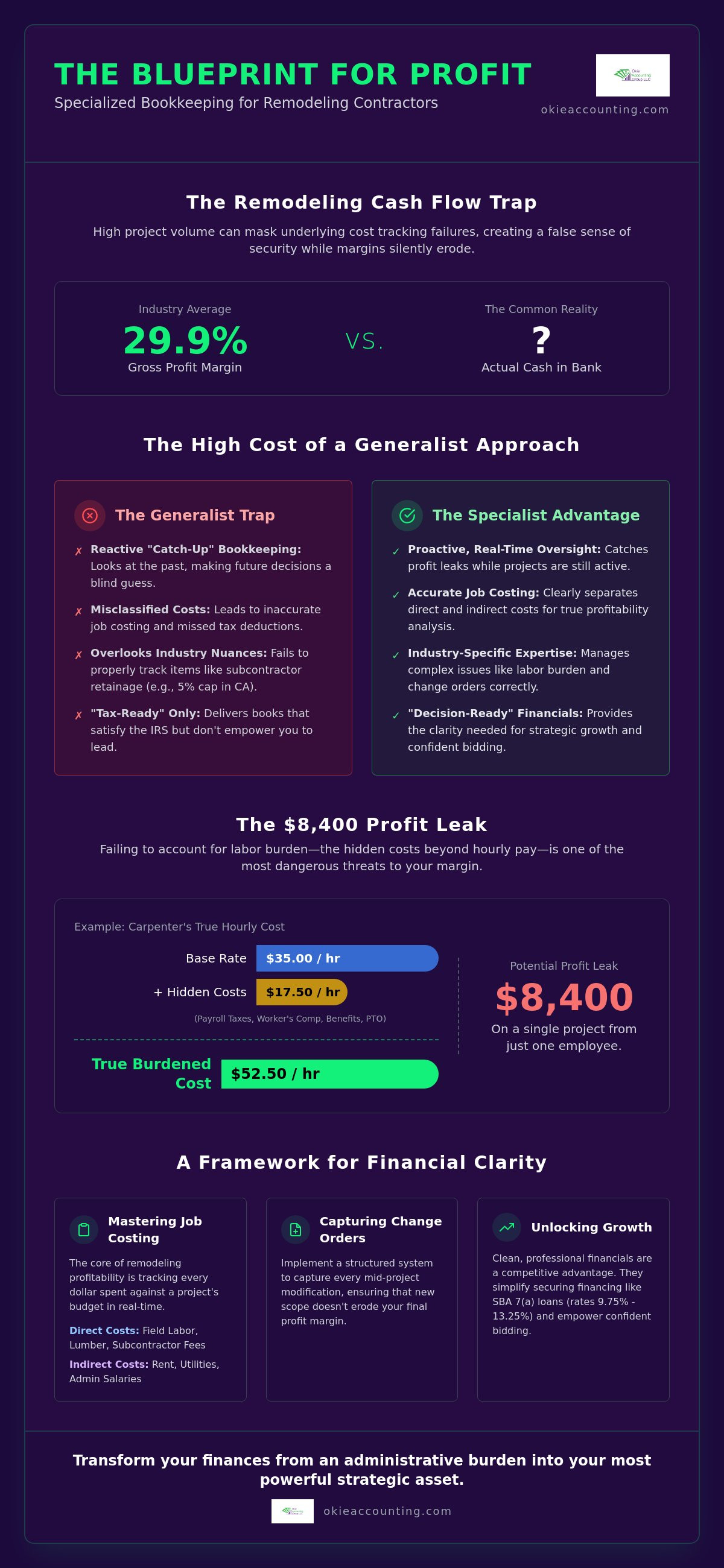
Why does your bank balance often feel like a work of fiction compared to the high-value projects your team is currently wrapping up? It is a frustrating reality for many that despite the industry seeing average gross profit margins near 29.9 percent, the cash in the bank doesn't always tell the same story. Professional bookkeeping for remodeling contractors requires a specialized approach that goes far beyond basic data entry. You need a disciplined system that captures every unrecorded change order and accounts for the true labor burden that often hides significant profit leaks.
You likely started your company to build beautiful spaces, not to spend your nights reconciling messy job costs or worrying about cash flow gaps between project draws. We agree that the transition from a hands-on service provider to a strategic leader requires a level of financial clarity that standard bank statements simply cannot provide. This article will show you how to master the complexities of project-based accounting to eliminate these anxieties and shield your remodeling margins. We will explore the structural framework necessary to achieve real-time visibility into project profitability and ensure your business is positioned for long-term stability and growth in 2026.
Why Remodeling Bookkeeping Requires a Specialized Strategic Framework
Remodeling businesses operate in a high-velocity environment where cash moves as quickly as the hammers swing. Generalist providers often treat your business like a retail shop, but bookkeeping for remodeling contractors requires a specialized strategic framework to be effective. Without it, you fall into the "Remodeling Trap." This occurs when high project volume masks underlying cost tracking failures. You might see a healthy bank balance while your actual margins are eroding due to uncaptured expenses or timing mismatches in project draws. This false sense of security often leads to cash flow anxiety when multiple projects reach the finishing stage simultaneously.
Specialized oversight also accounts for industry-specific regulations that generalists frequently overlook. For instance, as of January 1, 2026, California law caps retention on private construction contracts at 5 percent. A generalist bookkeeper might not understand how to properly track these withheld funds or disclose subcontractor information as required. True financial management moves you from reactive data entry to proactive oversight. This transition creates a disciplined foundation that supports scaling, allowing you to move from working in the business to strategically leading it.
The High Cost of Generalist Accounting
Generalists often struggle with the distinction between direct and indirect costs. If your labor or materials aren't correctly allocated to specific projects, your job costing becomes a guess rather than a science. This misclassification doesn't just hurt your project analysis; it can lead to missed deductions during tax season. "Catch-up" bookkeeping is another significant risk. It leaves you looking at the past while trying to make decisions for the future. There is a massive difference between "tax-ready" books, which satisfy the IRS, and "decision-ready" financial data, which empowers you to lead. Relying on outdated data makes it impossible to catch profit leaks before they drain a project's potential.
Financial Clarity as a Competitive Advantage
Accurate data is your most powerful tool for sustainable growth. When you know your exact costs, you can bid more aggressively on high-value projects without risking your company's health. Clean, professional financial statements also simplify the process of securing lines of credit or SBA 7(a) loans, where variable rates currently range from 9.75 percent to 13.25 percent as of July 2026. Financial infrastructure is the backbone of project success, providing the structural integrity needed to weather market shifts. By establishing robust management accounting systems, you transform your financial department from an administrative burden into a strategic partner that protects every dollar of your 29.9 percent average gross margin.
Mastering Job Costing: The Core of Remodeling Profitability
While the previous section established the need for a strategic framework, job costing is where that framework meets the reality of the job site. For those managing bookkeeping for remodeling contractors, job costing is the systematic process of tracking every dollar spent against a specific project's budget. It isn't a static record. It's a dynamic tool that allows you to see if a kitchen renovation is staying on track or if a bathroom remodel is bleeding profit before the tile is even laid. By tracking costs throughout the remodeling lifecycle, you gain the ability to make course corrections while the project is still active.
Allocating Direct vs. Indirect Costs
Precision starts with clear categorization. You must distinguish between direct project costs like field labor, lumber, and subcontractor fees, and indirect costs that support the business but aren't tied to one specific nail. Handling small tools and consumables requires a disciplined approach. Rather than tracking every box of screws to a project, many successful firms use a percentage-based allocation to keep the ledger clean without losing accuracy. This balance is a hallmark of professional Construction Bookkeeping Services. Aligning your internal processes with authoritative literature on Construction accounting ensures that your financial statements are lender-ready and structurally sound.
Tracking Labor Burden Correctly
Labor burden is arguably the most dangerous hidden cost in the remodeling sector. If you pay a carpenter $35 per hour, that is not your actual cost. You must account for payroll taxes, workers' compensation insurance, health benefits, and paid time off. Ignoring these factors creates a raw hourly rate trap. For example, a base rate of $35 often translates to a burdened cost of $52.50 per hour. On a single project, failing to account for this difference can lead to an $8,400 profit leak. To protect your margins, use this checklist for calculating the true cost of an employee:
Employer-paid payroll taxes including FICA, FUTA, and SUTA.
Workers’ compensation insurance premiums specific to trade classifications.
General liability insurance allocations.
Employee benefits, 401k contributions, and health insurance.
Non-billable time such as safety meetings and mandatory training.
Material management requires a strategic choice between allocating inventory or tracking direct project purchases. In 2026, with material costs remaining a concern due to supply chain issues, real-time tracking is essential. This data doesn't just protect today's project; it builds the foundation for future estimate precision. If your bookkeeping reflects that your last three deck builds cost 15 percent more in materials than estimated, you can adjust your next bid accordingly. This proactive oversight is exactly what we discuss during a brief discovery call to help you regain control over your margins.
Managing Change Orders and Overhead Allocation
Remodeling contractors face a unique challenge that new-build firms rarely encounter: the constant evolution of project scope. When you're managing bookkeeping for remodeling contractors, the change order is often where profitability lives or dies. An unrecorded modification to a kitchen layout or a last-minute upgrade in flooring materials might seem minor in the field, but it creates a massive "leak" in your financial system. Without a structural framework to capture these additions mid-project, you're essentially providing free labor and materials to your clients. This lack of discipline doesn't just hurt one job; it destabilizes your entire company's financial health.
The Change Order Workflow
A disciplined change order workflow requires seamless integration between your project management data and your accounting software. Every field change must trigger a corresponding update in your ledger before the next project draw occurs. It's vital to ensure change orders are invoiced before the final draw is issued to prevent uncollected revenue at the end of the job. A mere 5% uncaptured cost on a project can slash your final net profit by more than half when operating on thin margins. By standardizing this process, you protect your 29.9 percent average gross margin and ensure that every hour of field labor is accounted for and billed.
Strategic Overhead Recovery
Beyond direct project costs, you must calculate your "real" overhead to ensure your business remains sustainable. Many contractors stop at rent and utilities, but true overhead includes vehicle maintenance, estimating time, and the administrative labor required to keep the wheels turning. Identifying these "hidden" costs is essential for accurate Construction Cash Flow Management. While good accounting software for construction businesses often helps automate this tracking, the strategy behind the data is what matters most.
Strategic overhead recovery typically involves choosing between "Dual-Rate" and "Single-Rate" allocation methods. A Single-Rate method applies a flat percentage across all jobs, which is simple but can be inaccurate for firms with diverse project types. The Dual-Rate method separates fixed costs from variable costs, providing a more granular view of how indirect expenses impact each active job site. By choosing the right methodology, you transform your overhead from a vague expense into a managed component of your project pricing. This level of oversight ensures that your business doesn't just survive on project draws but thrives through rigorous management of every indirect dollar spent.
Optimizing QuickBooks Online for Remodeling Success
While job costing and overhead recovery are the strategies, QuickBooks Online is the engine that drives your financial clarity. For effective bookkeeping for remodeling contractors, you must move beyond a standard "out-of-the-box" setup. As of July 2026, the QuickBooks Online "Plus" plan, priced at $115 per month, is the minimum tier recommended for your sector. This version provides the essential project tracking and job costing features that lower tiers simply lack. If you're scaling into multiple large-scale renovations simultaneously, the "Advanced" plan offers deeper reporting and automation that justifies its $275 monthly cost.
Your Chart of Accounts should mirror your actual production workflow. Instead of using generic "Supplies" categories, design a structure that separates rough materials from finish materials. The "Products and Services" list is equally critical. It acts as the bridge between your field activities and your financial reports. When configured correctly, this list allows you to see granular profitability by service line; you can finally determine if your kitchen cabinetry installs are as profitable as your plumbing rough-ins. Automating bank feeds and requiring field teams to use mobile receipt capture tools ensures that no expense is left behind on a truck floorboard.
Step-by-Step QuickBooks Configuration
To build a robust system, you must first adjust your account settings. Enable "Track expenses and items by customer" to ensure every receipt is linked to a specific project. You should also configure the "Classes" feature to distinguish between different service lines, such as interior renovations versus exterior additions. This creates a multi-dimensional view of your income and expenses. If your current setup feels disorganized or lacks these critical links, professional QuickBooks Setup & Training can realign your software with your actual business operations.
Avoiding Common Software Pitfalls
One of the most dangerous habits is over-relying on "Bank Rules" for project-specific materials. While automation saves time, a generic rule that categorizes every hardware store purchase as "Job Materials" will destroy your job costing accuracy. You must manually review these transactions to assign them to the correct customer and sub-project. Similarly, reconciling credit card statements requires a disciplined approach to ensure that individual charges aren't lost in a single lump-sum payment. You can find more advanced tactics in our guide on Mastering QuickBooks for Contractors.
A well-optimized software environment transforms your financial data from a pile of receipts into a strategic asset. It provides the real-time visibility you need to catch profit leaks before they become catastrophic. Ready to build a financial engine that actually works for your business? Schedule a discovery call today to discuss a custom configuration for your firm.
Transitioning to Strategic Financial Leadership
Scaling a remodeling firm requires more than just recording receipts. It demands a transition from administrative maintenance to strategic oversight. Professional bookkeeping for remodeling contractors provides the foundational data, but strategic leadership is what transforms that data into a roadmap for growth. One of the most powerful tools in this transition is the Work in Progress (WIP) report. This report allows you to identify "under-billed" projects early. If you've completed 60 percent of a kitchen remodel but have only billed for 40 percent, you're essentially financing the client's renovation. Recognizing this gap allows you to adjust billing cycles and protect your cash reserves before they're depleted.
Cash flow forecasting goes a step further by looking ahead at the next 90 to 120 days. It aligns your project pipeline with your financial obligations. This ensures you have the capital necessary for material deposits or specialized subcontractor draws before they're due. By shifting your focus from the rear-view mirror to the road ahead, you eliminate the cash flow anxiety that often plagues the remodeling lifecycle. You move from wondering if you can afford the next project to knowing exactly how it fits into your long-term health.
The Fractional Controller Advantage
As your firm grows, the complexity of managing internal controls and long-term strategy often exceeds the capacity of a standard bookkeeper. This is where specialized oversight becomes a competitive necessity. A controller shifts the focus from historical recording to future-focused strategy. They establish rigorous internal controls to prevent errors and mitigate risks. This partnership provides a level of security that allows you to focus on high-level business development rather than granular data entry. It's the difference between merely staying afloat and building a scalable, resilient organization.
Lender-Ready Financials and Growth
The lending environment in July 2026 remains competitive. With the Prime Rate at 6.75 percent and SBA 7(a) loan rates ranging from 9.75 percent to 14.75 percent, lenders are scrutinizing financial statements with increased intensity. Having professional oversight ensures your balance sheets and profit and loss statements are structurally sound. This transition represents a psychological shift from being a "Contractor" who manages jobs to a "Business Owner" who manages an asset. Establishing this structural framework is the final step in securing long-term profit protection and operational freedom. Experience Financial Clarity with Okie Accounting Group LLC.
Build Your Financial Foundation for Sustainable Growth
The transition from reactive data entry to proactive financial oversight is the defining factor for remodeling success in 2026. By implementing a specialized framework for bookkeeping for remodeling contractors, you move beyond mere compliance to true profit protection. You've seen that mastering job costing, capturing every change order, and optimizing your software are not just administrative tasks; they're essential structural components of a healthy firm. These systems provide the real-time visibility needed to catch profit leaks and the lender-ready data required for strategic scaling.
As specialists in Construction and Real Estate Accounting, we understand the unique mechanics of your market. Our team of QuickBooks Online Certified ProAdvisors is dedicated to building the foundational systems that allow you to lead with confidence. Whether you need fractional controller expertise to manage complex WIP reports or a complete software realignment, we're here as your strategic partner. We value accuracy and long-term stability as much as you value your craftsmanship.
Don't let uncaptured costs or cash flow anxiety limit your firm's potential. Schedule a Strategic Financial Review for Your Remodeling Firm today to secure your margins and reclaim your time. You've built a reputation for quality; it's time your financial systems reflected that same standard of excellence.
Frequently Asked Questions
How does bookkeeping for remodeling differ from general construction accounting?
Remodeling financial management focuses on high-velocity changes within existing structures rather than ground-up builds. This requires more granular tracking of change orders and labor burden on significantly shorter timelines. While a new build might have a static budget, remodeling budgets are fluid and require constant reconciliation to maintain the 29.9 percent average gross margin currently seen as the industry standard.
What is the most common bookkeeping mistake remodeling contractors make?
Mistaking cash flow for actual job profitability is the most frequent error. Contractors often see a healthy bank balance from new project draws and fail to notice margin erosion on completing jobs. This "fake profit trap" hides the fact that individual projects may be losing money due to uncaptured labor costs or unbilled change orders that only surface weeks after the job is finished.
Do I really need job costing if I only have 2-3 projects at a time?
Yes, job costing is essential regardless of your project volume. Even with only two active jobs, failing to track burdened labor and materials leads to inaccurate bidding on future work. Professional bookkeeping for remodeling contractors ensures that every hour spent on a specific site is accounted for, allowing you to identify if a single project is draining the profits of the other two.
How can specialized bookkeeping help me manage change orders?
Specialized systems create a bridge between field modifications and the final invoice. Instead of waiting until the end of a project to tally extras, a strategic framework captures additional labor and material costs in real-time. This ensures that every modification is documented and billed before the final draw, preventing the significant net profit slash that occurs when small changes go unrecorded.
Is QuickBooks Online the best software for remodeling contractors in 2026?
QuickBooks Online remains the industry standard in 2026 due to its robust integration capabilities and job costing features. With Intuit discontinuing support for older Desktop versions in May 2026, the "Plus" or "Advanced" cloud tiers are necessary for contractors. These versions allow for real-time tracking and class-based reporting that is vital for protecting project margins in an environment where the Prime Rate stands at 6.75 percent.
What is the difference between a bookkeeper and a fractional controller for my firm?
A bookkeeper records historical data, while a fractional controller provides future-focused strategic guidance. While the bookkeeper ensures your transactions are categorized, a controller analyzes WIP reports and manages cash flow forecasting. This higher level of oversight is critical for firms scaling beyond a few million in revenue that need internal controls to prevent errors and ensure financial readiness for lending.
How often should I review my financial statements as a contractor?
You should review your project-specific job cost reports weekly and your full financial statements monthly. Weekly reviews allow you to catch labor leaks or material overages while you still have time to make operational adjustments. Monthly reviews of your Profit and Loss and Balance Sheet provide the high-level clarity needed to assess the overall structural health of your business and prepare for long-term growth.
Can a specialized bookkeeper help me with payroll compliance?
Yes, a specialist ensures that your payroll management accounts for the complex labor burden specific to the remodeling industry. This includes tracking workers' compensation classifications and ensuring compliance with evolving standards, such as the 2026 OSHA silica and heat illness regulations. Accurate payroll tracking is the only way to determine your true burdened labor rate, which is the foundation of profitable bidding.


Comments