Bookkeeping for Remodeling Contractors: Protect Your Margins in 2026

Updated: Nov 7
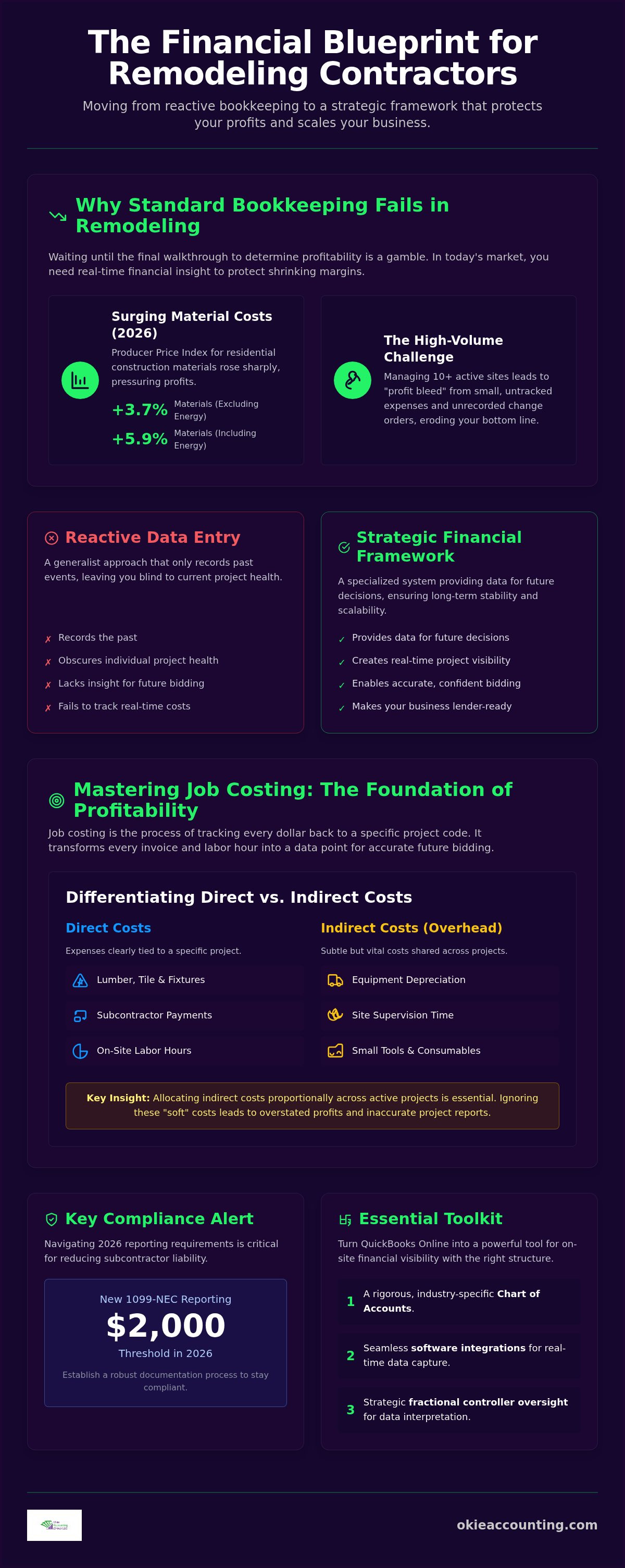
If you're waiting until the final walkthrough to see if a project was actually profitable, you're not just building homes; you're gambling with your company's future. With the Producer Price Index for residential construction materials rising 3.7% in early 2026, even a minor oversight in job costing can turn a high-end kitchen remodel into a financial drain. You likely already know that shrinking margins on change orders and cash flow gaps between milestone payments are the silent killers of a growing firm. Specialized bookkeeping for remodeling contractors must go beyond simple data entry to provide a structural financial framework that tracks every nail and board.
We'll show you how to move from basic administrative tasks to a strategic partnership that ensures your business is both profitable and scalable. You'll learn how to maintain real-time visibility into project health, navigate the new $2,000 threshold for 1099-NEC compliance, and prepare lender-ready financial statements. This guide provides a clear roadmap for automating your workflows so you can focus on the job site while your financial systems protect your bottom line. By the end, you'll have the tools to build a business that is as solid as the structures you create.
Why Remodeling Bookkeeping Requires a Specialized Strategic Framework
Effective bookkeeping for remodeling contractors isn't a secondary administrative task. It's the structural link between your project management software and your bank account. While a generalist bookkeeper might understand how to categorize a utility bill, they often lack the specialized insight required to track the shifting margins of a multi-room renovation. In this sector, financial oversight must intersect directly with project timelines. If your books don't reflect the current state of your job sites, you're essentially flying blind. Remodeling requires a specialized strategic framework for construction accounting that accounts for the unique rhythm of draws, retainage, and job costing.
The 2026 economic environment makes this specialized approach mandatory rather than optional. With the Producer Price Index for residential construction materials (excluding energy) rising 3.7% in April 2026, profit margins are under constant pressure. When you include energy, that price index jumped 5.9% compared to the previous year. Financial readiness means having the data to adjust your bidding strategies before the next contract is signed. Transitioning from reactive data entry to proactive financial management ensures that your cash flow remains steady, even when material costs fluctuate or milestone payments are delayed.
The High-Volume Project Challenge
Managing ten or more active remodeling sites creates a unique set of financial risks. Unlike new home builds with predictable phases, remodeling projects are prone to profit bleed from small-scale, off-site material purchases and unrecorded change orders. Without a centralized cloud-based system, these micro-expenses quickly erode your bottom line. A disciplined accounting partner ensures that every receipt from the local hardware store is attributed to the correct project code in real time. This level of granular detail is the only way to maintain visibility when your team is spread across multiple zip codes.
Administrative Tasks vs. Structural Frameworks
There is a fundamental difference between simple data entry and building a scalable accounting system. Basic bookkeeping records the past, but management accounting provides the data needed for future decision-making. We focus on constructing a structural framework that supports long-term stability. This involves setting up a rigorous Chart of Accounts and establishing workflows that capture labor costs and subcontractor liabilities as they occur. By treating your financial system as a foundational asset, you create a business that is lender-ready and capable of scaling without the typical growing pains of the construction industry.
Mastering Job Costing: The Foundation of Remodeling Profitability
Job costing is the process of tracking every dollar back to a specific project code. It's the heart of your data. Without this granular level of detail, your financial statements offer a bird's eye view that obscures the reality of individual project health. For those providing specialized bookkeeping for remodeling contractors, the goal is to transform every material invoice and labor hour into a data point for future bidding. By assigning costs to specific codes, you create a historical record that reveals exactly where your estimates were accurate and where they fell short. This level of precision is what differentiates a sustainable firm from one that is constantly surprised by "hidden" costs at the end of a project.
Accurate job costing isn't just about looking backward; it's a tool for future stability. When you know your exact cost per square foot for a master bath remodel in 2026, you can bid with confidence despite fluctuating material prices. This historical accuracy protects your margins from the start. To understand how this fits into a broader financial strategy, you can explore our guide on Construction Bookkeeping Services, which details the infrastructure required for scalable growth.
Direct vs. Indirect Costs in Remodeling
Differentiating between direct and indirect costs is where many contractors struggle. Direct costs are the obvious expenses: lumber, tile, plumbing fixtures, and the labor hours spent on-site. When managing these labor costs, it's critical to ensure you are classifying subcontractors and employees correctly to maintain compliance and accurate tax reporting.
Indirect costs are more subtle but equally vital to your margin protection. These include:
Equipment depreciation for your trucks and heavy machinery.
Site supervision time that isn't billed to a specific trade.
Small tools and consumables that are used across multiple sites.
Allocating these overhead expenses proportionally across your active projects ensures that your reported margins reflect the true cost of doing business. If you ignore these "soft" costs, your net profit will always be lower than your project reports suggest.
WIP Accounting: The Secret to Accurate Profit & Loss
Cash basis accounting can be dangerous for remodeling contractors. It creates a false sense of security when a large milestone payment arrives, even if the associated costs haven't hit your books yet. Work in Progress (WIP) accounting solves this by matching revenue to the actual percentage of project completion. This prevents revenue overstatement and ensures your Profit & Loss statement reflects reality rather than just your bank balance. WIP accounting is the mechanism that aligns financial reporting with physical project progress.
If your current reports leave you guessing about your actual project performance, it may be time for a more disciplined approach. You can schedule a discovery call to see how a structured job costing framework can stabilize your firm's future.
Managing Subcontractors and Compliance: Reducing Liability Risks
Managing a network of trade partners is one of the most complex aspects of bookkeeping for remodeling contractors. While subcontractors provide the specialized labor that brings your designs to life, they also introduce significant financial and legal risks if not managed with professional discipline. A strategic bookkeeper doesn't just record vendor payments; they build a compliance firewall that protects your firm from audit penalties and insurance gaps. This proactive approach ensures that every person stepping onto your job site is properly documented before the first dollar leaves your bank account.
The regulatory landscape has shifted significantly in 2026. Under the One Big Beautiful Bill Act, the reporting threshold for Form 1099-NEC has increased from $600 to $2,000 for payments made on or after January 1, 2026. While this might seem like a relief, it requires even tighter oversight to ensure you don't miss filings for those who cross the new limit mid-year. Following SBA guidelines on financial management helps establish the rigorous documentation standards needed to stay ahead of these changes. Integrating these checks into your construction payroll services workflow ensures that compliance is a built-in feature of your business rather than an afterthought.
Insurance and COI Management
Expired Certificates of Insurance (COI) are a silent threat to remodeling margins. If a subcontractor’s workers’ comp or general liability coverage lapses while they're on your site, the financial responsibility often falls back on you. We implement systems that track expiration dates for every trade partner. Automated alerts within your accounting software should prevent payments to any vendor with non-compliant or expired insurance. This structural safeguard ensures you never unintentionally assume the liability of another business.
1099-NEC and Tax Readiness
Waiting until January to "clean up" subcontractor records is a strategic failure that leads to administrative chaos. Professional management accounting dictates that W-9 collection must happen during the onboarding phase. No subcontractor should be set up in your system without a verified tax ID. By maintaining tax readiness throughout the year, you avoid the high-stress scramble of year-end reporting and ensure your firm is prepared for the mandatory electronic filing requirements now standard in 2026. This level of organization signals to lenders and auditors alike that your business is managed with precision and long-term stability.
Optimizing QuickBooks Online for Remodeling Workflows
QuickBooks Online is the industry standard for cloud-based accounting, but for many contractors, it remains an underutilized tool. A generic setup designed for a retail store or a consulting firm will not provide the granular data required for effective bookkeeping for remodeling contractors. To protect your margins in 2026, your software must be configured as a project-based engine that mirrors your physical workflow. This requires moving beyond simple expense tracking and into a structured environment where every transaction is tied to a specific project phase and budget line item.
One of the most critical gaps in standard accounting setups is the handling of change orders. In remodeling, a change order that isn't properly documented and billed is essentially a gift to the homeowner at the expense of your profit. We configure QuickBooks to ensure that every deviation from the original contract is captured, approved, and reflected in your job costing reports. For those looking to dive deeper into advanced configurations, our QuickBooks for Contractors guide provides a comprehensive roadmap for a 2026-ready financial system.
The Remodeling Chart of Accounts
A generic Chart of Accounts (COA) is the primary cause of "messy" books that offer no real insight. Instead of broad categories like "Construction Materials," a specialized remodeling COA structures accounts by project phases. This includes specific headers for demolition, rough-in, and finishes. By using "Classes" and "Locations" within QuickBooks, you can track performance across different states or divisions, allowing you to see which types of projects are generating the highest returns and which are dragging down your averages. This level of organization transforms your Profit & Loss statement from a tax document into a strategic management tool.
Automating Receipt and Expense Capture
The "shoebox of receipts" is an outdated liability that has no place in a modern firm. We bridge the gap between the job site and the back office by implementing mobile apps that integrate directly with your accounting software. When a lead carpenter buys a box of specialized fasteners, they can capture the receipt and assign it to the project code before they even leave the parking lot. This real-time data entry is supported by automated bank feeds that eliminate manual entry errors. However, technology is only as effective as the people using it, which is why we emphasize the importance of software training for your field staff.
If your current software setup feels like a burden rather than a benefit, it may be time to rebuild your financial infrastructure. You can request a QuickBooks optimization review to ensure your system is built for the specific complexities of the remodeling industry.
Beyond the Books: Scaling Your Firm with Fractional Controller Oversight
Scaling a remodeling firm requires a shift in perspective. While fundamental bookkeeping for remodeling contractors focuses on the accuracy of past transactions, sustainable growth depends on your ability to look forward. This is where the transition from administrative oversight to strategic partnership occurs. Many owners find themselves trapped in the daily minutiae of project costs, unable to step back and analyze the broader financial health of their organization. Implementing Fractional Controller Services allows you to access high-level financial strategy and data interpretation without the overhead of a full-time executive salary.
In the current high-interest-rate environment of 2026, where the Wall Street Journal Prime Rate sits at 6.75%, the cost of capital is significant. Managing your own funds efficiently is no longer just a good habit; it's a survival requirement for any contractor looking to expand. A fractional controller acts as a disciplined mentor, helping you move from working in the business to working on the business. They provide the structural integrity your financial data needs to support larger projects and more complex operations.
Interpreting Financial Reports for Strategy
Strategic growth requires moving beyond the basic Profit & Loss statement. While the P&L shows if you made money on a project, the Balance Sheet reveals the actual health of your company. A controller helps you identify red flag projects where costs are accelerating faster than milestone payments, potentially draining your cash reserves before the job is complete. You can learn more about our Controller Services to see how we help growing firms maintain this level of oversight. By catching these variances early, you protect your firm from the profit bleed that often accompanies rapid scaling.
Cash Flow Management and Growth
Large remodeling projects often suffer from a cash gap, where you must fund labor and materials before the next draw is released. In July 2026, with SBA 7(a) loan rates for amounts over $250,000 reaching 9.75%, relying on credit to bridge these gaps is an expensive strategy. We focus on building 13-week cash flow forecasts that provide the peace of mind needed to make bold business choices. This forward-looking approach ensures you have the liquidity to take on new contracts while maintaining your current commitments. Financial clarity is the ultimate competitive advantage in the remodeling industry, providing the stability required to outpace competitors who are still guessing at their numbers.
Constructing a Foundation for Scalable Success in 2026
Protecting your margins in a fluctuating market requires more than just keeping up with administrative tasks. It demands a specialized framework where job costing, compliance, and software optimization work in unison. By implementing a disciplined system for 1099-NEC reporting and refining your project workflows, you move from reactive management to proactive leadership. This structural integrity is what allows a remodeling firm to bridge cash gaps and scale with confidence. Specialized bookkeeping for remodeling contractors is the difference between a business that merely survives and one that dominates its market.
At Okie Accounting Group LLC, we provide the specialized construction accounting expertise needed to turn your financial data into a strategic asset. Our cloud-based systems offer nationwide service, ensuring you have real-time visibility regardless of where your job sites are located. Through our Fractional Controller oversight, you gain the high-level guidance necessary to navigate high interest rates and complex project timelines. You don't have to manage these complexities alone. Schedule your strategic financial review with Okie Accounting Group LLC today. We're ready to help you build a more profitable and stable future.
Frequently Asked Questions
How is construction bookkeeping different from regular small business bookkeeping?
Construction bookkeeping focuses on project-specific financial health rather than just the business as a whole. While regular bookkeeping tracks general overhead, specialized bookkeeping for remodeling contractors prioritizes job costing and Work in Progress (WIP) accounting. This allows you to see the profitability of every individual site, ensuring that a single underperforming project doesn't drain the company's total cash reserves.
What is the best accounting software for remodeling contractors in 2026?
QuickBooks Online remains the industry standard for remodeling firms due to its robust integration with project management tools. It provides the flexibility needed for on-site receipt capture and real-time job costing. When properly configured with a specialized Chart of Accounts, it offers the structural integrity required to manage multiple high-detail renovations simultaneously without losing track of granular expenses.
Should I use cash or accrual accounting for my remodeling business?
Accrual accounting is the superior choice for remodeling contractors who want a true picture of their project profitability. While cash basis is simpler for tax purposes, it often creates a distorted view of your finances by recording income when received and expenses when paid. Accrual accounting matches costs to the revenue they generated, which is essential for accurate Work in Progress reporting and long-term stability.
How do I track change orders so they don’t eat my profit?
Tracking change orders effectively requires a disciplined workflow where every deviation is assigned a unique project sub-code. You must document the approval and cost of the change before the work begins on-site. By integrating these updates directly into your accounting software, you ensure that the additional labor and materials are billed correctly and that your project margins remain protected.
What documents do I need from my subcontractors before I pay them?
You must collect a completed W-9 form and a valid Certificate of Insurance (COI) before issuing any payment to a subcontractor. The COI should confirm both general liability and workers' compensation coverage to protect your firm from third-party liability. Maintaining these documents in a centralized system ensures you stay compliant with the 2026 1099-NEC reporting thresholds and avoid insurance audit penalties.
How much should a remodeling contractor spend on professional bookkeeping?
The investment in professional bookkeeping should be viewed as a strategic cost of protecting your margins rather than a simple administrative expense. While the exact cost varies based on your volume and complexity, a healthy firm typically allocates resources to ensure financial accuracy. The value lies in the lender-ready statements and the profit protection that specialized oversight provides.
What is WIP accounting and do I really need it?
Work in Progress (WIP) accounting is a mechanism that aligns your financial reporting with the physical progress of your projects. You absolutely need it if you manage multi-month renovations where milestone payments and material costs don't always occur in the same month. WIP accounting prevents the false profits often seen in cash-based systems by deferring revenue until it's actually earned through project completion.
When should a contractor hire a Fractional Controller vs. a basic bookkeeper?
You should hire a Fractional Controller when your needs move beyond data entry and toward strategic growth interpretation. While a basic bookkeeper focuses on recording past transactions, a controller analyzes that data to forecast cash flow and optimize profit margins. If you're scaling your firm and need high-level financial strategy to make data-driven choices, the transition to controller oversight is a critical step.


Comments