Bookkeeping for Roofing Contractors: A Strategic Framework for Profitability

Updated: Nov 7
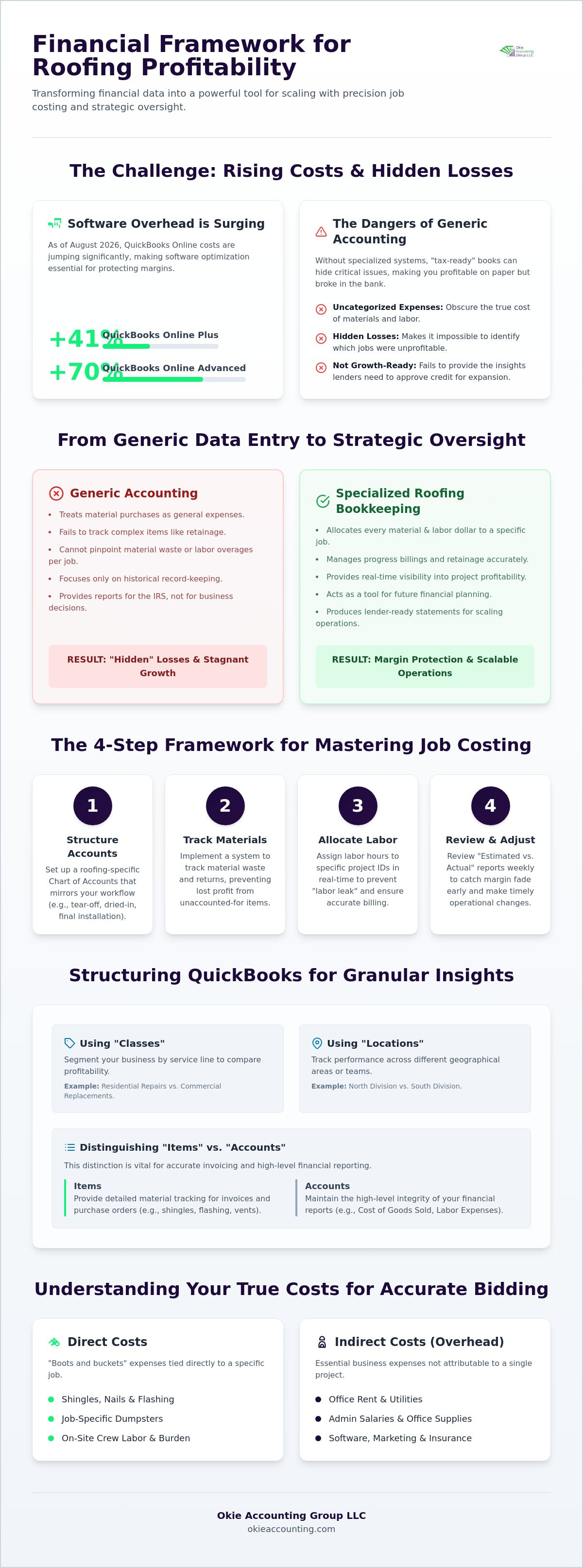
With QuickBooks Online Plus prices jumping by 41% and Advanced plans by 70% as of August 2026, simply "having the software" is no longer a cost-effective strategy for roofing firms. Many owners feel the weight of this overhead while still struggling with uncategorized expenses and "hidden" losses on jobs they thought were profitable. Effective bookkeeping for roofing contractors requires more than just basic data entry; it demands a structural framework that protects your margins against rising material costs and persistent labor shortages.
You likely started your company to build a legacy, not to spend your evenings untangling 1099 compliance or worrying about seasonal cash flow gaps. We understand that financial clarity is the foundation of structural growth. This article will teach you how to transform your financial data into a powerful tool for scaling through precision job costing and strategic oversight. You will learn the methodology for building a scalable accounting system that provides real-time visibility into project profitability and produces the lender-ready statements necessary to expand your crew count with confidence.
Beyond the Shoebox: Why Roofing Contractors Need Specialized Bookkeeping
Many roofing company owners start their journey with a simple spreadsheet or a literal shoebox of receipts. As the crew count grows and project volume increases, this informal method quickly collapses under the weight of complex operational demands. Effective bookkeeping for roofing contractors is not just about tracking what enters and leaves the bank account; it is a project-centric financial management system designed to protect your margins. Unlike a retail store where a sale is immediate and final, a roofing project involves multiple phases, from the initial deposit to the final inspection and the eventual release of retainage.
Generalist bookkeepers often lack the niche expertise required to handle these variables. They might record a large material purchase as a generic expense rather than allocating it to a specific job address. This oversight makes it impossible to determine which projects were winners and which were "hidden" losers. Without the nuances of specialized bookkeeping for construction, you risk falling into the trap of being profitable on paper while remaining broke in the bank. This happens when your financial reports don't account for the timing of progress billings or the true cost of labor. Our approach focuses on building a structural financial framework that treats your data as a tool for long-term health rather than a historical record of past spending.
The Danger of Generic Accounting
Generic accounting fails to capture the granular details that drive bidding accuracy. If your system doesn't categorize shingles, flashing, and vents to specific jobs, you can't see if a particular crew is consistently over-ordering materials or if waste is eating your profits. Even more critical is the failure to track labor burden. Your true labor cost isn't just the hourly rate paid to the crew. It includes workers' comp insurance, FICA taxes, and benefits. If these aren't factored into your job costing, your margins are thinner than you think. Remember that "tax-ready" books are designed for the IRS; they don't provide the "growth-ready" insights a lender needs to see when you apply for a line of credit to scale your operations.
The 2026 Standard for Roofing Financials
In 2026, the standard for excellence has shifted toward real-time, cloud-based data access. With QuickBooks Online Plus and Advanced plans seeing significant price increases as of August 2026, you must maximize the value of your software. Digital integration between your CRM and accounting software prevents data silos and ensures that field crews and office staff are looking at the same numbers. This connectivity allows for immediate adjustments if a project starts to drift off course. By establishing a robust system, you move away from basic administrative tasks and toward strategic financial oversight that empowers your entire team to make data-driven choices on every roof you install.
Mastering Job Costing: The Foundation of Roofing Profitability
Job costing is the process of assigning every dollar of cost to a specific roof. For those managing bookkeeping for roofing contractors, this is the only way to move from guessing to knowing your true margins. Without this precision, your financial statements are just a blur of numbers that don't tell you if a specific project was a winner or a "hidden" loser. High-growth firms use a four-step framework to ensure every nail and labor hour is accounted for:
Step 1: Set up a roofing-specific Chart of Accounts in QuickBooks. This structure must reflect your actual workflow, separating costs into categories like tear-off, dried-in, and final installation.
Step 2: Implement a system for tracking material waste and returns. Shingle waste is expected; however, unaccounted-for returns are lost profit that often goes unnoticed in generic systems.
Step 3: Allocate labor hours to specific project IDs in real-time. This prevents "labor leak," where hours are billed to the wrong client or absorbed by the company.
Step 4: Review "Estimated vs. Actual" reports weekly. Catching margin fade early allows you to make operational adjustments before the final bill is sent.
Structuring QuickBooks Online for Roofing
To achieve true precision, you must go beyond basic ledger entries. Utilizing "Classes" and "Locations" allows you to segment your business by service lines, such as comparing the margins of residential repairs against commercial replacements. The distinction between "Items" and "Accounts" is equally vital. Items provide detailed material tracking for your invoices and purchase orders, while Accounts maintain the integrity of your financial reports. For owners looking to empower their office staff, professional QuickBooks training for contractors ensures these systems are maintained with the necessary rigor.
Tracking Direct vs. Indirect Costs
Profitability depends on your ability to distinguish between direct and indirect costs. Direct costs are the "boots and buckets" expenses: shingles, nails, dumpsters, and the direct labor of the crew on that roof. Indirect costs are the "back office" expenses like estimator commissions, vehicle fuel, and warehouse rent. A common mistake in bookkeeping for roofing contractors is failing to calculate the true cost of the team. A burdened labor rate is the total cost of an employee beyond just their hourly wage, including taxes, insurance, and benefits. Maintaining labor compliance for contractors is non-negotiable when calculating these figures to avoid costly misclassification penalties.
If your current system feels like a maze of uncategorized expenses, it might be time to schedule a strategy session to refine your financial infrastructure.
Navigating Seasonal Swings and Labor Compliance in 2026
Seasonal swings are an inherent challenge in the roofing industry, often leading to significant anxiety during the "Winter Dip." While revenue might peak in the summer, the lack of a proactive financial strategy can leave you vulnerable when the weather turns. Specialized bookkeeping for roofing contractors utilizes historical data to create accurate cash flow forecasts, allowing you to anticipate periods of lower activity with precision. This foresight transforms your accounting from a reactive task into a profit protection strategy that secures your company’s stability throughout the entire year.
Proactive cash management is a core pillar of a healthy roofing business. It requires a shift in mindset from simply "having money in the bank" to understanding your burn rate during the off-season. By analyzing past performance, you can identify the exact date your cash reserves typically begin to dwindle. This data allows you to adjust your spending, negotiate better terms with suppliers, or launch targeted marketing campaigns well before the dip occurs. Maintaining the integrity of your data is the only way to ensure these forecasts are reliable enough to drive high-stakes business decisions.
Cash Flow Management for the Off-Season
Strategic owners set up a dedicated "Cash Reserve" account within their bookkeeping system to act as a financial shock absorber. This account should be funded by a set percentage of every project's profit during the peak season. By utilizing construction cash flow management frameworks, you can determine the precise moment to invest in new equipment or hire additional staff without jeopardizing your liquidity. This disciplined approach ensures that you aren't just surviving the winter, but positioning yourself for a fast start when spring arrive.
Subcontractor Compliance and Reporting
Managing a mix of 1099 subcontractors and W2 employees introduces complex compliance risks that require rigorous oversight. Your bookkeeping workflow must include a verification process for Certificates of Insurance (COIs) to ensure they are active before any payment is issued. Failure to track these documents can lead to devastating results during a Workers’ Comp audit, where you may be forced to pay premiums for uninsured subcontractors. Following strict IRS recordkeeping requirements is essential for documenting these relationships and protecting your firm from misclassification penalties.
Your financial system should also facilitate the tracking of backcharges. When a subcontractor provides poor workmanship that requires a fix, those costs must be recorded against their specific contract in real-time. This ensures your margins remain protected and your 1099-NEC filings at year-end are accurate. Transitioning these tasks from a manual spreadsheet to an integrated accounting framework creates the order and predictability necessary for a scalable roofing operation.
Strategic Financial Oversight: Transitioning to a Fractional Controller
When a roofing company crosses the $2 million revenue mark, the financial needs of the business evolve. Basic bookkeeping for roofing contractors is necessary for tax compliance, but it rarely provides the strategic leverage required to scale a high-volume operation. This is the stage where the transition to a fractional controller becomes a competitive advantage. While a bookkeeper focuses on recording historical transactions, a controller focuses on influencing your company's future by interpreting that data to drive growth.
A fractional controller acts as a strategic mentor for your firm. They ensure your financial statements are lender-ready and that your cash flow is optimized for upcoming expansion. If you are bidding on large commercial contracts, a controller provides the rigorous financial analysis needed to ensure the project remains profitable even with complex progress billing and retainage requirements. Monthly financial reviews become the heartbeat of your operations, turning a static Profit and Loss statement into a roadmap for the next quarter. This level of fractional controller services allows you to move beyond administrative tasks and toward structural profit protection.
KPIs That Actually Matter for Roofers
To lead with confidence, you must track the metrics that directly impact your bottom line. A controller helps you isolate these figures so you can make adjustments in real-time. Key indicators include:
Gross Profit Margin per Crew: This reveals which teams are your "A-Team" and which crews may be struggling with material waste or slow installation times.
Days Sales Outstanding (DSO): This measures how many days it takes to get paid after a roof is dry. High DSO numbers indicate a bottleneck in your collection process.
Overhead as a Percentage of Revenue: Maintaining this ratio is vital for ensuring that your fixed costs don't outpace your growth.
Scaling with Data-Driven Decisions
Data-driven choices prevent the "growing pains" that often sink expanding roofing firms. For example, deciding when to move from a home office to a professional warehouse should be based on financial readiness rather than a gut feeling. A controller analyzes your debt-to-equity ratio and cash reserves to determine if you can support the increased overhead. Similarly, you can analyze the ROI of different lead sources. If your data shows that Google Ads yield a higher profit margin per job than door knocking, you can reallocate your marketing budget to the most profitable channel. If you're ready to build a more resilient business, you can schedule a discovery call to discuss your path to scaling.
Building a Scalable Infrastructure with Okie Accounting Group LLC
Scaling a roofing company requires more than just adding crews and equipment; it requires a financial foundation that can support increased complexity without buckling. At Okie Accounting Group LLC, we don't just record transactions. We build custom financial frameworks that align with your specific growth goals for 2026 and beyond. By moving beyond a simple vendor relationship, we serve as a strategic partner invested in your firm's structural integrity. We understand that effective bookkeeping for roofing contractors is the difference between a business that survives the season and one that builds a multi-generational legacy.
Our nationwide remote service capability ensures that you have access to specialized financial leadership regardless of your local market. We utilize cloud-based systems to provide real-time visibility into your numbers, allowing you to make decisions based on facts rather than intuition. This proactive approach alleviates the industry-specific stress of "hidden" losses and seasonal instability. We build the systems, we train your team, and we monitor the outcomes to ensure your profit remains protected at every stage of the project lifecycle.
Our Approach to Roofing Financials
Every engagement begins with a deep dive into your current records. Whether you need a comprehensive QuickBooks cleanup or a professional setup from the ground up, Okie Accounting Group LLC ensures your data is accurate from day one. Once the foundation is set, we establish a consistent cadence for monthly reporting and strategic oversight. This disciplined process provides the financial clarity needed to secure lines of credit or high-level bonding for commercial work. We also empower your internal team through specialized QuickBooks Training, ensuring your office staff can maintain the system with professional rigor.
Next Steps for Your Roofing Firm
The first step toward financial control is identifying the primary bottleneck in your current process. Is it inaccurate job costing, a mess of uncategorized expenses, or anxiety over your cash flow? Evaluating your firm's structural integrity requires an honest look at how your data is handled today. If your current bookkeeping for roofing contractors feels like a reactive chore rather than a strategic asset, it's time to implement a more robust framework. We invite you to gain control over your roofing financials today and begin the transition from administrative complexity to operational clarity.
Securing Your Firm's Financial Future
Moving your company from a state of financial anxiety to one of data-driven confidence is the hallmark of a scaling roofing firm. By adopting the structural frameworks discussed, you protect your margins against the volatility of 2026. This transformation requires moving beyond basic recording and embracing the strategic oversight that turns your numbers into a roadmap for growth. It's about shifting your focus from the daily grind of administrative tasks to the high-level decisions that define your market position.
Specialized bookkeeping for roofing contractors serves as the foundation for this stability. Whether you're managing 1099 compliance or preparing lender-ready statements for expansion, having a disciplined system is non-negotiable. As nationwide experts specialized in construction financial mechanics, Okie Accounting Group LLC is dedicated to your long-term health. We take a meticulous, forward-thinking approach to ensure your financial data becomes your most powerful tool for building a lasting legacy.
Partner with Okie Accounting Group LLC for specialized roofing bookkeeping and build a resilient foundation for your crew. You've built the expertise to install a quality roof; let us provide the framework to protect the business behind it.
Frequently Asked Questions
Why is job costing so important for roofing contractors?
Job costing allows you to assign every dollar of cost to a specific roof, which is the only way to identify "hidden" losses. Without this granular data, you can't tell if a specific project was a winner or if material waste and labor drift ate your profits. It provides the clarity needed to adjust future bids based on actual historical performance rather than optimistic estimates.
Can I use the same bookkeeper for my roofing business and my rental properties?
While a generalist might handle simple ledgers, specialized bookkeeping for roofing contractors requires an understanding of construction-specific mechanics like progress billing and labor burden. Rental properties follow a different accounting logic focused on lease management. Using a construction specialist ensures your roofing firm has the structural framework needed for bonding and commercial growth.
How often should a roofing contractor review their financial statements?
You should review your high-level financial statements, like the Profit and Loss and Balance Sheet, at least once a month. However, project-specific "Estimated vs. Actual" reports should be monitored weekly. This frequency allows you to catch margin fade while the crew is still on the job, providing the opportunity to make immediate operational adjustments before the project concludes.
What are the most common bookkeeping mistakes roofers make in QuickBooks?
The most frequent error is failing to distinguish between "Accounts" and "Items" in QuickBooks, which muddies the job costing data. Many roofers also neglect to track labor burden, such as workers' comp and payroll taxes, against specific projects. Another common mistake is neglecting to categorize material purchases to a job address, which makes it impossible to calculate true project profitability.
Is it better to have an in-house bookkeeper or an outsourced construction specialist?
Outsourcing to a construction specialist is often superior because it provides access to high-level strategic oversight without the overhead of a full-time executive salary. A specialist understands the nuances of 1099 compliance and seasonal cash flow forecasting. In-house staff often get bogged down in general admin, while an outsourced partner focuses on building a scalable financial infrastructure.
How does a fractional controller help a roofing company scale?
A fractional controller moves your firm from recording historical data to influencing future profitability. They provide the financial analysis required to secure lines of credit, manage large-scale commercial contracts, and determine the ROI of marketing spend. This strategic oversight ensures that your business remains stable as you increase crew counts and take on more complex project volumes.
What documents do I need to provide for monthly roofing bookkeeping?
You must provide bank and credit card statements, payroll records, and material invoices that include specific job addresses for accurate costing. Additionally, you need to submit subcontractor W9s and Certificates of Insurance to maintain compliance. Digital integration between your CRM and accounting software can automate much of this document collection, ensuring your data remains real-time and accurate.
How do I track roofing material waste in my accounting software?
Tracking waste requires setting up specific "Items" in your accounting software to record material variances. You should compare your total material costs against the original project estimate to identify discrepancies. Consistently monitoring this variance helps you determine if a particular crew is over-ordering or if site-level waste is eroding your margins on every roof you install.


Comments