Bookkeeping for Syndication Deals: A Strategic Framework for 2026

Updated: Nov 7
Your financial ledger isn't just a record of past transactions; it's the structural foundation of your investor's trust. While many view bookkeeping for syndication deals as a back-office chore, it's actually the primary engine for scaling your portfolio and mitigating regulatory risk. You've likely felt the pressure of manual reporting cycles that eat up your weeks or the anxiety of tracking complex inter-company fund transfers during a value-add phase. It's a heavy burden to carry when your focus should be on the next acquisition.
We understand that the complexity of multi-entity accounting can feel like a moving target, especially with the 2026 shift toward modern reporting and AI-driven bank feeds. This article provides a strategic framework to help you master these complexities and build an audit-ready back office. You'll learn how to automate investor reporting, clearly separate CapEx from OpEx for maximum tax efficiency, and implement the scalable infrastructure required to protect your profits. From applying IRS Section 709 capitalization rules to meeting March 16 tax deadlines, we're covering the essential systems that turn financial data into a competitive advantage.
The Structural Complexity of Bookkeeping for Syndication Deals in 2026
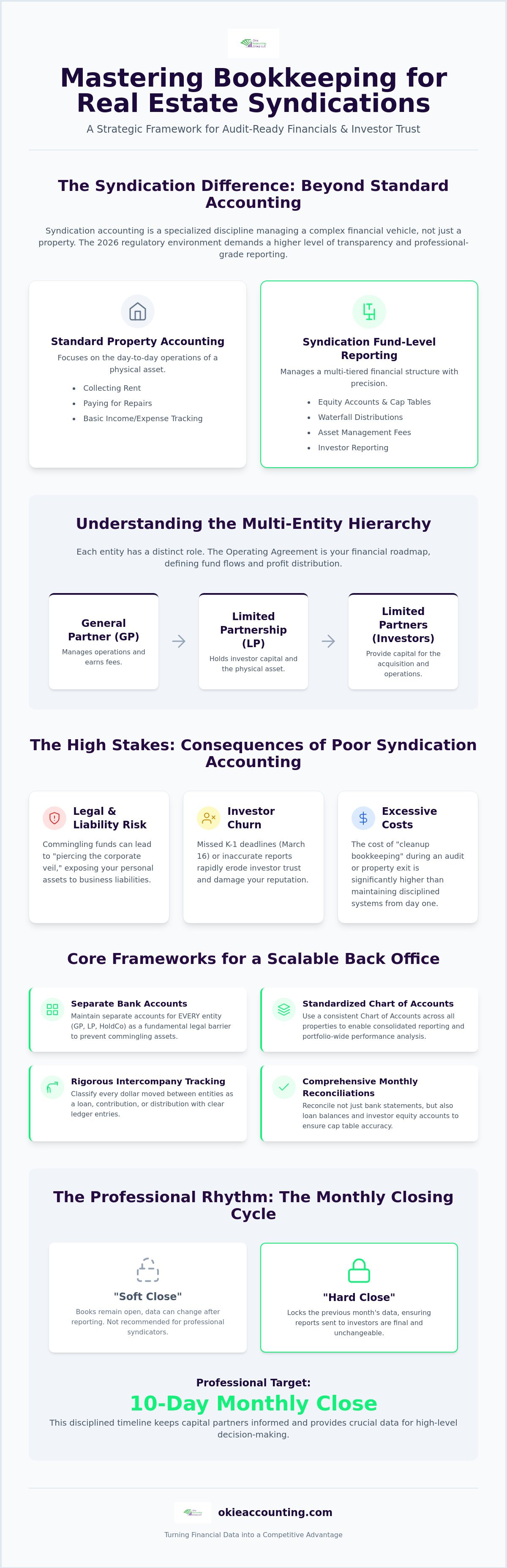
Effective bookkeeping for syndication deals is the rigorous process of managing a multi-tiered entity structure, typically involving General Partners (GP), Limited Partners (LP), and various Holding Companies (HoldCos). It's a specialized discipline that goes far beyond basic income and expense tracking. While standard property management accounting focuses on the day-to-day operations of a physical asset, like collecting rent and paying for repairs, fund-level reporting requires a sophisticated understanding of equity accounts, waterfall distributions, and asset management fees. You aren't just managing a property; you're managing a complex financial vehicle.
The 2026 regulatory environment for private placements under SEC Regulation D, specifically Rules 506(b) and 506(c), demands a higher level of financial transparency than ever before. Investors now expect real-time clarity and professional-grade reporting as a baseline. With the SEC's continued focus on modernized reporting standards, your data must be structured, accessible, and beyond reproach. Moving from "checkbook accounting" to a professional structural framework isn't just a best practice. It's a survival requirement for any syndicator looking to scale their portfolio in today's market.
Understanding the Multi-Entity Hierarchy
Accounting for the General Partner (GP) is fundamentally different from the Limited Partnership (LP). While the LP holds the investor capital and the asset, the GP manages the operations and earns specific fees. Funds flow from investors into the LP, but the Operating Agreement dictates exactly how those funds are deployed and returned. This document serves as your financial roadmap. It defines the "waterfall"—the specific order in which profits are distributed—and outlines the accounting rules that govern every entry in your ledger. If your books don't mirror the Operating Agreement, you're inviting a dispute.
The Consequences of Poor Syndication Accounting
Sloppy records create massive legal and operational risks. Commingling funds between different syndications or personal accounts can lead to "piercing the corporate veil," which exposes your personal assets to business liabilities. Beyond legal risks, poor accounting leads to investor churn. If you miss the March 16, 2026, deadline for issuing Schedule K-1s or provide inaccurate distribution reports, you'll lose the trust of your capital partners quickly. The cost of "cleanup bookkeeping" during a property exit or an audit is significantly higher than the cost of maintaining a disciplined management accounting system from day one.
Core Frameworks: Managing Fund Flow and Distributions
Establishing a structural framework for fund flow is the difference between a scalable enterprise and a legal liability. In bookkeeping for syndication deals, you must maintain separate bank accounts for every single entity. This isn't merely an organizational preference; it is a fundamental legal barrier that prevents the commingling of assets. When you move capital between a GP and an LP, you cannot simply record it as a generic transfer. You must implement a rigorous intercompany loan tracking system. Every dollar moved must be classified as either a loan, a contribution, or a distribution, with clear ledger entries that mirror the physical movement of cash.
To achieve portfolio-wide visibility, standardize your Chart of Accounts across every property. This consistency allows for consolidated reporting, enabling you to compare the performance of different assets without manual data mapping. Your reconciliation process must also expand beyond basic bank statements. Professional management accounting for syndicators requires monthly reconciliations of loan balances and investor equity accounts. If your equity balances don't match your cap table, your investor reporting is fundamentally flawed.
Tracking Investor Capital and Distributions
Tracking investor basis begins with the initial capital contribution. Your systems must record these amounts with precision to ensure future tax filings are accurate. As the deal matures, the accounting becomes more complex. You must account for preferred returns versus catch-up provisions as defined in your Operating Agreement. Automating these distribution calculations within your financial software is the best way to minimize human error. It ensures that distributions are paid correctly and that your records are ready for the March 16, 2026, partnership tax deadline.
The Monthly Closing Cycle for Syndicators
The rhythm of your back office depends on the monthly closing cycle. While some operators rely on a "soft close" where books remain open, professional syndicators utilize a "hard close." This process locks the previous month's data, ensuring that the reports sent to investors are final and unchangeable. Aim for a 10-day monthly close. This disciplined timeline keeps your capital partners informed and provides the data needed for accounting for real estate investors at a high level. If you need help establishing these foundational systems, you can schedule a discovery call to discuss a tailored framework for your portfolio.
CapEx vs. OpEx: Protecting Your Pro Forma in Value-Add Deals
The value-add phase is where many operators lose control of their financial narrative. In bookkeeping for syndication deals, the distinction between operating expenses (OpEx) and capital expenditures (CapEx) isn't just a tax preference; it's a critical component of your project's structural integrity. While standard repairs are expensed immediately, improvements that adapt an asset to a new use or restore it to a like-new condition must be capitalized. You must establish a clear capitalization threshold, often $2,500 based on the de minimis safe harbor, to ensure your pro forma accurately reflects the property's increased value rather than artificially depressing your Net Operating Income (NOI).
Managing a renovation budget requires a "Sources and Uses" of funds report that remains in constant sync with your ledger. This report tracks exactly where capital originated, whether from investor equity or debt, and how it's being deployed across the project. To maintain this clarity, you must reconcile construction draws against the general ledger in real-time. Waiting until the end of a quarter to match bank statements with contractor invoices is a recipe for budget creep. A disciplined approach ensures that your renovation remains on track and that your investors receive accurate updates on the project's health.
Job Costing for Real Estate Renovations
Breaking down costs by unit or phase allows you to monitor the specific ROI of every improvement. If you're spending $10,000 per unit on a 50-unit turn, your books should show exactly how that capital is allocated between flooring, cabinetry, and labor. This granular level of detail is a core component of our construction bookkeeping services. Accurate job costing doesn't just protect your current budget; it provides the documentation needed for future cost segregation studies that can significantly enhance investor returns.
Depreciation and Cost Segregation Readiness
Professional bookkeeping for syndication deals prioritizes cost segregation readiness from the first invoice. By tracking 5-year, 7-year, and 15-year assets during the renovation phase, you simplify the tax CPA's work at year-end. For large-scale developments, utilizing Work in Progress (WIP) accounting is vital. This method keeps renovation costs on the balance sheet until the project is placed in service, ensuring your financial statements reflect the true stage of the asset's lifecycle. This forward-thinking oversight is what separates a strategic partner from a basic data entry service.
Building Audit-Ready Systems with QuickBooks Online
QuickBooks Online (QBO) has evolved into the definitive standard for fund-level accounting, particularly after the final phase-out of QuickBooks Desktop support in May 2026. To construct an audit-ready infrastructure, you must move beyond simple ledger entries and utilize "Classes" or "Projects" to isolate property-level data within a single legal entity. This granular structure allows you to generate individual Profit & Loss statements for specific assets while maintaining a consolidated view of the entire fund. By connecting specialized property management software like AppFolio or Buildium to QBO, you establish a "Source of Truth" ledger where operational data flows directly into your professional bookkeeping for syndication deals.
Security and transparency are the twin pillars of a 2026 back office. Implementing a cloud-based document management system ensures that every invoice, closing statement, and bank reconciliation is digitally archived and linked to its corresponding transaction. To protect investor capital and maintain your reputation, you must establish rigorous internal controls. This requires a clear segregation of duties, where the individual initiating payments is never the same person reconciling the accounts. This disciplined approach mirrors the organized systems we build for our clients, providing the clarity and control necessary to satisfy sophisticated investors.
Configuring Your Chart of Accounts
Your Chart of Accounts serves as the blueprint for your financial data. For syndicators, this requires specific accounts for Investor Equity, GP Contributions, and Asset Management Fees to ensure every dollar is correctly categorized. You must also set up "Due To/Due From" accounts to manage intercompany transfers with precision, preventing the commingling of funds that often triggers audit red flags. For a deeper look at optimizing these settings, explore our guide on Mastering QuickBooks for Contractors.
Automation and Technology Stack
Modern syndication management relies on a high-performing tech stack. As of May 2026, AI-powered bank feeds are the default experience in QBO, offering automated categorization that significantly reduces manual entry errors. Integrating your accounting system with a dedicated investor portal allows for real-time dashboarding, giving your capital partners immediate access to the metrics that matter. If your current systems aren't delivering this level of insight, our QuickBooks Online Training can help you bridge the gap between basic admin and strategic oversight.
Transitioning from manual spreadsheets to an automated, audit-ready system is a critical step in scaling your syndication business. If you're ready to implement a professional structural framework that protects your profits and impresses your investors, schedule a discovery call today to begin your transformation.
Strategic Oversight: The Fractional Controller for Scaling Syndications
While basic bookkeeping for syndication deals focuses on the accurate recording of historical data, strategic oversight requires a forward-looking perspective. A bookkeeper ensures the ledger balances; a Controller ensures the financial data supports your long-term investment thesis. This distinction becomes critical as your portfolio grows and the complexity of managing multiple GP and LP entities increases. For companies with under $5 million in revenue, a fractional controller is often 70% to 85% more cost-effective than a full-time hire, providing high-level expertise without the overhead of a C-suite salary. This role transforms your accounting from a back-office necessity into a powerful investor relations tool that builds trust through transparency and precision.
A Fractional Controller manages the "Sources and Uses" report with a level of rigor that basic data entry cannot match. During investor meetings, this report serves as the definitive account of how capital was raised and exactly where it was deployed. Beyond investor reporting, this oversight is vital for maintaining lender-ready financials. Whether you are pursuing a supplemental loan or preparing for a refinance in a shifting interest rate environment, having audit-ready statements ensures you can move quickly when opportunities arise. Professional oversight provides the structural integrity lenders require, moving your firm beyond simple record-keeping into the realm of institutional-grade financial management.
Financial Forecasting and Cash Flow Management
Proactive cash flow management is the heartbeat of a successful syndication. A Controller analyzes your current position to predict distribution capabilities 6 to 12 months in advance, allowing you to manage investor expectations effectively. With the effective federal funds rate projected to approach 4% by the end of 2026, monitoring your Debt Service Coverage Ratio (DSCR) is no longer optional. Our Fractional Controller Services provide the rigorous analysis needed to ensure loan compliance and protect your asset's stability through every market cycle.
Preparing for the Exit
The quality of your books directly impacts the valuation and speed of a property sale. When it’s time to exit, potential buyers and their due diligence teams will scrutinize every ledger entry. A Controller prepares you for this moment by creating a comprehensive "Data Room" filled with pristine, audit-ready financials. This level of readiness eliminates the friction that often kills deals during the 11th hour. If you are ready to transition from basic administration to a professional structural framework, schedule a consultation for specialized syndication bookkeeping and take control of your firm's financial future.
Institutionalizing Your Financial Framework
Transitioning from fragmented spreadsheets to an institutional-grade financial infrastructure is a baseline requirement for the modern syndicator. By implementing the multi-entity frameworks and audit-ready systems we've discussed, you protect your net operating income and solidify your reputation with capital partners. Professional bookkeeping for syndication deals shouldn't be a reactive administrative chore; it's the engine that drives your ability to scale from a single asset to a diversified fund. When your ledger mirrors your operating agreement, you gain the confidence to pursue larger deals and more complex structures.
Okie Accounting Group LLC specializes in real estate investment and construction accounting, providing the specialized expertise needed to navigate the 2026 regulatory landscape. We offer proactive Fractional Controller oversight and nationwide remote support for US-based syndicators, ensuring your back office remains a strategic asset rather than a bottleneck. Our team understands the granular nuances of waterfall distributions and job costing, keeping your books ready for any audit or refinance. If you're ready to move beyond basic data entry and establish a professional foundation, Gain financial clarity for your next deal with Okie Accounting Group LLC. We're here to help you build a more stable and profitable future.
Frequently Asked Questions
How does bookkeeping for syndications differ from standard rental property accounting?
Bookkeeping for syndication deals focuses on the multi-tiered entity structure rather than just property-level operations. While standard accounting tracks rent and repairs, syndication bookkeeping manages investor equity accounts, waterfall distributions, and intercompany loan balances between the GP and LP entities. This structural framework ensures that fund-level reporting remains accurate for capital partners and regulatory compliance.
Do I need a separate QuickBooks file for every property in my syndication?
You should maintain a separate QuickBooks file for every legal entity to ensure the highest level of legal separation and audit readiness. While QuickBooks Online allows for "Classes" to track different properties within a single file, most syndicators prefer separate files for each LP to prevent commingling. This setup simplifies the closing process and ensures that each entity’s balance sheet remains distinct for tax and legal purposes.
What is the best way to track investor distributions in my books?
The most effective method for tracking distributions is utilizing dedicated equity sub-accounts for each investor class or partner. By isolating preferred returns from capital repayments in your ledger, you maintain a clear record of the basis for every participant. This level of detail is essential for accurate year-end reporting and ensures that your distribution calculations always align with the specific waterfall provisions in your Operating Agreement.
Should CapEx be tracked separately for each unit in a value-add syndication?
Tracking capital expenditures at the unit level is a best practice for value-add deals because it allows for precise ROI analysis on renovations. Implementing unit-specific job costing helps you monitor the "Sources and Uses" of your renovation budget in real-time. This granular data also simplifies future cost segregation studies, allowing a tax professional to identify 5-year and 15-year assets with much greater accuracy.
How often should I provide financial reports to my passive investors?
Most professional syndicators provide financial reports on a monthly or quarterly basis to maintain high levels of investor trust. While quarterly reporting is the minimum standard for many private placements, a disciplined 10-day monthly close provides capital partners with the transparency they expect. Providing consistent, audit-ready statements demonstrates that you have rigorous oversight over the fund’s financial health.
What are the most common bookkeeping mistakes real estate syndicators make?
The most common mistakes include commingling funds between different entities and failing to reconcile intercompany loan balances monthly. Many operators also struggle with inaccurate categorization of CapEx versus OpEx, which can artificially deflate the property's Net Operating Income. These errors often lead to expensive cleanup projects and significant delays during the property exit or refinancing phase.
Can I use my property management software as my primary accounting system?
Property management software is excellent for operational tasks but should not serve as your primary general ledger for bookkeeping for syndication deals. These systems often lack the sophisticated equity tracking and fund-level reporting capabilities required for complex ownership structures. It’s best to use property management software for rent collection and then sync that data into QuickBooks Online for a comprehensive, audit-ready financial record.
How does a Fractional Controller help with K-1 preparation?
A Fractional Controller ensures that your books are fully reconciled and structured correctly well before the March 16 partnership tax deadline. They manage the complex task of tracking investor basis and distribution history, which reduces the time and effort required for K-1 preparation. This strategic oversight ensures that the financial data is accurate, consistent, and ready for a tax CPA to finalize the partnership returns.


Comments