BRRRR Method Accounting: The Strategic Financial Framework for 2026

Updated: Nov 7
In a market where investors now claim over 33% of all single-family home sales, the difference between a growing portfolio and a stalled project isn't your ability to find deals; it's your ability to prove them to a lender. While the "One Big Beautiful Bill Act" of 2025 restored 100% bonus depreciation and provided long-term clarity, many investors still struggle to translate these benefits into a clean balance sheet. If you can't distinguish between a capital improvement and a simple repair, you're not just risking an audit; you're actively shrinking your borrowing power. Implementing a rigorous system for BRRRR method accounting is no longer optional for those who want to scale in 2026.
We understand that managing the financial transition from the rehab phase to a 75% LTV cash-out refinance can feel like a high-stakes balancing act. You need more than just basic bookkeeping; you need a structural framework that offers clear visibility into project ROI and ensures your financials are always ready for a DSCR lender's scrutiny. This guide will show you how to transform messy files into a scalable accounting system. We'll outline the exact steps to automate your cloud-based oversight and build the financial discipline required to turn individual properties into a professional enterprise.
What is BRRRR Method Accounting?
Success in real estate isn't just about the physical renovation; it's about the financial architecture behind it. BRRRR method accounting is the specialized discipline of systematically tracking cost basis, capital improvements, and operating cash flow across the lifecycle of a property. While many investors view bookkeeping as a reactive administrative chore, strategic accounting is a proactive tool. It ensures that every dollar spent during the rehab phase is correctly categorized to maximize your borrowing power during the refinance step. Without a structural financial framework, the "Repeat" stage of the BRRRR method investment framework becomes nearly impossible to execute at scale.
The distinction between transactional bookkeeping and strategic real estate accounting lies in the intent. Basic bookkeeping records what happened, but strategic accounting plans for what's next. By maintaining rigorous records from the initial purchase through the final rental phase, you protect your profit margins. This level of oversight provides the clarity needed to identify which projects are yielding the highest returns and which are draining your capital reserves. It transforms your ledger from a history book into a roadmap for growth.
Why General Bookkeeping Fails the BRRRR Investor
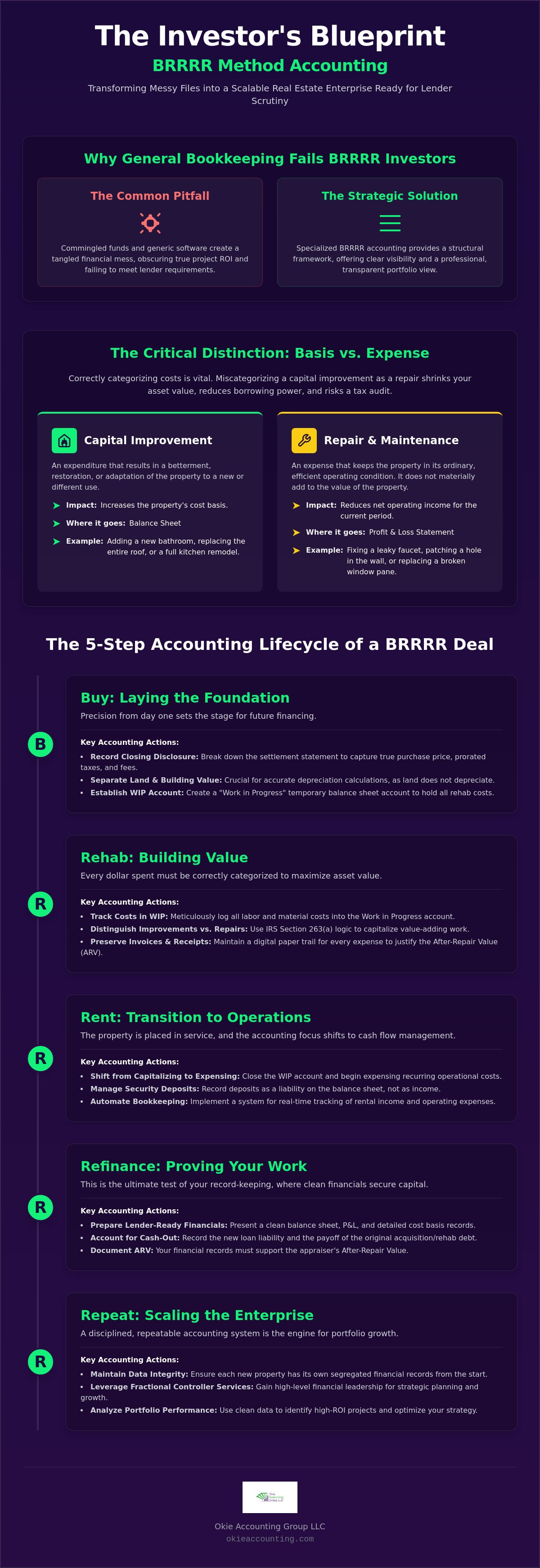
Generic "small business" accounting software often lacks the nuance required for property-based tracking. Many investors fall into the trap of commingling funds across multiple projects, which creates a tangled mess that's difficult to unwind during tax season or a loan application. Lenders require "Lender-Ready" financials, which go far beyond a simple profit and loss statement. They want to see a clean balance sheet that reflects the true value of your assets and the specific debt associated with each property. Relying on professional management accounting principles allows you to present a professional, transparent view of your portfolio's health that generalist providers often miss.
The Critical Distinction Between Basis and Expense
Understanding what belongs on the balance sheet versus what stays on the P&L is vital for your long-term success. Cost basis represents the total investment in a property, including acquisition costs and capital improvements. In contrast, operating expenses are the day-to-day costs of keeping the property running. According to IRS Section 263(a) logic, a capital improvement is any expenditure that results in a betterment, restoration, or adaptation of the property to a new or different use. Miscategorizing these items can be a costly mistake. If you record a major renovation as a repair expense, you artificially lower your net income and shrink the asset value on your balance sheet. This error can destroy your ability to secure a high-leverage refinance or trigger a grueling tax audit.
The 5-Step Accounting Lifecycle of a BRRRR Deal
Executing the five stages of a BRRRR deal requires a disciplined workflow that mirrors the physical progress of the property. While Forbes on the BRRRR investment strategy frames the method as a vehicle for generational wealth, your general ledger determines how quickly you can drive that vehicle. Each phase demands specific journal entries to maintain a lender-ready posture. Effective BRRRR method accounting ensures that your acquisition costs, renovation capital, and rental cash flows are never commingled or mischaracterized.
Tracking the Purchase and Initial Capital Outlay
Recording the "Buy" phase starts with the closing disclosure. You must break down the settlement statement to capture the true purchase price, prorated taxes, and loan origination fees. A common error is recording the entire purchase price as a single asset. Instead, you must separate land value from building value. Since land does not depreciate, failing to make this distinction leads to inaccurate tax filings and inflated asset values. During this stage, you should also establish a "Work in Progress" (WIP) account. This temporary balance sheet account holds all rehab costs until the property is placed in service, ensuring your capital expenditures are tracked with precision.
Transitioning from Rehab to Rental Operations
The moment a tenant moves in, your accounting focus shifts from asset building to operational management. You must determine the exact date to stop capitalizing rehab costs and begin expensing recurring repairs. This transition is critical for maintaining an accurate profit and loss statement. Recording the first month of rent and managing security deposits requires strict adherence to escrow rules. Security deposits are liabilities, not income; they must sit on your balance sheet until they are earned or returned. Setting up automated monthly bookkeeping at this stage protects your data integrity and provides the real-time visibility needed for the next step.
The refinance phase is the ultimate test of your record-keeping. You'll need to account for the cash-out by recording the new loan liability and the payoff of the original acquisition debt. This process resets your debt structure and reveals the actual equity you've created. Any excess cash "pulled out" is then moved into the next acquisition ledger for the "Repeat" phase. This reinvestment cycle is what allows for exponential portfolio growth. If you're ready to build a more resilient financial structure, you can schedule a discovery call to discuss your specific portfolio needs.
Mastering Job Costing During the Rehab Phase
Job costing is the mechanism that transforms a vague rehab budget into a precise financial instrument. While common advice suggests keeping a spreadsheet, those manual records often fail the scrutiny of sophisticated lenders and lack the necessary audit trails. Transitioning to a project-based approach within BRRRR method accounting allows you to see the true cost of each renovation component. This granular data is what enables you to determine if a specific upgrade, such as a premium kitchen package, actually drives the "After Repair Value" (ARV) high enough to justify the outlay. Without this level of detail, you're merely guessing at your project's profitability.
Using cloud-based systems like QuickBooks Online facilitates real-time tracking of vendor payments and material costs. When your actual ledger is aligned with your rehab budget, you can identify "budget creep" before it erodes your equity. This level of oversight ensures that your capital is working as hard as possible, providing a clear path to the refinance phase with no financial surprises. It’s about building a system where the data informs your next move rather than just recording what happened in the past.
Allocating Labor and Material Costs by Project
Precision begins with coding every invoice to its specific property or unit at the point of entry. If you're managing multiple BRRRR projects simultaneously, you must establish a protocol for shared overhead. For instance, costs for a shared storage unit or a large-scale waste removal contract should be allocated proportionally across the active projects to reflect true costs. Additionally, tracking 1099 contractor payments throughout the rehab ensures you aren't scrambling for compliance data at year-end. This proactive management protects your business from the administrative friction that often slows down scaling investors.
Avoiding the Cash Flow Trap in QuickBooks
A healthy bank balance is often a deceptive metric during an intensive rehab. You might have significant cash on hand from a construction draw, yet your unpaid vendor liabilities could exceed that balance. Utilizing cash flow forecasting is essential to predict funding gaps and ensure the project doesn't stall. In real estate rehabs, the burn rate is the average amount of capital your project consumes per week or month until it reaches the rent-ready stage. Monitoring this rate allows you to adjust your strategy before a cash crunch occurs, keeping your momentum steady as you move toward the refinance.
Strategic Financial Reporting for the Refinance Step
Refinancing is the moment of truth where your documentation meets institutional scrutiny. While basic mortgage guides focus solely on credit scores and property appraisals, commercial and DSCR lenders evaluate the financial health of your business entity. Professional BRRRR method accounting moves beyond a disorganized folder of receipts to provide a cohesive narrative of value creation. You must prove your After Repair Value (ARV) through a documented cost basis that justifies the appraiser's findings. In 2026, most lenders cap cash-out refinances for investment properties at 75% of the appraised value. Precise equity tracking is essential for maximizing your return of capital.
Your books must clearly calculate the Debt Service Coverage Ratio (DSCR). This is the primary metric for modern investment property loans. As of mid-2026, most lenders require a minimum DSCR of 1.0 to 1.20. Maintaining a ratio of 1.25 or higher typically unlocks more competitive interest rates. A professional Balance Sheet is far more persuasive than a list of expenses. It demonstrates a disciplined approach to asset management. It shows the lender that you aren't just flipping houses. You're building a stable, cash-flowing business with structural integrity. Data drives the deal.
Generating the Balance Sheet Lenders Actually Want
A lender-ready balance sheet highlights equity growth by showing capitalized improvements as assets rather than lost expenses. It must also list all liabilities and existing debt structures with absolute clarity. This level of reporting signals that your business is managed with professional rigor. Utilizing fractional controller services provides the high-level oversight and financial leadership that institutional lenders trust. This partnership ensures your statements are not only accurate but strategically presented to support your long-term borrowing goals. Lenders value clean data.
Proving ROI Through Accurate Rent-to-Value Tracking
Proving your Net Operating Income (NOI) at the property level is the most effective way to justify higher rent rolls to appraisers. By tracking every dollar of income and every cent of operating expense, you create a data-driven case for the property's performance. This transparency is crucial when you prepare for the "Repeat" step. It provides a clear proof of concept for future partners or investors. When you can demonstrate a consistent ROI through verified data, you reduce the perceived risk of your portfolio. Accurate reporting accelerates your ability to scale.
Ready to present a professional financial package to your next lender? Schedule a discovery call to build your lender-ready framework.
Scaling Your Portfolio with Fractional Controller Oversight
The transition from a solo investor to a real estate business owner is marked by a shift in focus from individual deals to portfolio-wide health. When you reach this stage, basic bookkeeping is no longer sufficient to protect your margins or guide your growth. Implementing a rigorous system for BRRRR method accounting requires high-level financial leadership. Fractional controller services provide this strategic oversight, offering the expertise of a seasoned executive at a fraction of the cost of a full-time hire. This partnership allows you to maintain structural integrity as you expand into new markets or increase your acquisition volume.
Scaling a national portfolio demands cloud-based accounting systems that offer real-time visibility across all assets. You need to know that your internal controls are robust enough to prevent fraud and minimize errors. By establishing a disciplined financial framework, you ensure long-term stability and profit protection. This isn't just about keeping the lights on; it's about building a resilient enterprise that can weather market fluctuations and capitalize on emerging opportunities with quiet confidence.
Moving from Transactional Data to Strategic Growth
Strategic growth depends on your ability to interpret financial reporting to make high-stakes decisions. A controller analyzes your data to help you decide which markets to exit and where to double down based on actual performance metrics. They manage your debt-to-equity ratios across the entire portfolio, ensuring you remain attractive to lenders for future "Repeat" cycles. Integrating accounting for real estate investors with your overall tax strategy is vital for maximizing the benefits of the "One Big Beautiful Bill Act" and other 2026 tax provisions. This level of coordination transforms your accounting from a back-office task into a powerful engine for wealth creation.
Implementing Professional Systems with Okie Accounting
We specialize in helping investors build the foundational systems required for rapid, sustainable growth. Our team provides specialized QuickBooks training for your internal staff, ensuring that every transaction is recorded with the precision a professional portfolio demands. A monthly financial review serves as a critical checkpoint to maintain the structural integrity of your files and identify potential cash flow bottlenecks before they manifest. This proactive approach alleviates the stresses of industry-specific complexities and gives you total control over your financial data.
Your portfolio deserves a strategic partner as invested in your success as you are. Don't let messy financials stall your momentum or limit your borrowing power in a competitive market. It's time to move beyond administrative tasks and build a comprehensive structural framework for your business. Gain financial clarity with Okie Accounting Group and take the next step in your investment journey with confidence.
Future-Proof Your Real Estate Enterprise
Transitioning from a collection of spreadsheets to a professional financial framework is the only way to sustain growth in a competitive real estate market. You've seen how precision in job costing and rigorous asset tracking serve as the pillars of a successful refinance. By mastering BRRRR method accounting, you move from reactive bookkeeping to proactive portfolio management. This shift ensures your financials aren't just a record of the past; they're a strategic tool for your next acquisition. You're no longer just managing properties; you're leading a scalable business with structural integrity.
Okie Accounting Group provides the specialized real estate and construction accounting knowledge your business requires. Our cloud-based national service and fractional controller expertise offer the high-level oversight needed to navigate niche-specific complexities. We focus on building foundational systems that ensure financial readiness and protect your long-term profit. When your data is organized and your reporting is transparent, you gain the quiet confidence to scale without limits.
Take control of your data today and build a portfolio that lenders trust. Gain Financial Clarity for Your Portfolio with Okie Accounting. We're ready to partner with you on your journey toward operational excellence and lasting wealth.
Frequently Asked Questions
What is the most common accounting mistake in the BRRRR method?
The most common mistake is miscategorizing capital improvements as repair expenses on the Profit and Loss statement. This error artificially lowers your net income and reduces the asset value on your Balance Sheet. When you're ready to refinance, a lower asset value can lead to a lower appraisal or reduced borrowing power. Correctly identifying these costs is a fundamental part of BRRRR method accounting that protects your equity from the start.
Should I use a separate QuickBooks file for each BRRRR property?
You don't need a separate QuickBooks file for every property. Instead, you should use the "Classes" or "Projects" feature to track each asset within a single file. This approach provides a consolidated view of your entire portfolio while allowing for property-specific reporting. It's a much more scalable solution that simplifies your administrative workflow and makes year-end tax preparation far more efficient for your accounting team.
How do I track rehab costs that I paid for out of my personal pocket?
You should record personal expenditures as an "Owner Investment" or "Equity Contribution" in your ledger. Simply create a journal entry that increases the property's cost basis while simultaneously increasing your owner equity account. This ensures your total investment is documented for the refinance step. It's vital to keep the original receipts as supporting documentation; even if the cash didn't flow through your business bank account, the value must be captured.
Does the BRRRR method require a specific chart of accounts?
Yes, a specialized chart of accounts is necessary to handle the multi-phase nature of these deals. Your setup must include "Work in Progress" accounts for rehab costs and separate entries for land versus building values. BRRRR method accounting also requires specific liability accounts for tenant security deposits and various debt structures. A generic chart of accounts won't provide the granular detail lenders expect when reviewing your entity's financial stability.
How do lenders view "sweat equity" on my financial statements?
Lenders typically view "sweat equity" with skepticism because it lacks a verifiable cash trail. Institutional and DSCR lenders base their decisions on hard costs and professional appraisals rather than the value of your personal labor. To maximize your borrowing power, you should focus on documenting every dollar of actual capital spent on improvements. Professional financial statements that show a clear cash-on-cash return are far more persuasive than claims of unrecorded labor value.
What is the difference between a repair and a capital improvement in BRRRR?
Repairs are costs that maintain a property in its current operating condition, such as fixing a leaky faucet. Capital improvements are expenditures that add significant value, prolong the property's life, or adapt it to a new use. For a BRRRR investor, replacing a furnace is a capital improvement that belongs on the balance sheet. Miscategorizing these items can lead to tax issues or a failure to prove the property's true value during the refinance.
How often should I review my financials during a BRRRR project?
You should conduct a formal financial review at least once a month to ensure data integrity. During the intensive rehab phase, a weekly check of your project's "Burn Rate" and vendor liabilities is a proactive way to avoid budget creep. Consistent monitoring allows you to identify cash flow gaps before they stall your progress. This rhythm of oversight ensures that your portfolio remains lender-ready and your strategic goals stay on track throughout the year.
Can I use QuickBooks for job costing my real estate rehabs?
QuickBooks Online is a powerful tool for job costing when it's configured correctly for real estate. By utilizing the "Projects" module, you can assign every material purchase and contractor invoice to a specific property. This setup provides immediate visibility into your ROI and allows you to compare actual costs against your initial rehab budget. It's a far more reliable and scalable system than manual spreadsheets, offering the audit trails that sophisticated lenders demand.


Comments