Budget vs Actual Reporting for Construction: A Strategic Framework for Profit Protection

Updated: 6 days ago
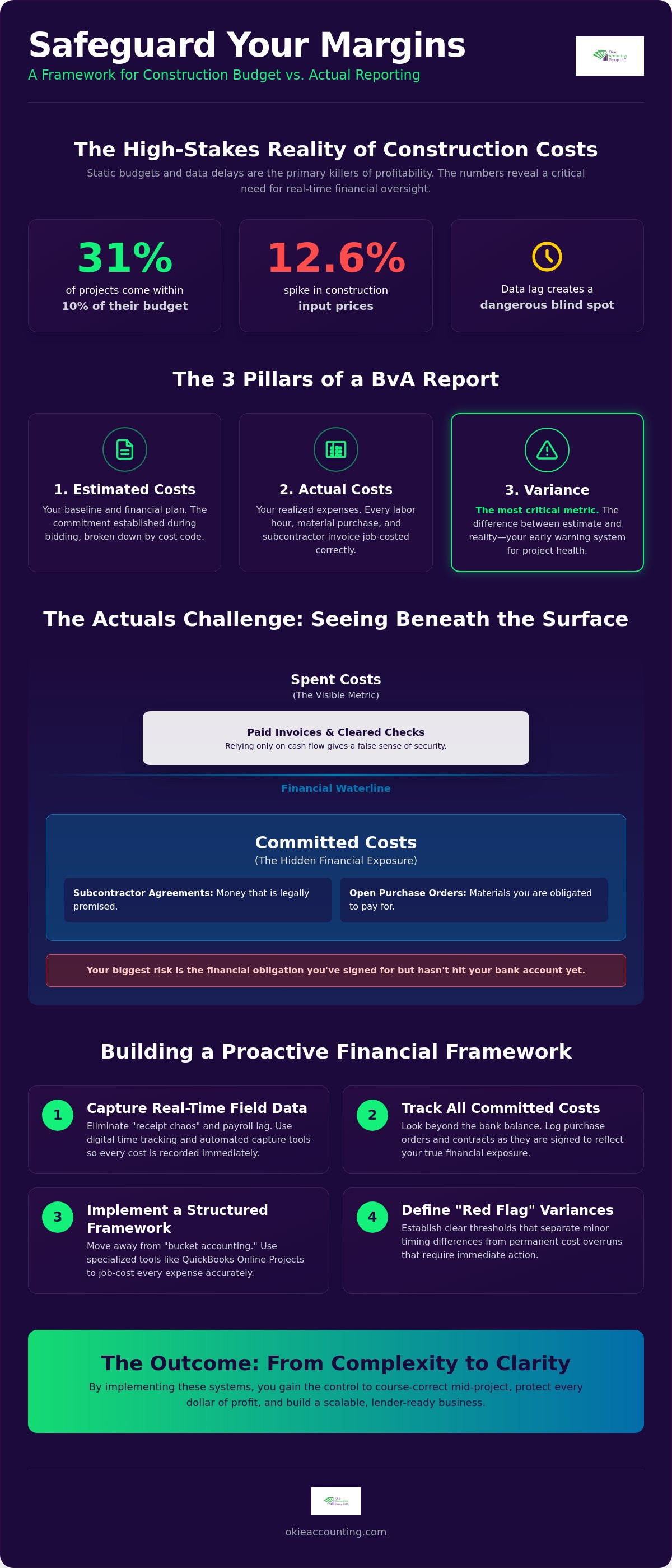
Only 31% of construction projects actually come within 10% of their original budget. When input prices are spiking by 12.6% and labor costs continue to climb, a disciplined approach to budget vs actual reporting for construction is the only way to safeguard your margins. You've likely experienced the frustration of data lag; field expenses often don't hit your office reports until it's too late to make a change. It's exhausting to manage messy files that feel more like a post-mortem than a map for success.
You can move from a state of financial complexity to one of operational clarity. This article outlines a strategic framework to transform your raw project data into a powerful reporting system that identifies cost overruns before they erode your bottom line. We'll show you how to achieve real-time visibility into project spend and build the lender-ready transparency your business needs to scale. By establishing these foundational systems, you'll gain the control necessary to course-correct mid-project and protect every dollar of your profit.
What is Budget vs Actual Reporting in Construction?
Budget vs actual reporting for construction serves as the structural bridge between estimating and execution. It's the primary instrument for financial oversight in an industry where margins are razor-thin and variables change daily. While a standard Profit and Loss statement provides a high-level view of company health, BvA reporting offers a microscopic look at individual project performance. It allows you to see exactly where your estimate met reality and where it fell short.
Static budgets often fail because they can't account for the volatility of a modern job site. In early 2026, construction input prices spiked by 12.6%, making initial bids vulnerable to rapid erosion. If your system for budget vs actual reporting for construction doesn't account for these shifts in real-time, you're managing by looking in the rearview mirror. The 2026 standard for construction accounting demands immediate data integration. This ensures that field expenses are reflected in office reports within hours, not weeks, allowing for proactive Project Cost Management that protects your bottom line.
The Core Components of a Construction BvA Report
A reliable BvA report isn't just a list of numbers; it's a diagnostic tool built on three specific pillars:
Estimated Costs: This is your baseline. It's the financial commitment established during the bidding phase, broken down by cost code.
Actual Costs: These are the realized expenses. This includes every labor hour, material purchase, and subcontractor invoice accurately attributed to the project.
Variance: This is the most critical metric. It represents the numerical and percentage difference between your estimate and reality, serving as an early warning system for project health.
Why Generalist Bookkeeping Fails the BvA Test
Generalist bookkeeping often relies on "bucket accounting." In this flawed system, costs are dumped into broad categories rather than being job-costed to specific projects. This lack of precision makes it impossible to identify which job is profitable and which is failing. When costs aren't mapped correctly to a construction-specific Chart of Accounts, you encounter "ghost variances." These are misleading reports that show a project is under budget simply because expenses were miscategorized or delayed. Professional financial reporting requires a structured framework that mirrors the complexity of your builds, ensuring that every dollar spent is accounted for in the right place at the right time.
The Actuals Challenge: Capturing Hidden Costs and Committed Spend
Most contractors manage their projects by watching their bank balance, yet cash flow is a deceptive metric for project health. Your bank balance only reflects what has cleared; it doesn't account for the legal obligations you've already signed. This is why effective budget vs actual reporting for construction must distinguish between "Spent" and "Committed" costs. If you only track paid invoices, you're operating with a dangerous blind spot that masks your true financial exposure.
Reporting lag is the primary killer of construction profitability. When there's a two-week gap between a field expense and its appearance in your ledger, you lose the ability to intervene. This delay is often compounded by unrecorded change orders. If your team performs extra work without updating the budget, your variance reports will show an artificial overrun that distorts your data. To gain true depth, you must also incorporate a Work in Progress (WIP) layer. This ensures that your revenue recognition aligns with your actual costs, revealing whether you are truly profitable or simply over-billed.
Tracking Committed Costs Before They Hit the Ledger
Committed costs include your signed subcontractor agreements and open purchase orders. These represent money that is "gone" even if the check hasn't been cut. Effective Construction Project Cost Control Techniques require looking beyond what has been paid to what is already promised. Relying on a lagging bank balance leads to a false sense of security that can vanish the moment a major vendor invoice hits. Building the right Construction Bookkeeping Services infrastructure allows you to track these commitments in real-time, providing a more accurate forecast of your remaining budget.
The Role of Real-Time Field Data
Your actuals column is only as reliable as the data feeding it. Daily logs and digital time tracking are essential for capturing labor costs as they occur, rather than waiting for payroll processing. Many firms struggle with "receipt chaos," where material expenses are lost in a glove box for weeks. Utilizing automated capture tools removes this friction, ensuring that every bolt and board is accounted for immediately. Data is only as good as the frequency of its entry. If your current reports feel like they're missing the full picture, you can schedule a discovery call to discuss building a more robust framework. By closing the gap between field activity and office reporting, you protect your margins from the silent erosion of unrecorded spend.
Interpreting Variances: Turning Data into Strategic Profit Protection
Data without interpretation is simply noise. To protect your margins, you must establish a "Red Flag" threshold for your project variances. In the current market, any line item showing a variance of more than 5% to 10% should trigger an immediate investigation. This threshold serves as a disciplined boundary; it prevents minor slippage from compounding into a project-killing overrun. When you implement a structured framework for budget vs actual reporting for construction, you stop looking at the past and start managing the future.
Many firm owners argue they're too busy to analyze every line item on a report. However, BvA reporting actually saves time by acting as a filter. You don't need to scrutinize the 90% of the project that's on track; you only need to focus on the 10% that's flagging. It's also vital to differentiate between timing variances and permanent overruns. A timing variance occurs when you pay for materials earlier than planned, such as bulk-buying lumber at $629 per 1,000 board feet to beat a price hike. A permanent overrun happens when you've simply used more labor or material than the estimate allowed. One is a cash flow shift; the other is a direct hit to your profit.
Favorable vs. Unfavorable Variances
A "favorable" variance isn't always a cause for celebration. If a report shows you're 20% under budget on a specific phase, it may indicate that materials haven't been ordered or labor hasn't been properly tracked. This "slippage" can mask upcoming costs and lead to a false sense of security. Understanding these nuances is a core component of Construction Cash Flow Management. By identifying why a variance exists, you can refine your future bidding and ensure your next estimate is rooted in historical reality rather than hopeful guesswork.
The Root Cause Analysis Framework
When a red flag appears, you must determine if the variance stems from a price fluctuation or a quantity error. With copper prices up 32% year-over-year in 2026, a price variance is often outside your control, but a quantity variance usually points to waste, theft, or subcontractor scope creep. Scope creep occurs when a sub performs work outside their original agreement without a signed change order, slowly eroding your fee. Budget vs actual reporting for construction acts as an early warning system for project managers to catch these issues before the job closes out. By isolating the root cause, you can apply a structured remedy that preserves the structural integrity of your project's finances.
Building a Scalable Reporting System in QuickBooks Online
While many generalist providers treat QuickBooks Online as a simple digital checkbook, professional contractors require a more rigorous structural framework. The foundation of effective budget vs actual reporting for construction begins with a clean, construction-specific Chart of Accounts. Without this specialized setup, your data remains trapped in broad categories that offer no insight into project-level health. By mapping your General Ledger (GL) to specific cost codes, you create a system where every transaction has a clear and logical home.
The "Projects" feature in QuickBooks Online is the engine that drives granular tracking. This tool allows you to isolate income and expenses by job, providing a live dashboard for each build. It's no longer enough to wait for year-end; you need to see your financial status today. As of May 22, 2026, QuickBooks retired the "Classic View" for reports in favor of the "Modern View," offering more dynamic ways to visualize your variances. If your current setup feels disorganized, our QuickBooks Setup & Training services can help you build the structural integrity your firm requires.
Configuring QuickBooks for Job Costing
Mapping GL accounts to specific service and material items is the only way to ensure your BvA reports are accurate. This process involves linking your products and services to the correct expense accounts so that data flows automatically from an invoice to your project dashboard. For firms managing multiple builds, consistent class or location tracking is essential for overhead allocation. You can find a deeper dive into these technical requirements in our guide on Mastering QuickBooks for Contractors. When your software is configured correctly, it stops being a burden and starts being a strategic asset.
Automating the Flow of Actuals
Manual data entry is a significant point of failure for many firms. Integrating bank feeds and third-party receipt management tools ensures that "actuals" are captured without human error. The path from receipt upload to BvA line item follows a disciplined sequence: a field supervisor captures the image, the software extracts the cost code data, and the transaction is reconciled against your bank feed to update your project dashboard in real-time. This automation allows you to establish a weekly "Data Lock," where all field expenses are reconciled and reviewed. If you are ready to move from messy files to a disciplined reporting system, schedule a discovery call to discuss your firm's specific needs. Professional configuration is the difference between a report that is merely paper and one that protects your profit.
Leveraging Fractional Controller Oversight for Growth
A report is just paper without professional interpretation. While software captures the data, it takes a disciplined eye to understand the implications of that data on your firm's long-term health. Moving from basic administrative tasks to a comprehensive structural financial framework is what separates a job-to-job contractor from a scalable construction enterprise. This is where the transition from a service provider to a strategic partner becomes essential for your business's success.
Effective budget vs actual reporting for construction requires more than just software configuration; it demands consistent, high-level analysis. A Fractional Controller acts as a strategic mentor, guiding you through the complexities of project-based financial tracking. We don't just hand you a PDF. We help you navigate the "why" behind the numbers, ensuring you have the clarity needed to make data-driven choices that protect your structural integrity. Our goal is to provide the proactive stance you need to maintain control over your financial data.
The Monthly Financial Review Process
A controller identifies trends that a standard bookkeeper might miss. For instance, they might notice that material slippage is occurring across multiple projects, signaling a systemic estimating error rather than a one-off field issue. This level of insight is vital for preparing lender-ready financials. Whether you're seeking a line of credit or increased bonding capacity, having organized, professional reports is non-negotiable. Our Management Accounting services provide the rigorous management required to satisfy external stakeholders and protect your firm's long-term stability.
Transitioning from Chaos to Clarity
The psychological relief of knowing exactly where every project stands cannot be overstated. When you move away from messy files and data lag, you gain the confidence to pursue larger, more complex builds. You're no longer guessing if you're profitable; you have the evidence. This clarity allows you to use your budget vs actual reporting for construction as a foundation for long-term strategic planning and equity building. By focusing on foundational systems rather than reactive fire-fighting, you position your firm for sustainable growth. Okie Accounting serves as the strategic partner you need to turn operational details into a roadmap for success. Investing in professional financial oversight is the most reliable way to ensure your project margins remain protected as you scale.
Building Your Firm's Financial Foundation
Protecting your profit margins requires a shift from retroactive bookkeeping to a disciplined structural framework. By implementing a robust system for budget vs actual reporting for construction, you gain the visibility needed to identify slippage before it compromises your project's integrity. We've explored how capturing committed costs and utilizing the specialized features of QuickBooks Online creates a live map of your firm's health. This isn't just about administrative accuracy; it's about building long-term stability and financial readiness.
As a QuickBooks Certified ProAdvisor specialized in Construction and Real Estate, we provide nationwide remote financial leadership that bridges the gap between field data and strategic growth. You don't have to navigate these complex variables alone. Our team acts as a strategic mentor, ensuring your financial systems are built for scale and lender-ready transparency. We're invested in your success as much as you are.
Gain financial clarity with specialized controller services for your construction firm.
Your firm's growth depends on the strength of your systems, and we're here to ensure that foundation remains unbreakable.
Frequently Asked Questions
How often should a construction company run a budget vs actual report?
You should run these reports weekly for active project management and monthly for high-level strategic reviews. Weekly reviews allow project managers to catch labor overruns or material spikes before they compound into major losses. Monthly reviews with a fractional controller ensure your company-wide overhead is properly covered by your project margins. This disciplined rhythm establishes the structural integrity needed to manage multiple builds simultaneously without losing control of your data.
What is the most common cause of budget variance in construction?
Unrecorded change orders and scope creep are the most frequent drivers of unfavorable variances. When field teams perform extra work without a signed agreement, your actual costs climb while your budget remains static. This creates a "ghost variance" that erodes your profit margins. Implementing a strict data lock ensures these changes are documented immediately in your budget vs actual reporting for construction, keeping your financial map accurate and reliable.
Can QuickBooks Online handle complex construction BvA reporting?
QuickBooks Online is highly capable of handling complex reporting when configured with a construction-specific Chart of Accounts. By utilizing the "Projects" feature, you can track income and expenses at the granular job level. This setup provides the visibility needed to monitor specific cost codes and labor hours in real-time. It's a scalable solution that replaces messy spreadsheets with a structured financial framework, provided the software is professionally configured for job costing.
How do committed costs affect my budget vs actual analysis?
Committed costs represent signed subcontractor agreements and open purchase orders that haven't been paid yet. If you ignore these, your budget vs actual reporting for construction will look healthier than it actually is, creating a false sense of security. Including committed costs reveals your true financial exposure. It ensures you don't over-commit cash that is already technically "spent" through legal obligations, protecting your firm from sudden liquidity crises.
What is the difference between a project budget and a company-wide budget?
A project budget focuses on the direct costs of a specific build, such as labor, materials, and subcontractors. In contrast, a company-wide budget accounts for your firm's total revenue and fixed overhead like rent, insurance, and administrative salaries. While project budgets protect your individual job margins, the company budget ensures those margins are high enough to sustain the entire business's long-term health and stability.
Do I need a controller to understand my budget vs actual reports?
While software generates the numbers, a fractional controller provides the expert interpretation required for strategic growth. They distinguish between simple timing differences and permanent profit loss that requires immediate course correction. A controller turns raw data into a strategic roadmap, helping you identify systemic bidding errors or subcontractor performance issues. This level of oversight moves your firm from basic administrative tasks to a position of professional discipline.
How can BvA reporting help with my construction cash flow?
BvA reporting improves cash flow by identifying exactly when and where money is leaving your firm compared to your initial plan. It helps you differentiate between a timing variance, like an early bulk material purchase, and a permanent overrun that won't be recovered. This clarity allows for more accurate cash flow forecasting. You'll know if a cash dip is a temporary operational hurdle or a signal to adjust your project's financial strategy.


Comments