Budgeting Guide for Hiring Commercial Roofing Contractors

Updated: 6 days ago
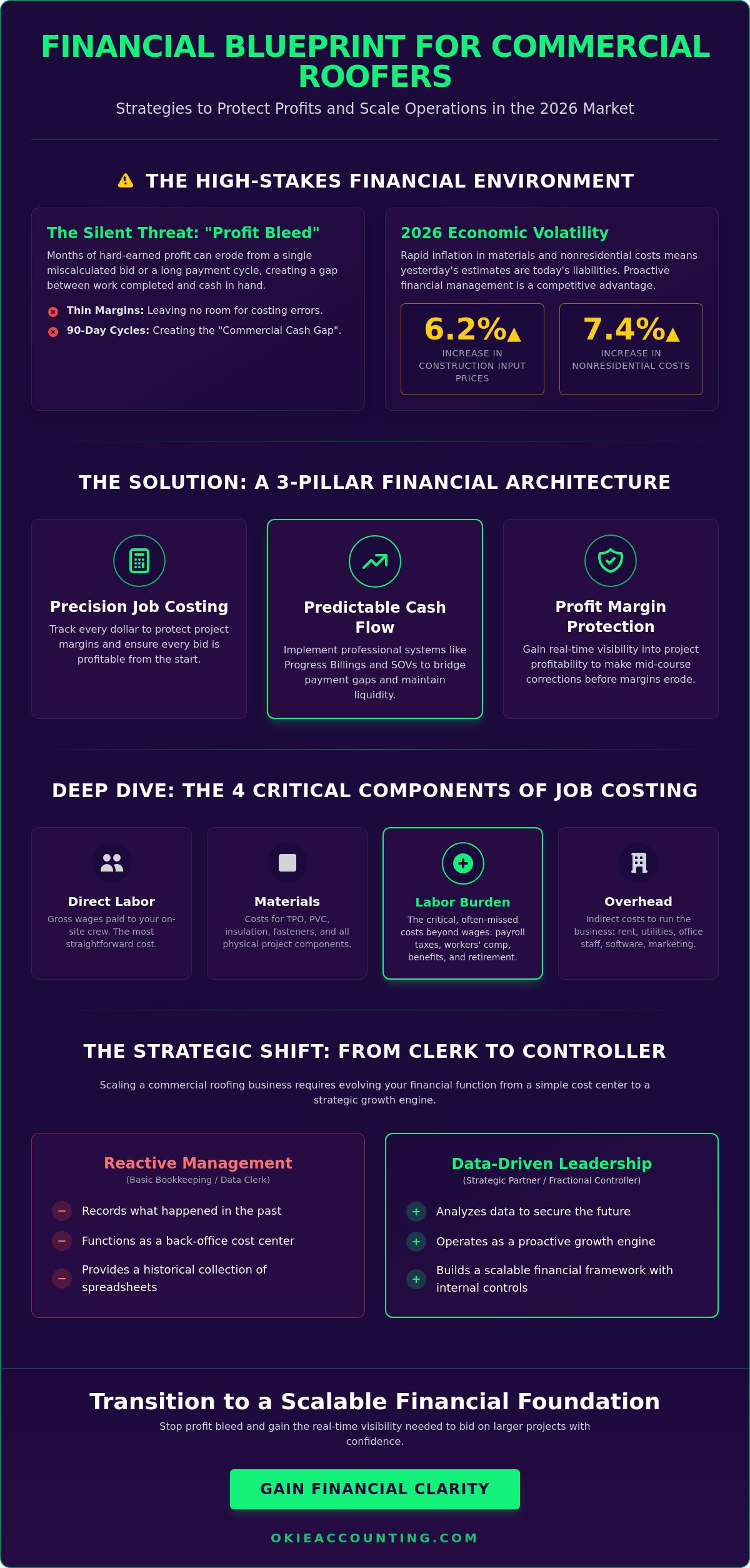
For commercial roofing contractors, the structural integrity of your financial framework is just as vital to your company's longevity as the membranes you install on a high-rise. You likely understand that a single miscalculated bid or a 90-day payment cycle can quickly erode months of hard-earned profit. With construction input prices having already climbed 6.2% in early 2026, the margin for error in your job costing is thinner than ever before.
It's frustrating to watch "profit bleed" happen when you're doing the work but the numbers don't align at the end of the quarter. We understand these complexities and believe your financial systems should support your growth, not hinder it. In this guide, you'll learn how to build a rock-solid financial foundation that protects your profit margins and scales your commercial roofing operations with confidence.
We will walk through the essential steps to achieve predictable cash flow and real-time visibility into project profitability. By implementing professional systems like strategic cash flow forecasting and specialized financial reporting, you can transition from reactive management to disciplined, data-driven leadership that supports national growth.
Key Takeaways
Discover why specialized job costing is the only way to account for labor burden and material volatility to protect your project margins.
Learn to bridge the "Commercial Cash Gap" by mastering progress billings and a professional Schedule of Values (SOV) structure.
Establish a scalable back-office using a customized QuickBooks Online setup designed specifically for the unique mechanics of the roofing industry.
Understand how successful commercial roofing contractors use fractional controller services to implement internal controls and gain strategic oversight.
Shift from basic administrative tracking to a comprehensive financial framework that supports national growth and long-term business stability.
The Financial Architecture of Successful Commercial Roofing Contractors
The financial ecosystem of the commercial roofing industry in 2026 requires more than just keeping track of receipts and invoices. For commercial roofing contractors, the financial architecture of the business must be as robust as the systems they install on industrial properties. It's a complex environment where high-volume contracts meet long-tail payment cycles. This unique dynamic demands a foundation built on three specific pillars: precision in job costing, predictability in cash flow, and protection of profit margins. Without these, even the most technically skilled firms risk "profit bleed" that can dismantle years of growth. You need a system that offers clarity rather than just a collection of spreadsheets.
Most contractors start with a simple data entry clerk, but scaling requires a transition to a strategic financial partner. A clerk records what happened in the past; a strategic partner analyzes that data to secure your future. This shift turns your accounting department from a back-office cost center into a growth engine. It's about building an organized system that mirrors the precision of your field operations. When your financial data is structured correctly, you gain the ability to make proactive choices rather than reactive guesses.
Beyond Basic Bookkeeping: Why Specialization Matters
Generalist accounting often fails because it treats every business like a simple retail shop. In the roofing world, you deal with multi-phase builds, retainage, and complex labor burdens. Utilizing specialized construction bookkeeping services is essential for tracking these variables accurately. When your records align with recognized construction accounting principles, you gain a level of clarity that basic data entry cannot provide. You move from simply recording history to actively managing your project lifecycle. This transition provides the quiet confidence needed to bid on larger, more lucrative projects without the fear of financial overextension.
The 2026 Economic Landscape for Commercial Roofers
The economic environment in 2026 has introduced new layers of complexity for commercial roofing contractors. Construction input prices rose by 6.2% in the first four months of the year alone, with nonresidential costs up 7.4%. This acceleration means that yesterday's estimates are often obsolete by the time the crew arrives on site. Material volatility for products like TPO and PVC requires a proactive approach to financial readiness. Successful firms treat their financial systems as a competitive advantage. They don't just react to price hikes. They have the real-time visibility to pivot their procurement and labor allocations before their margins disappear. This level of structural integrity in your back-office ensures you remain stable while competitors struggle with cash flow strain.
Precision Job Costing: Protecting Profit Margins on Large-Scale Projects
For commercial roofing contractors, the difference between a profitable year and a financial crisis often comes down to the accuracy of a single bid. Precise job costing is the practice of tracking every dollar associated with a specific project to ensure the final invoice covers more than just the bills. In a competitive bidding environment, the temptation to "sharpen the pencil" can lead to dangerous under-costing. If you don't account for every variable, you aren't just winning a job; you're inheriting a liability. A robust job costing framework breaks expenses into four critical categories: direct labor, materials, burden, and overhead. Without this granular visibility, "profit bleed" becomes an invisible tax on your operations.
Real-time data is your most effective tool for mid-project corrections. When you track actual expenditures against your initial estimates weekly, you can identify red flags before they become catastrophes. If labor hours are exceeding the budget in week two, you can investigate site conditions or crew efficiency immediately. This proactive oversight allows you to protect your margins while the project is still active. If you're ready to move beyond basic tracking and implement a system that offers true financial clarity, you can schedule a discovery call to discuss your specific operational needs.
Tracking Labor and Burden with Accuracy
Calculating the true cost of labor involves much more than simply multiplying an hourly rate by the number of workers on a roof. You must account for the labor burden, which includes payroll taxes, workers' compensation insurance, health benefits, and retirement contributions. Labor burden represents the total cost of an employee beyond their gross wages, encompassing every secondary expense that directly reduces the net ROI of a project if left uncalculated. Utilizing specialized construction payroll services ensures these numbers are captured accurately for every job. This level of precision prevents the common mistake of assuming a project is profitable based on gross wages alone while the burden quietly erodes your bottom line.
Material Volatility and Profit Protection
Material costs in 2026 remain highly volatile, making historical pricing a dangerous baseline for new bids. For example, TPO installation costs currently range from $5.00 to $14.50 per square foot, while metal systems can climb as high as $25.00 per square foot. By utilizing professional construction cost estimation methods, you can ensure that your bids are grounded in current market reality rather than optimism. Integrating purchase orders directly with your job costing system prevents unallocated spending and ensures every roll of membrane or bucket of adhesive is tied to a specific contract. This data-driven approach allows you to refine future bids based on actual historical performance, creating a cycle of continuous improvement in your bidding accuracy.
Navigating the Commercial Cash Flow Gap and Progress Billings
The "Commercial Cash Gap" is the silent killer of otherwise healthy roofing firms. It represents the period between paying for high-cost inputs, such as specialized labor and bulk materials, and the moment the client's check actually clears your account. For commercial roofing contractors, this gap can span 60 to 90 days, or even longer on large-scale government or industrial projects. It creates a dangerous paradox where a company appears profitable on its income statement but remains insolvent at the bank. Managing this gap requires a disciplined approach to progress billings and a deep understanding of your project's financial lifecycle.
Strategic oversight is the only way to fund growth without relying on high-interest debt. By implementing rigorous construction cash flow management, you can ensure that your operations remain liquid throughout the build. This involves more than just sending invoices. It requires a structured methodology for tracking every dollar as it moves through the contract. When you master these mechanics, you gain the ability to scale your operations using your own capital rather than external financing.
The Art of the Schedule of Values
A Schedule of Values (SOV) is your most powerful tool for maintaining liquidity. It is a detailed statement that allocates the total contract sum to various portions of the work. You should structure your SOV to ensure you aren't "financing" the client's project with your own cash. This means accurately front-loading mobilization costs and material deliveries so that your initial billings cover your heaviest expenses. Negotiating favorable payment terms during the contract phase is equally critical. Clear, accurate billings that follow the agreed-upon SOV lead to faster approval cycles and more predictable payment dates. If your documentation is messy, your cash flow will be too.
Managing Retainage and Liquidity
Retainage is a standard practice where owners withhold 5% to 10% of every payment until the project is fully closed out. For many commercial roofing contractors, this retainage represents the entirety of their net profit on a job. If you don't track these funds with precision, they can easily get lost in the administrative shuffle of a long project. Maintaining operational liquidity while waiting for final close-outs requires constant monitoring. We recommend using cash flow forecasting to predict "dry spells" months before they happen. This foresight allows you to adjust your spending or labor allocations, ensuring that you have the stability to reach the finish line without a cash crunch.
Building a Scalable Accounting Infrastructure with QuickBooks Online
Modern commercial roofing contractors can no longer rely on fragmented paper trails or legacy desktop software. As of late 2024, Intuit stopped selling standard Desktop versions to new customers, effectively making QuickBooks Online the foundational tool for any firm looking to scale. While the "Plus" plan saw a price increase to $110 per month on May 1, 2026, the value of a cloud-based ecosystem far outweighs the subscription cost. It provides a centralized hub where job costing, payroll, and financial reporting converge. This infrastructure allows your back-office to mirror the organization of your most successful job sites.
A generic accounting setup is a liability for a specialized trade. You need a customized Chart of Accounts designed specifically for the unique mechanics of roofing. This means structuring your accounts to track specific material categories, labor burdens, and equipment costs. When your accounting system speaks the language of your field operations, you eliminate the need for manual translation. This alignment ensures that every dollar spent on a TPO installation or a metal roof restoration is captured in the right bucket. If your current system feels like a maze of unallocated expenses, it's time to schedule a discovery call to discuss a structured setup.
Automating Data Entry to Focus on Strategy
Manual data entry is a significant source of administrative overhead and human error. By implementing automated bank feeds and receipt capture, your crews can submit expenses directly from the field. This real-time data flow reduces the burden on your office staff and provides immediate visibility into project spending. Professional QuickBooks training for contractors empowers your internal team to manage these tools effectively. For those needing hands-on implementation support, our software training services provide the roadmap for a seamless transition to a cloud-based framework.
Real-Time Reporting for Decision Makers
Financial reports are only useful if they're accurate and timely. You should be reviewing essential monthly reports, including P&L by Job, AR aging, and Work-in-Progress (WIP) reports. The WIP report serves as an early warning system for project profitability by highlighting over-billings and under-billings before they impact your year-end balance sheet. Interpreting these dashboards allows you to make data-driven hiring and equipment decisions with quiet confidence. You'll know exactly when you have the liquidity to invest in a new crane or expand your sales force into a new territory.
Strategic Financial Oversight: Why Commercial Roofers Need Fractional Controller Support
While a bookkeeper focuses on the accurate recording of past transactions, a fractional controller provides the forward-looking strategy necessary for sustained growth. For commercial roofing contractors, this distinction is critical. You aren't just managing a checkbook; you're managing complex Work-in-Progress (WIP) schedules, prevailing wage requirements, and multi-state compliance. A bookkeeper ensures your data is entered, but a controller ensures that data is used to drive profit. Transitioning to this level of oversight allows you to stop working in the administrative weeds and start working on the strategic expansion of your firm.
Implementing fractional controller services acts as a catalyst for national scaling. It provides the high-level financial structural integrity required to handle larger contracts and more complex operational demands. This partnership transforms your back-office from a reactive recording department into a proactive command center. You gain a mentor who understands the specific mechanics of the roofing market and can help you navigate the nuances of high-stakes financial management. With this support, commercial roofing contractors can move from a state of constant financial stress to one of quiet confidence.
Internal Controls and Profit Protection
Profit leakage often happens in the gaps between field operations and office reporting. Without rigorous internal controls, financial waste can go unnoticed for months. A controller establishes the checks and balances needed to prevent fraud and minimize unallocated spending. By utilizing professional controller services, you can secure your firm against common industry risks:
Payroll Auditing: Ensuring accurate labor burden allocation and compliance with Davis-Bacon or local prevailing wage laws.
Purchasing Oversight: Verifying that every material order is tied to a specific job and authorized purchase order.
Overhead Analysis: Identifying and eliminating expenses that don't contribute directly to project ROI.
The Strategic Mentor: Navigating Growth
As you scale, your financial needs become more sophisticated. You may need to prepare your firm for increased bonding capacity, commercial lending, or even an eventual acquisition. A fractional controller assists with long-term financial forecasting and budgeting, providing the data-driven roadmap your business needs to stay stable during rapid growth. They provide the clarity required to move from a state of operational complexity to one of disciplined control. If you're ready to evaluate the structural health of your firm, we invite you to start with a comprehensive management accounting review to identify your next steps for growth.
Building Your Financial Structural Integrity
Commercial roofing contractors face a unique set of financial pressures that generalist providers simply don't understand. From navigating the 60 to 90 day cash gap to calculating accurate labor burden, your back office requires the same level of expertise as your field crews. We've explored how a robust financial architecture, driven by precision job costing and real time reporting, protects your margins from economic volatility. Transitioning from a reactive administrative model to a strategic partnership allows you to focus on national growth with total clarity.
At Okie Accounting Group LLC, we provide nationwide service for US based contractors with specialized expertise in the construction and real estate sectors. We don't just enter data; we build the foundational systems that secure your firm's long term health. This strategic partnership approach ensures you have a disciplined mentor in your corner to help navigate complex growth phases. You deserve a partner who is as invested in your profitability as you are. To begin constructing your rock solid financial foundation, gain financial clarity with Okie Accounting Group LLC’s specialized services for contractors. Your path to predictable cash flow and scalable operations starts with a single data driven choice.
Frequently Asked Questions
How is accounting for commercial roofing different from residential roofing?
Commercial accounting centers on long term project management rather than high volume, short term transactions. While residential jobs often conclude with immediate payment, commercial roofing contractors must manage multi-month progress billings and legal retainage requirements. This shift requires specialized tracking of Work-in-Progress (WIP) and a deep understanding of the "Commercial Cash Gap" to maintain operational liquidity during long payment cycles.
What are the most important financial KPIs for a roofing contractor to track?
You should focus on Gross Profit Margin per Job, Labor Burden percentage, and Days Sales Outstanding (DSO). Tracking your WIP report is also essential as it serves as an early warning system for under billings. These metrics provide a clear picture of project level health and help you identify which types of commercial contracts are actually contributing to your bottom line.
How do I handle progress billings and retainage in QuickBooks?
The most effective method is to enable the "Progress Invoicing" feature within QuickBooks Online. You should also create a specific "Retainage Receivable" asset account to track the 5% to 10% withheld by the owner. This structure ensures your revenue is recognized correctly while keeping the withheld funds visible on your balance sheet until the final project close out.
Can a fractional controller help my roofing company get bonded?
Yes, a fractional controller is instrumental in securing or increasing your bonding capacity. Bonding agents require highly accurate, GAAP compliant financial statements and detailed WIP reports to assess your firm's risk. A controller provides the strategic oversight needed to ensure your records meet these rigorous standards, giving the surety company confidence in your financial structural integrity.
What is the best way to track labor burden for roofing crews?
The most accurate method is to calculate your total secondary employment costs, such as payroll taxes and workers' comp insurance, as a percentage of gross wages. You then apply this percentage as an additional cost to every hour worked on a project. This ensures that your job costing reflects the true expense of your field crews rather than just their base hourly rate.
How often should a commercial roofing contractor review their financial statements?
We recommend a comprehensive monthly review of your P&L and Balance Sheet with a strategic partner. However, critical operational reports like AR aging and job level profitability should be monitored weekly. This frequency allows you to catch material price spikes or labor overruns in real time, providing the opportunity to make mid project corrections before they impact your net profit.
What are the risks of using a generalist bookkeeper for my roofing business?
A generalist often lacks the technical knowledge to manage construction specific complexities like retainage and job costing. This oversight frequently leads to inaccurate reporting where profit margins appear higher than they actually are. Without niche expertise, you risk significant "profit bleed" and a lack of financial readiness when navigating the volatile material costs typical of the 2026 market.


Comments