Building a Financial Model for a Construction Company: A 2026 Strategic Guide

Updated: Nov 7
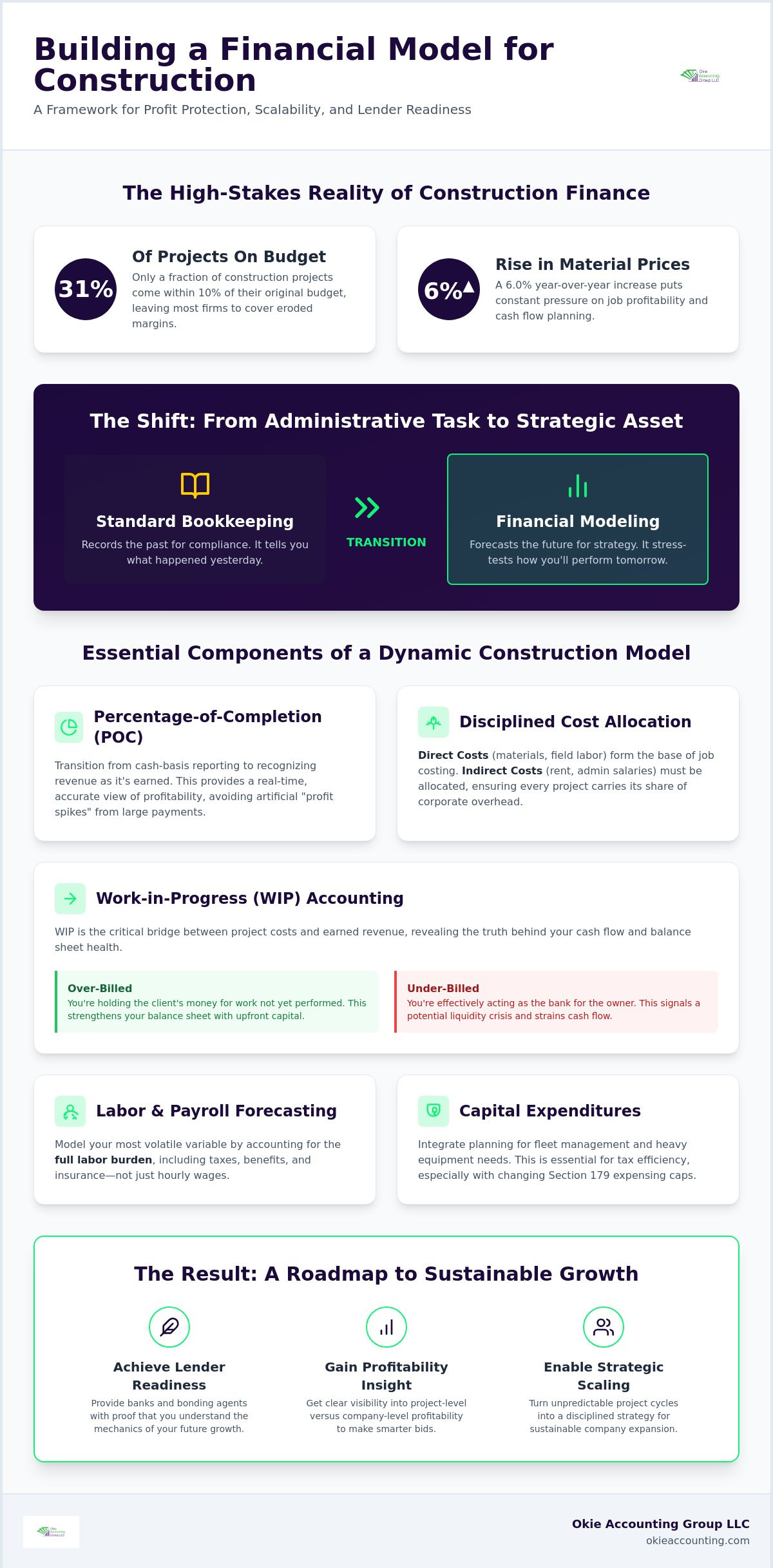
Only 31% of construction projects come within 10% of their original budget. This reality often leaves firms scrambling to cover eroded margins while managing the complexities of a 2026 market defined by a 6.0% year-over-year increase in material prices. In this environment, building a financial model for a construction company is the only way to maintain structural integrity. You've likely felt the sting of a project delay that ripples through your cash flow, making it nearly impossible to plan for the next quarter with any certainty.
We agree that managing complex WIP accounting while trying to secure competitive lending rates is a heavy lift. It's difficult to focus on growth when your financial data feels like a liability rather than a strategic asset. This guide promises to teach you how to construct a robust financial model that bridges the gap between daily job costing and long-term strategic growth. We will outline how to move from basic administrative tracking to a sophisticated framework that offers clear visibility into project-level versus company-level profitability, ensuring your firm is finally lender-ready.
Why Construction Financial Modeling Requires a Specialized Structural Framework
A construction financial model is far more than a static spreadsheet or a historical record. It's a dynamic structural framework designed to predict future performance by synthesizing current project data with corporate-level overhead. Most generic business models fail because they assume a linear relationship between sales and expenses. In our industry, revenue is tied to specific job milestones, and profit is often locked in retention for months after a project ends. Building a financial model for a construction company requires a shift in perspective. You aren't just tracking expenses; you're building a system for profit protection and long-term health.
The Difference Between Bookkeeping and Financial Modeling
Standard bookkeeping is focused on the past. It records what happened yesterday to ensure compliance. While essential, it doesn't provide the clarity needed to scale. Financial modeling looks forward. It uses your general ledger as a foundational source of truth to stress-test future scenarios. If material costs for steel rise another 12.5 percent, how does that affect your total liquidity? A model answers these questions. Moving from administrative bookkeeping to strategic oversight through Fractional Controller Services allows you to interpret these data points rather than just filing them away. Accurate modeling requires a clean Chart of Accounts, ensuring that every dollar spent is categorized to provide meaningful insights into where your money is actually going.
Addressing Construction-Specific Complexities
Construction accounting is notoriously lumpy. Large inflows from progress billings are often followed by significant outflows for labor and materials. A standard P&L statement rarely tells the whole story because it doesn't account for the timing of cash. A specialized project finance model integrates these variables to prevent cash flow dry spells. You must also account for retainage, which can represent your entire profit margin on a job. Without a model that factors in these delayed payments, your balance sheet might look healthy while your actual liquidity is dangerously low.
Establishing this framework is the first step toward achieving lender-ready financials. Banks and bonding agents don't just want to see that you've been profitable in the past. They want proof that you understand the mechanics of your future growth. By building a financial model for a construction company, you create a roadmap that turns unpredictable project cycles into a disciplined strategy for sustainable expansion. This structure ensures that your daily job costing isn't just an administrative chore but a vital component of your company's long-term strategic growth.
The Essential Components of a Dynamic Construction Model
Building a financial model for a construction company requires moving beyond simple cash-basis accounting. For accurate 2026 forecasting, you must adopt the percentage-of-completion (POC) method for revenue recognition. This approach recognizes income based on the actual progress of a project, providing a more realistic view of your earned revenue compared to when checks finally clear. It prevents the artificial "profit spikes" that often occur when large progress billings are received, ensuring your model reflects operational reality rather than just bank balances.
Your model's architecture must distinguish clearly between direct costs and indirect costs. Direct costs, such as materials and field labor, are the foundation of job costing. Indirect costs, including project management and safety equipment, must be factored in through disciplined overhead allocation. Every project should carry its proportional weight of the firm's fixed costs, such as rent, insurance, and administrative salaries. Without this allocation, you might find that high-revenue projects are actually draining your corporate cash reserves. Additionally, your model should account for capital expenditures, such as fleet management and heavy equipment needs. Since Section 179 expensing caps are indexed for inflation starting in 2026, planning these purchases within your model is essential for tax efficiency. You may find that Spreadsheet Aids for Financial Planning provides a helpful starting point for structuring these complex cash flow variables.
The Role of WIP (Work in Progress) Accounting
WIP is the most critical calculation in your financial model because it exposes the truth behind your cash flow. Work in Progress (WIP) serves as the bridge between project costs and earned revenue. It reveals whether you are over-billed, which means you're holding the client's money for work not yet performed, or under-billed, which means you're effectively acting as a bank for the owner. Over-billings can strengthen your balance sheet by providing upfront capital, but under-billings signal a potential liquidity crisis. A robust model tracks these figures monthly to ensure your balance sheet remains strong and lender-ready.
Labor and Payroll Forecasting
Labor is typically your most volatile variable. Your model must account for the full labor burden, which includes taxes, benefits, and workers' compensation, rather than just hourly wages. Integrating data from construction payroll services allows you to project these costs with precision. With construction wages increasing by 4% to 11% in high-demand markets as of early 2026, failing to model specialized compliance and labor costs can quickly erode your estimated margins. If you're unsure if your current system captures these nuances, consider scheduling a discovery call to discuss building a more resilient framework.
Integrating Job Costing with Financial Forecasting
The most sophisticated financial model is only as strong as the data feeding it. In the construction industry, this requires a disciplined feedback loop between project managers in the field and the accounting department in the office. While PMs track daily progress and material usage, the accounting team provides the actual cost data that validates those estimates. When these two worlds are siloed, the financial model becomes a work of fiction. Building a financial model for a construction company necessitates a shared language, typically rooted in a clean, project-centric Chart of Accounts that mirrors your estimating categories.
A primary goal of this integration is the early identification of margin fade. With 2026 gross markup targets for builders and remodelers hovering around 29 to 30 percent, even a slight slip in labor productivity or a spike in material costs can erase your profit. By comparing your model's projections to real-time actuals, you can spot these trends before they become irreversible. To ensure your projections remain grounded in industry reality, many firms utilize tools like the Construction Financial Benchmarker to compare their performance against regional and sector-specific peers. This external validation ensures your internal model isn't operating in a vacuum.
Setting Up Your QuickBooks for Success
QuickBooks Online serves as the engine for your financial model, but it must be configured specifically for the needs of a contractor. Utilizing the "Projects" and "Classes" features allows you to segment data effectively, ensuring that every expense is tied to a specific job and cost code. This level of granularity is what transforms a basic general ledger into a strategic tool. However, the software is only as good as the person operating it. Investing in professional QuickBooks training for contractors ensures your team understands how to enter data that supports, rather than confuses, your financial model. Monthly reconciliations are non-negotiable; your model must be updated with "clean" data every 30 days to maintain its predictive power.
Forecasting Cash Flow at the Project Level
Every project has a unique "cash curve" that dictates when money leaves the business and when it returns. Mobilization often requires significant upfront cash for materials like copper or steel, which have seen year-over-year price increases of 32 percent and 12.5 percent respectively as of early 2026. Your model should include "what-if" scenarios for project delays or unexpected change orders to see how they impact your total liquidity. For a deeper dive into the tactical side of this process, see our guide on construction cash flow management. This level of foresight allows you to anticipate cash crunches months in advance, giving you the lead time needed to adjust project schedules or secure short-term financing.
Building Your Model: A Step-by-Step Implementation Guide
Building a financial model for a construction company requires more than just filling out a template. It demands a rigorous analysis of your firm's specific operational DNA. While competitors often suggest long-term ten-year projections, a strategic 2026 model should focus on a three-year horizon with deep granularity in the first twelve months. This bottom-up approach ensures that your projections are rooted in the reality of your current project backlog and the specific market pressures of the current year.
Step 1-3: Data, Assumptions, and Logic
Start by gathering the last 24 months of financial data to establish a baseline. You must normalize this data by removing one-off anomalies, such as a unique insurance settlement or a non-recurring equipment sale, to ensure your starting point isn't skewed. Once your history is clean, define your assumptions based on 2026 market realities. With construction material prices reaching a Producer Price Index high of 354.9 in March 2026, a 6.0 percent year-over-year increase, your model cannot rely on outdated costs. You should also factor in labor wage increases, which are tracking between 4 percent and 11 percent in specialized trades. Build your revenue schedule by mapping out your current backlog and layering in a conservative estimate for new contract awards based on your historical win rate.
Step 4-5: Testing and Refinement
A static model is a fragile model. You must perform a sensitivity analysis to understand how external shocks impact your bottom line. Ask yourself: what happens to my liquidity if copper prices, which rose 32 percent year-over-year in early 2026, spike another 15 percent? This stress-testing allows you to build a "margin of safety" into your bids. Additionally, your model should track your Debt Service Coverage Ratio (DSCR) to ensure ongoing lender compliance. With bank financing rates for construction loans currently ranging from 6.5 percent to 9.5 percent, maintaining a strong DSCR is vital for securing the capital needed for equipment or expansion. Finally, create an executive dashboard that highlights key performance indicators like your WIP-adjusted gross margin and days sales outstanding (DSO).
Validating this model against each month's actual results is the only way to ensure it remains a reliable tool for strategic growth. If your internal team lacks the capacity to maintain this level of oversight, our Fractional Controller Services can provide the high-level interpretation needed to turn these numbers into actionable choices. If you are ready to move from basic spreadsheets to a comprehensive structural framework, book a discovery call today to discuss your firm's specific modeling needs.
Beyond the Spreadsheet: Leveraging Strategic Financial Oversight
Building a financial model for a construction company is a significant achievement, but it's only half the battle. A model is a dynamic framework, not a static monument. Without regular interpretation and adjustment, even the most complex spreadsheet becomes obsolete as soon as the next project delay occurs or material prices shift. The real value lies in the transition from simply "having a model" to practicing active management accounting. This requires a disciplined monthly rhythm where you compare your projected "cash curve" against actual bank balances and project progress.
This oversight ensures that your structural integrity remains intact as you take on larger contracts. When you treat your model as a living document, you gain the ability to spot trends before they impact your liquidity. You can see exactly how a change in your billing cycle or a shift in labor productivity ripples through your corporate overhead. This proactive stance allows you to make data-driven choices instead of relying on gut feelings, transforming your financial department from a cost center into a strategic partner in your firm's success.
The Fractional Controller Advantage
Many contractors find that while their bookkeeper is excellent at recording the past, they lack the specialized expertise to forecast the future. This is where fractional controller services become a force multiplier for scaling firms. A controller bridges the gap between raw data and the CEO’s vision. They use model insights to negotiate better terms with vendors or lenders, using your proven Debt Service Coverage Ratio as leverage. By presenting a professional, lender-ready framework, you signal to external partners that your business is managed with the same rigor you apply to your job sites.
Preparing for Scalable Growth
Strategic growth requires precise timing. Your model should be the primary tool you use to determine when to hire new crews or invest in heavy equipment. By stress-testing your cash flow, you can identify the exact moment your backlog supports a new salary or a lease payment without straining your working capital. This level of planning is essential for firms looking to build a structural framework that supports multi-state operations or complex infrastructure projects. If you're ready to move beyond the spreadsheet, contact Okie Accounting Group for a professional financial infrastructure audit to ensure your systems are ready for the challenges of 2026.
Securing Your Firm's Structural Integrity Through Strategic Modeling
Building a financial model for a construction company is the definitive shift from reactive bookkeeping to proactive leadership. By integrating percentage-of-completion revenue recognition with disciplined oversight, you create a system that protects your margins against unpredictable market shifts. This structural framework isn't just about managing the next project cycle. It's about building a lender-ready business that can scale with confidence and precision.
At Okie Accounting Group, we provide more than just reports. We offer a proactive, mentor-style partnership that delivers cloud-based financial clarity tailored specifically to the mechanics of the construction and real estate sectors. Our experts are invested in your success, turning raw data into the strategic roadmaps you need to lead your firm effectively.
Ready to build a strategic financial framework for your firm? Explore our Fractional Controller Services.
Take control of your financial data today to build the resilient, profitable future your hard work deserves.
Frequently Asked Questions
What is the most important KPI in a construction financial model?
WIP-adjusted gross margin is the most critical metric for any contractor. It provides a clear picture of true profitability by neutralizing the timing differences between progress billings and actual work performed. Without this adjustment, your model might show a false profit spike due to a large mobilization payment, leading to poor strategic choices. Tracking this KPI ensures you're managing actual earnings rather than just bank balances.
How often should I update my construction financial model?
You should update your model every 30 days. Building a financial model for a construction company requires a steady flow of clean data from your monthly reconciliations to remain accurate. This monthly rhythm allows you to identify margin fade early and adjust your bidding strategy before a project reaches closeout. Regular updates transform your model from a static plan into a dynamic management tool.
Can I use a standard Excel template for construction modeling?
Standard business templates usually fail because they don't account for the unique mechanics of the industry. Construction requires specific logic for retainage, labor burden, and percentage-of-completion revenue recognition. A generic template misses these nuances, which can lead to dangerous inaccuracies in your cash flow projections. A specialized framework ensures your projections aren't distorted by assumptions that don't apply to project-based work.
What is the difference between a project model and a corporate model?
A project model focuses on the economic feasibility and specific cash curve of a single job site. In contrast, a corporate model is a broader structural framework that aggregates all active projects while layering in fixed overhead and debt service. You need both to understand how individual site performance impacts your overall corporate liquidity. This dual-level visibility is essential for making informed decisions about equipment purchases or hiring.
How does WIP accounting affect my financial projections?
WIP accounting is the foundation of accurate projections because it identifies over-billings and under-billings. If you're under-billed, your model will show that you're effectively using corporate cash to fund the owner's project. This visibility is vital for maintaining a strong balance sheet while building a financial model for a construction company. It acts as the bridge between project costs and earned revenue, preventing distorted profit reports.
Why do lenders ask for a financial model instead of just a tax return?
Lenders prioritize models because they show your future capacity to repay debt based on your current backlog. While tax returns verify past performance, a forward-looking model demonstrates that you understand the impact of 2026 interest rates and material volatility. It proves to a bank that you have the disciplined systems in place to manage growth sustainably. This level of readiness often leads to more favorable lending terms.
How do I account for retainage in my cash flow forecast?
Retainage must be modeled as a separate, delayed cash inflow rather than part of your monthly progress billing receipts. You should map its collection to the expected project closeout date based on your historical timelines. Failing to isolate retainage can lead to a liquidity crisis, as it often represents your entire profit margin on a job. Accurate forecasting ensures you have enough working capital to reach the finish line.
What software is best for building a construction financial model in 2026?
QuickBooks Online remains the industry standard for the underlying data engine, but it works best when paired with specialized forecasting tools. For 2026, many contractors use custom-built spreadsheets or advanced reporting software to handle complex "what-if" scenarios. The key isn't just the software itself, but ensuring your system supports a project-centric Chart of Accounts. This setup allows for the granular tracking required for high-level strategic oversight.


Comments