Calculating Overhead and Profit for Construction Jobs: The 2026 Strategic Guide

Updated: Nov 7
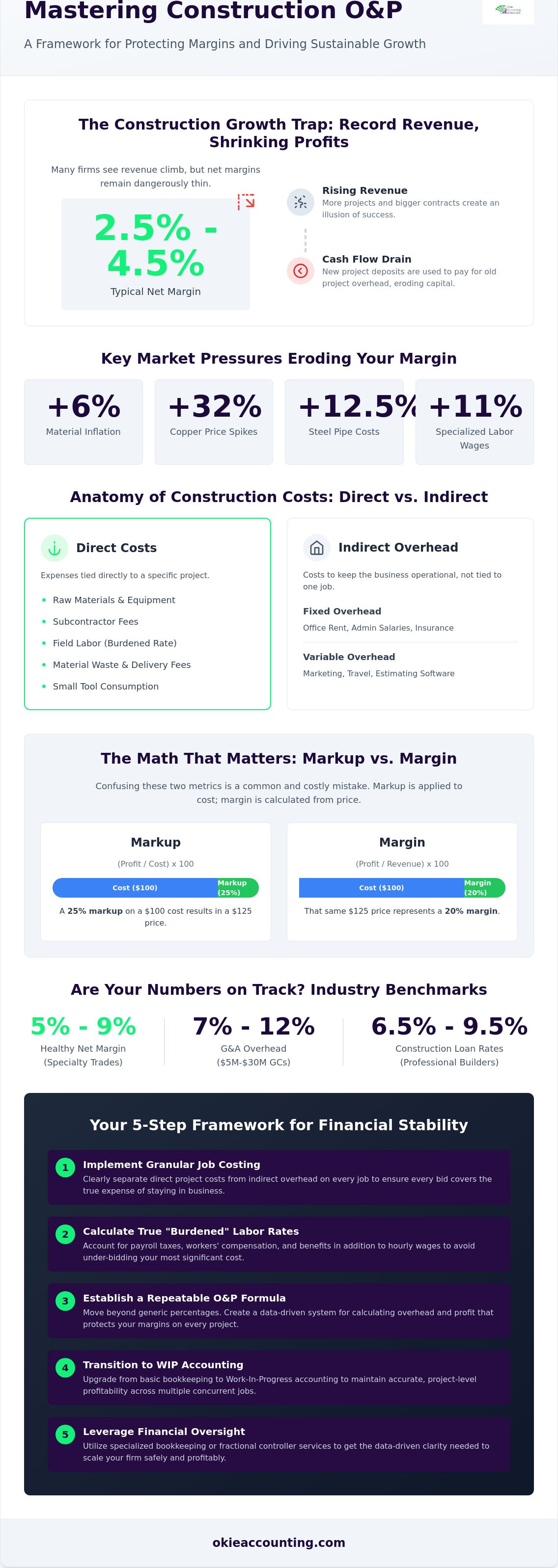
Many construction firms are currently seeing record revenue, yet their net margins are stuck between a razor-thin 2.5% and 4.5%. It's frustrating to manage a high-growth project only to realize that indirect costs and 6% material inflation have quietly eroded your take-home pay. You aren't alone if you feel that calculating overhead and profit for construction jobs has become a moving target in a market defined by 32% spikes in copper prices and shifting labor demands.
We're here to change that narrative. This guide provides the structural framework you need to master your O&P, allowing you to protect your margins and build a foundation for long-term financial stability. We'll move beyond generic percentages to establish a repeatable formula for project-level profitability, clear up the confusion between markup and margin, and implement a scalable system for job costing that works as hard as your crew does. By the end, you'll have the data-driven clarity required to transition from a reactive service provider to a strategic, profitable partner.
The Strategic Importance of Accurate Overhead and Profit in 2026
Overhead and profit (O&P) represent the structural foundation of any construction enterprise. While direct costs cover the physical build, O&P ensures the business itself remains operational and solvent. In 2026, the complexity of calculating overhead and profit for construction jobs has intensified due to record-high material costs. With the Producer Price Index for construction materials hitting 354.9 in March 2026, a 6% increase from the previous year, "guessing" at these figures is no longer a viable option. You need a system that accounts for every dollar spent outside the job site.
Many contractors fall into the "growth trap." They see revenue climbing and assume success follows. However, without a disciplined approach to business overhead, more work often results in less available cash. This occurs when indirect costs are under-allocated, forcing the business to use new project deposits to pay for old project expenses. It's a cycle that feels like progress but is actually a slow erosion of your company's capital.
Precise O&P tracking also builds a lender-ready financial infrastructure. With construction loan rates for professional builders currently ranging from 6.5% to 9.5%, banks demand granular data. Demonstrating a clear understanding of your margins proves you can handle debt service while maintaining a healthy net margin, which for most specialty trades sits between 5% and 9% according to 2025 industry data. This financial readiness is what separates a stable firm from one that is vulnerable to market shifts.
Why O&P is the Difference Between Survival and Scaling
Scaling requires more than just a bigger crew or more equipment. It demands a psychological shift from being a technician to becoming a strategic business owner. When you accurately price indirect costs during rapid growth, you protect your personal liability and ensure business longevity. Without this, you aren't scaling; you're just increasing your risk profile. Accurate O&P calculations act as a buffer against the 32% spikes in copper prices or the 12.5% rise in steel pipe costs reported in May 2026. Transitioning to fractional controller services can provide the high-level oversight needed to manage these volatile variables effectively.
The Consequences of Improper O&P Allocation
Improper allocation creates dangerous cash flow bottlenecks where your current projects are essentially funding your company's past overhead. This cycle prevents you from investing in new equipment or securing top-tier labor, which saw wage increases up to 11% in specialized trades this year. If your margins are too thin, you can't weather a single delayed payment or a minor material price hike. Profit protection is a proactive management strategy that ensures every dollar of revenue contributes to the structural integrity of the business rather than just covering historical debts.
Identifying the Components: Direct Costs vs. Indirect Overhead
To master calculating overhead and profit for construction jobs, you must draw a hard line between what belongs to a specific project and what belongs to the business entity. Many firms struggle here, often misclassifying indirect expenses that end up eating into the net margin. Using a reliable framework for understanding and calculating business costs ensures your financial reporting acts as a strategic map rather than just a list of expenses. For general contractors with $5M to $30M in annual revenue, G&A overhead typically falls between 7% and 12% of revenue. If your numbers sit outside this range, it's often a sign of miscategorized data.
The Anatomy of Construction Overhead
Overhead is generally divided into fixed and variable categories. Fixed overhead includes the non-negotiable costs of staying in business, such as office rent, administrative salaries, and annual insurance premiums. These remain constant regardless of your project volume. Variable overhead, however, fluctuates based on your activity level. This includes marketing spend, travel expenses, and specialized estimating software. Your construction bookkeeping services must separate these clearly to provide an accurate picture of your "break-even" point. If these costs are lumped together, you'll never truly know how much volume you need to cover your base operations.
Direct Costs: The Foundation of Your Estimate
Direct costs are the "hard" expenses specifically tied to a single project. This includes raw materials, specialized subcontractor fees, and field labor. However, a common mistake is only tracking hourly wages. You must account for the "burdened" labor rate, which includes payroll taxes, workers' compensation, and benefits. Additionally, don't overlook material waste, delivery fees, and small tool consumption. Your QuickBooks for contractors setup should reflect these granular categories to ensure your job costing is precise. When your data entry is this detailed, you can spot profit erosion before it becomes a crisis.
One of the most frequent errors in the industry is the "General Requirements" trap. These are project-specific overhead costs like temporary fencing, site cleanup, and portable toilets. While they aren't "hard" materials like lumber or steel, they are direct costs of the project. If you bury these in your company-wide overhead, you're artificially inflating your business expenses and under-pricing your bids. It's a costly mistake that obscures project-level profitability. If you're ready to refine these categories for better clarity, consider scheduling a brief discovery call to discuss your current structural framework.
The Math of Profitability: Calculating Markup vs. Margin
One of the most dangerous myths in the industry is that markup and margin are interchangeable. They aren't. Confusing these two mathematical concepts is a leading cause of profit erosion, especially when calculating overhead and profit for construction jobs in a high-inflation environment. While markup is a percentage added to your costs to determine a sales price, margin is the percentage of the final sales price that remains as profit. If you don't understand the difference, you might believe you're securing a 20% profit when you're actually barely covering your bills.
To establish a resilient financial structure, you must also calculate your firm's "Breakeven Multiplier." This figure tells you exactly how much you need to charge for every dollar of direct cost just to cover your company's overhead. For example, if your total annual overhead is $200,000 and your direct costs are $1,000,000, your overhead is 20% of your costs. However, to find your multiplier, you divide your total revenue by your direct costs. This structural tool ensures that no project is bid without a clear understanding of its contribution to the firm's long-term health.
Markup vs. Margin: The Math That Saves Your Business
Visualizing the difference is the best way to protect your bottom line. If a project has a direct cost of $100 and you apply a 20% markup, your contract price is $120. Your profit is $20. However, your margin is $20 divided by $120, which is only 16.7%. If your overhead is 18%, you've just lost money on that job despite "marking it up" by 20%. This is why margin-based pricing is the standard for high-level management accounting. Using a markup table can help your team quickly identify the correct markup percentage needed to reach a specific target net margin.
Determining Your Target Profit Percentage
Setting your target profit requires benchmarking against current industry data. As of 2025, the median net margin for general contractors ranges from 2.5% to 4.5%, while specialty trades typically see 5% to 9%. However, these averages don't account for the unique risks of 2026. With material cost inflation rising at a 6% year-over-year rate and labor wages increasing by up to 11% in some markets, your contingency margins must be robust. Complex projects with higher volatility require a higher profit target to offset potential "slippage" in your estimates. You aren't just pricing for today's costs; you're pricing for the financial readiness of your business tomorrow.
Implementing a Structural Framework for Accurate Job Costing
Calculating overhead and profit for construction jobs is not a static exercise performed once at the start of a project. It's a dynamic process that requires a disciplined structural framework to track costs as they occur. Many firms struggle because they rely on "shoebox accounting," where receipts and invoices are processed weeks late. This delay makes it impossible to see if a project is actually meeting its O&P targets until it's too late to course-correct. By implementing WIP accounting for construction, you gain the ability to recognize revenue and expenses in the period they're earned, providing a clear view of your financial health at any given moment.
Closing the loop is the final, critical step in this framework. This involves a rigorous comparison of your estimated O&P against the actual results once a project is completed. If your estimated 20% margin consistently results in a 14% actual margin, your system has identified a leak. This could be due to uncaptured indirect costs, field labor inefficiencies, or material waste. Without this feedback loop, you're destined to repeat the same bidding errors. A specialized partner can help you build the systems necessary to capture this data accurately, ensuring that your future bids are based on reality rather than hope.
Setting Up Your QuickBooks for Success
Your QuickBooks Online file must be more than a digital checkbook; it should be the engine of your project oversight. This starts with a Chart of Accounts specifically configured to separate direct job costs from company-wide indirect expenses. Professional software training for your office and field teams is essential to ensure data is entered correctly from the start. When you automate expense tracking through integrated apps, you reduce the risk of manual data entry errors that can skew your profitability reports. This level of organization creates the predictability required for sustainable growth.
The Power of Real-Time Job Costing Reports
Real-time data allows you to generate a Profit and Loss report by job at the click of a button. These reports are the primary tool for identifying which types of work are your most and least profitable. You might discover that while data center projects offer high revenue, your margins are actually healthier on smaller specialized trade contracts. This insight allows you to "no-bid" work that doesn't meet your profit criteria. Because construction cash flow management relies on the accuracy of these reports, maintaining them is a non-negotiable part of your financial readiness. If you're ready to move beyond basic bookkeeping and build a professional financial infrastructure, book a discovery call with our team today.
Scaling Your Firm with Strategic Financial Oversight
Reaching the $1M revenue milestone is a significant achievement, but it often marks the point where basic administrative record-keeping begins to fail. At this stage, your business complexity outpaces simple data entry. You aren't just managing a single site; you're balancing multiple project lifecycles, complex labor burdens, and tiered subcontractor payments. Calculating overhead and profit for construction jobs must transition from a back-office task to a core component of your proactive financial leadership. This shift is what allows you to build a "Profit First" culture where margins are protected by design rather than by accident.
Scaling safely requires more than just more volume; it requires structural integrity. This is where fractional controller services become essential. A controller doesn't just record what happened; they forecast what is coming. They analyze your Work-in-Progress (WIP) reports to ensure your billing is ahead of your costs and that your overhead isn't quietly siphoning away your project gains. By moving from reactive bookkeeping to strategic oversight, you ensure that every new contract strengthens your firm's financial readiness.
When to Hire a Fractional Controller
Many owners realize they've outgrown their bookkeeper when their profit remains flat despite rising revenue. If you're managing multiple entities, navigating complex WIP adjustments, or struggling to find the cash for new equipment, it's time for a higher level of expertise. A controller interprets your financial data to drive scaling decisions, such as when to expand your fleet or hire additional project managers. The ROI of professional oversight is found in the elimination of "bad data" that leads to under-priced bids and missed opportunities. It's the difference between guessing your way through growth and engineering your success.
Next Steps: Securing Your Financial Future
To begin your transition toward strategic oversight, start with these actionable steps:
Conduct a retrospective audit of your last three completed projects to compare estimated vs. actual O&P.
Refine your calculating overhead and profit for construction jobs formulas based on actual indirect costs from the previous quarter.
Implement a monthly financial review meeting to analyze project-level profitability and cash flow forecasts.
Partnering with a specialist who understands the unique mechanics of the construction lifecycle provides the clarity you need to lead with confidence. When your financial systems are as robust as your builds, scaling becomes a predictable, manageable process rather than a source of stress. You've built the business; now it's time to build the framework that protects it.
Building Your Foundation for 2026 and Beyond
Many contractors spend years building impressive structures only to realize their own business lacks a solid financial foundation. Mastering the mechanics of calculating overhead and profit for construction jobs is the single most effective way to insulate your firm from market volatility. By distinguishing between direct costs and indirect overhead while accurately applying margin-based pricing, you move beyond simple administrative tasks. You begin to lead with data-driven confidence.
True profit protection requires a structural framework that evolves as your firm scales. Whether you’re refining your job costing systems or preparing to scale past the $1M revenue mark, professional oversight makes all the difference. We provide specialized construction bookkeeping and fractional controller strategic oversight through our nationwide US cloud-based support. This partnership ensures your financial data is as precise as your project blueprints. When your systems are organized and your margins are protected, you can focus on the craftsmanship that built your reputation.
If you’re ready to stop guessing and start growing with clarity, we’re here to help you bridge the gap between complex data and operational control. Gain financial clarity with Okie Accounting’s specialized construction services. Your business deserves the same level of discipline you bring to every project. Let’s build a more profitable future together.
Frequently Asked Questions
What is the typical overhead and profit margin for a general contractor in 2026?
Typical overhead for general contractors in 2026 ranges from 7% to 12% of revenue, with median net margins sitting between 2.5% and 4.5%. Specialty trades often see higher net margins, typically between 5% and 9% according to 2025 industry data. These figures vary based on your sector and project complexity, so relying on outdated averages can lead to significant financial risk in the current market.
How do I calculate overhead for a construction project if I have multiple jobs running?
You calculate overhead for multiple projects by determining your company-wide "Breakeven Multiplier." This involves dividing your total annual overhead by your total direct costs. By applying this multiplier to every project's direct costs, you ensure each job contributes its fair share toward business expenses. This method provides a more accurate structural framework than simple guessing.
Is markup the same as profit in construction accounting?
No, markup and profit are mathematically distinct concepts. Markup is the percentage you add to your direct costs to set a price, while profit margin is the percentage of the final contract price that remains after all costs are paid. Confusing these two is a common error when calculating overhead and profit for construction jobs, often resulting in lower than expected take-home pay.
Can I include my own salary in the overhead calculation?
Yes, you should include your administrative salary in your overhead calculations. If you spend time in the field, that portion of your pay should be tracked as a direct labor cost for that specific project. Correctly allocating your time ensures your overhead percentage reflects the true cost of running your business operations and protects your personal financial health.
What is a "10 and 10" in construction, and is it still viable?
"10 and 10" refers to adding 10% for overhead and 10% for profit to a bid. While it was once an industry standard, it's rarely viable in 2026. With material inflation at 6% and labor wages rising up to 11% in some markets, this flat rate often fails to cover actual indirect costs and leaves zero room for error or business growth.
How do I track overhead and profit using QuickBooks Online?
You track O&P in QuickBooks Online by using the "Projects" feature and configuring a specialized Chart of Accounts. By assigning every expense to either a specific project or a company-wide overhead account, you can generate real-time Profit and Loss reports by job. This level of detail is the foundation of accurate data entry and professional financial reporting.
What happens if my actual overhead exceeds my estimated overhead on a job?
When actual overhead exceeds your estimate, your net profit margin is directly reduced. This "slippage" indicates that your bidding formula doesn't reflect your current business reality or that indirect costs aren't being captured correctly. You should perform a retrospective audit to identify if the error stems from uncaptured expenses or inefficiencies in your field operations.
Why do I need a fractional controller if I already have a bookkeeper?
A bookkeeper focuses on recording historical transactions, while a fractional controller provides strategic financial leadership and forward-looking oversight. Controllers analyze WIP reports, manage cash flow forecasting, and help you make data-driven scaling decisions. This level of expertise is critical for firms hitting the $1M revenue mark that need to move beyond basic administrative tasks.


Comments