Calculating the Breakeven Point for Your Construction Company: A 2026 Strategic Guide

Updated: 6 days ago
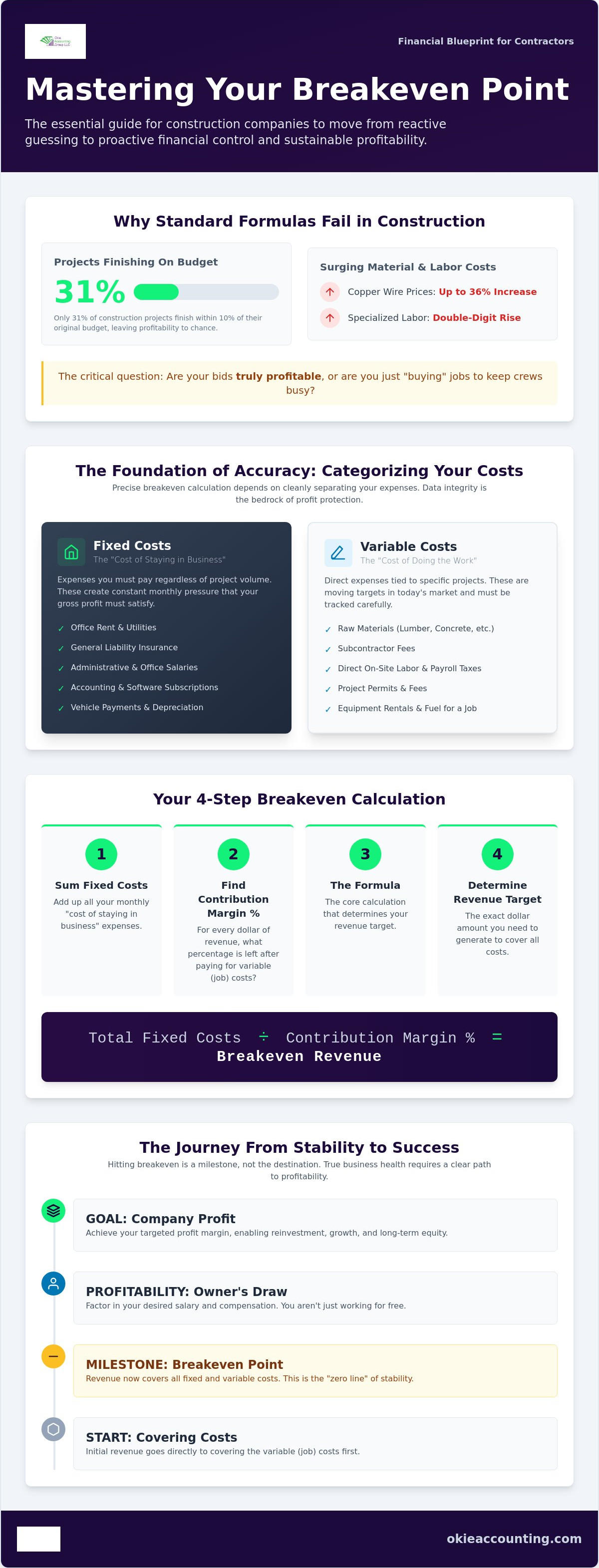
Only 31% of construction projects currently finish within 10% of their original budget. In an environment where copper wire prices have surged by up to 36% and specialized labor costs are rising by double digits, the margin for error has effectively disappeared. You likely feel the constant pressure of high overhead costs eating your cash flow, leaving you uncertain if your next bid is actually profitable or if you're simply "buying" a job to keep the crews busy. Mastering the process of calculating breakeven point for construction company operations is the only way to move from reactive guessing to proactive financial control.
We understand that your projects are complex, but your financial clarity shouldn't be. You deserve a structural framework that protects your profits and provides a clear revenue target for every month of the year. This guide provides the financial framework needed to identify exactly when your projects turn into profit and how to use that data to scale your firm. We will explore the dynamic variables of the 2026 market, provide a disciplined formula for stability, and show you how to build a system that tracks these critical metrics automatically.
Defining the Breakeven Point in a Construction Framework
In its simplest form, Defining the Breakeven Point involves identifying the exact dollar amount of revenue required to cover every operational expense without leaving a single cent of profit or loss. For many owners, this number represents the "zero line." However, in a project-based industry, calculating breakeven point for construction company health is more nuanced than it is for a retail store selling identical products. While a coffee shop calculates how many lattes it must sell, a contractor must account for the high volatility of material costs and the unpredictability of labor hours.
Generic unit-based formulas fail specialty contractors because no two projects are identical. A $50,000 kitchen remodel carries a different risk profile and margin than a $50,000 deck installation. Relying on "average" unit sales ignores the structural reality of your overhead. By shifting from a survival mindset to a strategic one, you stop viewing revenue as a way to "get by" and start seeing it as a tool to protect your firm's long-term health. This figure acts as the structural floor for your bidding strategy. If a bid doesn't contribute enough to cross this line, you aren't just working for free; you're paying for the privilege of working.
The Relationship Between Revenue and Overhead
Fixed costs like office rent, insurance premiums, and administrative salaries create a constant, silent pressure on your monthly revenue. These expenses exist regardless of whether your crews are on-site or sitting at home. If you attempt to increase project volume without calculating breakeven point for construction company requirements first, you risk accelerating a downward spiral. More work often means more variable costs, which can actually shrink your ability to cover overhead if margins aren't precisely managed. Utilizing specialized construction bookkeeping services is the most effective way to separate these fixed burdens from your direct job costs, ensuring your data is clean enough to drive strategic choices.
Breakeven vs. Profitability: Knowing the Difference
Hitting your breakeven is a milestone of stability, but it isn't the definition of success. True business health requires a margin that covers more than just the bills. You must factor in your desired owner’s draw and specific company profit goals to move beyond the zero line. This requires a clear distinction between accounting breakeven, which includes non-cash expenses like depreciation, and cash flow breakeven, which focuses on the actual dollars leaving your bank account. Partnering with a fractional controller helps you bridge this gap. This ensures your bidding targets account for both your immediate cash needs and your long-term equity growth.
Categorizing Construction Costs: Fixed Overhead vs. Variable Job Costs
Precision in calculating breakeven point for construction company operations depends entirely on how you categorize your spending. If your Chart of Accounts is a cluttered list of generic expenses, you'll struggle to see where project costs end and company overhead begins. Data integrity is the bedrock of profit protection. Without a clean distinction between direct and indirect costs, your breakeven figure will be a guess rather than a reliable target. This organization allows you to see exactly how much of every dollar earned actually goes toward keeping the lights on versus building the project.
Fixed Costs: The "Cost of Staying in Business"
Fixed costs are the expenses you must pay regardless of your project volume. These are the checks you write even if every job site is quiet. Common examples include office rent, general liability insurance, administrative salaries, and your accounting software subscriptions. These costs create a constant monthly pressure that your gross profit must satisfy. Because these figures don't fluctuate with your workload, they are the baseline for your financial planning. Our fractional controller services help you audit these fixed expenses to ensure your overhead isn't bloated, providing the lean foundation necessary for competitive bidding in a tight market.
Variable Costs: The "Cost of Doing the Work"
Variable costs are the direct expenses tied to specific projects. These include raw materials, subcontractor fees, and project permits. Unlike fixed overhead, these costs are typically expressed as a percentage of your revenue. The breakeven analysis formula relies on an accurate understanding of your variable cost ratio to determine your contribution margin. This is particularly challenging in 2026. With copper wire prices rising up to 36% and aluminum products increasing by 33%, your variable costs are moving targets. If you don't update these ratios to reflect current material volatility, your breakeven revenue target will be outdated before the month ends.
Labor is the most complex category to track. Field crew wages are usually variable job costs because they only occur when a project is active. However, your office manager or a salaried superintendent might be a fixed cost. You also have to watch for "hidden" variables. Items like small tools, fuel, and consumables often get dumped into general overhead, but they are actually project-specific expenses. Categorizing them correctly prevents them from skewing your math. Establishing a clear structural framework for these costs turns your financial data into a strategic asset. If you're unsure if your current accounting setup captures these nuances, you can schedule a brief discovery call to discuss a more organized approach.
The Step-by-Step Formula for Calculating Your Construction Breakeven
Moving from cost categorization to a functional mathematical model is where your financial data becomes a strategic tool. Once you've organized your Chart of Accounts, you can apply a structured process for calculating breakeven point for construction company operations. This isn't a one-time exercise. It's a dynamic calculation that should be revisited as material prices and labor rates shift. Following a disciplined four step process ensures that your revenue targets are grounded in reality rather than optimism.
Step 1: Total your fixed overhead costs. Look at your Profit and Loss statement for the last twelve months to identify your recurring "cost of staying in business." This includes everything from office rent to administrative payroll.
Step 2: Calculate your average Gross Margin percentage. Review your completed projects to determine what percentage of revenue remains after all direct job costs are paid. If your revenue was $1,000,000 and your direct costs were $650,000, your gross margin is 35%.
Step 3: Apply the formula. Divide your total fixed costs by your gross margin percentage. This reveals the exact sales volume needed to reach the zero line.
Step 4: Analyze production capacity. Compare your breakeven sales figure against your actual ability to produce work. If your breakeven requires $1 million in revenue but your crews can only physically complete $800,000 in projects, your business model requires a structural adjustment.
Calculating Your Contribution Margin Ratio
The contribution margin ratio is the percentage of each dollar that remains after paying variable costs. This ratio represents the portion of every dollar earned that contributes to covering your fixed overhead after direct project costs are satisfied. In QuickBooks Online, you can find this figure quickly by running a Profit and Loss report and looking at your Gross Profit as a percentage of Total Income. If this ratio is too low, you'll find yourself trapped in a cycle of high volume with no profit protection.
A Practical Example for a Specialty Contractor
Consider a roofing contractor with annual fixed overhead costs of $200,000. Through historical job costing, they determine their average gross margin is 35%. By calculating breakeven point for construction company requirements using the formula ($200,000 ÷ 0.35), they discover they must generate $571,428 in annual revenue just to stay in the black. Any revenue below this mark results in a loss; any dollar above it begins to generate true company profit. Mastering QuickBooks for contractors is essential for getting these numbers right, as it allows you to automate the data collection needed for these calculations. Without accurate job costing, your margin percentage is a guess, and a 5% error in that guess can mean the difference between scaling your firm and insolvency.
Leveraging Breakeven Analysis for Bidding and Strategic Growth
Breakeven analysis is more than a static accounting exercise. It is a live decision making framework. When you move beyond simply calculating breakeven point for construction company requirements, you gain the ability to set a "Minimum Acceptable Margin" for every bid. This prevents the common trap of "buying" jobs just to keep your crews active. If a project's contribution margin doesn't satisfy its share of your overhead recovery, it is actively draining your company's equity. This data allows you to evaluate "filler" jobs with total objectivity. You can finally determine if a low margin project actually supports your fixed costs or if it simply increases your risk without a corresponding reward.
Bidding with Precision, Not Guesswork
Many contractors rely on "market pricing," assuming that if they bid what the competition is bidding, they'll remain profitable. This is a dangerous assumption because your overhead structure is unique to your firm. Mathematical pricing ensures that every estimate includes a calculated portion of your fixed costs. Integrating construction cash flow management into this process ensures you have the liquidity to reach your BEP before your next project mobilization. This disciplined approach protects your cash reserves and ensures that every signed contract is a step toward true profitability rather than just another obligation.
Scenario Planning: What If Your Costs Rise?
Scaling your firm requires a clear understanding of how new investments impact your structural floor. Every strategic hire or equipment purchase raises your breakeven point. For example, hiring a new Project Manager with a $110,000 salary isn't just a $110,000 expense. If your firm operates at a 25% gross margin, you must generate an additional $440,000 in revenue just to cover that single salary. Similarly, purchasing a new excavator with a monthly lease payment requires a specific increase in project volume to remain at the zero line. Knowing these numbers before you sign a lease or an offer letter allows you to scale with quiet confidence.
In the volatile 2026 market, you must also account for sudden shifts in variable costs. If material prices jump by 10%, your contribution margin shrinks, which immediately pushes your breakeven point higher. A fractional controller can run "What-If" simulations to show you exactly how these fluctuations will affect your bottom line. This proactive stance allows you to adjust your pricing structure before your cash flow is compromised. To build a customized growth plan based on your firm’s specific financial data, book a discovery call with our strategic team today.
Building a Structural Framework for Profit Protection
Transitioning from a state of financial uncertainty to one of operational clarity requires more than just a spreadsheet. It demands a deliberate shift from basic administrative tasks to strategic financial leadership. In 2026, data-driven choices are the only way to scale a construction firm effectively while protecting against market volatility. By calculating breakeven point for construction company operations through a structured framework, you protect your margins and ensure long-term stability. This transformation is best supported by a monthly financial review service, which provides the oversight needed to monitor your progress against your revenue targets in real time.
QuickBooks Online: The Engine of Your Financial System
Your accounting software should be more than a digital ledger; it must be a high-performance tracking tool. By setting up classes and locations within QuickBooks Online, you can track breakeven points for specific divisions or geographic service areas. This granular view helps you identify which parts of your business are truly profitable and which are dragging down your company average. Automating overhead allocation is another critical step, as it ensures your job costing reflects the true burden of your fixed expenses. We provide specialized software training to help your team implement these advanced workflows, turning routine data entry into actionable intelligence.
The Role of a Fractional Controller in Scaling
Sarah O’Quinn and the Okie Accounting team act as strategic mentors rather than just administrative providers. While a bookkeeper records what has already happened, a fractional controller looks ahead to build the foundational systems required for scaling. We help you move beyond the traditional bookkeeper role by offering high-level strategy that protects your profits from rising labor and material costs. This partnership ensures that your financial readiness is never in question, allowing you to focus on project execution while we maintain the integrity of your financial data.
The final step in your journey is moving from theory to execution. You now have the formulas and the logic, but implementing them requires precision and professional discipline. We invite you to book a consultation to audit your current breakeven framework and build a customized roadmap for your firm's success. With the right systems in place, calculating breakeven point for construction company growth becomes a predictable, repeatable process that empowers you to lead with quiet confidence.
Building Your Foundation for 2026 and Beyond
Mastering the process of calculating breakeven point for construction company operations is the first step toward reclaiming control over your firm's future. By distinguishing between fixed overhead and variable project costs, you move beyond the stress of inconsistent bidding and begin to set margins that actually protect your long-term health. We've explored how a dynamic breakeven formula allows you to scale with confidence, whether you're hiring new staff or investing in heavy equipment. This data driven approach ensures that every project you take contributes to your company's stability rather than draining its resources.
True financial readiness requires more than a one-time calculation. It needs a structural framework that evolves alongside the market. At Okie Accounting, we combine specialized construction expertise with cloud-based financial oversight to turn your data into a strategic asset. Our fractional controller strategy is designed to move you from administrative burden to high-level leadership. You don't have to navigate these complex financial waters alone. We are here to provide the clarity and discipline your business needs to thrive.
Gain Financial Clarity with a Strategic Consultation from Okie Accounting
Take the next step toward a more stable and profitable business today.
Frequently Asked Questions
How often should a construction company calculate its breakeven point?
You should review your figures monthly to account for the significant price volatility seen in 2026. With material costs like copper wire increasing by up to 36% year-over-year, a quarterly check is no longer sufficient for maintaining accuracy. Monthly reviews ensure your bidding reflects current market realities rather than outdated benchmarks from the previous season.
Is breakeven the same as a zero-profit year?
Technically, the breakeven point is the moment revenue equals total expenses, resulting in no net profit or loss. However, a strategic business model often treats your desired profit or owner's draw as a "fixed cost" to ensure the firm actually grows. Reaching the accounting breakeven protects you from insolvency, but it doesn't build company equity or fund future scaling.
What is a good gross margin percentage for a general contractor in 2026?
In 2026, residential general contractors typically target a gross profit margin between 18% and 25%. Net profit margins across most construction segments are currently hovering between 6% and 7.5%. Achieving these targets requires disciplined job costing to offset the 4% to 6% construction-specific inflation expected throughout this year.
Can I use QuickBooks Online to calculate my breakeven point automatically?
QuickBooks Online doesn't offer a native "breakeven" button, but it provides the essential data
through the Profit and Loss report. By using Class tracking and proper cost categorization, you can create a custom framework that simplifies calculating breakeven point for construction company operations. Our training services help teams set up these systems to automate the data collection process.
What happens if my breakeven point is higher than my maximum production capacity?
This scenario indicates a fundamental structural flaw in your business model. If your fixed costs are so high that your crews can't physically produce enough work to cover them, you're "working yourself out of business." You must either raise your project prices to improve your margin or aggressively reduce your fixed overhead to bring the floor down.
Should I include my own salary in the fixed overhead costs?
You must include a fair market salary for yourself within the fixed overhead costs. If the business cannot afford to pay its leader, it hasn't truly reached its breakeven point. Treating your draw as an optional expense hides the true cost of your operations and skews your bidding accuracy, making your firm appear more stable than it actually is.
How do I account for seasonal fluctuations in my breakeven analysis?
You should calculate an annual breakeven revenue target and divide it by twelve to establish a monthly baseline for the year. While some months will naturally fall below this line due to weather or seasonal demand, your high-volume months must compensate for the deficit. Tracking this through cash flow forecasting helps you manage the lean periods with confidence.
Does the breakeven point change if I use subcontractors instead of employees?
Yes, using subcontractors shifts your costs from fixed to variable. Subcontractors only cost you money when you have an active project, which lowers your monthly overhead and reduces your calculating breakeven point for construction company requirements. However, this often results in a lower contribution margin per project, meaning you may actually need more total revenue to reach your profit goals.


Comments