Cash Flow Analysis for Real Estate Investors: The 2026 Strategic Framework

Updated: Nov 7
The "1% rule" is officially a relic of the past, and relying on it in 2026 is a recipe for a portfolio-wide cash crunch. With investment mortgage rates currently ranging from 7.09% to 8.59%, the margin for error in your cash flow analysis for real estate investors has effectively vanished. You've likely felt that sense of financial blindness where a property looks profitable on paper, yet your bank account tells a different story after debt service and CapEx. It's a common stressor for those managing complex portfolios through manual spreadsheets, where a single formula error can lead to unexpected shortages.
We understand that you need more than just a ledger; you need a disciplined system for profit protection. This article will teach you how to transform raw data into a professional-grade strategic framework. By implementing these systems, you'll learn to move from basic administration to building foundational structures that offer true clarity. We will cover how to automate your forecasting, leverage permanent tax advantages like 100% bonus depreciation under the One Big Beautiful Bill Act, and prepare lender-ready statements that facilitate your next acquisition with quiet confidence. This is the roadmap to moving from a state of complexity to one of operational clarity.
Key Takeaways
Learn the critical distinction between Net Operating Income and Net Cash Flow to ensure your portfolio remains liquid after debt service and capital expenditures.
Master the mechanics of Gross Potential Income versus Effective Gross Income to identify exactly where revenue leaks are occurring in your property operations.
Discover how to implement a professional-grade cash flow analysis for real estate investors by standardizing your Chart of Accounts and automating manual data entry.
Move beyond outdated rules of thumb to build a strategic framework that accounts for the high-tax and high-insurance environments of the current market.
Understand when to transition from basic administrative bookkeeping to fractional controller services for high-level investment strategy and long-term profit protection.
The Foundation of Profit Protection: Defining Cash Flow for Real Estate Investors
Cash flow is the oxygen of your real estate business. Without it, even a portfolio with significant equity can suffocate under the weight of debt obligations or sudden capital requirements. For many, the initial goal of property ownership is passive income, but achieving true profit protection requires a shift in perspective. You must move from viewing numbers as a simple list of transactions to seeing them as a structural framework. A rigorous cash flow analysis for real estate investors serves as the diagnostic tool that separates a hobbyist's ledger from a professional enterprise.
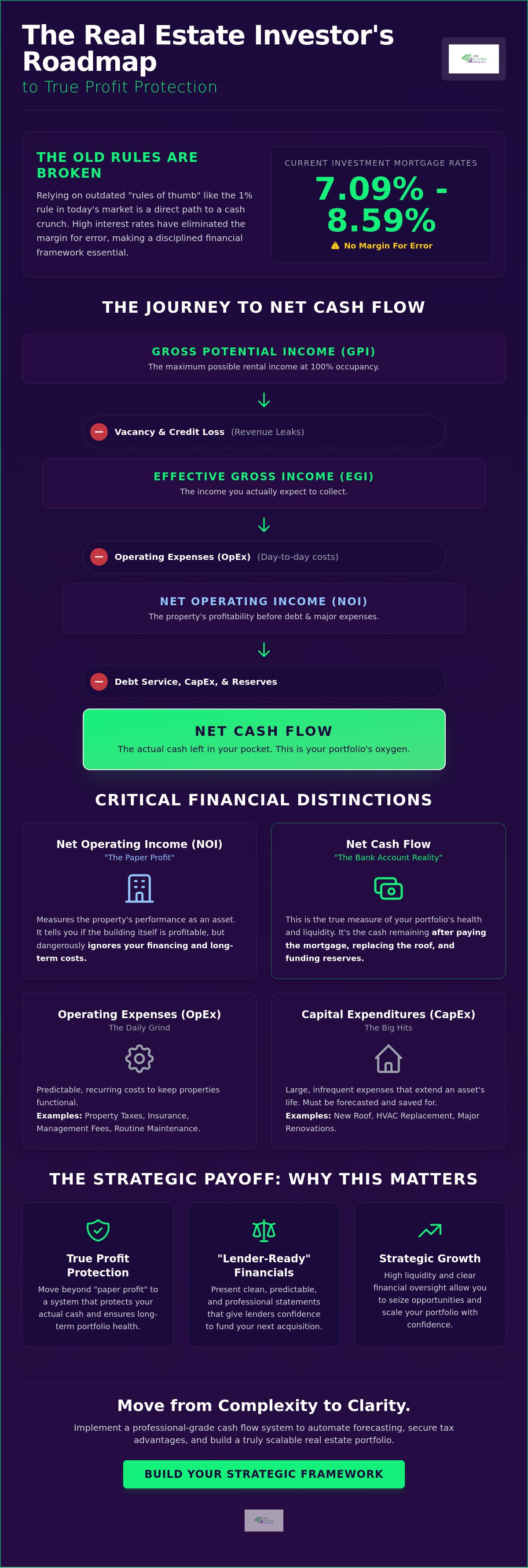
The most dangerous misconception in real estate is conflating Net Operating Income (NOI) with Net Cash Flow. While NOI tells you how the property performs as an asset, it ignores the realities of your capital structure. Net Cash Flow is what remains after you've accounted for debt service, capital expenditures (CapEx), and reserve contributions. This is where many investors fall into the "Paper Profit" trap. Your Profit and Loss statement might show a healthy bottom line, but if that capital is tied up in uncollected rent or drained by a massive HVAC replacement, your bank account will remain empty. We focus on building systems that reveal these discrepancies before they become crises.
Cash vs. Accrual Accounting in Real Estate
Most investors begin with cash basis accounting because it's simple; you record income when it hits the bank and expenses when they leave. However, as your portfolio grows, this method creates distorted snapshots. A large rent check received on the 31st of one month instead of the 1st of the next can make one month look like a windfall and the next like a failure. Timing differences in rent collection and major repairs can make your cash flow appear volatile when it is actually stable. Accrual accounting provides a more accurate long-term health indicator by matching income and expenses to the period in which they actually occur. This transition is essential for any strategy that aims for predictability over reactive firefighting.
The Role of Liquidity in Portfolio Scaling
Liquidity is the bridge between owning a few properties and building a legacy. A disciplined cash flow analysis for real estate investors ensures you aren't just "asset rich and cash poor." Lenders look for consistent, predictable liquidity when evaluating your "lender-readiness" for the next acquisition. If your financial statements are inconsistent, you'll find it nearly impossible to secure competitive financing in a market where investment mortgage rates currently range from 7.09% to 8.59%.
Maintaining high liquidity allows you to strike when distressed assets or secondary market opportunities arise. By building a system for accounting for real estate investors, you move beyond basic administrative tasks toward a state of financial readiness. This structural oversight ensures your capital is always working toward growth rather than just covering the next unexpected bill.
The Structural Mechanics: Deconstructing Income, Expenses, and Debt Service
Effective cash flow analysis for real estate investors requires a forensic approach to the income statement. It is a common mistake to treat cash flow as a simple calculation of rent minus mortgage. To build a truly scalable framework, you must deconstruct your financials into three distinct pillars: income realization, operating efficiency, and capital preservation. This level of granular oversight prevents the "profit leaks" that often go unnoticed in basic spreadsheets.
The starting point is Gross Potential Income (GPI), which represents the total revenue your portfolio would generate at 100% occupancy and market rates. However, GPI is a theoretical maximum. Your actual performance is measured by Effective Gross Income (EGI), which accounts for the realities of vacancy and credit loss. Distinguishing between these two figures allows you to identify whether underperformance is a result of market conditions or operational failures in tenant retention and collection.
Operating Expenses (OpEx) encompass the daily costs of keeping your properties functional. This includes property management fees, property taxes, insurance, and routine maintenance. While OpEx is predictable, Capital Expenditures (CapEx) are the "big hits" that can devastate a portfolio's liquidity if not properly forecasted. By separating these categories, you ensure that your cash flow analysis for real estate investors reflects the true cost of ownership over the entire lifecycle of the asset. If you find yourself struggling to maintain this distinction, you might consider how professional financial oversight can help stabilize your reporting.
Debt service remains the most significant variable in the 2026 market. With investment property mortgage rates currently ranging from 7.09% to 8.59%, the impact of interest and amortization on your bottom line is substantial. A professional framework doesn't just track these payments; it analyzes how different debt structures affect your total return and your ability to refinance in the future.
Managing Reserves: The CapEx Structural Framework
Failing to segregate CapEx reserves leads to "phantom" cash flow, where a property appears profitable only because you haven't yet paid for the inevitable roof or HVAC replacement. We recommend calculating a reserve percentage based on the specific age and condition of each asset rather than using a flat industry average. Establishing a dedicated 10% reserve for major structural repairs ensures that your portfolio remains resilient during high-cost years.
The Reality of Vacancy and Credit Loss
Assuming a 0% vacancy rate is one of the most dangerous errors in financial modeling. Real-world turnover involves cleaning, marketing, and often a month or more of lost rent. By utilizing professional monthly bookkeeping, you can track real-time vacancy impacts and adjust your forecasts accordingly. This data-driven approach allows you to see exactly how turnover costs are eating into your margins, providing the clarity needed to make strategic adjustments to your leasing or management practices.
Beyond the 1% Rule: Why Strategic Analysis Beats Basic Rules of Thumb
The 1% rule was a useful heuristic in a low-interest-rate environment, but it has become a liability in the 2026 market. Relying on such simplifications often leads to "analysis paralysis" or, worse, the acquisition of a property that drains your reserves. A professional cash flow analysis for real estate investors must account for the reality that mortgage rates now sit between 7.09% and 8.59%. Napkin math won't protect your profit when your cost of debt has doubled over the last few years.
Strategic analysis requires looking at the Debt Service Coverage Ratio (DSCR). This metric tells you exactly how much "breathing room" your property has to cover its debt obligations. Lenders prioritize this over your personal income because it measures the asset's inherent strength and resilience. Similarly, Cash-on-Cash return allows you to evaluate your real estate performance against the stock market or private equity. This ensures your capital is deployed in its highest and best use rather than being parked in an underperforming asset.
We see many investors struggle when they apply broad rules to specific niches. A Midwest property delivering an 8-12% cash-on-cash return requires a different analytical framework than a luxury multifamily unit in the Northeast. By moving beyond basic rules, you establish a disciplined approach that values accuracy and long-term stability over quick, often inaccurate, estimates.
When Rules of Thumb Fail Your Portfolio
The 50% rule is particularly dangerous in an inflationary environment where the Consumer Price Index has risen 4.2% year-over-year. Property taxes and insurance premiums don't follow market averages; they follow local legislation and climate risk. For instance, the SALT deduction cap has increased to $40,400 for 2026, which significantly alters the net return profile for high-value properties. Professional investors ignore generalities and often consult with experts at wrightaa.com to ensure their project-based financial tracking captures these granular shifts and protects their margins from inflationary pressure.
Professional Metrics: DSCR and IRR
While cash flow provides immediate stability, the Internal Rate of Return (IRR) measures the total lifecycle of your investment, including the eventual sale. Lenders use DSCR to evaluate your risk profile and determine your eligibility for future financing. If your DSCR falls below a certain threshold, you'll face hurdles during your next acquisition. Moving from basic metrics to these sophisticated indicators often requires a transition to Fractional Controller services. This provides the high-level strategy needed to scale a complex portfolio without the overhead of a full-time executive.
Building a Scalable Analysis System: From Bookkeeping to Forecasting
Transitioning from a disorganized spreadsheet to a professional structural framework requires a disciplined sequence of actions. A scalable cash flow analysis for real estate investors begins with a clean, standardized Chart of Accounts. This foundation ensures that every dollar of rent, every repair cost, and every debt payment is categorized with precision. Without this level of organization, your financial reporting remains a collection of disconnected facts rather than a strategic tool for growth.
Once your accounts are standardized, the next priority is data integrity. Automating data entry through cloud-based tools reduces the risk of manual errors that often lead to cash shortages. However, automation is not a "set and forget" solution. Monthly reconciliations are essential to ensure that your digital records match your bank reality. By following this methodical approach, you move from basic administrative tasks to a state of financial readiness. This transformation is what turns a reactive ledger into a professional cash flow analysis for real estate investors.
The final stage of this system is the transition from historical reporting to proactive forecasting. By generating rolling 12-month cash flow forecasts and reviewing KPIs with a strategic partner, you gain the ability to adjust your course before market shifts impact your bottom line. If you are ready to move beyond manual entry, you can schedule a discovery call to build your custom framework.
QuickBooks Online for Real Estate Investors
QuickBooks Online serves as the engine for property-level reporting when configured correctly. By setting up "Classes" or "Projects," you can track the individual performance of each asset within your portfolio. This allows you to see exactly which properties are underperforming and which are driving your growth. Integrating bank feeds eliminates the friction of manual entry; however, the software is only as good as the person operating it. Utilizing professional software training ensures you master these advanced features to protect your profit margins.
The Power of Cash Flow Forecasting
Forecasting allows you to move from asking "What happened?" to "What will happen?" This shift is critical for predicting cash-tight months, such as when property tax payments are due under the new $40,400 SALT cap. By visualizing your liquidity months in advance, you can time your acquisitions strategically. This foresight ensures you have the capital necessary to strike when mortgage rates fluctuate or when new designations in the Qualified Opportunity Zone program are announced in July 2026. Forecasting isn't just about survival; it's about maintaining the agility required to scale your enterprise.
The Fractional Controller Advantage: Transforming Data into Investment Strategy
Every growing portfolio eventually reaches an inflection point where standard bookkeeping and automated systems become insufficient for high-stakes expansion. At this stage, a standard cash flow analysis for real estate investors must evolve from a historical record into a forward-looking strategic tool. This is where the transition from basic administration to professional financial oversight becomes essential. You need a partner who doesn't just categorize transactions but understands the mechanics of your specific market and the long-term health of your enterprise.
The role of the Controller is particularly vital when navigating debt restructuring and tax readiness. With interest rates for investment properties currently as high as 8.59%, a strategic partner helps you evaluate whether to hold, sell, or refinance based on real-time liquidity data. They ensure your business is prepared to maximize the permanent 100% bonus depreciation established by the One Big Beautiful Bill Act. By positioning Okie Accounting Group LLC as your strategic partner, you gain the discipline and accuracy required to protect your profit in a volatile environment.
Strategic Financial Oversight vs. Basic Bookkeeping
While a bookkeeper records history, a Controller builds the future. This distinction is critical for investors who want to move beyond simple data entry toward comprehensive structural frameworks. A Fractional Controller develops rigorous internal controls to protect your assets from fraud, waste, or simple human error. They monitor your Debt Service Coverage Ratio (DSCR) and liquidity levels to ensure you're always ready for the next opportunity. A Fractional Controller bridges the gap between raw financial data and high-stakes investment decision-making by interpreting the "why" behind the numbers.
Ready to Scale Your Portfolio?
Outsourcing this level of expertise allows you to reduce the daily stress of financial management while gaining the high-level strategy of a full-time executive without the associated overhead. This partnership ensures that your business is "investor-ready" at all times; whether you are seeking new financing or bringing on a private partner, your financial statements will reflect a professional, disciplined operation. Moving to this level of oversight is the final step in mastering cash flow analysis for real estate investors. When you're ready to transform your data into a scalable growth engine, you can Schedule a consultation for Fractional Controller services.
Securing Your Financial Future Through Structural Oversight
Mastering your portfolio's health requires a shift from reactive data entry to proactive strategy. We've explored how a rigorous cash flow analysis for real estate investors serves as the foundation for profit protection. By deconstructing your income pillars, implementing automated cloud systems, and moving beyond outdated rules of thumb, you establish the clarity needed to scale. True growth isn't about working harder on your spreadsheets. It's about building a structural framework that supports your long-term vision.
Our team brings specialized expertise to the real estate and construction sectors. We offer proactive Fractional Controller support and NIST-compliant cloud accounting setups to ensure your financial data is secure and lender-ready. You don't have to manage these complexities alone. We're here to act as your strategic partner in building a stable, high-performing enterprise.
Build Your Scalable Financial Infrastructure with Okie Accounting Group LLC
We're ready to help you transform your financial data into a powerful engine for investment growth.
Frequently Asked Questions
What is a good cash flow for a rental property in 2026?
A cash-on-cash return of 7% is the current suggested benchmark for real estate investors in 2026. While the old 1% rule is largely outdated in a high-interest market, certain secondary markets in the Midwest can still deliver returns between 8% and 12%. A good cash flow must provide a positive margin after you've accounted for debt service, all operating expenses, and a dedicated 10% CapEx reserve.
Is cash flow more important than appreciation for real estate investors?
Prioritizing cash flow is the recommended strategy for 2026 because national home price appreciation has flattened to a modest 0.4% year-over-year. Appreciation should be viewed as a speculative bonus rather than a guaranteed return. Cash flow provides the immediate liquidity needed to sustain operations and maintain lender-readiness, whereas relying on appreciation in a flat market can lead to dangerous cash shortages.
How do I calculate cash flow on a rental property accurately?
Accurate cash flow analysis for real estate investors requires subtracting all operating expenses, debt service, and capital reserves from your Effective Gross Income (EGI). You must use EGI instead of Gross Potential Income to account for real-world vacancy and credit loss. This calculation should be performed on a monthly basis to capture the seasonal fluctuations in maintenance and utility costs that annual estimates often miss.
Can I use QuickBooks for real estate cash flow analysis?
QuickBooks Online is a highly effective tool for cash flow analysis for real estate investors when configured with property-specific Classes or Projects. This structural framework allows you to track the performance of individual assets within a single ecosystem. By integrating bank feeds and automating data entry, you eliminate manual spreadsheet errors and create the professional financial statements required to secure new financing for your next acquisition.
What happens if my investment property has negative cash flow?
Negative cash flow indicates that a property's income is insufficient to cover its debt and operating costs, requiring you to inject personal capital to keep it afloat. This often signals a need for a forensic audit of expenses or a debt restructuring strategy. You should immediately evaluate whether the property's long-term potential justifies the current drain on your liquidity or if a strategic exit is necessary.
How much should I set aside for CapEx reserves?
We recommend setting aside a baseline of 10% of your monthly rental income for capital expenditure reserves. However, this percentage should be adjusted based on the specific age and structural condition of each property. Older assets with aging HVAC systems or roofs require more aggressive reserve funding to prevent unexpected "big hits" from devastating your liquid cash position during a high-maintenance year.
Why do lenders care about my Debt Service Coverage Ratio (DSCR)?
Lenders use the DSCR to measure an asset's ability to cover its own debt obligations, which serves as a primary indicator of investment risk. A ratio below 1.20 often signals that the property has very little room for error, making it difficult to secure competitive financing. Maintaining a strong DSCR demonstrates to lenders that you have a disciplined system for profit protection and operational oversight.
What is the difference between cash flow and profit in real estate?
Profit is an accounting figure that includes non-cash items like depreciation, while cash flow represents the actual liquid currency moving in and out of your bank account. A property can show a "paper profit" on a tax return while suffering from a cash shortage due to high debt service or uncollected rent. Understanding this distinction is essential for maintaining the liquidity required for sustainable portfolio scaling.


Comments