Cash Flow Analysis for Real Estate Investors: The 2026 Strategic Framework

Updated: 6 days ago
Why does your bank account often feel empty when your profit and loss statement says you're winning? Many investors face this exact disconnect, staring at a "profitable" portfolio while navigating inconsistent monthly draws and the quiet fear of over-leveraging. It's a common frustration that stems from a lack of structural oversight. In a 2026 market where mortgage rates hover near 6.75% and inflation remains a factor, "back-of-the-napkin" math is no longer a viable strategy for growth.
Mastering a rigorous cash flow analysis for real estate investors is the only way to move from reactive management to proactive scaling. You deserve a system that distinguishes between taxable profit and actual liquidity while providing the data needed to secure your next deal. This guide provides the strategic framework required to track, analyze, and forecast your finances with precision. We'll examine the specific metrics that define a healthy portfolio, the necessity of a scalable accounting system, and how to produce the lender-ready reports that modern acquisitions demand. By the end, you'll have the clarity and control to treat your investments like the high-level business they are.
The Structural Difference Between Profit and Cash Flow
Many investors discover a painful truth: a "profitable" portfolio on paper doesn't always translate to liquidity. This discrepancy often leads to a false sense of security, where an owner feels wealthy based on their tax return while struggling to fund a sudden roof replacement. A rigorous cash flow analysis for real estate investors looks beyond the bottom line to identify the actual movement of currency through your business. It's the difference between seeing a theoretical gain and having the funds available to execute your next acquisition.
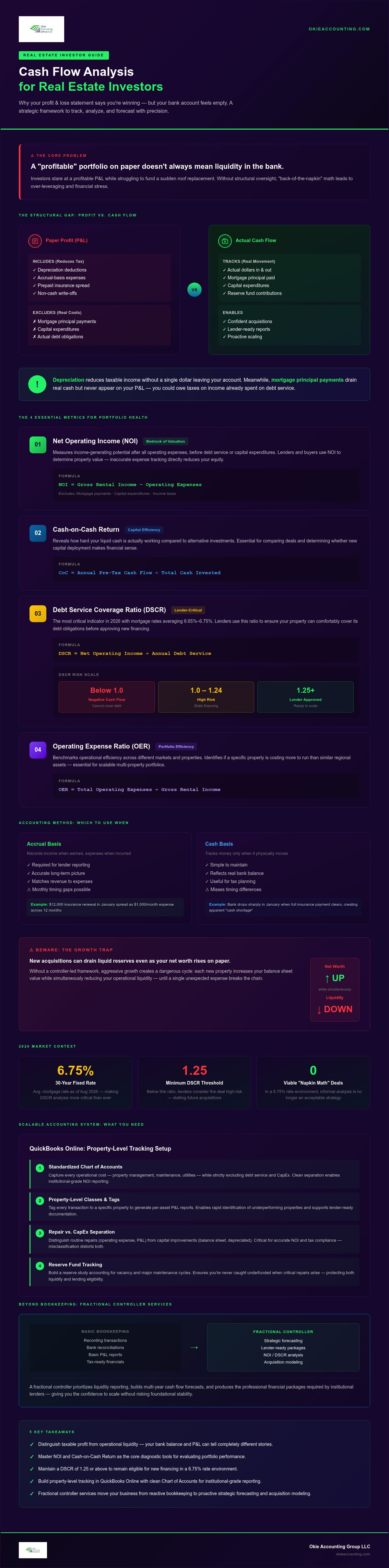
The core of the issue lies in non-cash items and debt structure. Depreciation is the most common "phantom" expense; it reduces your taxable income significantly without a single dollar leaving your bank account. Conversely, mortgage principal payments are actual cash outlays that do not appear on your profit and loss statement. This structural gap means you could potentially owe taxes on income that has already been spent on debt service. Without a controller-led framework, it's easy to fall into a "growth trap" where new acquisitions drain your liquid reserves even as your net worth increases on your balance sheet.
In its simplest form, cash_flow represents the net amount of cash being transferred into and out of your business. It's the physical fuel that keeps your operations running while you wait for long-term appreciation to materialize. If you don't track this movement with precision, you risk over-leveraging your assets during market fluctuations.
The Accrual vs. Cash Basis Debate
Accrual accounting records income when earned and expenses when incurred, while cash basis tracks money only when it moves. Real estate investors need to understand both to maintain a complete financial picture. Timing differences, such as property tax escrows and prepaid insurance premiums, can create significant monthly fluctuations. Your bank balance might drop in January due to a large insurance renewal, even if the "expense" is spread across twelve months on an accrual basis. Monitoring these timing gaps prevents the stress of unexpected cash shortages and ensures you're always ready for operational costs.
Why "Paper Profit" Won’t Pay the Mortgage
The psychological shift from tax-minimization to cash-maximization is a hallmark of a maturing investor. While your tax strategy might focus on high depreciation to minimize liability, your operational health depends on actual dollars. Relying on "paper profit" is dangerous because it ignores the reality of capital expenditures and debt obligations. Cash Flow is the lifeblood of portfolio sustainability in 2026. Utilizing fractional controller services ensures your reporting prioritizes liquidity, giving you the confidence to scale without risking your foundational stability.
Key Metrics for Modern Real Estate Cash Flow Analysis
Successful scaling requires moving from anecdotal evidence to empirical data. While basic spreadsheets provide a snapshot, a professional cash flow analysis for real estate investors utilizes specific benchmarks to evaluate both current performance and future risk. These metrics act as the diagnostic tools for your portfolio's health, ensuring every asset supports your long-term stability and borrowing power.
Net Operating Income (NOI) serves as the bedrock of property valuation. It measures the income-generating potential of an asset after accounting for all operating expenses but before debt service or capital expenditures. Because lenders and buyers use NOI to determine value, any inaccuracy in your expense tracking directly impacts your equity. Similarly, the Cash-on-Cash Return measures the efficiency of your invested capital, revealing how hard your liquid cash is working for you compared to alternative investments.
With 30-year fixed mortgage rates averaging between 6.65% and 6.75% as of August 2026, the Debt Service Coverage Ratio (DSCR) has become a critical indicator of financial readiness. Lenders use this ratio to ensure your property can comfortably cover its debt obligations. A ratio below 1.25 often signals high risk, potentially stalling your ability to secure new financing for future acquisitions. If your current reporting lacks this level of granular detail, you can schedule a strategy session to refine your financial framework.
Calculating NOI with Precision
Precision in NOI calculation depends on a standardized Chart of Accounts. You must capture every operational cost, from property management fees to routine maintenance, while strictly excluding debt service and CapEx. This separation allows you to see the true operational efficiency of the asset, independent of how it is financed. A disciplined approach to QuickBooks Online setup ensures that property-level data is clean, making your cash flow analysis for real estate investors accurate enough for institutional-grade reporting.
Advanced Liquidity Ratios for Scalable Portfolios
For those managing scalable portfolios, the Operating Expense Ratio (OER) provides a benchmark for efficiency across different markets. It helps identify if a specific property is costing more to run than the regional average. Knowing your Break-Even Occupancy Rate is equally vital; it establishes the exact point where your rental income covers all operating costs and debt. Implementing robust management accounting systems ensures these ratios are calculated automatically, removing the guesswork from your strategic decision-making process.
Accounting for the "Cash Killers": CapEx, Vacancy, and Reserves
A disciplined cash flow analysis for real estate investors requires more than just tracking rent. It demands a clinical look at the "cash killers" that erode liquidity when left unmonitored. While your profit and loss statement might show a healthy margin, unallocated capital expenditures and unmodeled vacancy can quickly turn a profitable portfolio into a cash-poor liability. Managing these variables requires a transition from static historical reporting to dynamic forecasting.
The distinction between Repairs (OPEX) and Improvements (CAPEX) is a common point of confusion. A repair restores a property to its previous condition, such as fixing a leaky faucet, and is treated as an immediate expense. Improvements, like a total roof replacement, add value or extend the asset's life. While CAPEX is capitalized on your balance sheet for tax purposes, the cash leaves your bank account immediately. Failing to distinguish these in your forecasting leads to a distorted view of your actual liquidity. With 30-year mortgage rates holding near 6.75% in August 2026, your cash flow buffers must be more robust than ever to handle these significant outlays.
Strategic Reserve Planning
Determining the right amount of cash to hold per door is a hallmark of a disciplined investor. We recommend building a formal reserve study that analyzes the life cycles of major systems like roofs, HVAC units, and flooring. By setting aside a percentage of gross income based on these specific cycles, you prevent the cash flow shocks that often derail smaller portfolios. This proactive approach is a core part of accounting for real estate investors, shifting your focus from simple bookkeeping to long-term structural health. Your reserves should reflect the age and condition of each asset rather than a generic industry average.
The True Cost of Turnover
Vacancy is often modeled as a static percentage, but the "hidden" costs of a vacant unit go far beyond lost rent. You must account for marketing expenses, professional cleaning, and leasing commissions that hit your cash flow simultaneously. These costs can easily double the effective loss of a single month's rent if not managed tightly. Vacancy is a controllable variable with the right data. By analyzing your historical turnover rates against current market trends, you can adjust your reserves and marketing timelines before a lease even expires. This level of oversight ensures that your debt service remains covered even during periods of transition, protecting your reputation with lenders and your personal peace of mind.
Building Your Cash Flow Analysis System in QuickBooks
While property management software helps you collect rent, it's your accounting infrastructure that truly manages your wealth. A professional cash flow analysis for real estate investors depends entirely on the integrity of your underlying data. QuickBooks Online (QBO) offers the structural tools needed to move beyond messy spreadsheets, but only if configured correctly from the start. Implementing these systems creates a "lender-ready" environment that simplifies future financing.
Setting up Class Tracking or Location Tracking is the first step toward property-level clarity. This allows you to tag every transaction to a specific asset, providing a granular view of performance across your entire portfolio. You should also automate rent collection data through bank feeds and third-party integrations to reduce manual entry errors. However, automation isn't a substitute for human oversight. Monthly reconciliations remain the gold standard for data integrity; they ensure every dollar on your Statement of Cash Flows matches the reality of your bank balance. If your current setup feels chaotic, you can request a professional QuickBooks diagnostic to identify and fix structural gaps.
Property-Level vs. Portfolio-Level Reporting
A scalable portfolio often hides underperforming assets. Without the ability to "drill down" into individual property reports, you might miss "drain" properties that are being quietly subsidized by your high-performers. Effective reporting exposes these inefficiencies, allowing you to decide whether to optimize or divest. Utilizing specialized software training ensures you can navigate these reports with confidence, turning raw data into a strategic roadmap for your next acquisition.
Cloud-Based Accounting for Real-Time Insights
The 2026 housing market moves too fast for quarterly "catch-up" bookkeeping. A modern tech stack integrates your property management platform directly with QBO, offering real-time visibility into your liquidity. This transition from reactive records to proactive oversight allows you to spot cash flow trends before they become crises. For those managing multiple entities, this structure is non-negotiable. You can learn more about managing complex projects in our guide on Mastering QuickBooks for Contractors, which shares many of the same foundational principles required for real estate development and large-scale renovations.
Leveraging a Fractional Controller for Strategic Growth
Scaling a portfolio requires a fundamental shift in perspective. Many investors rely on a basic bookkeeper to record what already happened, but recording history doesn't build a future. A fractional controller acts as a strategic mentor, helping you interpret your cash flow analysis for real estate investors to make data-driven choices. This relationship moves beyond administrative tasks to focus on the foundational systems that protect your equity and prepare you for aggressive expansion.
Lenders in 2026 are increasingly rigorous. With mortgage rates stabilizing in the mid-6% range, the competition for capital is tight. Presenting "lender-ready" financials demonstrates a level of professional discipline that sets you apart from casual investors. It shows you understand your Debt Service Coverage Ratio (DSCR) and have modeled the impact of potential tax reassessments or rising insurance premiums. This structural integrity gives banks the confidence to fund your next move.
Proactive Forecasting vs. Reactive Bookkeeping
A 12-month cash flow forecast provides a window into your business's future liquidity. Unlike a profit and loss statement, this forecast accounts for the timing of property tax payments, insurance renewals, and planned capital improvements. It allows for sophisticated scenario planning. What happens if the annual inflation rate, which was 3.4% for the 12 months ending July 2026, continues to fluctuate? How would a shift in interest rates affect your ability to refinance? By utilizing specialized controller services, you gain the ability to answer these questions before they impact your bank balance. This foresight ensures you're never caught off guard by a capital call or a sudden market shift.
Preparing for Your Next Acquisition
Expansion requires more than just a good deal; it requires proof of concept. When you approach private equity or institutional banks, your financial history must be impeccable. A fractional controller implements the internal controls necessary to protect your growing portfolio from fraud and operational errors. These systems provide the structural integrity that institutional partners demand. You can explore how these high-level frameworks function in our detailed guide on Fractional Controller Services. This strategic oversight ensures that when the right opportunity appears, your financials are already prepared to support the move. You transition from a solo operator to the lead of a sophisticated real estate enterprise.
Securing Your Financial Foundation for Future Acquisitions
Building a scalable real estate business requires moving beyond the basic administrative tasks of rent collection and bill payment. You've seen how the gap between taxable profit and actual liquidity can create hidden risks; you've learned that "cash killers" like unmodeled CapEx can stall growth. Mastering a comprehensive cash flow analysis for real estate investors is the final step in transitioning from a property owner to a portfolio strategist. It's about building a structural framework that protects your equity while ensuring you remain lender-ready in any market environment.
At Okie Accounting Group, we provide the strategic cash flow forecasting and cloud-based efficiency that modern investors demand. Our nationwide service focuses on real estate investor growth by replacing financial confusion with clinical clarity. Whether you need to refine your QuickBooks setup or require the high-level oversight of fractional controller services, we're here to serve as your strategic partner. Ready to build a scalable financial framework for your portfolio? Schedule a consultation with Okie Accounting Group. You've done the hard work of acquiring assets; now let's ensure they have the structural integrity to support your long-term success.
Frequently Asked Questions
How is cash flow different from taxable income in real estate?
Cash flow represents the actual liquid currency moving through your accounts, while taxable income is a calculation used for tax liability. Taxable income includes non-cash deductions like depreciation, which lowers your tax bill without reducing your bank balance. Conversely, mortgage principal payments are cash outlays that don't reduce your taxable income. Understanding this gap is essential for a precise cash flow analysis for real estate investors to avoid liquidity crises.
What is a good cash-on-cash return for a rental property in 2026?
A "good" return depends on your risk profile, but many investors target 8% to 12% in the 2026 market. With mortgage rates near 6.75%, your return must exceed your cost of capital to justify the investment. High-growth markets might offer lower immediate returns in exchange for appreciation, while stable markets often provide higher cash yields. Always compare this metric against other asset classes to ensure your capital is working efficiently.
Should I use cash or accrual accounting for my real estate portfolio?
You should ideally monitor both for a complete financial picture. Cash accounting is intuitive for daily liquidity, showing exactly when money hits your bank. Accrual accounting is superior for long-term strategy because it matches income and expenses to the period they occur. This prevents distorted views when paying large annual bills like property taxes or insurance. A hybrid approach provides the most structural integrity for a growing portfolio.
How much cash reserve should an investor keep for each property?
Most disciplined investors maintain three to six months of gross rent as a baseline reserve. This buffer covers unexpected vacancies, routine repairs, and debt service during tenant transitions. For older properties with aging systems, you should increase this amount based on a formal reserve study. Having these funds liquid prevents the need for high-interest short-term loans when major systems like HVAC units fail unexpectedly.
Can QuickBooks Online handle property-level cash flow analysis?
QuickBooks Online can effectively manage property-level data when configured with Class Tracking or Location Tracking. This structure allows you to tag every expense to a specific property, enabling you to generate individual profit and loss statements. When paired with automated bank feeds and regular reconciliations, it becomes a powerful tool for cash flow analysis for real estate investors. It provides the "lender-ready" financials needed to secure competitive financing.
What are the biggest "cash killers" that investors often overlook?
Capital expenditures and tenant turnover costs are the most frequent "cash killers." Small repairs are easily tracked, but large improvements like roof replacements are often underfunded. Turnover costs are equally dangerous; they include lost rent, cleaning fees, and leasing commissions hitting all at once. If you don't model these variables into your long-term forecasting, they can quickly drain your liquid reserves and stall your acquisition plans.
How often should I perform a comprehensive cash flow analysis?
You should review your cash flow monthly to maintain operational control. A monthly cadence allows you to spot trends, such as rising utility costs or late rent payments, before they become systemic issues. For strategic planning, a deeper quarterly analysis is necessary to adjust your 12-month forecast and reserve allocations. Regular oversight ensures your portfolio remains stable and ready for the next market opportunity or interest rate shift.
When does an investor need a fractional controller instead of just a bookkeeper?
You need a fractional controller when your focus shifts from recording history to planning for growth. A bookkeeper manages administrative data entry, but a controller provides the strategic framework for scaling. If you're managing multiple entities, preparing for capital calls, or seeking institutional financing, a controller's expertise is vital. They move your business beyond basic reporting toward proactive forecasting and structural financial health.


Comments