Certified Payroll for Gov Contracts: 2026 Strategic Guide

Updated: 6 days ago
A single clerical error in your worker classifications shouldn't be the reason you lose a multi-million dollar federal project, yet in 2026, the Department of Labor is more vigilant than ever. You likely pursued public works for the stability and scale they offer, but the administrative weight of certified payroll reporting for government contracts often feels like a liability rather than a standard process. It's a common frustration to see your team's productivity sidelined by the manual tracking of varying prevailing wage rates across different labor classes, especially when the stakes include contract debarment or severe financial penalties.
At Okie Accounting Group LLC, we understand that your focus should be on project execution, not the fear of a DOL audit or payment delays caused by data entry mistakes. This strategic guide will help you master the complexities of Davis-Bacon compliance and build a robust framework that safeguards your contract eligibility and profit margins. We'll preview the current $2,000 contract thresholds, analyze the 2026 shift toward mandatory electronic submissions in various jurisdictions, and provide a roadmap for accurate job costing. By the end of this article, you'll have the clarity and control needed to transition from basic administration to a position of long-term financial readiness and operational confidence.
What is Certified Payroll Reporting for Government Contracts?
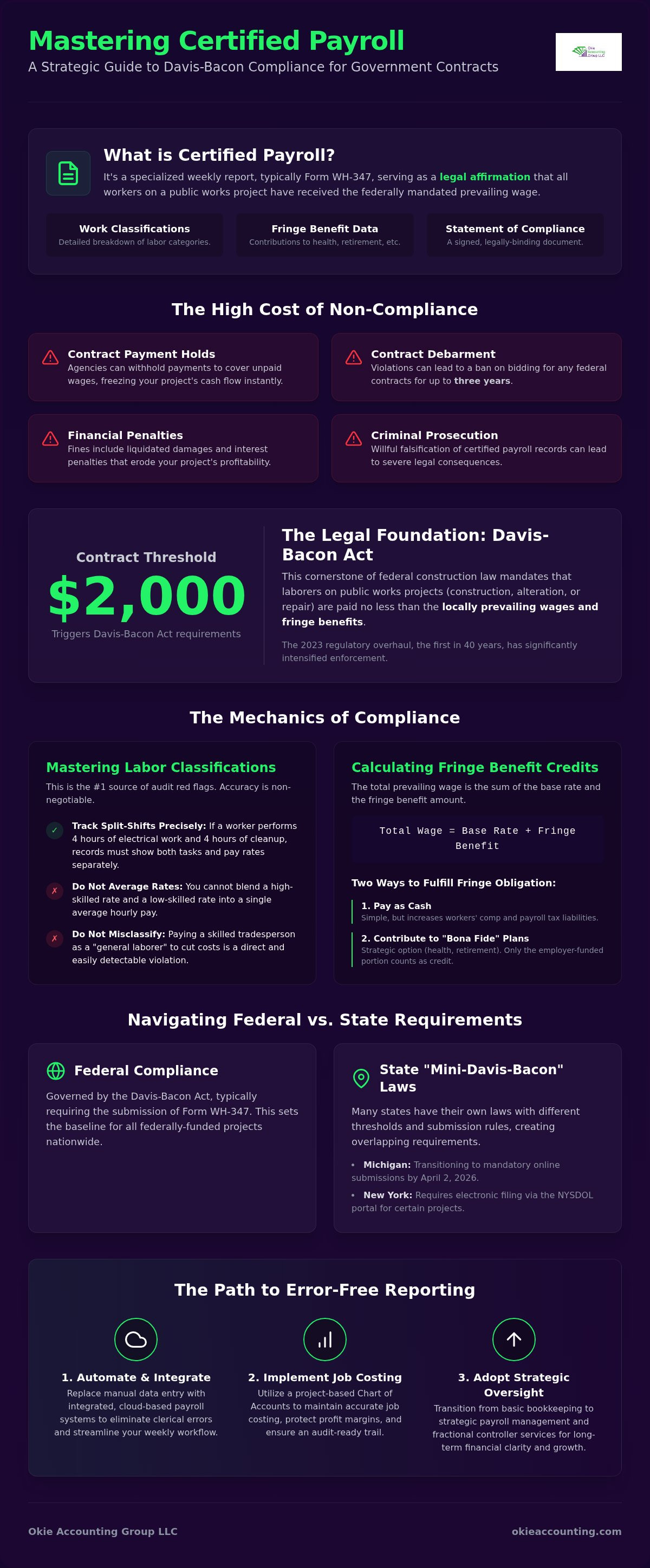
Certified payroll is a specialized weekly submission, typically utilizing Form WH-347, that documents the wages and benefits paid to laborers on public works projects. It's a fundamental requirement for contractors who want to maintain eligibility for federally funded work. The "certified" portion of this process isn't a mere administrative suggestion; it's a legal affirmation that the records provided are accurate and that every worker has received the mandated prevailing wage. This reporting serves as the primary mechanism for the Department of Labor to verify that your firm is meeting its contractual obligations under federal law.
A standard payroll report lists hours worked and gross pay, but certified payroll reporting for government contracts requires significantly more detail. It must include work classifications, fringe benefit contributions, and a signed Statement of Compliance. Without this signed statement, the payroll report isn't considered "certified," and your project funding can be frozen immediately. This document carries the weight of law, meaning any inaccuracies can lead to severe legal and financial consequences.
The Legal Foundation: Davis-Bacon and Beyond
The Davis-Bacon Act is the cornerstone of federal construction law. It mandates that any contract in excess of $2,000 for the construction, alteration, or repair of public buildings must pay laborers no less than the locally prevailing wages and fringe benefits. This $2,000 threshold remains the trigger for federal reporting requirements in 2026. The 2023 overhaul of these regulations, which was the first major update in nearly 40 years, has significantly intensified the enforcement landscape.
The Statement of Compliance is the most critical element of this framework. It must be signed by the business owner or an authorized officer, certifying under penalty of perjury that the records are correct. Failure to comply can result in:
Withholding of contract payments to cover unpaid wages.
Liquidated damages and interest penalties.
Debarment from bidding on any federal contracts for up to three years.
Criminal prosecution for willful falsification of records.
Federal vs. State Reporting Requirements
Compliance isn't a one-size-fits-all task because many states enforce their own "mini-Davis-Bacon" laws. These state-level regulations often have different wage thresholds and specific electronic filing portals. For instance, Michigan has transitioned to an online submission system for certified payroll records, with a mandatory deadline of April 2, 2026. New York requires electronic submission through the NYSDOL portal for projects under Article 8 of the NYS Labor Law.
You'll often encounter projects that receive both state and federal funding, which creates overlapping requirements. Identifying which jurisdiction governs your specific project is the first step in building a reliable reporting framework. Managing these complexities requires a transition from basic bookkeeping to a more strategic controller approach to ensure your firm remains audit-ready across all jurisdictions.
The Mechanics of Compliance: Prevailing Wages and Fringe Benefits
Successful certified payroll reporting for government contracts relies on your ability to interpret and apply Wage Determinations with absolute precision. These determinations, found on the System for Award Management (sam.gov), dictate the minimum pay for every labor category on your project. They aren't static; rates vary by geographic location and specific trade. Using an outdated determination or pulling a rate from the wrong county can trigger a compliance failure before your team even breaks ground. Accuracy here is the foundation of your project’s financial health and long-term stability.
Mastering Labor Classifications
Labor classification is the primary source of audit red flags. The Department of Labor looks specifically for instances where skilled tradespeople are misclassified as general laborers to lower payroll costs. If a worker spends any part of their day using the specialized tools of a trade, they must be paid that trade's specific rate. This becomes particularly difficult when managing "split-shifts." If an employee performs four hours of electrical work and four hours of general cleanup, your records must reflect that distinction. You can't simply average the rates; you must track and pay for every minute at the correct classification to maintain a defensible audit trail.
Calculating the Fringe Benefit Credit
The total prevailing wage is the sum of the base hourly rate and the required fringe benefit. You have the option to pay this fringe as cash in lieu of benefits, but this often increases your workers' compensation and payroll tax liabilities. A more strategic approach involves contributing to "Bona Fide" benefit plans, such as health insurance, life insurance, or retirement accounts. Only the employer-funded portion of these premiums counts toward your fringe benefit credit. Employee-paid portions or mandatory taxes like FICA do not reduce your prevailing wage obligation.
Tracking these hourly contributions across multiple workers and trades requires a methodical system. Leveraging QuickBooks for contractors helps automate these complex calculations, ensuring that your fringe credits are applied accurately against the wage determination minimums. This level of oversight protects your profit margins and ensures your reporting is always ready for scrutiny. If your current systems aren't providing this level of clarity, booking a discovery call can help you build a more robust compliance framework.
Top Risks and Common Mistakes in Certified Payroll
The administrative burden of certified payroll reporting for government contracts is high, but the cost of a mistake is often higher. Even minor oversights can cascade into project-wide financial disruptions. Agencies typically have the authority to freeze 100% of a progress payment if even one weekly report is missing or contains errors. This cash flow interruption creates a ripple effect, impacting your ability to meet other obligations and stalling project momentum. When your capital is tied up due to a clerical error, the stability you sought in government work quickly disappears.
Inaccurate data entry remains one of the most persistent issues for contractors. Small rounding errors on Form WH-347 might seem trivial, but they suggest a lack of systemic control to auditors. Beyond the forms themselves, you must adhere to strict record-keeping standards. The Department of Labor requires you to retain all certified payroll records, including original timecards and benefit plan documentation, for at least three years after project completion. Losing these records during that window can make a routine inquiry impossible to defend, leaving your firm vulnerable to retroactive penalties.
The Audit Trap: Why the DOL Flags Your Reports
Investigators look for specific red flag patterns that indicate non-compliance. These include suspicious apprentice-to-journeyman ratios or crews that consistently report exactly 40 hours with zero overtime across the entire project duration. Such patterns often trigger a deeper look into potential "under-the-table" payments or mismanaged overtime calculations. To mitigate these risks, many firms utilize a fractional controller to provide an internal audit layer. This high-level oversight ensures your data is scrutinized before it ever reaches a government portal, providing the peace of mind that your reporting is defensible.
Subcontractor Compliance Management
As a prime contractor, you're the guarantor of compliance for every subcontractor on your site. If a lower-tier sub fails to pay the prevailing wage, the government holds you liable for the back wages. Protecting your firm requires a proactive review process for every subcontractor report before it's finalized. Implementing a strict "no report, no pay" policy ensures you have the necessary documentation in hand before funds leave your account. This structural framework transforms subcontractor management from a liability into a controlled administrative process, safeguarding your reputation and your bottom line.
Building a Structural Framework for Reporting Accuracy
Most contractors treat compliance as a weekly scramble, but sustainable growth requires a shift toward a permanent structural framework. Relying on manual spreadsheets for certified payroll reporting for government contracts is a recipe for disaster as your project volume increases. These manual systems lack the version control and real-time visibility needed to protect your profit margins. A cloud-based integrated system ensures that every hour logged on-site flows directly into your financial reporting, allowing you to catch labor cost overruns before they erode your project's health.
At the core of this framework is a project-based Chart of Accounts. Your accounting system shouldn't just record total labor costs; it must be configured to track expenses by specific project phases and worker classifications. This granular level of detail is what makes real-time job costing possible. When your financial data is organized this way, you gain a clear view of your true project performance, ensuring that your bids remain competitive and your margins remain secure. This transition from basic administration to strategic financial oversight is what distinguishes market leaders from their competitors.
Integrating QuickBooks for Certified Payroll
Configuring your payroll items to mirror the specific categories found in your wage determinations is a critical step in system setup. This alignment reduces the need for manual adjustments and minimizes the risk of reporting errors. Many firms find that software training is the most efficient way to empower their internal teams to manage these complex configurations. By leveraging third-party applications that integrate directly with your accounting software, you can automate the generation of Form WH-347, transforming a multi-hour task into a streamlined, repeatable process that scales with your business.
Establishing Internal Controls and Oversight
Even the most advanced software requires human oversight to ensure total accuracy. Implementing the "Four Eyes" principle is a simple yet effective internal control: no certified report should be submitted until it's been reviewed by someone other than the person who prepared it. This secondary check should include a monthly reconciliation between your payroll journals and the submitted certified reports to catch any discrepancies. Creating a standardized checklist for every government project ensures that no detail, from apprentice certificates to fringe benefit documentation, is overlooked. If you're ready to build a more resilient reporting system, scheduling a discovery call is the first step toward strategic financial clarity.
Strategic Payroll Management with Okie Accounting Group LLC
Effective certified payroll reporting for government contracts shouldn't be viewed as a standalone administrative chore. It's an integral component of your firm's broader financial health. When payroll data is siloed from your cash flow forecasting and project management, you lose the ability to make data-driven decisions that protect your bottom line. Transitioning to a strategic model means your payroll records provide real-time insights into labor efficiency and contract profitability. This shift moves your business from a reactive state of compliance survival to a proactive state of operational clarity, managed by the experts at Okie Accounting Group LLC.
We focus on building the foundational systems that allow your firm to scale without the constant threat of a Department of Labor audit. Our approach ensures that your infrastructure is audit-ready from day one, protecting your reputation with contracting agencies and prime contractors alike. By establishing rigorous internal controls and cloud-based tracking, Okie Accounting Group LLC helps you secure the structural integrity needed to pursue larger, more complex public works projects. You gain the peace of mind that comes from knowing your financial data is managed by specialists who understand the unique mechanics of the construction sector.
The Fractional Controller Advantage
High-growth firms quickly outgrow the capabilities of a standard data-entry clerk. You need a partner who can interpret the "why" behind the numbers, not just the "what." Our management accounting services provide the high-level oversight required to monitor apprentice ratios, verify fringe benefit credits, and ensure job costing accuracy. Led by Sarah OQuinn, a strategic accounting professional, Okie Accounting Group LLC acts as your dedicated mentor in the financial space. This partnership allows you to focus on field operations while we handle the complexities of prevailing wage compliance and profit protection, positioning your firm for long-term stability and success.
Secure Your Discovery Call Today
Moving from complexity to clarity begins with a tailored assessment of your current systems. During a discovery call, we'll evaluate your existing payroll workflow and identify the specific gaps that could lead to reporting errors or payment delays. We'll discuss how to implement the structural framework mentioned throughout this guide, ensuring your QuickBooks setup is optimized for the specific demands of government work. Don't let administrative friction hold your business back from its full potential. Book your Discovery Call with Okie Accounting Group LLC today and take the first step toward a more disciplined, strategic financial future.
Securing Your Firm’s Future in Public Works
Mastering Davis-Bacon compliance requires moving from reactive administration to a robust structural framework. We've analyzed how accurate labor classifications and automated cloud-based systems protect your profit margins from the ripple effects of payment delays and DOL audits. Effective certified payroll reporting for government contracts isn't just about filling out Form WH-347; it's about building a defensible, audit-ready infrastructure that supports nationwide growth. Okie Accounting Group LLC specializes in construction accounting, providing nationwide remote fractional controller services that ensure your financial data remains a strategic asset rather than a liability. This specialized oversight allows you to focus on project execution while your back-office systems handle the weight of federal regulations.
You don't have to navigate these complexities alone. By integrating a disciplined approach to your payroll management, you gain the clarity needed to scale your business with confidence and precision. Schedule your Discovery Call to secure your payroll compliance framework. We're ready to partner with you to build the systems that turn compliance into your strongest competitive advantage.
Frequently Asked Questions
What is the Davis-Bacon Act and how does it affect my payroll?
The Davis-Bacon Act is a federal law that mandates the payment of local prevailing wages and fringe benefits on public works construction projects exceeding $2,000. It transforms your payroll process by requiring you to track specific labor classifications and ensure every employee meets or exceeds the rates set by the Department of Labor. Failure to align your payroll journals with these wage determinations can lead to withheld payments and contract termination.
Do I need to submit a certified payroll report if no work was performed this week?
You must continue to submit weekly reports even if no work was performed on the project during a specific week. These are often referred to as "No Work" or "Non-Performance" reports. Maintaining this consecutive numbering is essential for certified payroll reporting for government contracts, as it proves to the contracting agency that there are no gaps in your compliance records. Stopping submissions without notice can trigger an immediate administrative flag.
Can I use my standard QuickBooks payroll for certified reporting?
Standard QuickBooks payroll does not automatically generate the WH-347 form required for federal compliance. While it's an excellent foundation for tracking labor costs, you must configure specific payroll items to match wage determinations or utilize integrated third-party applications. We often help contractors through specialized software training to ensure their QuickBooks environment is structured to handle the granular data required for government reporting without manual data entry.
How long must I keep certified payroll records for a federal contract?
You are legally required to maintain all certified payroll records for at least three years after the completion of the contract. This retention rule applies not only to the submitted reports but also to original timecards, fringe benefit plan documentation, and apprentice certifications. Keeping these records in a secure, cloud-based system ensures you are prepared for a Department of Labor audit long after the project has been finalized and paid.
What happens if I misclassify a worker on a certified payroll report?
Misclassifying a worker triggers immediate liability for back wages representing the difference between the paid rate and the correct prevailing wage. Beyond financial restitution, the Department of Labor may impose liquidated damages or initiate debarment proceedings, which prevent you from bidding on future federal work for up to three years. These errors are often viewed as "red flags" that can prompt a more exhaustive investigation into your firm's entire financial history.
What is a Statement of Compliance in certified payroll?
The Statement of Compliance is the second page of Form WH-347 and serves as a legal affirmation of the report's accuracy. By signing this document, an owner or authorized officer certifies under penalty of perjury that all workers received the correct prevailing wages and fringe benefits. It's the element that makes the payroll "certified," and submitting a report without a completed statement is a violation of federal contract requirements.
Are fringe benefits required to be paid in cash on government contracts?
You aren't required to pay fringe benefits in cash, although it's a common practice for contractors without established benefit plans. You can satisfy the fringe requirement by making contributions to "Bona Fide" plans, such as health insurance or retirement accounts. If your contributions don't meet the full hourly rate required by the wage determination, you must pay the remaining balance as a cash addition to the employee's hourly check.
How do I handle overtime pay on a prevailing wage project?
Overtime on a prevailing wage project is calculated at one and one-half times the basic hourly rate of pay. It's important to note that the fringe benefit portion of the prevailing wage is typically paid at the straight-time rate, even for overtime hours, unless the specific wage determination states otherwise. Accurate tracking of these separate components is vital for certified payroll reporting for government contracts to avoid miscalculation and potential underpayment claims.


Comments