Construction Bookkeeping for Subcontractors: Practical Guide

Updated: Nov 7
A busy subcontractor job can quietly drain profit when costs, billings, and cash receipts never line up. Construction bookkeeping for subcontractors needs to do more than sort income and expenses. It should connect labor and material costs to each job, match billings to approved change orders, and show what has been paid, including any retainage.
That can be difficult to manage when payroll posts before labor is assigned to a project, invoices lag behind completed work, or records are incomplete. Without timely, job-specific information, it is hard to tell whether a project is over budget or simply waiting on payment. Basic transaction entry alone won’t close those gaps.
This guide explains how to organize job costs, billing, payroll, and cash records so you can see each job’s financial position. It covers the records to keep, how to compare costs with invoices and payments, and how financial reporting and cash flow forecasting can bring payment timing and retainage into view. A reliable monthly bookkeeping process helps you spot pressure sooner and make more informed operating decisions.
Construction Bookkeeping for Subcontractors: What It Needs to Track
Construction bookkeeping for subcontractors connects financial records to the work that generates revenue. It should bring together each job’s costs, contract documents, billings, payments, receivables, and reports. Company-wide records show the business’s overall financial position. Job-level records show which projects are using labor, materials, equipment, and other resources.
This distinction matters when you review margins or plan for upcoming cash needs. A profit and loss statement may show total payroll expense for the month without showing how much labor belonged to a specific project. Consistent cost coding adds that context and makes the reports more useful. Construction accounting also describes how construction businesses categorize costs, including direct and indirect costs.
Which records should a subcontractor keep for each job?
Set up a clear record for each project and use the same job name or code across documents and transactions. Keep these items connected to the job:
Direct costs: Labor, materials, equipment, and other costs incurred to perform the work.
Contract and scope documents: The original agreement and approved change orders, so recorded work and costs can be compared with the current scope.
Billing and payment records: Invoices submitted, payments received, and outstanding receivables.
Retainage: Amounts withheld from payment, tracked separately when the contract requires it.
For example, code a materials purchase to the project it supports instead of leaving it in a general expense category. Then you can review the job report and billing records against the same project documentation.
How does job costing support subcontractor decisions?
Job costing organizes a project’s revenue and costs by job and category; a company-wide profit and loss statement summarizes income and expenses across the business. Comparing recorded job costs with the original estimate or budget helps you spot differences. If labor is running higher than expected, for example, review the labor assigned to that job rather than relying on a company-wide payroll total.
Software can organize transactions and produce reports, but a misclassified cost is still unhelpful. Accurate project coding, complete source documents, and regular review make the numbers more dependable. A consistent bookkeeping process gives you a clearer view of job performance, receivables, and cash needs.
How Job Costs, Change Orders, and Subcontractor Billing Connect
A job’s financial trail starts with its contract terms and estimate, then follows the work as costs are incurred, invoices are submitted, and payments arrive. Connecting each step helps you see whether a job is tracking to budget, whether completed work has been billed, and whether billed amounts have turned into cash. The IFRS Foundation’s construction-contract accounting literature offers international context; the applicable reporting framework determines how a business accounts for its contracts.
Include approved change orders in this trail. Keep each approval and revised scope with the job record, update the project budget or estimate, and include the added work in billing when contract terms and documentation support it. If costs are recorded against the original scope while billing reflects changes, job reports may not show the full picture.
How should subcontractors organize direct job costs?
Use consistent project identifiers and cost categories for labor, materials, equipment, and other direct costs. Before relying on a job report, compare its entries with source documents such as time records, purchase receipts, and vendor invoices. Consistent coding helps pinpoint whether a budget variance comes from labor, materials, or another category. Reconciliation makes unusual or missing entries easier to investigate.
How should billing and retainage appear in the records?
Prepare invoices in line with contract terms and documentation of completed work. Record submitted invoices as receivables, not as cash collected. Match each payment to its invoice and track any balance still due. When the contract requires retainage, show it separately from collected cash so you can see what remains outstanding and plan around payment timing.
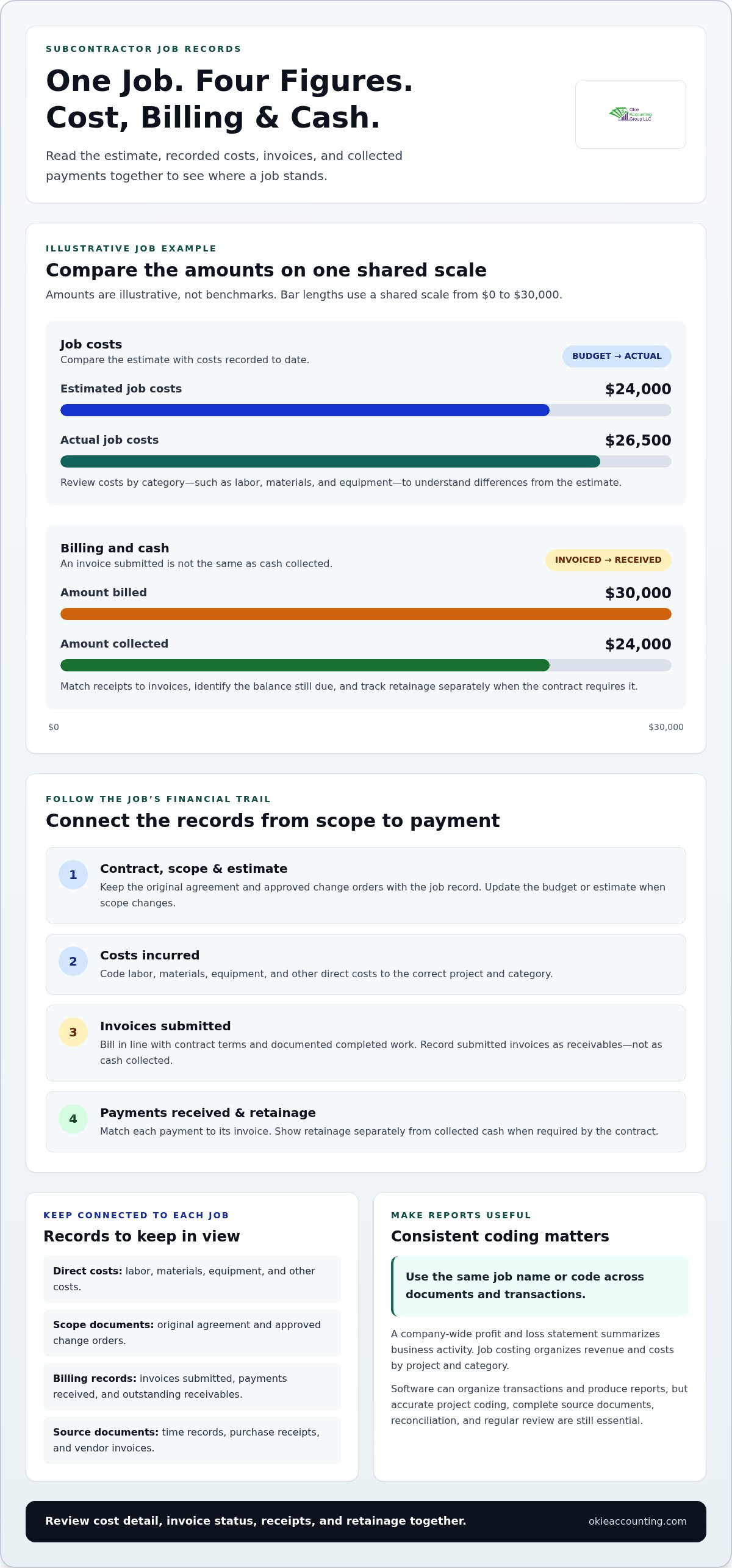
The example below shows why the figures should be reviewed together. Amounts are illustrative, not benchmarks.
Here, actual costs exceed the estimate, while the billed amount differs from the amount collected. Review cost detail, invoice status, and the remaining receivable together to decide what needs follow-up and how to plan for cash needs. Okie Accounting Group LLC provides construction bookkeeping support, including monthly bookkeeping and financial reporting. Learn more through a construction bookkeeping discussion.
Is Basic Bookkeeping or QuickBooks Enough for a Subcontractor?
QuickBooks or another accounting platform can record transactions and organize financial activity, but it can’t ensure each cost is assigned to the right project or that supporting documents are complete. Those results depend on a consistent process: transactions need to be coded, connected to source records, reconciled, and reviewed. Software is the tool; accurate, timely information is the foundation.
A company-wide ledger might show total labor expense, invoices, and customer payments. Job-aware records add the project context: which job incurred the labor, what has been billed against it, what remains outstanding, and whether retainage is still withheld. That distinction helps you interpret results instead of relying on totals that combine unrelated projects. For practical software guidance, see this QuickBooks setup and training resource.
What can bookkeeping software do, and what requires a process?
Software can store transaction details, organize accounts, and generate reports from the information entered. Your team still needs to use consistent project and cost-category labels, submit documents promptly, and investigate uncoded or unusual items. If a supplier invoice is left in a general expense category instead of assigned to a job, the report may look tidy but still fail to show the project’s actual cost position.
Construction bookkeeping for subcontractors works best when software setup and daily practices support the same reporting structure. Hubstaff’s construction bookkeeping guide also discusses retainage, which needs to remain visible separately from cash collected when amounts are withheld under contract terms.
When might a subcontractor need more than basic transaction entry?
Look for recurring signs that your books aren’t giving you timely, job-level insight:
Costs remain uncoded or are assigned inconsistently across projects.
Bank or account reconciliations are incomplete, making balances harder to rely on.
Reports arrive too late to help assess current project performance or upcoming cash needs.
Invoice balances, receipts, or retainage are difficult to track against the related job.
The process you need depends on project volume, billing complexity, and the decisions your reports need to support. A subcontractor managing a few straightforward jobs may need a different review structure than one handling overlapping projects, frequent scope changes, or layered billing requirements. Recurring bookkeeping and financial review bring company-wide results and project records into view together.
Timely records don’t eliminate cash-flow risk or guarantee a profitable job. They do help clarify what has been spent, billed, and collected, so you can spot gaps sooner and make more informed operating decisions. If transaction entry is happening but useful reports aren’t following, the issue may be the process around the software, not the software itself.
A Monthly Bookkeeping Workflow for Subcontractor Jobs
A reliable monthly close separates transaction entry from financial review. Recording bills and receipts keeps the ledger current. Reviewing reconciled records helps catch missing documents, late invoices, and costs assigned to the wrong job. This repeatable workflow makes construction bookkeeping for subcontractors more useful for project oversight and cash planning.
Collect and organize documents. Gather bank and credit card statements, vendor invoices, receipts, time and payroll records, customer invoices, payment details, and contract-related documents. Sort them by period and job where applicable.
Record transactions consistently. Enter income and expenses, assigning direct costs to the correct project and category. Attach or retain the source documentation so unusual transactions can be traced.
Reconcile financial accounts. Compare bank and credit account activity with the ledger. Investigate unmatched or duplicate transactions instead of carrying unexplained differences into the reports.
Review job and billing balances. Check job-cost coding, open customer invoices, receipts matched to invoices, and retainage balances. Compare current project reports with prior periods, budgets, or expected progress, and note variances that need follow-up.
Review cash needs and close with actions. List upcoming costs, payroll obligations, and contract-related balances alongside expected receipts. Document next steps, such as following up on an overdue invoice or locating a missing vendor document.
What should be reconciled and reviewed each month?
Reconciliation confirms that recorded activity agrees with account statements; it doesn’t replace reviewing what the numbers mean. Check whether job costs are coded consistently, customer receipts clear the correct invoices, and withheld retainage remains distinct from collected cash. Compare reports over time and record unresolved items with an owner and a follow-up date.
How can subcontractors keep payroll and reporting records organized?
Keep payroll records and labor allocations aligned with the project labels used for other job costs. This connects labor expense to the work performed and reduces confusion when reviewing project reports. Before relying on payroll, information-reporting, or recordkeeping deadlines and obligations, verify current federal and applicable state requirements for your business. This guidance is for bookkeeping organization, not legal advice.
Consistent monthly bookkeeping and review can clarify what has been spent, billed, collected, and committed, but they can’t remove cash-flow uncertainty. Okie Accounting Group LLC provides monthly bookkeeping and financial reporting to help establish a repeatable close and clearer financial records. Learn more by scheduling a discovery call.
Build a Reliable Subcontractor Bookkeeping System with Ongoing Support
A dependable bookkeeping system gives subcontractors more than a record of past transactions. It creates a consistent foundation for reviewing job costs, outstanding balances, and overall financial position. Monthly bookkeeping keeps transactions recorded, accounts reconciled, and the general ledger maintained, so financial statements are based on organized records rather than a last-minute catch-up.
What should subcontractors expect from monthly bookkeeping support?
Monthly bookkeeping includes transaction recording, bank reconciliations, general ledger maintenance, and standard monthly financial statements. For subcontractors, these services are most useful when project coding is consistent: labor and other costs can be reviewed by job, while invoices and receipts show what remains outstanding. That recurring structure makes it easier to address recordkeeping gaps before they become harder to untangle.
QuickBooks setup and training help a team record transactions consistently, apply project labels, and follow a shared workflow. Okie Accounting Group LLC also provides payroll management to support organized payroll records and labor allocations. The firm works remotely with construction businesses across the United States, including in Tennessee and Jacksonville, Florida. Payroll and reporting requirements still depend on the business’s applicable jurisdictions.
When can controller support add another layer of financial oversight?
Routine bookkeeping records and reconciles activity; controller oversight adds a review and planning layer. Fractional controller services can include helping owners interpret financial reports, consider budgets, strengthen internal controls, and connect cash flow forecasts to upcoming business needs. As project volume, billing complexity, or reporting demands grow, that perspective helps turn accurate records into more informed operating decisions. Explore fractional controller services for additional financial oversight.
Construction bookkeeping for subcontractors works best as a coordinated system: monthly records establish a reliable base, payroll and QuickBooks processes support consistency, and reporting or controller review brings the wider picture into focus. No bookkeeping process can guarantee a profitable job or eliminate cash-flow uncertainty, but timely, well-organized information can help owners identify questions and respond with greater clarity.
Okie Accounting Group LLC provides bookkeeping support for subcontractors. Book a discovery call to discuss your bookkeeping needs.
Turn Clearer Job Records Into Confident Decisions
Reliable construction bookkeeping for subcontractors connects project costs to billing, receipts, and outstanding balances. With consistent coding and regular review, you can see how each job is tracking, identify records that need attention, and plan with a clearer view of upcoming cash needs. Software supports that structure, while accurate records and thoughtful financial review make the information useful.
Okie Accounting Group LLC supports construction businesses with monthly bookkeeping and fractional controller services, alongside QuickBooks setup and training, payroll management, cash flow forecasting, and financial reporting. These services help establish dependable records and make financial information easier to use as your business grows.
For support with job costs, reconciliations, and reporting, book a discovery call with Okie Accounting Group LLC.
Frequently Asked Questions
What is construction bookkeeping for subcontractors?
Construction bookkeeping for subcontractors is the organized recording and review of company finances alongside project-level costs and billing. It connects job expenses, such as labor and materials, with invoices, receipts, and applicable retainage while maintaining company-wide records. The goal is useful financial information: owners can assess job performance, outstanding balances, and cash needs instead of relying on transaction entries without project context.
How do subcontractors track job costs in bookkeeping?
Assign each job-related transaction to the correct project and a consistent category, such as labor, materials, or equipment. Keep receipts, vendor invoices, payroll records, and approved change-order documents organized with the relevant job. Reconcile accounts regularly, then review job reports for costs that are missing, misclassified, or unexpectedly high. For example, labor coded to the wrong project can distort the reported cost of both jobs.
Is QuickBooks enough for subcontractor bookkeeping?
QuickBooks can record transactions and produce financial reports, but it can’t ensure that costs are coded to the right job or that source documents are complete. Reliable results depend on suitable setup, consistent project labels, timely document handling, and regular review. A subcontractor’s process should connect job costs with invoices, payments, and supporting records so reports reflect the work accurately, rather than presenting organized but incomplete information.
How should subcontractors track retainage in their books?
Track retainage separately from cash received and connect it to the relevant job and invoice. Review contract terms and supporting documents to understand when the retained amount may be billed or collected, and keep any remaining balance visible in receivables. The appropriate accounting treatment can depend on the contract and circumstances. Okie Accounting Group LLC provides bookkeeping and financial oversight to help organize and review these records.
Can a bookkeeper help a subcontractor understand job profitability?
Yes. When job costs are assigned consistently and billing and receipts are recorded accurately, job reports can compare actual costs with the project’s estimate or budget. A bookkeeper can maintain and reconcile the underlying records, while financial reporting or controller oversight can help owners interpret patterns and investigate variances. Reports provide a clearer basis for decisions, but they can’t guarantee a particular project’s profitability or outcome.
When should a subcontractor hire construction bookkeeping support?
Consider bookkeeping support if reconciliations are falling behind, job costs are difficult to identify, invoices and receipts don’t match clearly, or reports arrive too late to inform decisions. The right support depends on workload and reporting needs. Monthly bookkeeping can maintain the records, while QuickBooks training, payroll management, cash flow forecasting, or controller oversight can address other needs. Okie Accounting Group LLC supports construction businesses in Tennessee and Jacksonville, Florida, as well as remotely nationwide.


Comments