Construction Job Costing Best Practices: The 2026 Strategic Guide to Profit Protection

Updated: Nov 7
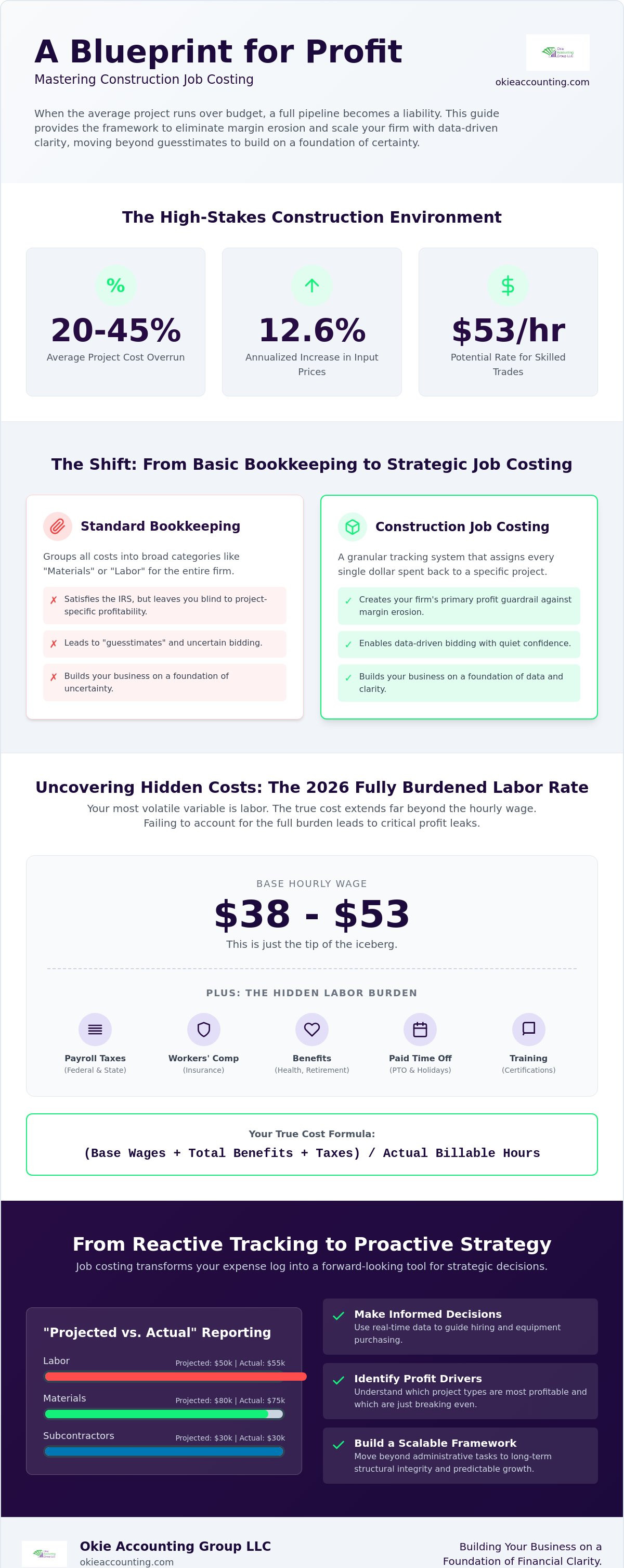
When the average construction project runs 20% to 45% over budget, a full pipeline is no longer a sign of health; it's a liability. You likely feel the pressure of shrinking margins even as your crews stay busy. It's difficult to bid with confidence when labor rates are volatile and nonresidential input prices have seen a 12.6% annualized increase this year. Implementing construction job costing best practices is the only way to move away from "guesstimates" for skilled trades that now command up to $53 per hour. Without a precise framework, you are building on a foundation of uncertainty rather than the stability your business requires.
This guide provides the structural framework necessary to eliminate margin erosion and scale your firm with data-driven clarity. We will explore how to transition from basic administrative tracking to a sophisticated system of financial oversight. This approach protects your bottom line and informs your most critical hiring and equipment decisions for 2026 and beyond. By the end of this article, you will have a reliable system for tracking every dollar per project to ensure your future growth is both predictable and profitable.
Why Construction Job Costing is Your Firm’s Most Critical Profit Guardrail
Construction job costing isn't just an administrative task. It's a granular tracking system that assigns every dollar spent back to a specific project. Most generalist bookkeepers group costs into broad categories like "Materials" or "Labor" for the whole firm. This might satisfy the IRS, but it leaves you blind to which projects are actually profitable. In a year where nonresidential construction input prices saw a 12.6% annualized increase, broad categories are dangerous. You need to know if a specific project is bleeding cash before it's too late. To understand the foundational mechanics, many professionals ask: What is Job Costing? It's the process of accumulating costs for a specific job to ensure your bids reflect reality.
Adopting construction job costing best practices allows you to move from a state of financial reactive stress to one of quiet confidence. When you have a clear view of your project health, you aren't just recording history; you're protecting your future. This structural framework ensures that every material purchase and every hour of labor is accounted for, creating a reliable barrier against margin erosion.
The Cost of Guesstimating vs. Data-Driven Bidding
Small errors in your initial estimate don't stay small. They compound. If you "guesstimate" labor for a project, a 5% error on day one becomes a massive margin leak by day ninety. With skilled trades now costing up to $53 per hour, guessing is a gamble you can't afford. Transitioning to a data-driven approach shifts your mindset. You stop hoping for a profit at the end of the year. Instead, you know your numbers before the first shovel hits the ground. Historical data becomes your most powerful bidding tool. It allows you to build a structural framework for growth that isn't dependent on luck.
Moving Beyond Compliance to Strategic Intelligence
Compliance is the floor, not the ceiling. While your bank requires financial statements, you require strategic clarity. This is where job costing evolves into management accounting. It identifies which project types are your true profit drivers and which ones are simply keeping the lights on. It's about building a system that protects your long-term health. By looking at real-time project health, you can make disciplined choices about which bids to chase and which to walk away from. Job costing is a profit-protection framework that transforms your expense log into a forward-looking strategy.
Mastering the Components: Direct Costs and the Hidden Labor Burden
Direct costs like materials and subcontractor fees are the most visible layers of any project. However, they're currently subject to extreme volatility. As of July 2026, steel prices have climbed 11.5% year-over-year, while lumber has risen by 10.6%. Tracking these in real-time is essential for construction job costing best practices. Beyond materials, project-specific permits and subcontractor invoices must be meticulously logged to prevent profit leakage. If these costs aren't assigned to the correct job, your financial reporting will reflect a skewed reality that can lead to disastrous bidding decisions later.
Hidden costs often act as a slow leak in an otherwise solid project. Indirect overhead, such as project management time or equipment depreciation, frequently goes unallocated. To maintain structural financial integrity, professionals often look toward AACE International's cost engineering standards for benchmarks on how to categorize these complex expenditures. Properly capturing these details ensures you aren't subsidizing one project's losses with another's gains. This level of precision is what separates a service provider from a strategic partner.
Calculating the 2026 Fully Burdened Labor Rate
Labor is your most volatile variable. The true cost of an employee extends far beyond their hourly check. In 2026, with the industry needing to attract 349,000 new workers to maintain equilibrium, labor rates for skilled trades have surged to between $38 and $53 per hour. Your labor burden must account for every cent spent to keep that worker on-site. A complete 2026 checklist includes:
Federal and state payroll taxes
Workers' compensation insurance premiums
Health, dental, and retirement benefits
Paid time off (PTO) and holiday pay
Safety training and mandatory certification costs
To find your true cost, use this formula: (Base Wages + Total Benefits + Taxes) / Actual Billable Hours. This calculation provides the clarity needed to bid with confidence. For firms struggling to maintain this level of detail, our fractional controller services offer the high-level oversight required to manage complex labor calculations and protect your margins.
Managing Indirect Costs and Equipment Allocation
Invisible costs like fuel, small tools, and maintenance can easily disappear into the general ledger if not properly tracked. Many firms use a flat-percentage overhead allocation, but this often leads to inaccurate project health reports. Activity-based costing provides a more disciplined approach by distributing costs based on actual equipment usage or hours spent on a specific site. Unallocated equipment costs are the silent killers of construction profitability. Capturing these details allows you to see the truth of your margins and make data-driven choices about future equipment investments. If you're ready to move from administrative chaos to strategic clarity, you can schedule a discovery call to discuss your firm's specific financial structure.
Building a Scalable System with QuickBooks Online Best Practices
Scaling your firm requires more than just a larger pipeline; it requires a digital foundation that can handle increased complexity. While some suggest expensive ERP systems, a correctly configured QuickBooks Online setup remains a powerhouse for construction job costing best practices. As of August 2026, QuickBooks Plus and Advanced tiers offer robust project-based tracking that, when paired with specialized oversight, provides the financial clarity needed for significant growth. Building this system involves four critical steps that move your accounting from a simple ledger to a strategic tool.
Step 1: Configuration of the Chart of Accounts. You must move beyond a standard retail structure. Your Chart of Accounts should mirror your production stages to ensure costs are categorized logically.
Step 2: Utilization of the 'Projects' Feature. This tool allows you to isolate income and expenses for every job site, providing a real-time view of project-specific profitability.
Step 3: Implementation of Standardized Cost Codes. Utilizing CSI MasterFormat codes ensures consistency across all bids and actuals, allowing you to compare performance across different project types.
Step 4: Integration of Field Data Tools. Connecting mobile apps for time tracking and receipt capture eliminates manual entry errors and reduces administrative lag.
If your team needs help navigating these configurations, our QuickBooks software training can bridge the gap between technical complexity and operational ease. This structured approach creates a sense of order that mirrors the organized systems we build for our strategic partners.
Structuring Your Chart of Accounts for Project Clarity
A standard Chart of Accounts is insufficient for the construction industry. You must specialize yours to reflect the unique mechanics of project-based work. The goal is to match your accounting structure to your estimating structure. When these two systems align, you can identify exactly where a project is deviating from the plan before the margin is eroded. For a deeper look at this setup, see our pillar article on Mastering QuickBooks for Contractors.
Automating Field Data Collection for Real-Time Accuracy
Administrative lag is the enemy of profit protection. If you wait until the end of the week to review labor hours from Monday, your opportunity to course-correct is already gone. Implementing mobile time-tracking and digital receipt capture ensures that field data flows into your system immediately. This fosters a "daily report" culture where labor hours are coded to the correct job as they happen. This real-time accuracy allows you to manage project health with quiet confidence rather than historical regret.
Strategic Oversight: Using Job Cost Data for Proactive Growth
Data collection is the foundation, but strategic oversight is the structure that protects your profit. Moving from a tracking mindset to an analytical one requires a fractional controller's perspective. You aren't just looking at what you spent; you're looking at why you spent it and how it compares to your initial bid. Implementing construction job costing best practices involves a weekly review of the 'Projected vs. Actual' report. This document acts as your early warning system. It allows you to identify "Red Flag" projects where rework, which averages 5% of a project's value, is starting to cannibalize your margin. With construction projects typically running 20% to 45% over budget, this oversight isn't optional; it's a requirement for survival.
When you understand these variances, you can adjust your operations in real-time. This level of oversight is closely tied to construction cash flow management, as project health directly dictates your firm's liquidity. By identifying deviations early, you ensure your pipeline remains a source of growth rather than a drain on resources. This proactive stance alleviates the industry-specific stress of financial uncertainty.
Analyzing Variance and Managing Work in Progress (WIP)
Work in Progress (WIP) accounting is essential for any firm that wants accurate monthly financial statements. It allows you to recognize revenue based on the percentage of completion rather than just when invoices are sent or bills are paid. This process helps you spot "over-billing" and "under-billing" before they impact your stability. Over-billing might provide a temporary cash surplus, but it often masks future cash shortages. Conversely, under-billing suggests you're financing the client's project with your own capital. Variance analysis prevents the same bidding mistake from happening twice by highlighting exactly where your estimates diverged from reality. By adhering to construction job costing best practices, you move from historical recording to proactive management.
Identifying Change Order Opportunities and Margin Erosion
Scope creep is a silent profit killer. It often hides in job costs as small, unrecorded requests that slowly erode your margin. Using granular job cost data allows you to prove the need for change orders with objective evidence. When you can show a client exactly how a shift in scope has increased labor hours or material consumption, the conversation moves from a negotiation to a data-driven fact. A fractional controller plays a vital role here by interpreting these complex reports and translating them into actionable strategies for the business owner. This ensures that your firm's long-term health is protected against the "death by a thousand cuts" that comes from unbilled work.
If you're ready to stop guessing and start growing with financial clarity, schedule a discovery call today to see how a strategic partner can transform your project health.
Scaling with Confidence: The Okie Accounting Specialized Framework
Implementing construction job costing best practices is more than a one-time software adjustment; it's a commitment to long-term structural integrity. While generalist providers often focus on basic data entry, Okie Accounting Group LLC acts as a strategic partner to ensure your financial foundation is as solid as your builds. We move firms away from the stress of bookkeeping chaos and toward a state of operational clarity. By aligning your accounting systems with the unique mechanics of the construction industry, we provide the visibility you need to protect every dollar of your margin.
Our approach is grounded in the belief that accurate data should drive every high-level decision. Whether you're considering a major equipment purchase or planning your next hiring phase, you deserve to move forward with data-driven confidence. We specialize in the construction and real estate sectors, providing a level of niche expertise that generalists simply cannot match. This specialized focus allows us to anticipate industry-specific challenges before they impact your bottom line.
Beyond Bookkeeping: The Fractional Controller Advantage
There is a fundamental difference between recording history and building a future strategy. Standard bookkeeping tells you what happened last month, but our Fractional Controller Services help you determine what should happen next. This high-level oversight acts as your firm's ultimate growth engine by identifying profit leaks and optimizing cash flow in real-time. Having a disciplined, strategic mentor in your corner provides the peace of mind that your margins are being rigorously managed. We don't just hand you reports; we help you interpret them to ensure long-term stability and profit protection.
Professional QuickBooks Setup and Training
A sophisticated job costing system is only as effective as its initial configuration. We provide professional QuickBooks Online setup and training that is tailored specifically for the construction workflow. This ensures your Chart of Accounts and project tracking features are optimized from day one. By empowering your internal team through specialized training, we create a sustainable system of financial readiness. The ROI of a correctly configured system is found in the hours saved on manual entry and the thousands of dollars saved by catching variance early. It's about building a scalable framework that grows alongside your firm's ambitions.
Your business deserves a financial partner that is as invested in your success as you are. If you're ready to transform your accounting from an administrative burden into a strategic asset, Schedule a consultation with Okie Accounting Group LLC to build your financial infrastructure. Let's build the systems your firm needs to scale with confidence.
Securing Your Firm's Future Through Financial Integrity
Establishing a structural framework for your finances is the most effective way to combat the volatility of 2026. By moving beyond basic record-keeping and mastering construction job costing best practices, you transform your accounting into a proactive profit engine. You now understand that capturing the full labor burden and utilizing specialized QuickBooks configurations aren't just administrative tasks; they are the foundational systems that allow for predictable, scalable growth.
Okie Accounting Group LLC provides the specialized construction and real estate focus your business requires to thrive. Our fractional controller oversight moves you from historical data to future strategy, while our certified QuickBooks experts ensure your digital infrastructure remains accurate and reliable. You don't have to manage these complexities alone. When your financial data is clear, your path to expansion becomes obvious.
Build Your Strategic Financial Infrastructure with Okie Accounting Group LLC today. Let's work together to protect your margins and build a legacy of stability.
Frequently Asked Questions
What is the difference between job costing and standard accounting?
Job costing tracks income and expenses for specific projects, whereas standard accounting groups costs into broad categories for the entire company. Standard accounting tells you if your firm is profitable as a whole, but it doesn't show you which specific projects are making or losing money. Job costing provides the granular visibility needed to identify high-margin work and eliminate projects that drain your resources.
Why is labor burden so difficult to calculate in construction?
Labor burden is complex because it involves fluctuating variables like workers' compensation codes, varying state payroll taxes, and specific fringe benefits. In construction, a single employee might perform different tasks with different risk levels in one day, which changes your insurance exposure. Tracking these shifting costs alongside non-billable time like safety training requires a disciplined structural framework that most generalist systems can't provide.
Can I do job costing in the basic version of QuickBooks Online?
No, you cannot effectively implement construction job costing best practices in the "Simple Start" or "Essentials" versions of QuickBooks Online. These basic tiers lack the native "Projects" feature required to isolate income and expenses per project. You generally need at least the "Plus" or "Advanced" versions to build a system that provides real-time project health and accurate financial reporting.
How often should I review my project cost reports?
You should review your project cost reports at least once a week to catch variances before they become financial disasters. Waiting until the end of the month or the end of the job is a reactive approach that leaves no room for course correction. Weekly reviews of "Projected vs. Actual" data allow you to spot scope creep or labor inefficiencies while you still have time to adjust your strategy.
What are the most common job costing mistakes contractors make?
The most common errors include failing to allocate indirect costs like fuel and small tools, and neglecting to update labor burden rates when insurance premiums rise. Many firms also suffer from administrative lag, where field data isn't entered into the system for weeks. Adhering to construction job costing best practices helps prevent these errors, which otherwise lead to inaccurate bidding data and winning projects that aren't actually profitable.
How does job costing help with my construction company's taxes?
Job costing provides the detailed documentation required for accurate revenue recognition, which is a critical part of construction tax compliance. It helps you justify project-specific deductions and ensures you aren't paying taxes on revenue that hasn't been earned yet. While Okie Accounting Group LLC doesn't provide tax preparation, our specialized financial reporting ensures your CPA has the clean data they need to file accurately.
Do I need a full-time CFO to manage my job costing system?
Most mid-sized construction firms don't require a full-time CFO; they need the strategic oversight provided by fractional controller services. This model gives you the high-level expertise of a financial executive without the overhead of a six-figure salary. A fractional partner can establish your structural framework and interpret complex variance reports, allowing you to make data-driven choices about your firm's growth.
What is a 'fully burdened' labor rate and why does it matter?
A fully burdened labor rate is the total cost of an employee per billable hour, including their base wage, payroll taxes, insurance, and benefits. It matters because bidding based on simple hourly wages is a primary driver of margin erosion. Knowing your true labor cost ensures that your bids are high enough to cover all expenses and protect the net profit your firm needs to remain stable.


Comments