Construction Progress Billing: The Strategic Guide to Cash Flow and Profit Protection in 2026

Updated: 6 days ago
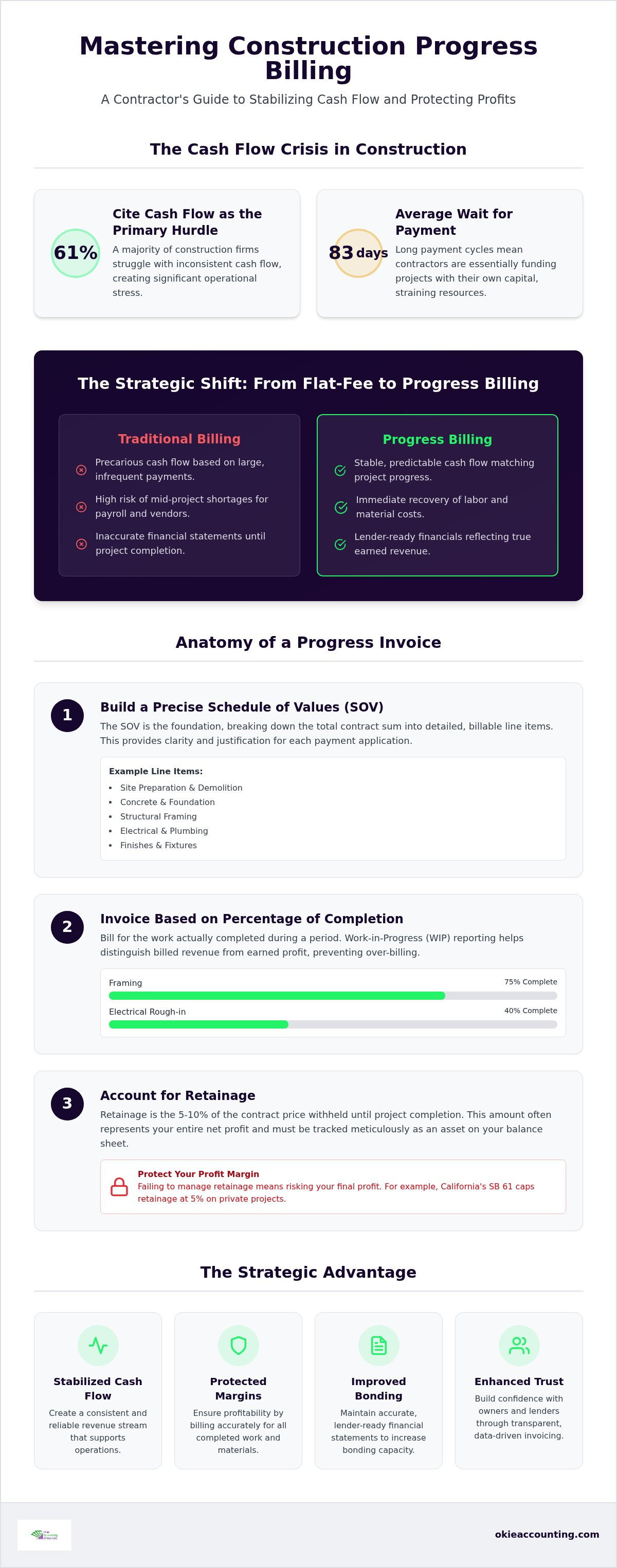
Did you know that 61% of construction firms cite cash flow as their primary operational hurdle, often waiting an average of 83 days to see payment for work already performed? It's an exhausting cycle where you're essentially funding the owner's project while wrestling with disputes over percentage-complete figures and buried change orders. You likely understand the stress of mid-project shortages that threaten your ability to meet payroll or satisfy vendors, especially when retainage starts eating into your working capital. Mastering construction progress billing is no longer just a back-office task; it's a survival strategy for the modern contractor.
We're going to show you how to transform your invoicing into a strategic framework that stabilizes your monthly cash flow and protects your project margins. You'll learn how to implement the rigorous accounting discipline needed to produce lender-ready financial statements and manage complex retainage laws, such as California's 5% cap. This article provides a clear roadmap for moving from basic administrative tracking to a sophisticated financial infrastructure that supports sustainable scaling and long-term profit protection.
Understanding Construction Progress Billing: A Strategic Cash Flow Framework
Traditional billing methods often leave construction firms in a precarious position. When you rely on flat-fee or large upfront deposits for long-term projects, you're essentially gambling on your ability to manage expenses months before the final check arrives. Construction progress billing serves as a more disciplined alternative. It's the practice of invoicing incrementally based on the actual percentage of work completed during a specific period. This method ensures that the revenue flowing into your business matches the costs going out, providing a stable foundation for your operations.
For large-scale projects, upfront billing usually fails because it doesn't account for the shifting reality of a job site. Costs aren't static. A project that looks profitable on day one can quickly become a liability if your billing doesn't reflect real-time progress. By adopting a structured framework, you move away from the "cash flow crunch" that plagues 61% of the industry. Instead of funding the owner's project with your own capital, you maintain a steady stream of income that supports your payroll and vendor obligations.
The Core Mechanics: Moving Beyond Basic Invoicing
At its heart, this system relies on the Percentage-of-completion method to recognize revenue. Unlike simple administrative invoicing, where a clerk might just send a bill for a flat amount, progress billing requires a deep understanding of project milestones and job costing. It's a transition from reactive paperwork to a proactive financial strategy. When you track progress at this level, you aren't just asking for money; you're providing a data-driven snapshot of the project's health. This level of detail is exactly what a fractional controller looks for to ensure your firm isn't over-extending its resources on any single job site.
Why Progress Billing is Essential for Project Solvency
The construction industry is notorious for sudden labor spikes and volatile material costs. If your billing doesn't keep pace with these realities, your project solvency is at risk. By implementing a structured construction progress billing cycle, you protect your firm's margins in several ways:
Immediate Cost Recovery: You recoup expenses for materials and labor as they occur rather than waiting for project closeout.
Structural Integrity: Your financial statements remain accurate and reflect true earnings, which is critical for maintaining bonding capacity.
Stakeholder Trust: Owners and lenders appreciate the transparency of seeing exactly what they're paying for at every stage.
This approach effectively eliminates the mid-project dip in liquidity. It allows you to maintain a healthy balance sheet that attracts better lenders and more lucrative contracts. You're building a scalable financial infrastructure that turns billing from a chore into a competitive advantage. It's about establishing control over your data so you can make informed, strategic decisions for the long-term health of your business.
The Anatomy of a Progress Invoice: Schedule of Values and Retainage
To execute construction progress billing effectively, you need more than just a list of expenses. You need a structured blueprint that translates your contract into a series of verifiable milestones. The industry relies on standardized documentation, specifically AIA forms G702 and G703, to facilitate this process. These documents provide the legal and financial clarity required by owners and lenders. One critical element often mishandled is the billing of mobilization costs. While it's essential to recover setup expenses early, doing so without clear documentation can raise red flags for project owners who fear "front-loading" or over-payment before work truly begins.
Building an Accurate Schedule of Values (SOV)
The Schedule of Values is the roadmap for project-based revenue. It functions as a complete breakdown of the contract sum into manageable, billable line items. Rather than presenting a single, monolithic invoice, you divide the project into specific scopes such as site preparation, foundation, framing, and finishes. This level of detail protects your firm's margins by ensuring you're paid accurately for the specific work completed. It also provides a clear framework for management accounting, allowing you to track project health in real time. A well-constructed SOV balances the need for early-project cash flow with the owner's requirement for financial transparency.
Managing Retainage: Protecting Your Final Profit Margin
Retainage is the percentage of a contract price withheld until the project reaches substantial completion, typically ranging from 5% to 10%. In many cases, this withheld amount represents your entire net profit for the job. Managing this requires rigorous discipline within your general ledger. You must track these funds as an asset while recognizing that the cash isn't yet available for operations. Effective January 1, 2026, California's SB 61 caps retainage at 5% for private projects, highlighting a growing trend of stricter state regulations that contractors must navigate.
For firms operating under government contracts, the Federal Acquisition Regulation on Progress Payments dictates specific terms for how these computations are handled. Ensuring the timely release of retainage requires proactive communication and flawless documentation of every change order and milestone. If your current systems feel disjointed, you might consider a strategic discovery call to discuss how to better align your billing with your long-term profit goals. By treating retainage as a strategic asset rather than a forgotten line item, you build the structural integrity necessary to scale your firm's volume without sacrificing its financial health.
The Accounting Backbone: WIP Reports and Job Costing Integration
Many contractors mistake a large invoice for a large profit. This is a dangerous assumption that often leads to a false sense of security. Successful construction progress billing requires a bridge between your invoices and your actual costs. This bridge is the Work-in-Progress (WIP) report. Without it, you're flying blind. You might be cash-rich today but facing a massive deficit as the project closes because you've spent the "profit" before the work was actually performed. Integrating your billing with a rigorous accounting backbone ensures that every dollar invoiced is backed by verifiable data.
On infrastructure or large-scale civil projects, strict standards like the Code of Federal Regulations for Construction Payments dictate how funds are disbursed and tracked. For private firms, the discipline should be just as rigorous. When your billing system operates in a vacuum, you lose the ability to see the structural health of your business. By connecting your invoicing to your general ledger through WIP reporting, you create a system of checks and balances that protects your long-term solvency.
WIP Accounting and Revenue Recognition
WIP accounting allows you to see if you've over-billed or under-billed on a project. Over-billing occurs when you've invoiced for more work than you've actually completed. While this helps with immediate cash flow, it's essentially a liability on your balance sheet. Under-billing means you've performed the work but haven't yet seen the cash, which can lead to a liquidity crisis. A Fractional Controller can review these reports monthly to identify "profit fade." This is the gradual decline of expected profit as costs rise faster than your billing cycles can catch up. This level of oversight ensures your financial statements remain lender-ready and your margins stay protected.
Real-Time Job Costing: The Difference Between Billing and Earning
Real-time job costing is the process of allocating labor, materials, and overhead to specific line items in your Schedule of Values. It's the only way to know if you're actually earning the money you're billing. If you've billed 50% of the framing phase but spent 70% of the budget, you have a problem that a simple invoice won't show. Identifying these overruns early allows you to adjust your strategy before the next billing cycle. This proactive approach is a cornerstone of effective Construction Cash Flow Management. By grounding your construction progress billing in real-time data, you move from guessing about your profits to managing them with precision.
Implementing Progress Billing in QuickBooks Online: A Step-by-Step Approach
Transitioning from manual spreadsheets to a digital system is the most effective way to protect your firm's profitability. Research indicates that manual construction progress billing carries an estimated 12% calculation error rate, whereas digital systems reduce that risk to under 1%. In 2026, QuickBooks Online Advanced has introduced enhanced bank matching and improved reconciliation features that make this transition even more beneficial for contractors seeking high-level financial clarity. By digitizing your workflow, you ensure that every invoice is grounded in the structural integrity of your project's original estimate.
Step 1: Navigate to Account and Settings, select the Sales tab, and toggle on the Progress Invoicing feature. This allows you to pull data directly from your estimates into multiple partial invoices.
Step 2: Create a comprehensive Estimate that serves as your digital Schedule of Values. Every line item should match the specific scopes of work defined in your contract.
Step 3: When it's time to bill, generate a progress invoice by selecting the specific percentage of work completed or a custom dollar amount for each line item.
Step 4: Use the 2026 reconciliation tools to match payments against project estimates. This ensures that your cash flow forecasting remains accurate as the project evolves.
Step 5: Add approved change orders as new line items on the original estimate. This maintains a clear audit trail and prevents billing disputes during project closeout.
Configuring QuickBooks for Percentage-of-Completion Billing
Proper configuration is the foundation of a reliable financial system. You must set up your Chart of Accounts to handle construction-specific categories like under-billings and over-billings. Utilizing the "Projects" feature is also essential, as it allows you to group all income and expenses by job for real-time profitability tracking. If your current setup feels disorganized, professional QuickBooks Training for Contractors can help you build the comprehensive framework your firm needs to scale. A proactive approach here prevents the data gaps that often lead to mid-project cash shortages.
Managing Change Orders without Disrupting the Billing Cycle
Change orders are often where profit margins begin to erode. To maintain your billing's structural integrity, you should never bill for a change order until it's officially documented and added to the SOV. Verbal approvals are the primary threat to your financial health; they create discrepancies that lead to disputes and delayed payments. For a deeper dive into these workflows, see our guide on Mastering QuickBooks for Contractors. If you're ready to move beyond basic administrative tasks and implement a professional financial system, schedule a discovery call today to discuss how we can support your firm's growth.
Scaling Your Firm with Professional Progress Billing Oversight
Scaling a construction firm requires more than just winning larger bids; it demands a transition from basic administrative tracking to high-level strategic financial management. As your project volume increases, the complexity of your construction progress billing grows exponentially. You can't afford to treat your back office as a secondary thought. Accurate, professional billing is the primary signal to lenders and bonding companies that your business possesses the structural integrity to handle larger contracts. When your financial statements are consistently precise and lender-ready, you unlock the credit facilities necessary to sustain rapid growth.
Transitioning your bookkeeping from a cost center to a profit-protection asset is a fundamental shift in mindset. It's about moving away from reactive data entry and toward proactive financial oversight. This transformation allows you to focus on project execution while knowing that your cash flow is being managed with professional discipline. By establishing a rigorous billing framework, you eliminate the uncertainty that often accompanies mid-project phases, ensuring that your firm remains solvent and competitive regardless of market fluctuations.
The Role of a Fractional Controller in Billing Strategy
A Fractional Controller acts as a strategic mentor, providing the oversight needed to audit your billing cycles and protect your margins. Unlike a generalist accountant, a specialized controller understands the nuances of project-based financial tracking. They interpret your WIP data to identify trends before they become crises, ensuring your firm maintains long-term stability. This level of professional discipline is essential for interpreting complex financial reports and guiding data-driven choices that support your firm's expansion. They ensure that your progress reports are not just documents, but strategic tools for building trust with project owners and financial institutions.
From Administrative Burden to Strategic Financial Asset
When you implement a structured framework for your billing, you stop viewing financial management as a burden and start seeing it as a competitive advantage. This clarity provides the peace of mind required to lead your team through complex builds. You're no longer buried in spreadsheets; instead, you're utilizing high-level data to steer your business toward a more profitable future. If you're ready to move beyond basic bookkeeping and build a scalable financial infrastructure, it's time to gain financial clarity with Okie Accounting Group LLC. By partnering with experts who understand the unique mechanics of your market, you ensure that your firm is built on a foundation of accuracy and long-term health.
Building a Foundation for Sustainable Construction Growth
Mastering construction progress billing is the difference between a firm that merely survives and one that dominates its market. By integrating a rigorous Schedule of Values with Work-in-Progress reporting, you ensure that every invoice reflects the true health of your project. This disciplined approach protects your net profit from the erosion of unmanaged retainage and undocumented change orders. It's about moving beyond basic data entry to build a comprehensive structural framework that supports your long-term vision.
At Okie Accounting Group LLC, we provide the specialized construction bookkeeping expertise and fractional controller strategic oversight necessary to turn your financial data into a profit-protection asset. Our cloud-based frameworks are designed to give you immediate clarity over your margins so you can focus on project execution. If you're ready to stabilize your cash flow and prepare your firm for scalable growth, Gain financial clarity with Okie Accounting Group LLC’s specialized construction services. Your firm's financial health is the engine of its success; we're here to help you steer it with confidence.
Frequently Asked Questions
What is the difference between progress billing and milestone billing?
Progress billing is based on the percentage of work completed during a specific timeframe, whereas milestone billing triggers an invoice only when a predefined event or stage occurs. While milestone billing works for short-term projects, it often creates cash gaps on long-term builds. Progress billing provides a more granular flow of capital, allowing you to recover costs for labor and materials as they're consumed rather than waiting for a major project phase to conclude.
How is progress billing calculated for construction projects?
You calculate construction progress billing by multiplying the percentage of completion for each line item by its total scheduled value and then subtracting previous payments. This requires a detailed Schedule of Values to ensure accuracy. By tracking the actual work in place versus the total budget, you maintain a clear record of earned revenue. This prevents the common industry error of over-billing, which can lead to significant liquidity issues during project closeout.
Is retainage mandatory in construction progress billing?
Retainage isn't federally mandatory for private projects, but it's a standard contractual practice used to ensure project completion. However, state laws are increasingly regulating these amounts. For example, California SB 61 caps retainage at 5% for private works executed after January 1, 2026. Failing to release these funds within 45 days of project completion can result in a 2% monthly penalty, making diligent tracking essential for your net profit protection.
What should I include in a progress billing invoice?
A professional progress invoice must include the total contract amount, the percentage of work completed to date, and the specific dollar amount for the current period. You should also clearly list the total retainage withheld and any approved change orders as distinct line items. Standardizing these invoices using AIA-style forms like the G702 and G703 provides the transparency that owners and lenders require to authorize timely payments.
How do change orders affect the progress billing process?
Change orders update the total contract sum and must be integrated into your Schedule of Values as new billable line items. You shouldn't invoice for extra work until a formal change order is signed, as verbal agreements often lead to payment disputes. Once approved, these additions are billed using the same percentage-of-completion method as the original scope, ensuring your financial reporting remains consistent and your margins stay protected.
Can I use QuickBooks Online for construction progress billing?
Yes, QuickBooks Online Advanced is highly effective for managing construction progress billing through its built-in progress invoicing features. By converting a project estimate into a series of incremental invoices, you can track exactly how much has been billed against the total project value. In 2026, the software's improved bank matching and reconciliation tools make it easier to maintain the structural financial integrity required for high-level strategic oversight.
What is a Schedule of Values and why is it important?
A Schedule of Values (SOV) is an itemized list that allocates the entire contract sum to specific portions of the work. It's important because it serves as the foundation for every progress payment application. Without a detailed SOV, you cannot accurately calculate completion percentages or provide the data-driven transparency needed to satisfy project owners. It transforms a complex contract into a series of manageable, billable milestones that guide your revenue recognition.
How does progress billing help with construction cash flow?
Progress billing helps cash flow by aligning your incoming revenue with the actual timing of project expenses. Instead of waiting until the end of a job to get paid, you receive a steady stream of capital to cover payroll, materials, and overhead. This reduces the need for high-interest construction loans, which range from 6.5% to 9.5% in 2026, and prevents the "cash flow crunch" that threatens project solvency. It ensures your business remains liquid throughout the entire project lifecycle.


Comments