Construction WIP Accounting: Profit Protection in 2026

Updated: Nov 7
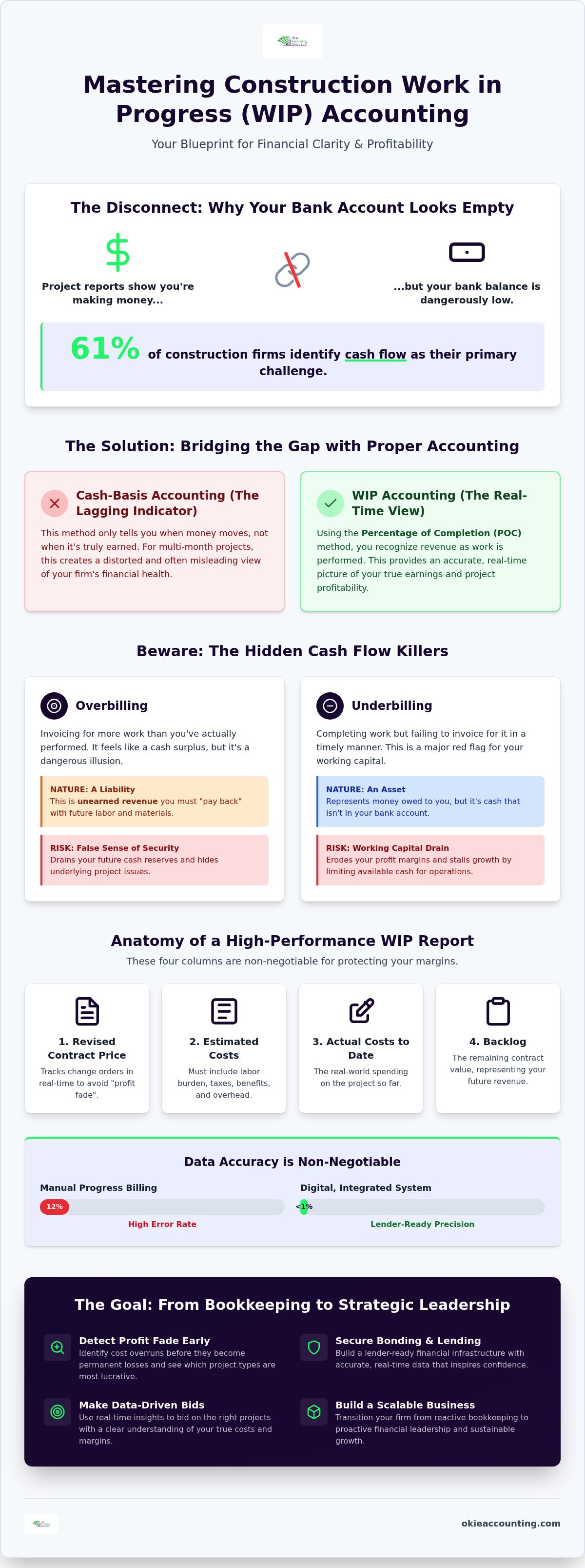
Why does your bank account often look empty when your project reports say you're making money? This disconnect is a common frustration for firm owners who face unpredictable cash flow and those dreaded surprise losses at the end of a job. Mastering construction work in progress accounting is no longer just a back-office task; it's the structural integrity of your firm's financial health. With 61% of construction firms identifying cash flow as their primary challenge in 2026, you're not alone in feeling the pressure of long payment cycles and new regulations like California's SB 61.
We understand that you need more than just a list of transactions; you need a system that offers quiet confidence and control. This article will show you how to eliminate profit fade and build a lender-ready financial infrastructure to secure the bonding you need to scale. We'll explore how to use the latest digital tools and the 2026 "One Big Beautiful Bill Act" to stabilize your cash flow. By the end, you'll have the strategic clarity to bid on the right projects with real-time data as your guide.
What is Construction WIP Accounting and Why Does It Define Your Success?
Effective construction work in progress accounting acts as the vital link between what's happening on the job site and what's recorded in your financial statements. While your project managers focus on milestones and materials, your accounting system must translate those physical actions into financial reality. Without this bridge, you're essentially flying blind. You might see a healthy bank balance today while unknowingly steering toward a cash crisis tomorrow. This disconnect is why many firms struggle to maintain stability despite a full pipeline of work.
Relying on standard cash-basis accounting is a common mistake that often leads to the downfall of otherwise skilled contractors. If you're managing multi-month projects, cash-basis only tells you when money moves, not when it's earned. This creates a distorted view of your firm's health. In the volatile economic environment of 2026, where material costs can shift overnight, relying on lagging data is a recipe for disaster. Real-time insights are no longer a luxury; they're a requirement for survival. You should view your WIP schedule as a financial blueprint that mirrors the structural integrity of your buildings. It provides the foundational data needed to make informed, proactive decisions. In technical terms, this is often referred to as Construction in Progress (CIP), representing the accumulated costs of a project that isn't yet complete or ready for its intended use.
The Role of Revenue Recognition in Construction
The industry gold standard for tracking this progress is the Percentage of Completion (POC) method. This approach ensures that you recognize revenue based on the actual costs incurred relative to your total estimated budget. It's a disciplined way to ensure your income matches your effort. Revenue recognition is the systematic process of identifying performance obligations and allocating the transaction price to each obligation as control of the asset is transferred to the customer. By following this method, you gain a clear picture of your true earnings, allowing you to manage your resources with precision rather than guesswork.
Overbilling vs. Underbilling: The Hidden Cash Flow Killers
Understanding the difference between overbilling and underbilling is critical for protecting your margins. Overbilling occurs when you've invoiced the client for more work than you've actually performed. While it feels good to have that extra cash, it's actually a liability, or unearned revenue, that you'll need to "pay back" through future labor and materials. It often creates a false sense of security while draining your future cash reserves. Conversely, underbilling is an asset, representing work completed but not yet invoiced. This is a major red flag. It usually indicates inefficient billing cycles or unapproved change orders that are draining your working capital. If you don't catch these imbalances early, they will eventually erode your profit and stall your growth.
The Anatomy of a High-Performance WIP Report in 2026
A high-performance WIP report is much more than a static spreadsheet. It serves as an active dashboard for construction work in progress accounting that guides your strategic choices. To protect your margins, your report must include four non-negotiable columns: Revised Contract Price, Estimated Costs, Actual Costs, and Backlog. We place a heavy emphasis on "Revised" figures. Change orders are the most common source of profit fade, and failing to account for them in real-time makes your margin data a myth. By tracking these changes as they happen, you maintain a clear view of your firm's structural health.
Accuracy also requires you to look ahead at committed costs. These include subcontracts and open purchase orders that haven't hit your "Actual Costs" yet but represent money already spent in principle. Integrating these details with QuickBooks for contractors allows for an automated, reliable data flow that reduces human error. Research from July 2026 indicates that manual progress billing carries a 12% calculation error rate. Transitioning to a digital, integrated system can reduce this error rate to under 1%. This level of precision is exactly what lenders look for when evaluating your firm's stability. If you're ready to move from basic bookkeeping to this level of oversight, you might consider scheduling a strategic discovery call to discuss your framework.
Estimated vs. Actual Costs: The Accuracy Gap
Your WIP report is only as reliable as the estimates your project managers provide in the field. We advocate for a disciplined monthly review of every project estimate to identify potential cost overruns before they become permanent losses. This process must go beyond simple material costs. You need to account for labor burden, including taxes and benefits, and a proportional share of indirect overhead. Without these factors, you aren't seeing the true cost of the work being performed.
Calculating the Percentage of Completion
We utilize the cost-to-cost method because it provides an objective measure of progress that "visual" estimates often miss. The formula is: (Actual Costs to Date / Total Estimated Costs) = % Complete. This mathematical approach keeps your revenue recognition grounded in financial fact rather than field optimism. For instance, on a $1,000,000 contract where you have incurred $300,000 in costs against a total estimate of $750,000, the project is mathematically 40% complete. This clarity allows you to bill accurately and protect your cash flow from the start.
Analyzing Your WIP Schedule for Profit Protection
Analyzing your WIP schedule is where raw data transforms into a defensive shield for your margins. While the report lists your numbers, the analysis reveals the story of your firm's operational health. The most critical trend to monitor is "Profit Fade." This occurs when your projected gross profit margin shrinks month-over-month. If a project started with a 20% estimated margin but currently sits at 16%, you're losing money you've already mentally banked. Consistent construction work in progress accounting allows you to catch these slides before they become permanent losses. By reviewing these schedules regularly, you can also identify which project types consistently hit their targets and which ones are prone to slippage, helping you refine your bidding strategy for 2026.
The "Backlog" column is another vital analytical tool. It represents the remaining value of your signed contracts and serves as the foundation for construction cash flow management. In an industry where firms wait an average of 83 days to receive payment, knowing your future revenue pipeline is essential for resource planning. This data ensures you don't overextend your labor force or take on more debt than your future billings can support. For bonding agents and lenders, a well-managed WIP report is the primary document they use to assess your firm's capacity and risk level.
Detecting and Reversing Profit Fade Early
Profit fade rarely happens all at once. It usually starts with small red flags: a slight rise in material costs, minor labor overruns, or change orders that haven't been formally approved. To reverse this, we recommend a monthly corrective action checklist. This includes verifying field reports against actual costs and ensuring all scope changes are documented and billed. A fractional controller uses this data to provide strategic oversight, acting as a mentor to help you decide which bids are worth the risk and which should be declined to protect your bottom line.
Using WIP for Lender-Ready Financial Statements
In 2026, with construction loan interest rates ranging between 6.5% and 9.5%, lenders are more meticulous than ever. They prioritize your WIP schedule over a simple P&L because it shows whether your Balance Sheet reflects true equity. WIP adjustments for overbillings and underbillings ensure that your financial position isn't distorted by timing differences in your billing cycle. Maintaining these lender ready financials for contractors builds the trust necessary to secure larger bonding limits and competitive financing for your scaling business.
Common Pitfalls in WIP Accounting (And How to Fix Them)
Messy financials often stem from a few recurring errors that undermine the structural health of your construction work in progress accounting. One of the most dangerous habits is treating overbilling as earned profit just because the cash is sitting in your bank account. This leads to a distorted reality where you feel financially secure while actually accumulating a liability that must be paid in labor and materials later. Similarly, commingled project costs occur when expenses aren't job-costed correctly, making it impossible to see which projects are truly profitable. When costs for Project A are accidentally coded to Project B, your margins for both jobs become fiction. Delayed expense tracking further skews your Percentage of Completion (POC) calculation. If your field expenses lag by even two weeks, your POC will be artificially low, causing you to under-recognize revenue and potentially trigger a "loss" on paper that doesn't exist. It's vital to prioritize fixing QuickBooks mistakes for contractors before these errors compound into tax liabilities or bonding rejections.
The 'Cash-Rich, Profit-Poor' Trap
A high bank balance from aggressive overbilling can easily mask a project that is fundamentally failing. This "false positive" prevents you from taking corrective action until the cash runs out at the end of the job. To avoid this trap, we recommend a strategy of segregating overbilled funds into a separate reserve or "unearned revenue" account. This ensures you have the capital to complete the project regardless of future billing cycles. You must communicate this technicality clearly to your project managers. They need to understand that "cash in hand" is not a green light for unplanned spending, but a resource reserved for future performance obligations. When your team views cash as a liability until it's earned, they become much more disciplined with project resources.
Cleaning Up Messy Job Costing Data
If your books are currently a tangle of unallocated costs, you need a structured cleanup to restore financial clarity. We follow a 3-step process to bring order to the chaos. First, reconcile your general ledger to your WIP schedule to ensure all costs are accounted for. Second, audit every open project for unrecorded committed costs, such as subcontracts or purchase orders that haven't been invoiced yet. Third, adjust your revenue recognition entries to match the actual cost-to-cost percentage of completion. This level of accuracy often requires specialized software training for your field staff to ensure data is input correctly from the start. As your firm scales past $5 million in annual revenue, manual spreadsheets typically fail to provide the structural integrity required for complex project tracking. If you are struggling with messy data and need a professional cleanup to protect your margins, book a strategic discovery call with our team today.
Building a Scalable WIP Framework with Strategic Oversight
Scaling a construction firm isn't just about winning more bids; it's about building the financial capacity to handle them. Moving from basic bookkeeping to high-level financial leadership is the only way to sustain growth without losing control of your margins. This is where specialized construction work in progress accounting transitions from a reporting requirement into a competitive advantage. At Okie Accounting Group LLC, we focus on creating foundational systems that scale with you, ensuring your data remains accurate even as project volume increases. By integrating fractional controller services, you gain access to the strategic oversight necessary to turn project-level data into firm-wide stability.
Monthly financial reviews serve as the heartbeat of this framework. They provide a structured environment to analyze the implications of your WIP data rather than just recording the numbers. This proactive approach allows you to identify resource gaps and capitalize on profitable trends before your competitors even notice them. When your accounting system is built for growth, your financial data becomes a roadmap for expansion rather than a history of past expenses. This disciplined management ensures that your firm's structural health remains intact as you take on larger, more complex contracts.
From Data Entry to Strategic Partnership
A common bottleneck for growing firms is staying stuck in the data entry phase of administrative bookkeeping. While recording costs is necessary, it doesn't offer the forward-looking insights found in management accounting. A controller at Okie Accounting Group LLC acts as a strategic mentor, helping you navigate the complex mechanics of your market with quiet confidence. This partnership transforms your financial department into a profit-protection center. You'll find that having a lender-ready infrastructure reduces the stress of bonding renewals and allows you to focus on high-level business development.
Next Steps: Implementing Your WIP System
Professionalizing your financial oversight is a deliberate process that starts with a clear assessment of your current systems. We begin by auditing your existing job-costing workflows to identify where data leaks are occurring. From there, we implement cloud-based structures that simplify reporting for your field staff while providing granular detail for your leadership team. This journey from complexity to operational clarity is essential for any firm aiming to lead the industry in 2026. We invite you to gain that clarity through a professional consultation where we can map out a system built for your firm's specific needs.
Secure the Foundation of Your Firm's Financial Future
Protecting your margins in 2026 requires more than just hard work in the field; it demands a disciplined approach to your project data. We've discussed how a robust framework for construction work in progress accounting allows you to detect profit fade early and manage the hidden risks of overbilling. By transitioning from basic administrative tasks to strategic financial leadership, you ensure your firm remains stable, profitable, and ready for any lending opportunity. At Okie Accounting Group LLC, we specialize in construction and real estate, providing the cloud-based strategic oversight and fractional controller expertise necessary for scaling firms to thrive.
You don't have to navigate these niche-specific complexities alone. We're here to act as your strategic partner, building the foundational systems that provide immediate clarity and long-term health. When your financial infrastructure is as solid as your builds, you can bid with confidence and lead with precision. Take the first step toward total financial control today. Build a scalable financial infrastructure for your firm with Okie Accounting Group LLC. Your firm's potential is limitless when your profits are protected by expert oversight.
Frequently Asked Questions
What is the difference between WIP and job costing?
Job costing is the granular process of tracking every dollar spent on labor, materials, and equipment for a specific project. In contrast, construction work in progress accounting is the high-level reporting framework that uses those costs to determine how much revenue you've actually earned. While job costing tells you what you spent, the WIP report tells you if those expenditures are translating into the profit margins you originally projected.
How often should a construction company run a WIP report?
You should run and review your WIP report at least once a month as part of your standard financial closing process. For firms scaling past $5 million in revenue, a bi-weekly review is often more effective for catching profit fade before it becomes a permanent loss. Frequent reporting ensures your backlog and overbilling data remain accurate, allowing you to make real-time adjustments to your field operations.
Is WIP accounting required for small contractors?
WIP accounting isn't a legal requirement for very small firms operating on a pure cash basis, but it's a strategic necessity for anyone managing multi-month projects. If you plan to secure a bank loan or a bonding line, lenders will insist on seeing a WIP schedule to verify your firm's true equity. Without it, you can't accurately track whether your long-term projects are actually making money or just draining your cash reserves.
Can QuickBooks Online handle construction WIP accounting?
QuickBooks Online Advanced is specifically designed to handle construction work in progress accounting through its enhanced project tracking and progress invoicing features. By utilizing the built-in bank matching and reconciliation tools available in 2026, you can automate much of the data flow. However, the system still requires professional setup and oversight to ensure your overbillings and underbillings are recorded correctly on the balance sheet.
How does overbilling affect my company's taxes?
Overbilling acts as a liability on your balance sheet because it represents unearned revenue. Under the percentage of completion method, you only pay income tax on the portion of the contract you've actually earned based on costs incurred. This means you aren't taxed on the "excess" cash you've billed in advance, which helps preserve your working capital for future project expenses.
What happens if my estimated costs are wrong on the WIP report?
Incorrect estimates lead to a distorted view of your firm's financial health, often resulting in "profit fade" or artificial gains. If your total estimated costs are too low, you'll over-recognize revenue early in the project and face a sudden, painful loss at the end. Disciplined monthly reviews of your estimates are the only way to ensure your financial statements reflect the actual structural integrity of your projects.
Why do bonding agents insist on a WIP schedule?
Bonding agents use the WIP schedule as a primary risk assessment tool to determine your firm's total capacity and operational efficiency. They look at your backlog to ensure you aren't overextended and check your history of profit fade to gauge the accuracy of your bidding. A clean, professionally managed WIP report signals that you have the internal controls necessary to complete large-scale contracts successfully.
How do I explain WIP adjustments to my project managers?
Frame WIP adjustments as the process of "earning" the revenue through performance. Explain to your team that just because we've sent an invoice doesn't mean the profit belongs to the company yet. Use the data to show them how labor overruns or unapproved change orders directly shrink the "earned" portion of the project, turning the financial technicalities into a practical lesson in project leadership.


Comments