Financial Analysis for Real Estate Investments: A Strategic Framework for 2026

Updated: 6 days ago
In a 2026 market where returns are driven by rental income rather than simple appreciation, your spreadsheet is no longer just a tracking tool; it's either your greatest liability or your most powerful competitive advantage. You've likely felt that late-night anxiety when a repair cycle hits or wondered if your estimated ROI is actually holding up against current federal funds rates of 3.63%. It's frustrating to feel like you're drowning in property data without seeing a clear path to your next acquisition. You want to scale, but the fear of inaccurate data leading to a bad investment choice keeps you stuck in manual oversight.
This guide will show you how to move beyond basic record-keeping to master financial analysis for real estate investments, turning fragmented receipts into a lender-ready framework. We'll explore the automated systems and key metrics required to gain portfolio-wide visibility and protect your profits under the permanent 100% bonus depreciation rules established by the One Big Beautiful Bill Act. You'll learn to build a scalable structure that provides absolute clarity and long-term stability without requiring twenty hours of manual data entry every month.
What is Financial Analysis for Real Estate Investments?
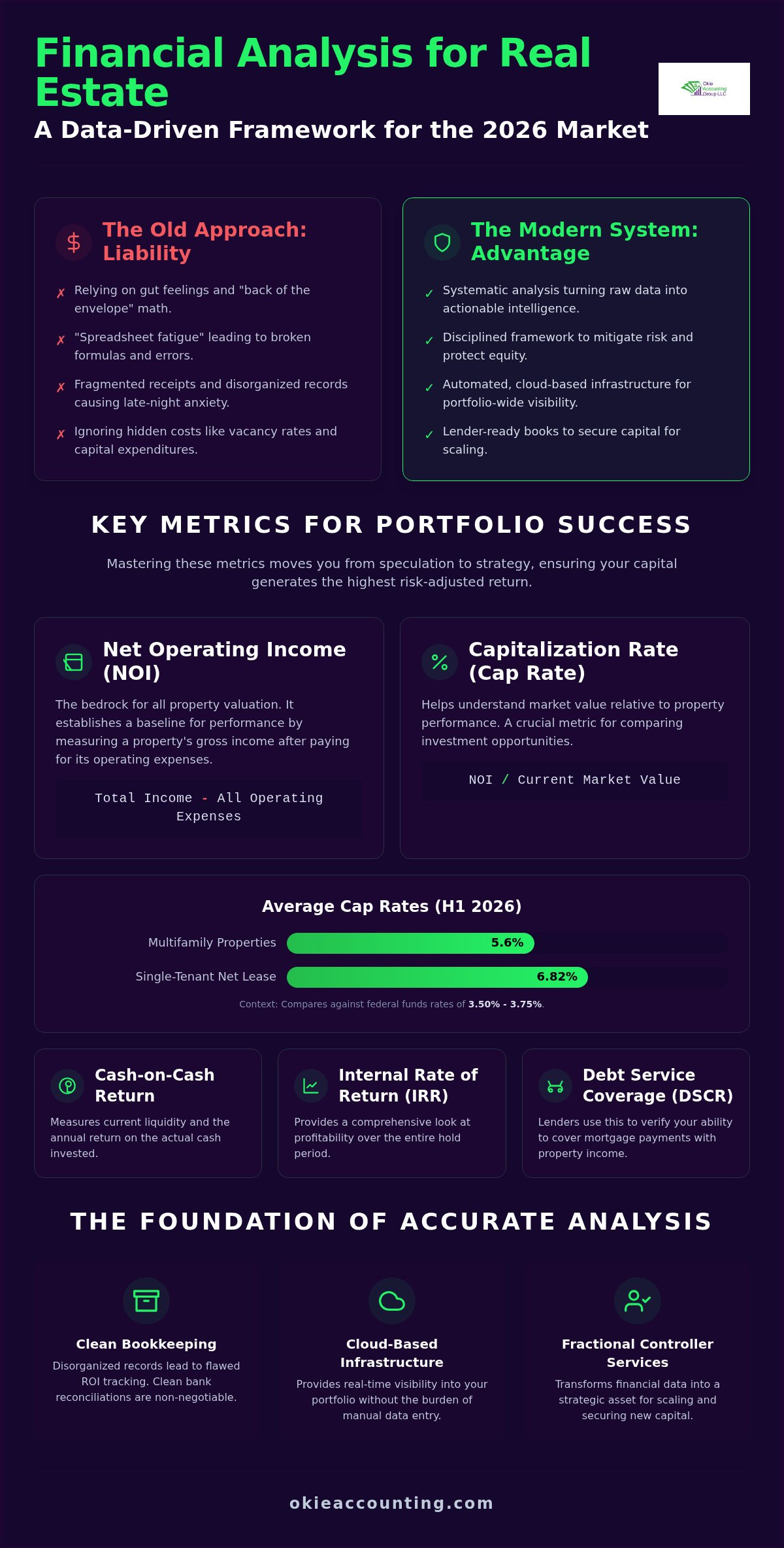
Real estate is no longer a "buy and hope" asset class. In 2026, with federal funds rates established between 3.50% and 3.75%, the margin for error has narrowed significantly. At its core, Financial Analysis for real estate investments is a systematic process of evaluating the profitability, solvency, and liquidity of a property or portfolio. It transforms raw data into actionable intelligence. This isn't just about recording income; it's about building a structural framework that protects your equity from market volatility. It's the difference between owning a property and running a business.
Relying on gut feeling or "back of the envelope" calculations is a recipe for stagnation. While a single residential rental might seem simple, the complexity increases exponentially when you transition to commercial investment oversight or multi-unit portfolios. Effective financial analysis for real estate investments requires a disciplined approach to tracking every dollar. It ensures that your capital is deployed where it generates the highest risk-adjusted return, rather than being drained by invisible inefficiencies. By adopting a methodical oversight system, you move from reactive bookkeeping to proactive wealth management.
The Core Purpose: Beyond the Monthly Rent Check
A rent check tells you what happened yesterday, but comprehensive analysis tells you what will happen next year. Professional oversight identifies hidden costs that often surprise amateur investors, such as the gradual depletion of capital expenditure reserves. You need to know exactly when a roof replacement or HVAC overhaul will hit your cash flow. This data determines your most critical moves: when to sell, when to hold, and when to refinance to pull equity for the next deal. High-quality reporting also ensures your books are "lender-ready," providing the transparency banks require to approve acquisition capital in a competitive environment.
Why Investors Fail Without a Systematic Approach
Failure in real estate rarely happens overnight; it's usually a slow leak caused by poor data. Many investors ignore realistic vacancy rates or miscalculate the true cost of professional property management fees. They fall into the trap of "spreadsheet fatigue," where manual data entry leads to broken formulas and expensive errors. When your records are disorganized, you can't see the portfolio-wide trends that signal trouble before it becomes a crisis. Real estate financial analysis is the foundation of portfolio longevity. Without it, you aren't scaling; you're just increasing your exposure to risk. Transitioning to Fractional Controller Services can provide the high-level oversight needed to turn these risks into managed variables.
Key Metrics Every Investor Must Track for Success
Mastering the specific metrics within financial analysis for real estate investments is how you move from speculation to strategy. While many investors focus solely on the gross rent multiplier, professional oversight requires a deeper dive into the numbers that actually drive portfolio health. You need a clear view of your Net Operating Income (NOI), which acts as the bedrock for all property valuation. By subtracting all operating expenses from your total income, you establish a baseline for performance. This figure is essential for calculating your Capitalization Rate (Cap Rate), a metric that helps you understand market value relative to property performance. In the first half of 2026, we've seen multifamily cap rates average 5.6%, while single-tenant net lease properties have trended closer to 6.82%.
Beyond valuation, you must measure the Internal Rate of Return (IRR) and Cash-on-Cash return to understand the true efficiency of your capital. IRR accounts for the time value of money over your entire hold period, providing a comprehensive look at profitability from acquisition to exit. Conversely, Cash-on-Cash return provides the reality of your current liquidity. It measures the annual pre-tax cash flow against the total amount of cash invested. When you are Analyzing Real Estate Investment Deals, these figures tell you if a property is a stable income generator or a drain on your resources.
The Math Behind the Metrics
To calculate NOI accurately, you can't afford to miss granular operating expenses like insurance premiums, property taxes, and maintenance reserves. A common mistake is overlooking the Debt Service Coverage Ratio (DSCR), which lenders use to determine your ability to cover mortgage payments with property income. In a high-interest environment, maintaining a strong DSCR is vital for securing favorable terms. A systematic approach ensures these calculations aren't just estimates; they're verified facts that support your growth strategy.
Ensuring Data Integrity for Accurate Reporting
Your metrics are only as reliable as the data feeding them. If your monthly bookkeeping is disorganized, your ROI tracking will be fundamentally flawed. Clean bank reconciliations are a non-negotiable requirement for real-time visibility. For investors managing complex portfolios, fractional controller services provide the high-level oversight needed to maintain structural integrity. This level of professional partnership ensures your financials are always lender-ready and your profit margins are protected. If you're ready to transition from manual data entry to strategic oversight, consider scheduling a discovery call to discuss your portfolio's specific needs.
Pro-forma vs. Actuals: Closing the Profitability Gap
Every successful deal starts with a pro-forma, but your portfolio's survival depends entirely on the actuals. During the acquisition phase, a pro-forma serves as your "best-case scenario," outlining the theoretical potential of a property based on market averages and optimistic projections. It's the document you use to secure financing and justify the purchase price. However, financial analysis for real estate investments is incomplete if you never reconcile those projections with real-world performance. Actuals are the only numbers that matter for long-term sustainability; they represent the true cash flow hitting your bank account after every repair, vacancy, and administrative fee has been paid.
A common frustration for growing investors is the "empty bank account" paradox. You might hear yourself saying, "My spreadsheet says I’m making money, but my bank account is empty." This disconnect usually happens because the pro-forma didn't account for the granular reality of operations. To fix this, you must implement a monthly variance analysis. This process involves comparing your projected budget against your actual income and expenses to identify exactly where profit leaks are occurring. It moves your oversight from theoretical hope to tactical precision.
Identifying the "Hidden" Profit Killers
Profit leaks are rarely caused by one large catastrophe; they're usually the result of several "hidden" costs that were omitted from the initial analysis. Unexpected minor repairs can quickly drain your reserves if you fail to budget for Capital Expenditures (CapEx) properly. Additionally, many investors overlook "soft costs" such as legal fees for FinCEN beneficial ownership reporting or specialized accounting services required for complex portfolios. A monthly variance analysis serves as an early warning system for investors, highlighting these discrepancies before they erode your equity or compromise your debt service coverage ratio.
Moving from Theoretical to Tactical
Once you understand why your actuals differ from your pro-forma, you can use that data to refine your future acquisition criteria. If your maintenance costs are consistently 15% higher than market averages, your future financial analysis for real estate investments should reflect that reality. This data-driven approach is essential for accurate cash flow forecasting for real estate, allowing you to predict repair cycles and vacancy dips with confidence. By building a structural framework for growth, as detailed in our guide on Accounting for Real Estate Investors, you ensure that every new property added to your portfolio strengthens your financial position rather than complicating it.
Building a Scalable Financial Infrastructure
Scaling a portfolio requires more than just knowing your metrics; it requires an automated system that generates those metrics without constant manual intervention. If your financial analysis for real estate investments relies on hunting through bank statements every quarter, your growth is capped by your administrative capacity. Building a scalable infrastructure starts with migrating to a cloud-based system like QuickBooks Online. This foundation allows for real-time collaboration and ensures that your financial data is accessible from anywhere, providing the agility needed in a fast-moving market.
Once the software is in place, the next step is designing a property-specific Chart of Accounts. This organizational structure ensures that every dollar spent on a specific unit or project is categorized correctly. By automating expense tracking and document management through integrated receipt-capture tools, you eliminate the risk of lost deductions and human error. The final piece of the framework is establishing a monthly financial review cadence. This discipline ensures that your data remains accurate, your reconciliations are current, and your portfolio stays lender-ready at all times.
QuickBooks for Real Estate: Best Practices
To maximize the utility of your accounting software, you must utilize the Classes or Locations features to track performance by individual property. This granular level of detail is what transforms a simple ledger into a powerful tool for financial analysis for real estate investments. Many investors struggle with the initial configuration, which is why professional QuickBooks training is a critical investment for your internal team. For those managing more complex scenarios involving heavy renovations or build-to-rent projects, refer to our guide on Mastering QuickBooks for Contractors for advanced setup logic and project-costing workflows.
The Power of Monthly Financial Reporting
Consistent reporting is the heartbeat of a healthy investment business. You need three essential reports every month: a Profit & Loss by Property, a Balance Sheet, and a Statement of Cash Flows. These documents provide the visibility needed to spot trends and identify profit leaks before they become liabilities. Regular reviews prevent the common year-end tax season chaos that plagues disorganized investors. While it’s tempting to handle the entry yourself, DIY bookkeeping often leads to significant "cleanup" costs that far exceed the price of professional service fees. If your current system feels more like a burden than a tool for growth, schedule a discovery call today to discuss how we can automate your financial infrastructure.
Strategic Growth with Fractional Controller Services
Advanced financial analysis for real estate investments requires more than just accurate entries; it demands a strategic interpretation of what those entries mean for your future capital allocation. While a standard bookkeeper focuses on recording historical transactions, a fractional controller acts as a high-level advisor who shapes your financial future. This role bridges the gap between basic administrative tasks and institutional-grade oversight. By implementing rigorous internal controls and sophisticated budgeting processes, a controller ensures your portfolio remains stable even during market shifts. They provide the professional discipline needed to manage complex portfolios with quiet confidence.
A fractional controller doesn't just report on your ROI; they help you protect it. They design the structural frameworks that allow for seamless multi-entity management and complex tax strategies. This level of professional leadership is what prepares you for the transition to institutional-grade investing. It provides the transparency and reliability that large-scale capital partners demand. At Okie Accounting Group LLC, we position ourselves as your strategic partner, offering the nationwide remote leadership necessary to scale your real estate business. We understand the unique mechanics of your market and provide the methodical oversight required for long-term health.
When to Hire a Fractional Controller
You'll know you've outgrown basic bookkeeping when your tax structures involve multiple entities or when your growth has stalled despite a healthy pipeline. If you find yourself unable to interpret your own data to drive business decisions, it's time for a higher level of oversight. A controller helps you navigate these complexities by providing a clear Strategic Framework for scaling your firm. They turn static reports into dynamic tools for expansion, ensuring that every acquisition is backed by rigorous data. This transition is essential for investors who value accuracy and long-term stability over short-term gains.
The ROI of Professional Financial Leadership
The value of professional leadership is measured in the time you regain and the expensive errors you avoid. When you stop spending twenty hours a month on manual data oversight, you can focus on finding the next deal. Strategic oversight protects your profit margins by identifying inefficiencies in your operating expenses before they become systemic issues. This proactive stance is vital in a 2026 market where rental income is the primary driver of returns. Professional leadership transforms your financial data from a source of stress into a source of strength. To gain total clarity on your portfolio and establish a foundation for long-term health, schedule a consultation with Okie Accounting Group LLC today.
Transforming Property Data into a Scalable Growth Engine
The transition from a reactive property owner to a strategic real estate investor requires a fundamental shift in how you view your data. By mastering financial analysis for real estate investments, you move beyond tracking monthly rent checks to managing a comprehensive structural framework. You now understand that your actual performance is the only metric that matters for long-term sustainability. Reconciling your pro-forma projections with real-world results ensures your portfolio remains resilient against market shifts and repair cycles.
Okie Accounting Group LLC provides the nationwide remote financial leadership you need to maintain this level of clarity. Our specialized fractional controller services focus on profit protection and building the lender-ready financials required for your next acquisition. We don't just record your history; we help you architect your future through disciplined systems and strategic oversight. This structural approach ensures that your business grows on a foundation of accuracy rather than guesswork.
If you're ready to stop guessing and start scaling with a dedicated partner, it's time to take the next step. Gain Financial Clarity for Your Portfolio with Okie Accounting Group LLC today. Your path to a more stable and profitable portfolio starts with a single conversation.
Frequently Asked Questions
What is the most important metric for real estate investment analysis?
Net Operating Income (NOI) is the most critical metric because it measures a property's ability to generate income independent of its financing structure. It serves as the fundamental baseline for calculating your capitalization rate and determining the overall market value of an asset. By focusing on NOI, you gain a clear view of operational efficiency before debt service influences the bottom line.
How often should I perform a financial analysis on my rental properties?
You should conduct a variance analysis monthly to identify profit leaks and reconcile your actuals against your pro-forma projections. A more comprehensive financial analysis for real estate investments should occur quarterly to evaluate portfolio-wide ROI and adjust your acquisition strategy. This regular cadence ensures that your data remains accurate and your portfolio stays lender-ready for future capital needs.
Can I use QuickBooks for real estate investment accounting?
Yes, QuickBooks Online is a powerful tool for investors when configured with a property-specific Chart of Accounts. By utilizing the Classes and Locations features, you can track the performance of individual units or entire multi-family complexes within a single file. This structural setup allows for automated expense tracking and professional reporting that scales alongside your growing portfolio.
What is a good Cap Rate for a residential investment property in 2026?
In the current 2026 market, a "good" cap rate is relative to the asset class and location. Multifamily properties are currently averaging a 5.6% cap rate, while single-tenant net lease properties have trended higher toward 6.82%. With federal funds rates established between 3.50% and 3.75%, investors are prioritizing income-driven returns over speculative appreciation to ensure long-term stability.
Why is my cash flow different from my net income on my P&L?
Your cash flow and net income rarely match because the Profit and Loss statement includes non-cash expenses like depreciation but excludes cash outflows like mortgage principal payments and capital expenditures. While net income is vital for tax purposes, cash flow represents the actual liquidity available in your bank account. Understanding this distinction is essential for maintaining a healthy debt service coverage ratio.
How does a fractional controller help a real estate investor scale?
A fractional controller provides the high-level oversight needed to move from administrative bookkeeping to strategic partnership. They implement internal controls, manage complex multi-entity structures, and interpret data to drive business decisions. This professional leadership ensures that your financial analysis for real estate investments supports aggressive growth while protecting your existing profit margins during market shifts.
Is financial analysis different for commercial vs. residential real estate?
Yes, commercial analysis relies almost exclusively on the income approach for valuation and requires granular tracking of tenant reimbursements and common area maintenance (CAM) charges. Residential analysis often incorporates a mix of income potential and comparable sales data. Commercial reporting also involves more complex lease structures that demand a higher level of professional oversight to maintain accuracy.
What documents do I need for a lender-ready financial package?
To secure acquisition capital, you need a property-specific Profit and Loss statement, a current Balance Sheet, and a Statement of Cash Flows. Additionally, lenders will require an updated Rent Roll and proof of capital expenditure reserves. Maintaining these documents through a disciplined financial framework demonstrates to capital partners that your business is managed with professional rigor and structural integrity.


Comments